Longtime fans of Nintendo will often reference the past fondly, maybe even going so far as to say that the company has since lost its way.
Look, I get it. We named this brand “Two Button Crew” out of our nostalgia for Nintendo’s first game console and its simple controls.
But before we continue focusing our infatuation with what has been, I’d like to pose a question: What if the Golden Age is actually now? Have you stopped to wonder if we could be experiencing Nintendo’s best efforts currently? I think so. Allow me to prove it by examining each era individually, and by the end, you might just agree!
NES
A strong case can be made for Nintendo’s debut home console. It made arcade-worthy experiences accessible in the home; revolutionary at the time. The hardware and controllers were simple and intuitive, and developers used the limitations of the day in creative ways. The resulting game library was expansive, full of memorable games that were easy to pick up, but difficult to conquer. We owe the NES generation for nearly all of the franchises we continue to enjoy.
SNES
The Super Nintendo period was one of refinement and perfection. Just as the console received a “Super” upgrade, so did each of Nintendo’s tentpole series. The Holy Trinity of Super Mario World, Legend of Zelda: A Link to the Past, and Super Metroid is a trifecta of “Best Game Ever” contenders. Titles like these succeeded by taking the formulae of previous games and maturing and enhancing them.
Nintendo 64
How we played video games was forever changed. Dimensionality increased by 50% with the introduction of polygonal 3D, and with the help of the analog stick, we were invited into Nintendo’s imaginative worlds with an all-new plane of immersion.
Another innovation must be credited to the 64: Group gaming. Yes, multiplayer modes existed previously, but this console fully realized the idea by including four controller ports and bringing people together with games like Mario Kart 64, Super Smash Bros., and the Mario Party series.
GameCube
This era was all about modernization. Nintendo’s competitors were beginning to steal the spotlight with their specs, and the Big N didn’t want to fall behind. However, they still wanted to provide the affordable alternative, so the resulting console suffered a bit of a hardware identity crisis. The upgrade from N64 was similar to the one seen between NES and SNES, where the approach remained largely the same but games improved alongside technology.
Nintendo was not afraid to experiment with software on GameCube, bringing us fresh experiences like Luigi’s Mansion, Pikmin, and Animal Crossing. Many classics from this era like Super Smash Bros. Melee, Metroid Prime, and Paper Mario: The Thousand Year Door are viewed as best-in-series games, and are begging to be played to this day.
Wii
Nintendo’s brand awareness exploded. A video game console with two letter i’s became a household name overnight, and Nintendo wasn’t ready. Production of the motion-controlled units couldn’t keep up with demand, and the company had to reevaluate their target audience on the fly. Development and marketing efforts were split between catering to core Nintendo fans and the newly-tapped blue ocean markets. It was great to see Nintendo topping the charts, but some of the decisions came across as tone-deaf to longtime Nintendo fans, like their focus on casual experiences during gaming press conferences.
Certainly, some strong titles were released during this era like Super Mario Galaxy, Metroid Prime 3: Corruption, and Excite Truck (don’t look at me like that!), but the console was crippled by its outdated, low-res graphics and weak online support.
Wii U
The misbegotten console. In a clear attempt to capitalize on Wii’s success, the branding stayed along with attempts to appeal to the casual crowd. What Nintendo did not anticipate was how sharply those users would pivot to mobile gaming. By the time Nintendo shifted their focus back to their faithful followers to deliver core titles like Super Smash Bros. for Wii U, Super Mario 3D World, and Star Fox Zero, it was too late. Slow sales lead to a lack of 3rd Party and Indie games, leaving fans to wait for 1st Party releases while Nintendo delievered the best games on its more successful 3DS handheld.
Wii U’s GamePad controller was useful for (spatially-limited) off-TV gaming, but its other implementations often got in the way of fun by splitting players’ attention across two screens. Solid software attempts weren’t enough to save Nintendo from the lack of buzz around their system. This console generation firmly knocked Nintendo off their pedestal and left them hungry.
Switch
At present day, Nintendo has launched their new console/handheld hybrid and are following it up with a stream of top-notch software. Legend of Zelda: Breath of the Wild paired with the sleek hardware made an enticing match. Splatoon 2 and Mario Kart 8 Deluxe brought the best experiences from Wii U to where more gamers could enjoy them. A level of hype surrounds Switch that hasn’t been seen since the Wii days over a decade ago, only this time… Nintendo fans are the ones generating the noise. Nintendo appears to be pulling out all the stops to support Switch with mainline entries in their top IP, from Super Mario Odyssey this holiday to Metroid Prime 4 and a Pokemon RPG in the future. If this is how the first few years look, imagine what we’ll be talking about in half a decade.
Indies love the platform… 3rd Parties are coming into the fold… Nintendo hit a real home run with this one, having crafted a console this a joy to play, feel, dock, and reconfigure.
I declare the Golden Age of Gaming… NOW! We’re living it today, The momentum that Nintendo has entered into this console generation with is insane.
Many people “got it” the instant they watched the reveal trailer. Some critics doubted it at launch, but in the time since, the console has earned its way into the hearts of many unsuspecting fans.
And I believe it’s here to stay. We will likely see more iterative updates for Switch hardware, in line with what Nintendo has always fone with their handhelds. Joy-Con XL, anyone? Switch VR Headset?
Grab yourself some games and enjoy them with friends! Nintendo’s going all in on Switch, so do the same.
Enjoy the Golden Age of Gaming.
I finally got around to playing Breath of the Wild’s First DLC pack and I had a lot of fun with it. When I finished it though, I started thinking whether or not DLC is really essential to enhance the experience of the game, or is it something that company’s feel obligated to do now, because it may look bad if they don’t. Obviously, there are different types of DLC out there, including but not limited to: enhancements (BoTW DLC Pack 1), additional story elements (BoTW DLC Pack 2), new modes, etc. I get that the advantage of DLC is that companies can release their games without further delay if they want to make an addition to the game but it is too late to fit it in the release schedule, and DLC can make a game last longer. But is that also opening the door for companies to release “unfinished” games? Nintendo themselves have even expressed disinterest in DLC in the past, saying that they want the consumer to have the full experience up front, but the tide has apparently turned.
A while back, I recall a company releasing DLC that was actually already loaded on to the original disc. Long story short, this created a huge controversy, and ever since, DLC has had sort of a negative tone to it, for me at least. The fact that you could buy the disc and not truly own all of its content seemed, well, cheap. I know that this is a rare case, but I consider it a turning point for this type of additional content. Just the idea of adding something after the fact makes me question the motive and ethics in general.
But from a positive viewpoint, DLC can drastically increase the life of a game if done right. I’m hoping the second DLC pack for Breath of the Wild, The Champion’s Ballad, will add a lot more to the game and justify the $20 price I paid for both DLC packs. Considering $20 is 1/3 of the price of the entire game, I’m expecting a lot of content. I do think it’s smart for Nintendo to “sell” the DLC a little more by releasing amiibo with it, hence the four Champion amiibo, which do look amazing. In my opinion, the more DLC can stand alone, the better it is. Yes, add-ons and enhancements are nice, but I think it’s tougher to pay for those compared with actual, fresh content. I do want to disclaim that this is in no way a review of The Master Trials DLC.
Mario Kart 8 is another game that comes to mind. I loved the bonus tracks included in the DLC, but I still can’t help but think they should have been included in the actual game. My fear, and point of this blog is that DLC in general, if not done right, can only decrease the value of the consumer dollar. Nintendo has surely jumped on the DLC bandwagon, and I think they are still in the experimentation phase. It seems like when it comes to releasing content after the fact, more developers have been getting away with charging more for less. At least that’s how things seem to be trending. The Master Trials was a fun motivator for me to get back in the game, but I really felt like it should have been included in the first place. Hopefully, the Champion’s Ballad proves to be a breath of fresh air (that pun was intended).
The Champion’s Ballad is scheduled to release this Holiday Season
It seems like the DLC trend Nintendo has been riding is here to stay. It will be interesting to see how it evolves.
Greetings! I hope you’ve all had a safe holiday season filled with family, friends, and festivities. In celebrating the coming of the new year with resolving to better ourselves, I find it will be helpful to reflect on a holiday we celebrated a few months ago.
While visiting my in-laws for Thanksgiving in beautiful Montana, I flipped through a Christmas catalog. I can’t remember the store, but it was one I was unfamiliar with, and was clearly geared toward an elderly crowd. While skimming the pages, I found this:
Notice the tagline “Can the expensive game systems offer that?” The answer is, of course, “Not for the low, low price of $49.95, they can’t!” But it really got me thinking; is this a legitimate selling point? Just because a “Handheld Arcade Gaming System” has 140 games, is it worth the money? These sorts of deals bring up memories of things like Action 52, an infamous NES game which bundled 52 poor quality games into a single cartridge, and a CD I had as a kid with 1,000 games on it… only a few of which were worth my time. I hate to assume the worst of this handheld, but experience has taught me skepticism. I ended up going deeper; what makes gamers happy?
Will more games make us happy?
The advertising method of this handheld is based on the assumption that more games > less games. It’s the simple principle of more is more. It’s my guess that most gamers would laugh at this style of advertising. I don’t know about you, but I would rather have one well-crafted adventure than to sort through a mound of games that are unpolished. My game collection is not really that impressive in size. I have a handful of experiences that I enjoy playing again and again, and a lot that I rarely, if ever, return to. So, I think it’s safe to say that, “No, more games will not make us happy.”
Will longer games make us happy?
Recently the crew discussed this in an episode entitled What Length Should a Game Be?Many times, in a game review, how many “hours” the game will be is included. This baffled me at first, as many of the games I grew up on could be played through in one sitting (if you were good enough at it), and the joy of the game came from playing it over and over again. One recent example of a great game despite having a very short length is Portal. I beat it in one sitting, but it left such a huge impact on me that, after my first play-through, I put it in my top 20 favorite games. Some games, on the other extreme, are too long and can feel needlessly drawn-out. Will longer games make us happy? No.
Will branding make us happy?
Hahahaha… No. Just because something has a specific title, character, or developer behind it does not mean it will make us happy.
Will quality make us happy?
The short and honest answer is, no. Let me qualify my answer. Of course, everyone has their own taste in genre, and no one game is guaranteed to please everyone. Also, a triple-A developer is probably going to produce a more enjoyable game than other developers, especially considering all of the app store shovelware out there. But just because a game is well-crafted, even perfect, and should, by all counts, appeal to me, does not mean it will make me happy. Take Ocarina of Time, for instance. I love the Legend of Zelda series. I love Majora’s Mask. Ocarina of Time is widely considered one of the greatest masterpieces of gaming, yet it failed to hold my attention. I’ve tried to get into it on several occasions, yet it always fails to suck me in. Mighty No. 9, on the other hand, isn’t that great of a game, and was extremely disappointing, but I find myself drawn to its unique style, fun level design, and interesting weapons.
To me, I only see one universal guarantee to make a gamer happy: give them a memory. In the end, a gamer will not care if a game is good, or balanced, or polished; he will only care if the game gives him a smile thinking back on it. If you start talking with a gamer long enough, you will hear him start to talk about a game he played in his childhood which, even though the game was probably garbage to everyone else, he remembers fondly because it left an impression. For me, some of those games are Power Rangers Lightspeed Rescue,Electro Man, andother games from my childhood that I remember fondly. I might return to them now and think they’re completely terrible, but the fond memory is something I’ll never lose.
This year, as you resolve to be a better person, make room for a few more resolutions. Resolve to make memories of your gaming experiences, and resolve to remember those games that made you smile.
#582 – In the past 581 episodes, we’ve messed up a handful of times. We’ve given you sub par content that doesn’t live up to our high-quality standard. What’s the best thing to do with those shows? Put them in a collection and laugh at them, of course! Feel free to make fun of us in the comments today. This is a day for fun at our expense. Enjoy!
“Escape the Premises” Kevin MacLeod (incompetech.com) Licensed under Creative Commons: By Attribution 3.0 http://creativecommons.org/licenses/by/3.0/
#584 – Are video games art? You bet they are! Or… they CAN be. Simeon and Scott have an eye for artistic expression in games, and today we’ve gathered a list of the best looking games to feast your eyes upon. We hope you enjoy!
With the autumn season upon us, what initially comes to mind? For most, probably colder weather, leaves falling, pumpkin spice x (where x = everything), hoodies, haunted houses, Halloween, and so on. I greatly appreciate the fall season and everything that comes with it. In fact, it’s probably my favorite season. But for me, it’s more than black cats and apple cider. It’s a time where I can enjoy certain types of video games at their best. Nintendo is absolutely fantastic at creating games that burst with seasonal energy. That is; games that display the best a season has to offer.
Of course, every game does it differently. Being the season that it is, I’ll start with the original Luigi’s Mansion for the GameCube. This game is built around one theme: a haunted house. My October would not be complete if I didn’t spend a weekend replaying through this game with the lights off. Not because it’s terrifying, but because for me, this is how the game should be played. I just get so much more out of it. Playing this game on a hot mid-summer night, or when snow is flying just doesn’t feel right. When running through the mansion vacuuming up ghosts and exploring dark rooms, I want to be able to look out my window and see colorful leaves. Another fall favorite of mine is Paper Mario: The Thousand Year Door. Why? This answer why may not be as obvious, but here it is: the chapter “For Pigs the Bell Tolls.” Yes, I know that there is a chapter where Mario travels to a tropical island and where there is snow, but making the trek to the Creepy Steeple (about 5 times), to me, is the most defining chapter. Everything about that section: the music, the characters, the lighting, the setting, creates a perfect Halloween experience.
Admittedly, I am biased when it comes to what season a game should be played because some of it has to do when the game came out, and my nostalgia for a game always peaks based on what time of the year I played through it and enjoyed it for the first time. The Thousand Year Door was released in October (yes, I may be a bit weird about my timely nostalgia). But seriously, if you haven’t experienced this glorious gem, there is no better time than now, and when you get to chapter 4, you’ll know exactly what I’m talking about.
And of course, there are games like Animal Crossing, where the game is set up to follow the time of year no matter what, so it can be played to the maximum level of enjoyment all year. This game has become immensely popular, and I attribute that a lot to what I referred to above as seasonal energy. It just feels right. Nintendo was brilliant to realize this and capitalize off of it. I remember playing the game and running around my town on Halloween looking for Jack, hearing my real world doorbell ring, and passing out candy to kids. This created a full 360° experience for me, and I’ll never forget it.
I won’t make a complete list of games I like to play during specific seasons, but here are just a few others that really stick out: Mario Baseball (spring/summer), Super Mario Sunshine (summer), Banjo Kazooie (fall/winter), Resident Evil 4 (fall), Splatoon (summer), Pikmin (any season – these games capture them all greatly), Wii Sports Resort (summer), Legend of Zelda: The Wind Waker (all but winter), and Kirby’s Epic Yarn (winter).
Lastly, the intention of this write-up is not to tell you when you can and can’t enjoy a game. Of course, this is 100% subjective, and everyone is going to have a different take. If you enjoy cleaning off Isle Delfino in the middle of winter to get some virtual sun and cure those winter blues, more power to you. I would love to hear comments about certain times of year you prefer what games, or if you don’t care at all and anytime is the best time. Now excuse me as I eat a freshly picked honey crisp apple and take on King Boo.
About the author: Matt has been a Nintendo fan since 1996 after his parents got him a Nintendo 64 with Super Mario 64. His love for gaming took off from there with games such as Diddy Kong Racing and Banjo Kazooie. When not playing video games, Matt can be found cycling, golfing, playing with his cat, reading math books, and partaking in anything nerdy. Once in a great while, he even may play a game that is… gulp… out of season.
#596 – Super Mario Odyssey is Nintendo’s next big hit game coming to Switch. We went hands-on and explored the Sand Kingdom. Included in this demo are a few different 8-bit challenge sections, purple coin locations, and an interesting Capture mechanic that involves a big Tiki Head and sunglasses. Enjoy this sneak-peak at Super Mario Odyssey!
“Escape the Premises” Kevin MacLeod (incompetech.com) Licensed under Creative Commons: By Attribution 3.0 http://creativecommons.org/licenses/by/3.0/
I think I discovered a pattern… this guy always let me win Round 1 and then spanked me!
#597 – Pokken is back! We played the original on Wii U, but now the Switch is receiving a deluxe inversion that includes all the arcade characters, plus a newcomer! Scott challenges a Nintendo rep in this video, so forgive him if he gets spanked. At least you get to see four playable characters in action that weren’t available on the Wii U version!
“Escape the Premises” Kevin MacLeod (incompetech.com) Licensed under Creative Commons: By Attribution 3.0 http://creativecommons.org/licenses/by/3.0/
#598 – We really had an awesome trip to PAX West 2017. Our patrons funded the trip, and we’re super thankful that you guys made it happen. In this Vlog you’ll get to see us travel, snag some last-minute Sunday passes, meet IGN staff, sneak into the showfloor while it was closed(!), play some Nindie titles, as well as new Mario & Luigi and Fire Emblem Warriors games! Make sure to watch until the end!
“Escape the Premises” Kevin MacLeod (incompetech.com) Licensed under Creative Commons: By Attribution 3.0 http://creativecommons.org/licenses/by/3.0/
#599 – Nintendo has been around our whole lives, and when we take the time to stop and reflect on it, it turns out: we’ve learned quite a lot from the quirky Japanese game publisher. We knew Nintendo was fun and creative, but also a source of life lessons? Why not! Simeon and Scott have a list, as well as some great additions from Two Button Crew patrons. Thanks, Crew!
“Escape the Premises” Kevin MacLeod (incompetech.com) Licensed under Creative Commons: By Attribution 3.0 http://creativecommons.org/licenses/by/3.0/
We don’t want you to miss these golden titles! We’ve played all these underrated games, and they deserve a lot more attention than they get. You can find all these on the cheap, so take our word and thank us later!
“Escape the Premises” Kevin MacLeod (incompetech.com) Licensed under Creative Commons: By Attribution 3.0 http://creativecommons.org/licenses/by/3.0/
#600 – Six hundred episodes later, this chapter of Two Button Crew is coming to a close. It’s been a wonderful ride, and we thank everyone that has supported us over the years. But we’re not going away! No, you can’t get rid of us that easily. Simeon and Scott have a masterful plan to come back with a vengeance. Watch for all the details on why we decided to wind down the daily show, as well as what’s to come. Lastly: thank you for everything.
“Escape the Premises” Kevin MacLeod (incompetech.com) Licensed under Creative Commons: By Attribution 3.0 http://creativecommons.org/licenses/by/3.0/
Let me begin with a disclaimer: I am a total Sonic the Hedgehog amateur and have very little experience with the games. I grew up with NES and SNES, while my neighbor across the street had Genesis consoles. This allowed us to get the best of both worlds without actually having to own both consoles. I was always a “Mario guy”, but when we wanted to get our Sonic fix, we would go to my neighbor’s house and play it there. That’s about the extent of my history with Sonic – I recall the first game, Sonic 2, and Sonic and Knuckles, but only vaguely. I have no history with the 3D games after I rented one as a kid and instantly felt ripped off. It’s a franchise I have always wanted to get into, but I just never felt the timing was right. Well, until now (I know, I jumped on the bandwagon).
Sonic Mania was everything I was hoping a new Sonic game would be. The developers (a small group of Sonic Fans), did an absolutely wonderful job of making the game appeal to series vets and newcomers alike.
You can tell this game was made with care by people with a passion for the blue hedgehog.
From the intro cinematic to the easter eggs, this game is bursting with fan appeal. With my lack of experience, I know I missed a handful of references, but the level design in this game is what kept it so fresh for me. If you aren’t aware, the level mix has old and new levels. The developers did such a nice job that half the time I couldn’t even tell if a level was new or a classic. Beyond that, it’s fast-paced, but not too fast. It’s tricky, but not too difficult. Everything about this game feels just right. The levels never grow tedious, and all of your skills are tested in the final level for a grand finale.
It’s apparent that everything in the game was handcrafted with care.
Even though it has been over a decade since I touched a Sonic game, after playing Mania for only a few hours, I felt like a veteran. Playing the game is so empowering, and it just makes you want to keep playing. At first, I was tremendously terrible at the ball collecting bonus stages and the race mode, but after a while, I found myself looking forward to these variations. Something about unlocking all of the bonus content and collecting those Chaos Emeralds just feels so good. Considering the many hours I put into this game, the $20 price point makes it a great value. Not to mention some of the music is among the best I’ve heard in recent years.
This game is filled with action-packed fun.
It will be interesting later this year when Sonic Forces releases as it will give Sega insight as to what the fans actually want. Will the developers be eager to create more classic sidescrollers, or will they continue to ride the rails and release 3D games? I believe the success of Sonic Forces will answer that question. One thing I do know is that Mania set a pretty high bar. Who knew that all Sonic needed to be revitalized in the eyes of gamers was a little fan service and a lot of passion. Regardless of the outcome, one thing is for certain; Sonic has a new fan.
#560 – Retro Studios is home to some of Nintendo’s most talented developers, but it always seems like such a mystery what they’re working on! Each year as E3 approaches, speculation is always bound to circle one topic: What is Retro cooking up in Austin Texas? Some hope for a new Metroid Prime, while others are content with Donkey Kong Country, Returns entries, but what about new IP? We discuss all the possibilities in today’s episode of the Two Button Crew show.
Footage credit: Metroid Prime Sunken Frigate – AuraChannelerChris | Donkey Kong Country Returns Minecart – AlphaAxl | Donkey Kong Country Tropical Freeze – NintenDaan | Mario Kart 8 Deluxe: 3DS DK Jungle – GamerJGB
“Escape the Premises” Kevin MacLeod (incompetech.com)
Licensed under Creative Commons: By Attribution 3.0
http://creativecommons.org/licenses/by/3.0/
#561 – As Reggie once said, Nintendo fans are “insatiable.” We really can’t deny it. As soon as we learned the NES Classic Edition was being made, we celebrated alright… but fans quickly turned their focus to the prospect of a Super Nintendo Entertainment System reboot. And now that we’re getting THAT this holiday, what else could we think about besides the Nintendo 64? So many must-plays debuted in 64 bits that the list practically writes itself. Watch us read off our picks for inclusion!
Footage credit: Diddy Kong Racing Wizpig Race – William5000000 | F-Zero X – arronmunroe | Goldeneye 007 – CasaRetro | Paper Mario – NomComms | Pokemon Snap – DazzaBound
“Escape the Premises” Kevin MacLeod (incompetech.com)
Licensed under Creative Commons: By Attribution 3.0
http://creativecommons.org/licenses/by/3.0/
#562 – It’s really happening. Dark Simeon makes his return to the Two Button Crew channel and he’s derailing it with non-Nintendo talk! Today we’re discussing all things SEGA, from their confusing console lineup to the mistakes that threatened to put them out of business. Please like this video for the guy-liner that was used for your enjoyment.
“Escape the Premises” Kevin MacLeod (incompetech.com) Licensed under Creative Commons: By Attribution 3.0 http://creativecommons.org/licenses/by/3.0/
Did we cross any lines in this episode? Barely not? Okay!
#563 – This video is a little hard to explain… let me try: You’ve been pronouncing everything Nintendo related WRONG. For a long long time. I’m sorry, but you’ve been horribly misled all these years. Your heroes, Simeon and Scott, have gone on a journey to discover the true pronunciations of all things Nintendo and this video contains their findings. Watch, listen, and learn… but most of all, repeat.
“Escape the Premises” Kevin MacLeod (incompetech.com)
Licensed under Creative Commons: By Attribution 3.0
http://creativecommons.org/licenses/by/3.0/
Welcome to That Was a Thing! A new series in which I discuss my favorite weird, obscure, or simply underrated pantendo games and media. Think of it as the evil twin to Simeon’s Nintendo Experience series. In this inaugural installment, I’m going to look at one of my favorite—not to mention one of the only—real-time strategy Nintendo series out there: Battalion Wars.
The Battalion Wars duology was a spin-off of the Nintendo Wars franchise and originally had the working title of Advanced Wars: Under Fire. Unlike the other Nintendo Wars games, however, Battalion Wars wasn’t developed by Nintendo or Intelligent Systems, but a British company: Kuju Entertainment. The first game was released for the GameCube on September 19, 2005 and its sequel debuted on the Wii on October 29, two years later.
Overview
The Battalion Wars games are a combination real-time strategy and third-person shooter. Like most R.T.S. games, players are tasked with completing objectives with the units provided for the mission—riflemen, tanks, bombers, etc. Needless to say, each unit type had its own strengths, weaknesses, and abilities and the majority of the strategy revolves around knowing where and when to deploy each unit. The unique selling point of this game is that the player directly controls one of the units the whole time, with the ability to freely switch between units as needed. Think of it as being sort of like Pikmin but with guns…and tanks.
Both games are set in a fictional world filled with global super-powers just itching to find a use for their massive armies. Seeing as the series was developed in England, each of the games’ fictional nations are comically stereotypical counterparts to real-life countries. The United States is represented by the gung-ho Western Frontier, the Tundran Territories are an odd combination of Tsarist/Soviet Russia, likewise Xylvania combines Imperial Germany with Nazi Germany, the Solar Empire is a futuristic tropical Japan, and the Anglo Isles—first introduced in the second game—mirrors the Anglo Isles…I mean the United Kingdom…seriously, they weren’t even trying to be subtle with that one.
As to be expected, each of these nations employ an eccentric and colorful cadre of commanders. Each mission has the player receiving orders from one of their faction’s commanding officers while the enemy commander emotes and responds according to the events of the game. While they don’t offer any special gameplay bonuses like the commanders of the Advance Wars series, the commanders’ typically blasé attitude toward warfare and nonchalant dialogue helps keep the tone light. I would say the only commander that I personally didn’t care for was Empress Lei Qo of the Solar Empire—who left so little of an impression on me, I had to look up her name just to write the previous sentence.
The third-person perspective really is what makes gameplay stand out. Giving orders from the perspective of one of your men while returning fire yourself really makes you feel like you’re an actual part of the conflict, instead of some ghostly observer calling the shots. When your battalion’s under fire, you’re under fire, and having to make tactical decisions in the midst of the chaos of the battlefield can create some really tense moments. Then there are the times when you spot some enemies in the distance or look at the map and have to plan your next move. I’m not sure I can properly express the feeling I would get as my men crowded around me, expectantly waiting for me to formulate a plan of attack.
Being an entity on the battlefield requires the player to look after both himself and and his units.
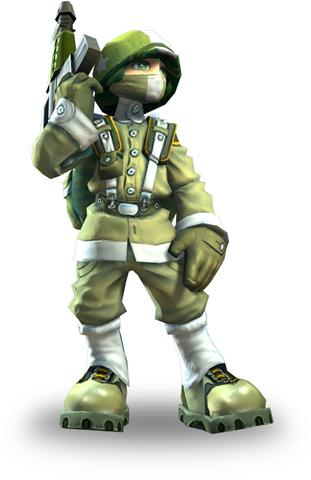
If quality gameplay wasn’t enough, these games are also overflowing with personality. The games’ humor and cartoonish visuals give the series a lighthearted tone; these aren’t games out to deliver a ham-fisted “war is bad” message but instead revel in the innocent—and perhaps naive—feeling of playing with toy army men. Despite having the depth of a Saturday morning cartoon, almost every character is likable in some way—with my personal favorites being Tsar Gorgi, Kaiser Vlad, and Col. Austin—and I genuinely wanted to know what happened to them next. Each faction’s units are instantly recognizable, and their designs convey a lot of personality, not just for the unit itself, but for the faction it belongs to.
Giving orders from the perspective of one of your men while returning fire yourself really makes you feel like you’re an actual part of the conflict.
Now that we’ve covered the basics, take a closer look at the first game.
Battalion Wars
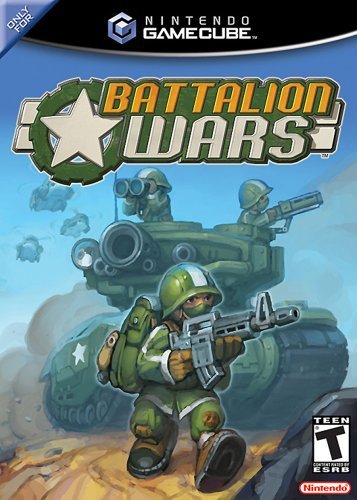
The cute proportions and solemn color choice of the cover art sums up the game’s unique atmosphere quite well.
I first heard of Battalion Wars from the now defunct Nintendo Power Magazine. That’s not to say I immediately took an interest in it, however. I wouldn’t pay it much mind until my younger brother returned from the now defunct Hasting’s Entertainment with a used copy of the game. Shortly after he inevitably lost interest in it, I took a crack at it and fell for it harder than Tsar Gorgi off a bridge (too soon?).
The game places the player in command of the forces of the Western Frontier—with some exceptions in the form of unlockable bonus missions. The story begins during an uneasy truce between the Western Frontier and their longstanding enemies, the Tundran Territories. War breaks out when Western Frontier troops find a Tundran spy on the Frontier side of the border. As the plot continues, the Tundrans ally themselves with the Xylvanians, the Xylvanians betray the Tundrans, an old man is thrown off a bridge, I think there was a zombie-ghost legion at some point…you get the picture.
While it won’t win any awards, the story has a great sense of progression to it. Plot-wise, mission objectives often tie into something you did in a previous stage. If you saved a spy, you can bet his intel is what will point you toward your next target. The fort you defend in one mission is essential to launching a counter attack in the next and so forth. It’s a small detail, but having your actions contextualized like that goes a long way toward making your input feel meaningful.
While it won’t win any awards, the story has a great sense of progression to it.
While we’re talking about writing, I need to discuss the most important character: the grunts. Throughout the game, the troops under your command are constantly responding to your orders, quipping at the enemy, talking among themselves, or commenting on the situation at hand…and it is freaking adorable! Okay, I know that sounds like it’d get annoying after awhile, but the troops have so many lines that I would sometimes still be discovering new ones on my fourth or fifth play-through of particular missions.
“I’m beat…let’s make camp and whip up some cocoa!”
On to the atmosphere: the visual style is a strange blend of cute, chibi soldiers and vehicles and a muted color palette that gives the environments an oddly grim and gritty feel. This, in conjunction with a great soundtrack that wouldn’t sound out of place in an old WW2 movie, produces a unique atmosphere in which the tone is never too heavy or oppressive but the player is still fully aware that—no matter how cute the enemy’s tanks are—this is still war.
The game isn’t without faults, however. The A.I. for units under the player’s control is a little slow on the uptake, to the point of seemingly lacking a self preservation instinct at times. I found any mission where I had to fight enemy aircraft especially aggravating, as anti-air vets tend to not take initiative, resulting in massive losses from even brief lapses in focus. I didn’t care much for missions where the game expects me to command planes and ground forces at the some time, either. For whatever reason, when given the wait command, planes continuously fly in a straight line instead of staying in proximity to where they were when the order was given. This required me to constantly check back on them to make sure they weren’t about to fly over enemy anti-air embankments.
Battalion Wars 2
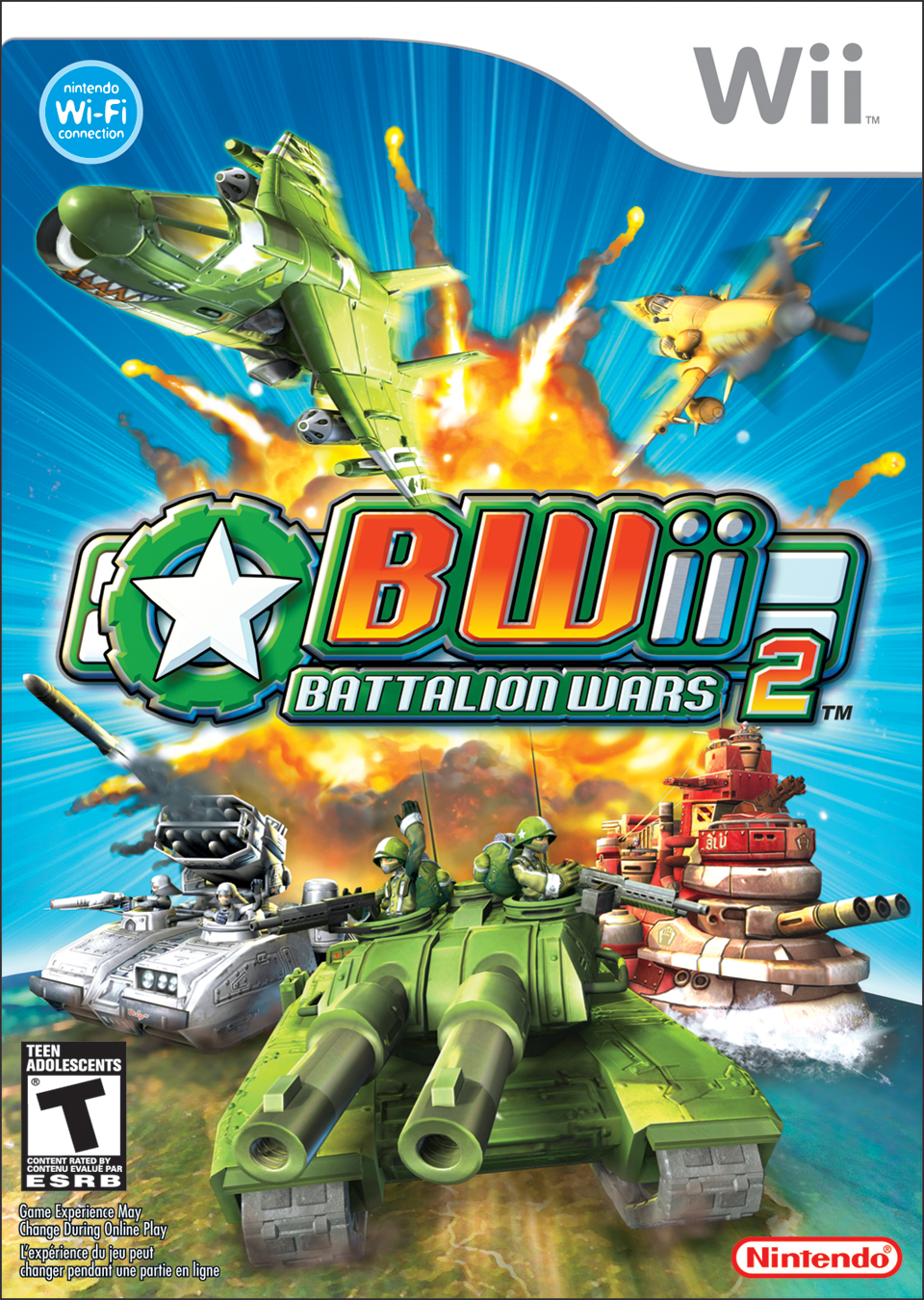
More playable factions, more unit types, more color! KA-BOOM!
Battalion Wars 2 starts its story off 200 years in the past by showing the player the final conflict between the Solar Empire and Old Xylvania at the end of the “Lightning Wars”. Bottom line is that the S.E. nukes O.X.’s H.Q. with an orbital death ray and then—fearing that the weapon is too much power for anyone to wield—chucks the controller (a staff) into a glacial ravine…what could possibly go wrong?
Back in present day, it’s been 2 years since the events of B.W. 1 and the nations of the world are at peace…until the Anglo Isles preemptively attack the Solar Empire based on rumors that they are harboring some sort of super weapon. The plot jumps between flashbacks and modern day from there with each campaign focusing on a different faction: a conflict between the Western Frontier and Tundra, the Anglo Islands staving off the Solar Empire’s retaliation, one where the player controls Old Xylvania’s forces, and finally Tundra’s attempts to prevent Xylvania from finding the staff.
The plot sounds a lot more complicated, but it really isn’t. I assume the 200-year-old-artifact-of-doom plot was meant to make the story feel bigger than the last game’s. Unfortunately, I’m not very fond of epics; I much prefer down-to-earth plots as I think they tend to have better focus and require the author to actually make me care about something specific like people or places. Fortunately, most of the characters are still quite likable, including most of the new ones.
Sadly, the narrative’s constantly changing point of view leaves the story unfocused and absolutely kills that sense of progression the first game had. You only play as any one faction for at most five missions (usually less). Between less emphasis being placed on the player’s actions between missions and the fact the player constantly switches sides, that feeling from the first game of being a single commander fighting in a series of much larger conflicts is completely gone.
Did I mention the volume on the player’s soldiers has also been dramatically reduced? They still speak, and I’m sure it’s still adorable, but I for the life of me can’t hear what they’re saying.
The narrative’s constantly changing point of view leaves the story unfocused and absolutely kills that sense of progression the first game had.
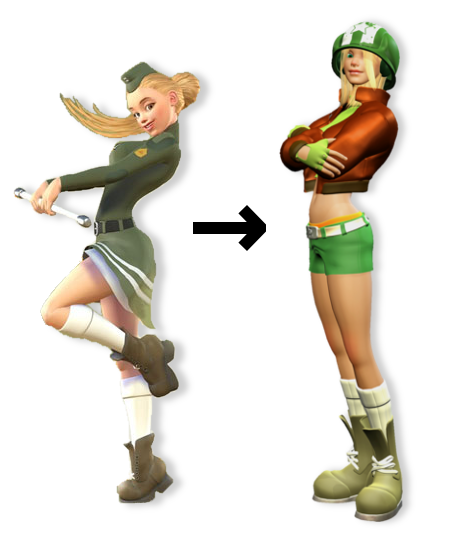
Moving on to the visual design of this game: many of the units received redesigns, especially the Tundran Territories’ infantry, most of which I think are improvements. The same can’t be said for Brigadier Betty: her look, not to mention her distinctive voice and a good deal of her peppy can-do attitude, are gone, making this iteration rather bland and forgettable. Speaking of bland, the game’s color palette is much more colorful which, while fitting well with the cartoonish style, demolishes the unique atmosphere of the B.W. 1 and stands out less by comparison.
On the left, a plucky, upbeat, and memorable character; on the right, the uncanny valley.
Okay, so maybe the aesthetics and narrative aren’t on par with the original, but this game fixes many of its predecessor’s failings when it comes to gameplay. The A.I. is much more proactive: there were many times I would be ordering my units to attack a tank or some entrenched enemy infantry and would be surprised by the wreckage of an enemy gunship I didn’t notice suddenly crashing nearby. Oh, and planes finally fly in circles when put on standby!
The motion controls also make targeting enemies and issuing commands a snap. The only place where they really feel out of place is when controlling aircraft, as pointing the Wii remote up or down controls altitude. This feels awkward, especially if the player is trying to target a ground based unit, partially due to the game not making the change in altitude immediately obvious.
The game’s missions do feel a bit more repetitive than before. BWii’s missions follow a pretty predictable formula: defend a location then go on the assault or go on the assault and then defend the capture point. That said, BWii doesn’t have any missions that drag on too long or feel unfair—which the first game was occasionally guilty of, so I guess it more or less balances out.
The game’s missions do feel a bit more repetitive than before. That said, BWii doesn’t have any missions that drag on too long or feel unfair—which the first game was occasionally guilty of.
Of course, Battalion Wars 2 also brought new gameplay elements to the table: naval units and buildings. Naval units basically feel like tanks and artillery, but much more sluggish. That said, the game does a great job of conveying their weight and scale, and their long range means naval missions don’t feel too drawn out. Unfortunately, missions in which the player has to command both land and sea units tend to feel disjointed and tedious, due the two unit types’ inability to travel together and the player not being able to use the “All Units” button to regroup their units without messing up their positioning.
Buildings are a solid addition. Players can’t select their position, instead having to secure predetermined locations. Once under the player’s control, buildings will periodically replace fallen units corresponding to the type of building (e.g. aircraft for airfields). These help take the edge off, as the player doesn’t have to worry about losing essential personnel. That said, the fact that units have to run all the way to the players position, which can be on the other side of the map, means the player can’t rely on reinforcements too much.
Debriefing
Despite all of the flak I just gave Battalion Wars 2, I do think it’s the better game. While I think Battalion Wars has more personality, it can also be much more tiring—and sometimes frustrating—to play. Of course, neither is particularly hard to come by, and they’re both worth your time.
Sadly, Nintendo never commissioned Kuju to make a Battalion Wars 3. I think it’s blend of action and strategy would’ve been a great fit for the Wii U, and the Wii U gamepad would’ve been a great help in micromanaging units, something that neither game made easy. Nintendo still seems to have a fondness for cartoony wars games if the recent 3DS game Tank Heroes is anything to go by, so I haven’t completely given up hope. If the rumors of GameCube games coming to the Switch’s Virtual Console are true, I’d happily double dip on Battalion Wars…and not just because of how utterly unreliable old GameCube memory cards are.
About the Author
Glen Straughn is a lifelong Nintendo fan whose love of video games has inspired him to pursue a career in computer programming. He is currently studying to receive his masters in computer science from Oklahoma State University. He has gotten an S rank on every mission in BWii, and even managed to get an S on the final mission on his first successful play-through…completely by accident.
If you’re old enough to remember printed game manuals, you’ve probably heard gamers joke about how superfluous they were. Ever since the mid 90’s, games have featured in-game tutorials and, even then, most people are smart enough to figure out the basics just by fiddling with the controller for a few seconds. They were utterly redundant. And yet, just about everyone admits that the first thing they did when they bought a new game as a kid was read those blasted booklets cover to cover. I know I did.
Nowadays, print manuals have been phased out in favor of in-game tutorials and digital guides accessible with a few, quick button presses. But just because something’s extinct doesn’t mean it’s not worth studying. Let’s take a look at how game manuals evolved over the years.
These have been gone for eons, and yet every natural history museum has to have at least one.
I’ll be limiting this examination to one mainline Mario title per console generation: Super Mario Bros., Super Mario World, Super Mario 64, Super Mario Sunshine, and Super Mario Galaxy 2. Why? Because contrary to popular belief I actually have a life, and to do this properly is way more work than even I’m willing to put out.
Printing
The most noticeable difference between manuals at first glance is their physical construction. The original Super Mario Bros.‘s manual is approximately 5.2×4 inches, which is considerably smaller the manuals of later generations, which all average to roughly 4.6×7 inches. Of course, size differences pale in comparison to the actual printing. With the exception of the cover and the gold Nintendo Seal of Approval on the first page, Super Mario Bros.‘s manual is entirely in black and white. Later generations would feature full color print for their manuals. Moreover, much more thought was given to how the pages were laid out, with sentences no longer being split between pages and more organic placement of text and illustrations. The last item of note is Super Mario Galaxy 2‘s manual is written in three languages: English, French, and Spanish. As to be expected, this tripled the booklet’s thickness.
Story
Back in the day, the only way to know a game’s plot often times was reading it in the game’s manual. Even after games started to become self-contained by providing opening cinematics, manuals continued to provide brief summaries of the game’s premise.
As to be expected, the plot summary of the first Super Mario Bros. is short and to the point. It describes what happens, without going into much detail as to how or why. Moreover, we don’t get to see things from any character’s point of view. Because of this, the narration has a sense of detachment from the plight of the hero, giving the plot summary a matter-of-fact tone. In short, it’s not so much a story as it is a plot.
In short, it’s not so much a story as it is a plot.
By contrast, Super Mario World‘s story uses a limited third-person narrative, presenting the story from Mario and Luigi’s perspective. The characters are presented as, well, characters: they’re given motives, emotions, and even dialog. Moreover, the story is actually presented as a narrative, with events playing out in sequence. Interestingly, the story (in the North American manual, at least), makes reference to the events of Super Mario Bros. 3, indicating that SMB3 is canonical despite Miyamoto stating it was all a stage-play…
Super Mario 64 continues the increased focus on narrative, notably by spending two whole pages on story! The story starts with a dose of self-awareness by asking, “Is there no end to the constant feuding between Mario and Bowser?” Afterward, the plot is told entirely from Mario’s perspective, with frequent interjections from the man himself. These quips from Mario are actually a bit jarring for anyone used to Mario’s modern portrayal, as they actually communicate some personality. It seems at this point Nintendo wasn’t afraid to let Mario be his own character instead of a stand-in for the player. Other than that, the story unfolds much like Super Mario World’s, which is to say a narrative instead of a plot. Interestingly, Mario 64 and Super Mario World‘s stories both include some overlap with what the player would see during gameplay.
It seems at this point Nintendo wasn’t afraid to let Mario be his own character instead of a stand-in for the player.
Super Mario Sunshine‘s story section is somewhere between the style of Super Mario Bros. and its super Nintendo and N64 predecessors, mostly leaning toward the former. While it attempts to convey the story with the sense of drama of Super Mario World and Mario 64, it only describes things in broad strokes. Like Super Mario Bros., there’s no focus on characters, instead favoring a description of events from an outside perspective. I assume this is in part due to the inclusion of cutscenes in the game itself. Since this was the first Mario game to be almost entirely self-contained when it came to plot, Nintendo probably thought it would be redundant to put information in the manual that the player would receive in-game.
Lastly, Super Mario Galaxy 2 somehow manages to beat even Super Mario Bros. in brevity. It doesn’t even set up the story’s conflict. All we learn from it is that Mario’s been invited to the castle and meets a Luma along the way. That’s it. The Prologue page actually devotes more space to character bios than story, which—given the game’s focus on gameplay over any semblance of plot—is probably appropriate.
Controls and Gameplay
The most important part of a game, and thereby the most important part of a game manual, is the gameplay. Gameplay and controls vary from game to game, even within the same franchise. As such, these sections are going to differ quite a bit on the granular level. Seeing as this is an examination of the evolution of game manuals and not the Mario series, I’m going to look at the big picture: what’s emphasized and how those instructions are written.
So right off the bat, I noticed something peculiar about the way pre-2000’s manuals were written. Often times when explaining controls or specific actions, the manuals often phrase actions in terms of Mario and not the player. For example, when listing the uses for the A-button, the Super Mario World manual says it “Makes Mario jump,” instead of, say, “Makes you jump.” Sunshine and Galaxy 2‘s manuals instead phrase controls and player actions in terms of the player, using terms like “when you touch an enemy” and so on.
This is interesting as conveys the idea that—despite the player controlling him—Mario is his own separate entity, with the player simply giving him instructions rather than Mario being an extension of the player. That said, I would be remiss to not mention that the pre-2000’s manuals were inconsistent in this trend, often alternating between describing actions as being performed in third-person (i.e. Mario) and second-person (i.e. the player). Also interesting is that while Mario Galaxy 2‘s manual exclusively describes the actions Mario can perform in second-person, actions that Yoshi can perform are exclusively third-person, indicating that the player isn’t the character he’s controlling, he is Mario.
This conveys the idea that—despite the player controlling him—Mario is his own separate entity.
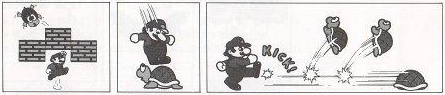
Older games take a very different approach to describing gameplay. Both Super Mario Bros. and Super Mario World go into great detail about everything: defeating enemies, items, kicking shells, using the weird pink ramps in Mario World, everything. Super Mario 64‘s manual spends most of its pages explaining analog movement, items, and how to progress through the game, with basic concepts like stomping on enemies being mostly glossed over. Sunshine‘s gameplay section is almost exclusively about all of the different moves and actions Mario can perform, only briefly touching on game progression or items. Lastly, while the Galaxy 2 manual mostly lists moves, it does go into more detail when explaining the mechanics of recurrent items and stage features like checkpoint flags than the previous 3D games.
Early manuals explained every facet of the game.
Personally, seeing how ideas and perspectives have changed over the last 30+ years is fascinating. We’ve seen Nintendo promote Mario as a character, only to make a 180 and make him a simple stand-in for the player. Then there’s getting to see what they thought was important for each game: back when Mario was first introduced, stomping on enemies, kicking shells, and so forth were new ideas, and the manuals tried to explain everything they could. Later games trusted that the player was familiar enough with the series—or video games in general—to figure out how to use their abilities and instead focused on the basic controls and the game’s new ideas, such as Mario 64‘s analog movement.
Unfortunately, this is where the story ends; Nintendo phased out print manuals during the Wii U era in favor of digital manuals, and now with the Switch, we don’t even have those. It’s a shame really, because, as I’ve just shown, even if you don’t need a manual to play a game or understand its plot, you can still learn from it.