This is probably the absolute peak of gaming fun. That’s it – we’ve reached the pinnacle. It’s all down-hill from here.
We don’t have a good explanation for this episode – we really don’t. Let’s just say that a little gem from Simeon and Scott’s past has popped up again, so they’re revisiting a pair of games that brought them a great deal of joy one decade ago. Watch them fumble through the flash games “Double Wire” and “There’s Two Wires” and then try for yourself! Double Wire: http://www.addictinggames.com/action-games/doublewires.jsp There’s 2 Wires: http://www.addictinggames.com/action-games/therestwowires.jsp
Shot by Alex Campbell
“Escape the Premises” Kevin MacLeod (incompetech.com) Licensed under Creative Commons: By Attribution 3.0 http://creativecommons.org/licenses/by/3.0/
“Yeah, I think it would be great if we totally forgot about the pointer on the Wii Remote and arbitrarily used motion controls…! Dahur!” – Skyward Sword Developers
After battling the game for around a year, Simeon finally declared defeat over the evil Demise and saved Hyrule. It wasn’t a quick trip through this Wii classic, but Simeon was noting his experience along the way and he has returned from the journey to tell us all about it. With the game being recently released for download on Wii U’s eShop, this is a great opportunity to see if a revisit to this game is worth it for you!
Shot by Alex Campbell
“Escape the Premises” Kevin MacLeod (incompetech.com) Licensed under Creative Commons: By Attribution 3.0 http://creativecommons.org/licenses/by/3.0/
We’d really appreciate it if there were some new default settings… LIKE STOCK MATCHES! GAAAAAAHHHHHH!
We enter a lot of Super Smash Bros. tournaments, and take it from us: the setup is an absolute pain. Oh, we gamers adapt. We make it work. But Nintendo could sure make things easier on their most hardcore fans by throwing us a bone in the form of a tournament special edition of their most competitive franchise: Super Smash Bros. And think about it – this is the perfect time for just such a revision to come into being; as Nintendo is theoretically ramping up their 2014 version for a Switch re-release.
Shot by Alex Campbell
“Escape the Premises” Kevin MacLeod (incompetech.com) Licensed under Creative Commons: By Attribution 3.0 http://creativecommons.org/licenses/by/3.0/
$50 for Metroid: Other M. Today. You read that right!
Have you ever noticed that the price for Nintendo games just DON’T ever drop? They sit on store shelves for years and cost the same amount that they did at launch time. It’s kind of crazy, especially when compared to the rest of the industry. Nintendo also just released their first Mario game on mobile, and it costs a whopping $10 – incredibly high compared to most of the bargain offerings on that platform. How is it that Nintendo is able to stand apart from the competition and charge more?
Shot by Alex Campbell
“Escape the Premises” Kevin MacLeod (incompetech.com) Licensed under Creative Commons: By Attribution 3.0 http://creativecommons.org/licenses/by/3.0/
We are so gonna Smash these goals! Welcome to 2017 everybody!
Goodbye 2016, hello 2017! We did pretty good on our goals from last year, so it’s time to set some all new resolutions for the coming year. And we’re gamers at the core, so each one of our goals is related to bettering ourselves as video game players and Nintendo fans during the next 365 days. We Have recently started playing over watch which is a great game, we even found this website for Overwatch boosting to help make our gaming experience more fun. Did you make any New Year’s Resolutions? What did you think of ours? Let us know in the comments below.
Shot by Alex Campbell
“Escape the Premises” Kevin MacLeod (incompetech.com)
Licensed under Creative Commons: By Attribution 3.0
http://creativecommons.org/licenses/by/3.0/
Greetings! I hope you’ve all had a safe holiday season filled with family, friends, and festivities. In celebrating the coming of the new year with resolving to better ourselves, I find it will be helpful to reflect on a holiday we celebrated a few months ago.
While visiting my in-laws for Thanksgiving in beautiful Montana, I flipped through a Christmas catalog. I can’t remember the store, but it was one I was unfamiliar with, and was clearly geared toward an elderly crowd. While skimming the pages, I found this:
Notice the tagline “Can the expensive game systems offer that?” The answer is, of course, “Not for the low, low price of $49.95, they can’t!” But it really got me thinking; is this a legitimate selling point? Just because a “Handheld Arcade Gaming System” has 140 games, is it worth the money? These sorts of deals bring up memories of things like Action 52, an infamous NES game which bundled 52 poor quality games into a single cartridge, and a CD I had as a kid with 1,000 games on it… only a few of which were worth my time. I hate to assume the worst of this handheld, but experience has taught me skepticism. I ended up going deeper; what makes gamers happy?
Will more games make us happy?
The advertising method of this handheld is based on the assumption that more games > less games. It’s the simple principle of more is more. It’s my guess that most gamers would laugh at this style of advertising. I don’t know about you, but I would rather have one well-crafted adventure than to sort through a mound of games that are unpolished. My game collection is not really that impressive in size. I have a handful of experiences that I enjoy playing again and again, and a lot that I rarely, if ever, return to. So, I think it’s safe to say that, “No, more games will not make us happy.”
Will longer games make us happy?
Recently the crew discussed this in an episode entitled What Length Should a Game Be?Many times, in a game review, how many “hours” the game will be is included. This baffled me at first, as many of the games I grew up on could be played through in one sitting (if you were good enough at it), and the joy of the game came from playing it over and over again. One recent example of a great game despite having a very short length is Portal. I beat it in one sitting, but it left such a huge impact on me that, after my first play-through, I put it in my top 20 favorite games. Some games, on the other extreme, are too long and can feel needlessly drawn-out. Will longer games make us happy? No.
Will branding make us happy?
Hahahaha… No. Just because something has a specific title, character, or developer behind it does not mean it will make us happy.
Will quality make us happy?
The short and honest answer is, no. Let me qualify my answer. Of course, everyone has their own taste in genre, and no one game is guaranteed to please everyone. Also, a triple-A developer is probably going to produce a more enjoyable game than other developers, especially considering all of the app store shovelware out there. But just because a game is well-crafted, even perfect, and should, by all counts, appeal to me, does not mean it will make me happy. Take Ocarina of Time, for instance. I love the Legend of Zelda series. I love Majora’s Mask. Ocarina of Time is widely considered one of the greatest masterpieces of gaming, yet it failed to hold my attention. I’ve tried to get into it on several occasions, yet it always fails to suck me in. Mighty No. 9, on the other hand, isn’t that great of a game, and was extremely disappointing, but I find myself drawn to its unique style, fun level design, and interesting weapons.
To me, I only see one universal guarantee to make a gamer happy: give them a memory. In the end, a gamer will not care if a game is good, or balanced, or polished; he will only care if the game gives him a smile thinking back on it. If you start talking with a gamer long enough, you will hear him start to talk about a game he played in his childhood which, even though the game was probably garbage to everyone else, he remembers fondly because it left an impression. For me, some of those games are Power Rangers Lightspeed Rescue,Electro Man, andother games from my childhood that I remember fondly. I might return to them now and think they’re completely terrible, but the fond memory is something I’ll never lose.
This year, as you resolve to be a better person, make room for a few more resolutions. Resolve to make memories of your gaming experiences, and resolve to remember those games that made you smile.
Can we please just have the Nintendo Switch and move on? D:
Oh 2016, we will miss you… somewhat. It sure wasn’t the best year for Nintendo fans, but maybe it wasn’t the worst, either. (?) We just couldn’t quite take the year seriously enough to try and hand out awards for certain categories like we did in the past, so this year we are taking a completely sarcastic approach. None of these categories that get awards mean anything, but they did get a kick out of us.
Shot by Alex Campbell
“Escape the Premises” Kevin MacLeod (incompetech.com) Licensed under Creative Commons: By Attribution 3.0 http://creativecommons.org/licenses/by/3.0/
For every time he raised the Master Sword skyward, he is also waved an imaginary flute around by the end of a Wii Remote…
Shigeru Miyamoto is a wonderful man to whom we owe a great debt of gratitude. However, in his many years as part of the game industry, he has had plenty of time to make a few missteps. And they were MAJOR. Miyamoto is someone who should be celebrated but not worshiped as perfect. Oh no – this is one developer who has seen the gamut of success and failure! Join Simeon and Scott as they explore the Japanese developer and creator of Mario’s history, highlighting the lows and the highs.
Shot by Alex Campbell
“Escape the Premises” Kevin MacLeod (incompetech.com) Licensed under Creative Commons: By Attribution 3.0 http://creativecommons.org/licenses/by/3.0/
Ironically, some of the best Nintendo games were made by outside developers.
First party, that’s Nintendo. Third party, that’s everyone else – right? WRONG. There’s an inbetween status that developers can achieve by meeting certain requirements and penning certain deals with the hardware publisher. Tune in as Scott and Simeon investigate the topic, as well as discuss each and every major 2nd party that Nintendo has enlisted.
Shot by Alex Campbell
“Escape the Premises” Kevin MacLeod (incompetech.com) Licensed under Creative Commons: By Attribution 3.0 http://creativecommons.org/licenses/by/3.0/
Props to you if you already have something like this set up at your house. Send us a picture!
Do you ever find yourself wishing that you could step through your TV screen and live in a Nintendo world? We’re not talking about VR today, but rather something more practical. Scott and Simeon are taking a look at the best Mario-themed rooms around, be they bedrooms, garages, or even bathrooms with portables for your pooping pleasure. Anyone can DIY themselves some of these crafts and decorations, so don’t go on living without some Nintendo themed touches in your life!
Shot by Alex Campbell
“Escape the Premises” Kevin MacLeod (incompetech.com) Licensed under Creative Commons: By Attribution 3.0 http://creativecommons.org/licenses/by/3.0/
This is probably the most exciting patent filing since the Switch started leaking!
What if Virtual Reality access was a mere plastic-headset away for Nintendo Switch owners? That dream could become a reality thanks to Nintendo’s latest patent filing. The mechanism described simply requires a Switch console to be inserted into a VR headset in order to immerse the gamer into a virtual world. Will the Switch’s specs be up to snuff for VR? Watch Scott and Simeon examine the patent and discuss the possibilities.
Shot by Alex Campbell
“Escape the Premises” Kevin MacLeod (incompetech.com) Licensed under Creative Commons: By Attribution 3.0 http://creativecommons.org/licenses/by/3.0/
Nintendo is known for many things: innovation, quality, terrible third party relations, etc. Throughout the years, the company has cultivated a reputation as highly creative, exacting master artisans. It’s one of the many reasons they’re so beloved by fans around the world. They don’t just make games, they make worlds and characters that are instantly recognizable and overflowing with personality. Creativity is a fundamental part of their identity as a company.
However, in recent years they’ve garnered a reputation among some as a bunch of corporate stiffs who keep churning out the same-old-same-old that they’ve always been, like Activision with Call of Duty, Ubisoft with Assassin’s Creed, or Capcom with…well take your pick. So what’s different? What makes the Nintendo titles of today “corporate cash-ins” instead of visionary, artistic masterpieces? If I had to give my two rupees on the subject, I’d say the issue isn’t that the games are bad or mechanically unsound, it’s that they lack personality.
So what even is personality? What makes it so important? What happens when a game doesn’t have it? Let’s take a look, shall we?
What I Mean by Personality
What is personality? Well, typically the word refers to the psychological concept of a collection of behavioral traits that determine how one sets priorities and reacts to different situations. Seeing as I’m writing about video games, however, that definition isn’t really of much use. For the sake of this article, I’ll just define it as the interplay between a game’s aesthetic choices (visual design, music, story, etc.) and its gameplay that give each game its identity.
Huh…that’s pretty vague, isn’t it? Maybe a visual aid is in order; consider the following image:
Even when packed onto the same cartridge, each game is easily distinguishable.
Clearly, these are all Mario games, but because each one has a unique visual style, even people unfamiliar with the franchise can easily tell that each one is a different game (Okay, technically you can get them all on one cartridge, but that’s beside the point). Furthermore, those who’ve played the games will tell you that despite each game staying true to the Mario formula, each game has its own unique mechanics and gameplay quirks that makes the gameplay feel different. That’s basically what I’m getting at when I say personality: a game’s unique look, sound, and feel. It’s why the first Paper Mario is cute and colorful while it’s sequel, The Thousand Year Door, is wry and occasionally dark, or how the claustrophobic corridors and eerie music give the Metroid series its trademark sense of isolation and unease, and so forth.
That’s basically what I’m getting at when I say personality: a game’s unique look, sound, and feel.
For the Want of an Identity
What happens when you have a mechanically airtight game that lacks the personality to set itself apart? You get the New Super Mario Bros. series.
When New Super Mario Bros. first came out on the DS, its deliberately vanilla presentation was—I dare say—welcome, considering it had been roughly fifteen years since Mario’s last new 2D outing. The aesthetic was familiar but modernized, making it a great choice for a game meant to be just that: a throwback with modern graphics and design sensibilities that epitomized what it meant to be “Mario”.
When you eliminate differences in graphical quality and resolution, these games are almost impossible to tell apart at a glance.
So what’s the problem? Nintendo made three nearly identical sequels, that’s what. Make no mistake, each game is excellent in its own right, but they’re all so ridiculously similar in terms of their visuals, gameplay, level themes, and music that they’re practically the same game! The New Super Mario Bros. series is proof that too much of a good thing is entirely possible. I honestly believe that if Nintendo had taken the time to give each game its own unique style—visually, setting-wise, musically, or otherwise—each game would be fondly remembered as classics, but because each game used the same “New” style, each one was more forgettable than the last. Ironically, between this and the lukewarm reception of Yoshi’s New Island, the word new has become Nintendo fan jargon for “safe” and “uninspired”.
The New Super Mario Bros. series is proof that too much of a good thing is entirely possible.
Making Okay Games Great
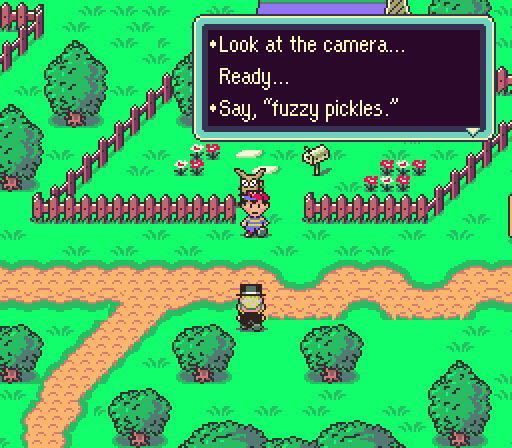
Alright, so an otherwise great game can lose its appeal without personality, but let’s be real for a moment, a game riddled with questionable design can’t really catch on just because of its personality, right? As proof of the contrary—and possibly of me secretly having a death wish—I present the 1995 cult-classic, EarthBound.
A man falls from the sky, tells you to say “fuzzy pickles”, takes your picture, and flies away. This is relatively normal by EarthBound standards.
Are you still reading? Okay, good.
If I had to summarize the gameplay of EarthBound in one word, I would say it’s serviceable. As R.P.G.s go, there are certainly more streamlined experiences on the Super Nintendo. In terms of core gameplay, EarthBound is very traditional. There are some minor mechanics which distinguish the game, but they honestly don’t affect the overall experience that often.
On top of that, EarthBound features some questionable design. EarthBound‘s interface is archaic, even for the time it was made. Simple actions like talking to people or investigating an object (which are separate actions) take multiple button presses with the default controls. Admittedly, there is a way to automatically do all of that in a single press, but if you didn’t read the manual or hear about it from someone else, you’d never know it’s there, likely because it’s unintuitively mapped to the L-trigger. Aside from that, inventory management is downright tedious, with actions like trading items between party members—or just buying and selling for that matter—taking many more windows, confirmations, and button presses than needed.
EarthBound‘s interface is archaic, even for the time it was made.
The game also has some difficulties with difficulty. Simply put, the game’s difficulty curve is as wild as its enemy designs. The beginning is particularly rough, with grinding being a must. Things do get easier once the other party members start showing up (several hours in), but the game loves to throw curveballs at the player.
And yet, the game is heralded as a masterpiece, and for good reason! Ask any EarthBound fan what makes the game so great, and I guarantee you they’ll mention the game’s quirky atmosphere long before they talk about the mechanics. EarthBound is full of humor, thought provoking themes, and obscene amounts of heart. In a fitting twist, EarthBound defies the usual mantra of “gameplay first” and sells itself almost entirely on its personality. If the game was just another fantasy epic about orphans saving the world from the physical manifestation of darkness—or whatever—I highly doubt anyone would remember it. Personality is what elevates EarthBound above its mechanics and earns it the title of classic.
Stay Fresh!
As I’ve stated prior, Nintendo’s struggled with getting personality right in their games of late. Some franchises—like Mario—are suffering from overexposure while others from Nintendo over-simplifying them in an attempt to be more accessible—thus removing the fun quirks that made them stand out in the first place. Fortunately, many of the Big N’s recent titles show that they haven’t completely lost their creative mojo: the urban, 90’s kid aesthetic of Splatoon, the jazzy sound and Geisel-esque environments of Super Mario 3D World, and the beautiful Ghibli styled world of the up-coming Legend of Zelda: Breath of the Wild, to name a few.
Next to gameplay, personality is the most important aspect of a game. Even if a game has great mechanics, it will quickly be forgotten if it doesn’t have the charm and appeal to leave a lasting impression. Likewise, a game with a lot of character can convince players to look past many of its flaws and hold it as a classic. And while Nintendo sometimes screws up and turns out games that don’t feel like they had much heart put into them, let’s be honest: there’s something about Nintendo that makes us willing to look past such missteps.
About the Author: Glen Straughn is a life-long Nintendo fan whose love of video games has inspired to pursue a career in computer programming. Currently, he is studying to get his masters in Computer Science at Oklahoma State University. He’s an INTJ on the Meyers-Briggs personality spectrum, which in fiction is the personality most often associated with evil geniuses like Professor Moriarty.
Fun exercise for the day: Decide which children depicted in the videos you would adopt into your family.
Ah, Christmas. The most wonderful time of the year. We’re just a few days away from Nintendo fans all over the globe, tearing into neatly wrapped packages of NES Classic Editions, amiibo, and 3DS consoles. Before that time we’d like to take a few moments and reflect on the past, when some of the most excitable kids in existence received their own Nintendo gifts that left an unforgettable mark on history. We have these children to thank for entertaining us with their over-the-top displays of joy and gratitude. Let’s get in the Christmas spirit and eagerly anticipate the joy that Nintendo gifts bring!
Shot by Alex Campbell
“Escape the Premises” Kevin MacLeod (incompetech.com) Licensed under Creative Commons: By Attribution 3.0 http://creativecommons.org/licenses/by/3.0/
Sometimes we just need to zip our lips and happily accept what Nintendo thinks is best for us!
Zelda fans, we blew it. After Nintendo released the original Wind Waker game for GameCube, the backlash about the artistic direction was so great that Nintendo not only changed the aesthetics for the next Zelda title, but completely scrapped a concept they were proud of. What we would have gotten instead of Twilight Princess would have been the sequel to Wind Waker. And that sounds pretty nice right about now, doesn’t it? Watch the video for the full scoop on why Nintendo shelved the idea and went in the complete opposite direction.
Shot by Alex Campbell
“Escape the Premises” Kevin MacLeod (incompetech.com) Licensed under Creative Commons: By Attribution 3.0 http://creativecommons.org/licenses/by/3.0/
Not too long… not too short… juuuuuust riiiiiight!
The length of a video game’s campaign or story mode can be a deciding factor in purchases these days. We as gamers want to feel like we are getting our full money’s worth when we invest in a new title. But some games just end up feeling way too long, and another problem arises when our time is not being respected by the developer. There has to be some kind of happy medium, where games don’t take too long to beat and they also don’t feel too short!
Shot by Alex Campbell
“Escape the Premises” Kevin MacLeod (incompetech.com) Licensed under Creative Commons: By Attribution 3.0 http://creativecommons.org/licenses/by/3.0/
For you, does the decision come down to time, money, or both?
Being a Nintendo fan can sometimes feel pretty lonely. We’re kind of a different breed, while the rest of the gaming industry seems to share their own kind of mutual understanding. Well, should we as Nintendo fans try to cross those borders and come home with our own Xbox or PlayStation console so we can experience some of those exclusives and the differences in online ecosystems? There are some definite pros and cons to look at!
Shot by Alex Campbell
“Escape the Premises” Kevin MacLeod (incompetech.com) Licensed under Creative Commons: By Attribution 3.0 http://creativecommons.org/licenses/by/3.0/
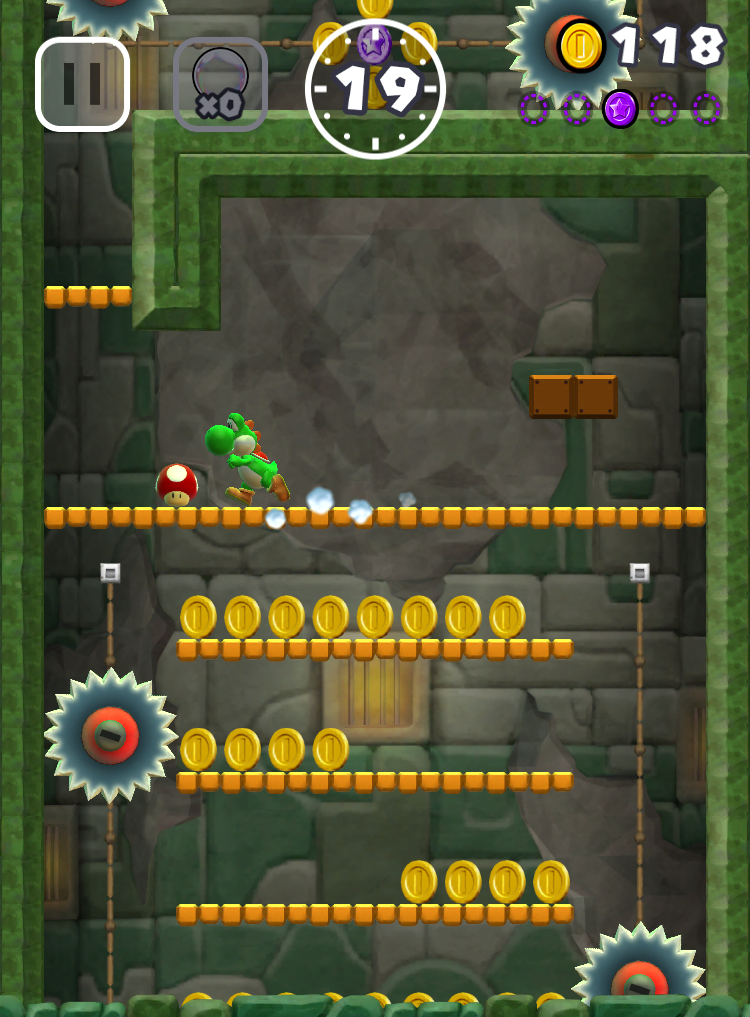
Super Mario Run landed on the Apple iPhone and iPad App Store, and hopefully will make its way to Android before too long. It’s not quite the “endless runner” that some people have incorrectly labeled it, but instead is quite the interesting PUZZLE-platformer. This little mobile gem has given us more of a challenge and more enjoyment than we expected, so we’ll break down the whole experience for you in the video to help you decide if the $10 purchase price is worth it.
Shot by Alex Campbell
“Escape the Premises” Kevin MacLeod (incompetech.com) Licensed under Creative Commons: By Attribution 3.0 http://creativecommons.org/licenses/by/3.0/
It’s no surprise that one of Nintendo’s main Holiday 2016 experiences has to do with Mario doing what he does best: running. Except this time, he is not being controlled by a controller, but the touch of a finger. Mario games have never been very complex in terms of gameplay, and that is likely why Nintendo made their most iconic figure transfer over to iOS devices (Android sometime next year). Mario running and jumping is a Nintendo staple, and even people who could not be more disconnected from video games surely are at least familiar with the physics behind the game. That is why I think it was brilliant for Nintendo to do this. The price point for the full game will turn some of the crowd away, but I predict this is going to be a massive success for Nintendo, and long term, they will be a big contributor to mobile gaming.
So, what’s next? I feel that some franchises will migrate over to mobile better than others. I have a tough time picturing a mobile Zelda game that brings the expansiveness and feeling of adventure that we are all used to with a console. I could possibly see Nintendo bringing it back to the classic style (per Link Between Worlds), but the mobile limitations alone would most likely water down what could be an otherwise rich experience.
Another direction Nintendo could take this would be to remake classic games (Ice Climbers, Balloon Fight, Excitebike, etc.) on mobile devices, since these games tend to have a simpler play style. With the recent release of the NES Classic Edition, these games are on the forefront of Nintendo’s radar, so maybe it’s a possibility that one day they will hit the mobile market. Of course, this is purely speculation, and Nintendo has proven time and time again that speculation usually amounts to no more.
Whatever the case, it will be interesting to see exactly where Nintendo goes with this, because right now, the market is still being tested. Are mobile devices better suited for $1.99 puzzle games, or $9.99 games that have had much more development invested in them. The money will talk, and Nintendo will surely respond. This season, however, the more Mario runs, the happier Nintendo will be. Who knows, he may even pave the way for other franchises.
A score of 11 makes us certified Nintendo geniuses!
Are there any video games that you know SO well that you could name them when only a single word is uttered about them? Maybe you could pull it off with a pair or trio of descriptive words about the game? That’s the exact challenge that Simeon and Scott have attempted in this episode. It’s not quite as hard as it sounds, but no proper nouns are allowed. It would make the game all too easy. So, how did they do? You can also play along as you watch – keep track of your score, and post it in the comments section below.
Shot by Alex Campbell
“Escape the Premises” Kevin MacLeod (incompetech.com) Licensed under Creative Commons: By Attribution 3.0 http://creativecommons.org/licenses/by/3.0/
When your BFF gets the machine gun, the bullet spreader, AND then dies right away.
In an effort to live up to his brothers’ reputation, Scott takes the NES controller, plugs its short cord into the NES Classic Edition console, and tried to make some headway in the Contra sequel, Super C. Of course, as always, Simeon joined him for the effort and ironically performed far better than his cohost counterpart. The few attempts are amusing, and hopefully you enjoy the retro nostalgia goodness!
Shot by Alex Campbell
“Escape the Premises” Kevin MacLeod (incompetech.com) Licensed under Creative Commons: By Attribution 3.0 http://creativecommons.org/licenses/by/3.0/