When your BFF gets the machine gun, the bullet spreader, AND then dies right away.
In an effort to live up to his brothers’ reputation, Scott takes the NES controller, plugs its short cord into the NES Classic Edition console, and tried to make some headway in the Contra sequel, Super C. Of course, as always, Simeon joined him for the effort and ironically performed far better than his cohost counterpart. The few attempts are amusing, and hopefully you enjoy the retro nostalgia goodness!
Shot by Alex Campbell
“Escape the Premises” Kevin MacLeod (incompetech.com) Licensed under Creative Commons: By Attribution 3.0 http://creativecommons.org/licenses/by/3.0/
A score of 11 makes us certified Nintendo geniuses!
Are there any video games that you know SO well that you could name them when only a single word is uttered about them? Maybe you could pull it off with a pair or trio of descriptive words about the game? That’s the exact challenge that Simeon and Scott have attempted in this episode. It’s not quite as hard as it sounds, but no proper nouns are allowed. It would make the game all too easy. So, how did they do? You can also play along as you watch – keep track of your score, and post it in the comments section below.
Shot by Alex Campbell
“Escape the Premises” Kevin MacLeod (incompetech.com) Licensed under Creative Commons: By Attribution 3.0 http://creativecommons.org/licenses/by/3.0/
Nintendo is known for many things: innovation, quality, terrible third party relations, etc. Throughout the years, the company has cultivated a reputation as highly creative, exacting master artisans. It’s one of the many reasons they’re so beloved by fans around the world. They don’t just make games, they make worlds and characters that are instantly recognizable and overflowing with personality. Creativity is a fundamental part of their identity as a company.
However, in recent years they’ve garnered a reputation among some as a bunch of corporate stiffs who keep churning out the same-old-same-old that they’ve always been, like Activision with Call of Duty, Ubisoft with Assassin’s Creed, or Capcom with…well take your pick. So what’s different? What makes the Nintendo titles of today “corporate cash-ins” instead of visionary, artistic masterpieces? If I had to give my two rupees on the subject, I’d say the issue isn’t that the games are bad or mechanically unsound, it’s that they lack personality.
So what even is personality? What makes it so important? What happens when a game doesn’t have it? Let’s take a look, shall we?
What I Mean by Personality
What is personality? Well, typically the word refers to the psychological concept of a collection of behavioral traits that determine how one sets priorities and reacts to different situations. Seeing as I’m writing about video games, however, that definition isn’t really of much use. For the sake of this article, I’ll just define it as the interplay between a game’s aesthetic choices (visual design, music, story, etc.) and its gameplay that give each game its identity.
Huh…that’s pretty vague, isn’t it? Maybe a visual aid is in order; consider the following image:
Even when packed onto the same cartridge, each game is easily distinguishable.
Clearly, these are all Mario games, but because each one has a unique visual style, even people unfamiliar with the franchise can easily tell that each one is a different game (Okay, technically you can get them all on one cartridge, but that’s beside the point). Furthermore, those who’ve played the games will tell you that despite each game staying true to the Mario formula, each game has its own unique mechanics and gameplay quirks that makes the gameplay feel different. That’s basically what I’m getting at when I say personality: a game’s unique look, sound, and feel. It’s why the first Paper Mario is cute and colorful while it’s sequel, The Thousand Year Door, is wry and occasionally dark, or how the claustrophobic corridors and eerie music give the Metroid series its trademark sense of isolation and unease, and so forth.
That’s basically what I’m getting at when I say personality: a game’s unique look, sound, and feel.
For the Want of an Identity
What happens when you have a mechanically airtight game that lacks the personality to set itself apart? You get the New Super Mario Bros. series.
When New Super Mario Bros. first came out on the DS, its deliberately vanilla presentation was—I dare say—welcome, considering it had been roughly fifteen years since Mario’s last new 2D outing. The aesthetic was familiar but modernized, making it a great choice for a game meant to be just that: a throwback with modern graphics and design sensibilities that epitomized what it meant to be “Mario”.
When you eliminate differences in graphical quality and resolution, these games are almost impossible to tell apart at a glance.
So what’s the problem? Nintendo made three nearly identical sequels, that’s what. Make no mistake, each game is excellent in its own right, but they’re all so ridiculously similar in terms of their visuals, gameplay, level themes, and music that they’re practically the same game! The New Super Mario Bros. series is proof that too much of a good thing is entirely possible. I honestly believe that if Nintendo had taken the time to give each game its own unique style—visually, setting-wise, musically, or otherwise—each game would be fondly remembered as classics, but because each game used the same “New” style, each one was more forgettable than the last. Ironically, between this and the lukewarm reception of Yoshi’s New Island, the word new has become Nintendo fan jargon for “safe” and “uninspired”.
The New Super Mario Bros. series is proof that too much of a good thing is entirely possible.
Making Okay Games Great
Alright, so an otherwise great game can lose its appeal without personality, but let’s be real for a moment, a game riddled with questionable design can’t really catch on just because of its personality, right? As proof of the contrary—and possibly of me secretly having a death wish—I present the 1995 cult-classic, EarthBound.
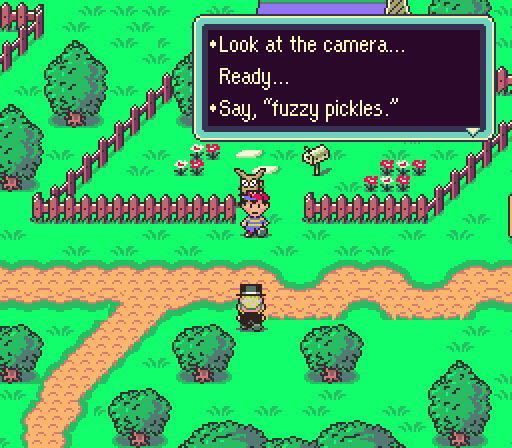
A man falls from the sky, tells you to say “fuzzy pickles”, takes your picture, and flies away. This is relatively normal by EarthBound standards.
Are you still reading? Okay, good.
If I had to summarize the gameplay of EarthBound in one word, I would say it’s serviceable. As R.P.G.s go, there are certainly more streamlined experiences on the Super Nintendo. In terms of core gameplay, EarthBound is very traditional. There are some minor mechanics which distinguish the game, but they honestly don’t affect the overall experience that often.
On top of that, EarthBound features some questionable design. EarthBound‘s interface is archaic, even for the time it was made. Simple actions like talking to people or investigating an object (which are separate actions) take multiple button presses with the default controls. Admittedly, there is a way to automatically do all of that in a single press, but if you didn’t read the manual or hear about it from someone else, you’d never know it’s there, likely because it’s unintuitively mapped to the L-trigger. Aside from that, inventory management is downright tedious, with actions like trading items between party members—or just buying and selling for that matter—taking many more windows, confirmations, and button presses than needed.
EarthBound‘s interface is archaic, even for the time it was made.
The game also has some difficulties with difficulty. Simply put, the game’s difficulty curve is as wild as its enemy designs. The beginning is particularly rough, with grinding being a must. Things do get easier once the other party members start showing up (several hours in), but the game loves to throw curveballs at the player.
And yet, the game is heralded as a masterpiece, and for good reason! Ask any EarthBound fan what makes the game so great, and I guarantee you they’ll mention the game’s quirky atmosphere long before they talk about the mechanics. EarthBound is full of humor, thought provoking themes, and obscene amounts of heart. In a fitting twist, EarthBound defies the usual mantra of “gameplay first” and sells itself almost entirely on its personality. If the game was just another fantasy epic about orphans saving the world from the physical manifestation of darkness—or whatever—I highly doubt anyone would remember it. Personality is what elevates EarthBound above its mechanics and earns it the title of classic.
Stay Fresh!
As I’ve stated prior, Nintendo’s struggled with getting personality right in their games of late. Some franchises—like Mario—are suffering from overexposure while others from Nintendo over-simplifying them in an attempt to be more accessible—thus removing the fun quirks that made them stand out in the first place. Fortunately, many of the Big N’s recent titles show that they haven’t completely lost their creative mojo: the urban, 90’s kid aesthetic of Splatoon, the jazzy sound and Geisel-esque environments of Super Mario 3D World, and the beautiful Ghibli styled world of the up-coming Legend of Zelda: Breath of the Wild, to name a few.
Next to gameplay, personality is the most important aspect of a game. Even if a game has great mechanics, it will quickly be forgotten if it doesn’t have the charm and appeal to leave a lasting impression. Likewise, a game with a lot of character can convince players to look past many of its flaws and hold it as a classic. And while Nintendo sometimes screws up and turns out games that don’t feel like they had much heart put into them, let’s be honest: there’s something about Nintendo that makes us willing to look past such missteps.
About the Author: Glen Straughn is a life-long Nintendo fan whose love of video games has inspired to pursue a career in computer programming. Currently, he is studying to get his masters in Computer Science at Oklahoma State University. He’s an INTJ on the Meyers-Briggs personality spectrum, which in fiction is the personality most often associated with evil geniuses like Professor Moriarty.
Super Mario Run landed on the Apple iPhone and iPad App Store, and hopefully will make its way to Android before too long. It’s not quite the “endless runner” that some people have incorrectly labeled it, but instead is quite the interesting PUZZLE-platformer. This little mobile gem has given us more of a challenge and more enjoyment than we expected, so we’ll break down the whole experience for you in the video to help you decide if the $10 purchase price is worth it.
Shot by Alex Campbell
“Escape the Premises” Kevin MacLeod (incompetech.com) Licensed under Creative Commons: By Attribution 3.0 http://creativecommons.org/licenses/by/3.0/
Not too long… not too short… juuuuuust riiiiiight!
The length of a video game’s campaign or story mode can be a deciding factor in purchases these days. We as gamers want to feel like we are getting our full money’s worth when we invest in a new title. But some games just end up feeling way too long, and another problem arises when our time is not being respected by the developer. There has to be some kind of happy medium, where games don’t take too long to beat and they also don’t feel too short!
Shot by Alex Campbell
“Escape the Premises” Kevin MacLeod (incompetech.com) Licensed under Creative Commons: By Attribution 3.0 http://creativecommons.org/licenses/by/3.0/
Sometimes we just need to zip our lips and happily accept what Nintendo thinks is best for us!
Zelda fans, we blew it. After Nintendo released the original Wind Waker game for GameCube, the backlash about the artistic direction was so great that Nintendo not only changed the aesthetics for the next Zelda title, but completely scrapped a concept they were proud of. What we would have gotten instead of Twilight Princess would have been the sequel to Wind Waker. And that sounds pretty nice right about now, doesn’t it? Watch the video for the full scoop on why Nintendo shelved the idea and went in the complete opposite direction.
Shot by Alex Campbell
“Escape the Premises” Kevin MacLeod (incompetech.com) Licensed under Creative Commons: By Attribution 3.0 http://creativecommons.org/licenses/by/3.0/
Fun exercise for the day: Decide which children depicted in the videos you would adopt into your family.
Ah, Christmas. The most wonderful time of the year. We’re just a few days away from Nintendo fans all over the globe, tearing into neatly wrapped packages of NES Classic Editions, amiibo, and 3DS consoles. Before that time we’d like to take a few moments and reflect on the past, when some of the most excitable kids in existence received their own Nintendo gifts that left an unforgettable mark on history. We have these children to thank for entertaining us with their over-the-top displays of joy and gratitude. Let’s get in the Christmas spirit and eagerly anticipate the joy that Nintendo gifts bring!
Shot by Alex Campbell
“Escape the Premises” Kevin MacLeod (incompetech.com) Licensed under Creative Commons: By Attribution 3.0 http://creativecommons.org/licenses/by/3.0/
Props to you if you already have something like this set up at your house. Send us a picture!
Do you ever find yourself wishing that you could step through your TV screen and live in a Nintendo world? We’re not talking about VR today, but rather something more practical. Scott and Simeon are taking a look at the best Mario-themed rooms around, be they bedrooms, garages, or even bathrooms with portables for your pooping pleasure. Anyone can DIY themselves some of these crafts and decorations, so don’t go on living without some Nintendo themed touches in your life!
Shot by Alex Campbell
“Escape the Premises” Kevin MacLeod (incompetech.com) Licensed under Creative Commons: By Attribution 3.0 http://creativecommons.org/licenses/by/3.0/
Ironically, some of the best Nintendo games were made by outside developers.
First party, that’s Nintendo. Third party, that’s everyone else – right? WRONG. There’s an inbetween status that developers can achieve by meeting certain requirements and penning certain deals with the hardware publisher. Tune in as Scott and Simeon investigate the topic, as well as discuss each and every major 2nd party that Nintendo has enlisted.
Shot by Alex Campbell
“Escape the Premises” Kevin MacLeod (incompetech.com) Licensed under Creative Commons: By Attribution 3.0 http://creativecommons.org/licenses/by/3.0/
For every time he raised the Master Sword skyward, he is also waved an imaginary flute around by the end of a Wii Remote…
Shigeru Miyamoto is a wonderful man to whom we owe a great debt of gratitude. However, in his many years as part of the game industry, he has had plenty of time to make a few missteps. And they were MAJOR. Miyamoto is someone who should be celebrated but not worshiped as perfect. Oh no – this is one developer who has seen the gamut of success and failure! Join Simeon and Scott as they explore the Japanese developer and creator of Mario’s history, highlighting the lows and the highs.
Shot by Alex Campbell
“Escape the Premises” Kevin MacLeod (incompetech.com) Licensed under Creative Commons: By Attribution 3.0 http://creativecommons.org/licenses/by/3.0/
Can we please just have the Nintendo Switch and move on? D:
Oh 2016, we will miss you… somewhat. It sure wasn’t the best year for Nintendo fans, but maybe it wasn’t the worst, either. (?) We just couldn’t quite take the year seriously enough to try and hand out awards for certain categories like we did in the past, so this year we are taking a completely sarcastic approach. None of these categories that get awards mean anything, but they did get a kick out of us.
Shot by Alex Campbell
“Escape the Premises” Kevin MacLeod (incompetech.com) Licensed under Creative Commons: By Attribution 3.0 http://creativecommons.org/licenses/by/3.0/
$50 for Metroid: Other M. Today. You read that right!
Have you ever noticed that the price for Nintendo games just DON’T ever drop? They sit on store shelves for years and cost the same amount that they did at launch time. It’s kind of crazy, especially when compared to the rest of the industry. Nintendo also just released their first Mario game on mobile, and it costs a whopping $10 – incredibly high compared to most of the bargain offerings on that platform. How is it that Nintendo is able to stand apart from the competition and charge more?
Shot by Alex Campbell
“Escape the Premises” Kevin MacLeod (incompetech.com) Licensed under Creative Commons: By Attribution 3.0 http://creativecommons.org/licenses/by/3.0/
We’d really appreciate it if there were some new default settings… LIKE STOCK MATCHES! GAAAAAAHHHHHH!
We enter a lot of Super Smash Bros. tournaments, and take it from us: the setup is an absolute pain. Oh, we gamers adapt. We make it work. But Nintendo could sure make things easier on their most hardcore fans by throwing us a bone in the form of a tournament special edition of their most competitive franchise: Super Smash Bros. And think about it – this is the perfect time for just such a revision to come into being; as Nintendo is theoretically ramping up their 2014 version for a Switch re-release.
Shot by Alex Campbell
“Escape the Premises” Kevin MacLeod (incompetech.com) Licensed under Creative Commons: By Attribution 3.0 http://creativecommons.org/licenses/by/3.0/
“Yeah, I think it would be great if we totally forgot about the pointer on the Wii Remote and arbitrarily used motion controls…! Dahur!” – Skyward Sword Developers
After battling the game for around a year, Simeon finally declared defeat over the evil Demise and saved Hyrule. It wasn’t a quick trip through this Wii classic, but Simeon was noting his experience along the way and he has returned from the journey to tell us all about it. With the game being recently released for download on Wii U’s eShop, this is a great opportunity to see if a revisit to this game is worth it for you!
Shot by Alex Campbell
“Escape the Premises” Kevin MacLeod (incompetech.com) Licensed under Creative Commons: By Attribution 3.0 http://creativecommons.org/licenses/by/3.0/
This is probably the absolute peak of gaming fun. That’s it – we’ve reached the pinnacle. It’s all down-hill from here.
We don’t have a good explanation for this episode – we really don’t. Let’s just say that a little gem from Simeon and Scott’s past has popped up again, so they’re revisiting a pair of games that brought them a great deal of joy one decade ago. Watch them fumble through the flash games “Double Wire” and “There’s Two Wires” and then try for yourself! Double Wire: http://www.addictinggames.com/action-games/doublewires.jsp There’s 2 Wires: http://www.addictinggames.com/action-games/therestwowires.jsp
Shot by Alex Campbell
“Escape the Premises” Kevin MacLeod (incompetech.com) Licensed under Creative Commons: By Attribution 3.0 http://creativecommons.org/licenses/by/3.0/
You might just think Scott and Simeon are a couple of parents based on how they’re talking here.
We get into the history of game ratings, our thoughts on the gaps between age restrictions, and we discuss the process of getting your game rated with the ESRB!
Shot by Alex Campbell
“Escape the Premises” Kevin MacLeod (incompetech.com) Licensed under Creative Commons: By Attribution 3.0 http://creativecommons.org/licenses/by/3.0/
Isn’t it great to see an episode fully hosted by members of the greater Crew body? That intro sure seems out of place though…
The January Switch Presentation is right around the corner, in which Nintendo will fully unveil their new home/portable console hybrid. A huge portion of this presentation is going to be fully dedicated to the games that surround the console’s launch window, because we gamers have to know what software is going to support this new hardware! After all, we only know of Zelda: Breath of the Wild, an unnamed Mario adventure, and a few third-party titles that belong to publishers who have been sworn to secrecy. It’s time to take a close look at what games belong on the Switch as a perfect fit – games that will take advantage of this console’s unique abilities!
Shot by Alex Campbell
“Escape the Premises” Kevin MacLeod (incompetech.com) Licensed under Creative Commons: By Attribution 3.0 http://creativecommons.org/licenses/by/3.0/
Nintendo, especially in recent years, has marketed itself as a family friendly console. This is very apparent when looking at game ratings on their consoles compared to competitors. With the Switch on the way it looks like their could be a slight shift. For the first time in a long time Nintendo is marketing a console to the older generations that grew up with their systems. Could we possibly see more games with mature settings and themes from the big N? Only time will tell.
While I’m very interested to see what Nintendo could do with a mature title, I hope they do it right and add a few simple features to make them more accessible. I recently started Devil’s Third on Wii U because I was interested in checking out a Nintendo published ‘M’ rated game. After booting it up I went directly to the settings to turn on a profanity and gore filter, but much to my surprise no such settings were to be found. This really baffled me. Multiple Xbox games in recent years such as Gears of War and Sunset Overdrive have had these features. I figured if anyone were to have such a feature it would be Nintendo. No such luck. This is something I hope they seriously consider in the future. I don’t play ‘M’ games when my son is around, but now that he gets himself out of bed silently after his nap and comes to find me it’s extremely nice to have the filters on when he sneaks up on me. Not to mention most games these days are a bit over the top when it comes to gore and language.
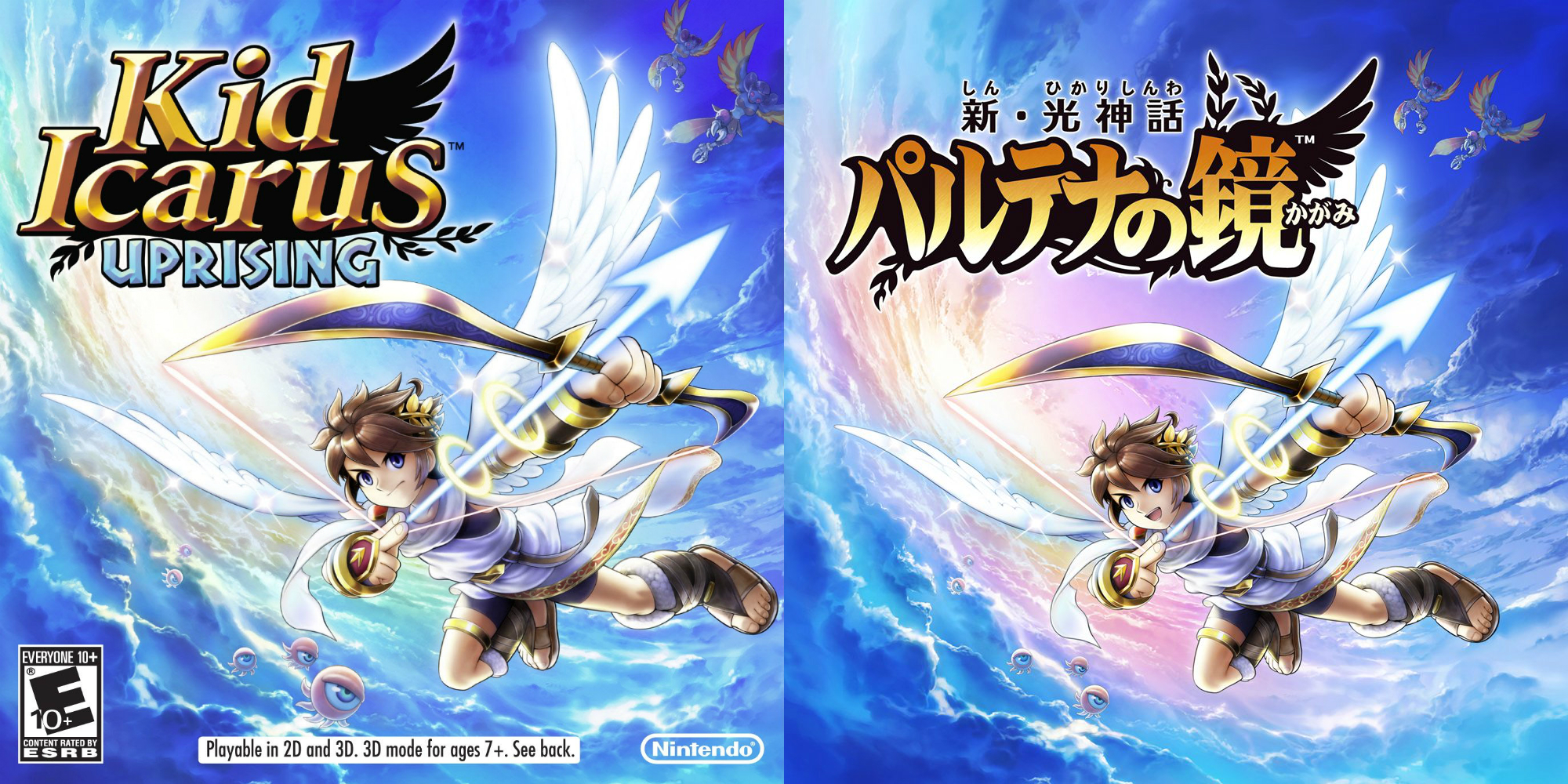
I also think it’s a bit odd that when it comes to localizing games Nintendo always cuts promiscuous sections or adds clothes to nearly bare characters, but the adult language is still fully intact. Especially when the box art that North America gets an angry or aggressive looking character while then Japanese cover has a cute and cuddly mascot, but I digress…
Why did they decide to change Pit’s facial expression?
They have published a handful of ‘M’ rated games such as Geist, Eternal Darkness, Perfect Dark, and Ninja Gaiden 3, but I think it’s time for them to develop one in house. I honestly just want to see what they can come up with. Most Nintendo games don’t focus on the story, but I would love to see a story based Nintendo game with mature settings and hard-hitting themes. They could easily have a filter available in the settings they can nerf it to a ‘T’ rating. Here’s hoping the Switch will give us something like this that Nintendo hasn’t experimented with before.
You know you’re messed up when you gotta use a third party controller. :(
We love Sakurai, the director of Smash Bros. There’s no question about that. But we do have some real concerns about him that range from the health of his body to the way he manages his employees. It might actually be the case that developing Smash Bros. games isn’t the best thing for him, or for his company! We are going to examine the issue from each angle and do our best to come to an objective conclusion: Should Sakurai quit?
Shot by Alex Campbell
“Escape the Premises” Kevin MacLeod (incompetech.com) Licensed under Creative Commons: By Attribution 3.0 http://creativecommons.org/licenses/by/3.0/
In less than a week, Nintendo will be blowing the lid off the Nintendo Switch secrecy container and giving us a complete look at their upcoming console. Nintendo fans are getting an early-E3 gift this year because Nintendo isn’t waiting until the industry’s standard slot for big reveals – they’re launching the console before the summer!
We’re going to see the Switch’s launch games, release date, pricing, and hidden features in just a matter of days.
Like any good Nintendo fan, I’m crossing my fingers for the Big N and hoping that they smash this Presentation out of the park. They’ll be taking the stage and streaming live from Japan (that’s why the broadcast is coming to us at such an odd, late time of night on a Thursday) – and they’re a bit out of practice on the live show front.
I’m relieved to hear that they’re stepping up to the plate and introducing some showmanship to their full Switch unveiling, but I’m equally nervous. Nintendo’s president, Kimishima, has had next to no contact with Nintendo fans since he stepped into the late Iwata’s office. Reggie and Aonuma have been appearing mostly in recorded formats, where multiple takes are allowed to get messaging across right… but not so on a live broadcast. On Reggie’s live appearance with Jimmy Fallon, you could feel a lot of that nervousness in his presentation and hear the stuttering that comes with a lack of practice.
I hope everyone is rehearsing right now – that should be priority #1.
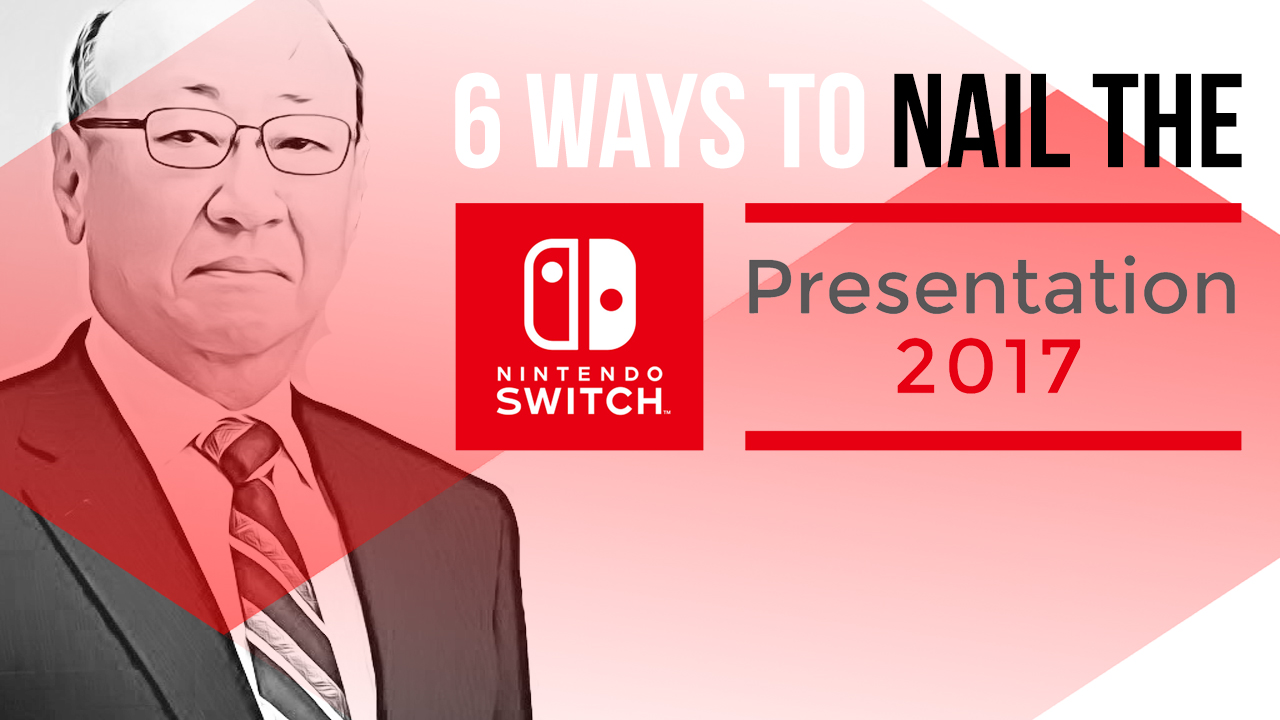
Misgivings aside, what will be the most important part of the presentation is the information, and I’ve arranged a simple list of things Nintendo can do to knock this one out of the park. Their initial reveal trailer was well-crafted and received positively, so here’s what they can do to maintain that momentum and keep the positive buzz around their console-portable hybrid:
Virtual Console Done Right
The launch lineup needs to be strong in quality, but I’ve grown to expect only a handful of games. On a console which almost surely cannot be backwards-compatible via hardware, the VC service is going to need to step in and keep us busy on our shiny new Switches.
Library
The Virtual Console should be the Netflix of gaming.
Something has to be done about the historically abysmal Virtual Console library. The slow drip-feed of mediocre games with email notifications sent weekly just isn’t doing it – and surely Nintendo’s digital sales figures reflect that.
Open this thing up, Nintendo! I would encourage the company to look at a subscription model as opposed to piecemeal sales. The VC should be the Netflix of gaming, where we’re sending them $10 a month to have access to a growing catalog. I guarantee their profits would increase.
Purchase History
If they make me repurchase my digital games one more time, I’ll… well, I won’t. I’ve already boycotted the SNES games on 3DS and I’m sending the message that I won’t double dip for them.
You must reward your loyal customers, not punish them for being early adopters.
Emulation
The NES Classic Edition blows Wii U out of the water as far as emulation goes – the NERD team at Nintendo (Nintendo Europe Research & Development) nailed it, and I don’t think I’ll be able to go back to the dim and muddy appearance of Nintendo’s other methods. Let’s not go halfway with the Switch – go all out and make it a service worth paying for!
Muti-SKU Positioning
Do you forget sometimes, that Wii U was sold in Basic and Deluxe models at launch? This was a new move for Nintendo, but it certainly paid off. What may have seemed like a really high entry price at $350 instead seemed like a worthy upgrade over the Basic console. And what true Nintendo fan (who actually watches these presentations) wants to be “basic”? Sure, the white Wii U sold a handful of consoles but it was primarily there for positioning, and I can’t blame Nintendo for implementing that marketing tactic. In fact, I think it’s smart. It provides a logical choice for casual and hardcore fans alike – and consumers love having choices between product models.
I hope Nintendo continues this trend and offers Basic and Deluxe switch packages.
The basic one would have a console with less storage, Joy-Cons, and a tech-demo game (think Wii Sports/Nintendo Land) packed in, while the deluxe version would have larger storage, a Joy-Con grip, and Breath of the Wild packed in.
Zelda at Launch
Nothing has been more frustrating to me than the messaging around this game’s release. Nintendo announced this game in 2014 and has sent nothing but mixed signals since then, delaying the game, saying trust us this will be out in 2015 just after Star Fox (also delayed) and delaying it again. Fine – I actually believe that delays can actually benefit a game – but they STILL aren’t committing to March for us to see Zelda! Yet. It needs to be confirmed for Switch launch day and release on Wii U at the same time.
I don’t even need a whole lot of coverage on the game during this presentation – we’ve been seeing more and more of it for a few years now. It was the only thing at E3. We’re just ready for the game to be available to purchase! The ambiguous “2017” release date that they’ve been very careful to not expound on has got me worried. In order to nail this Switch Presentation, Nintendo needs to confirm that the development is not in fact as troubled as it seems. Imagine the negative buzz around yet another Breath of the Wild delay.
Leave Handholding to the Parents
Alright Nintendo – in the Switch reveal trailer you marketed this console to adults, so you won’t be restricting our online communication, RIGHT?
If they want this game to be popular with the crowd that it looks like they’re targeting, then let’s see it. Let’s see this console come unrestricted out of the box – voice chat, parties, etc. All the features that have been staples in competing products for the last decades.
If parents want to implement controls – great – let them. It is their job, not Nintendo’s.
Preorders The Day Following
Rather self-explanatory. No one is going to want to run out to their store at midnight on a Thursday evening with work the next day – but Friday, that’s a different story! We’re gonna be all hyped up on the Switch from the Presentation and Nintendo better be ready to receive our money! (Well, the retailers – but you know what I mean.)
Over-Produce
This is absolutely critical. Most of Nintendo’s missteps in the last few years have been production related.
Pokemon Go Plus
amiibo
NES Classic Edition
That bullet list right there represents literally millions of dollars left on the table (and/or scooped up by scalpers) due to under-production.
Nintendo’s been playing far too conservative with their production runs.
They have the capital, so they need to make more of these consoles. 2 million worldwide (the rumored figure) is not enough at launch – the Switch reveal trailer already has that many views! Sure, not everyone who watches the video will get one at launch but the same can be said in reverse for the people that will buy it who have not yet watched the trailer.
Up that number. Fill those shelves. Not being able to get a Switch on launch-day when you’re a die-hard Nintendo fan would be a huge red-flag, and that’s what has happened with the aforementioned hardware launches!
And those are my thoughts! I think my blog post came across in a negative tone, but I’m actually truly excited for this presentation. I think Nintendo will nail it, and I think they’ll surprise me to boot.
Of course, stay tuned at TBC for full coverage of the event. We’ll be making shows and live streaming this weekend!