We’ll take one internet browser please, and a side of… hmm… the DEATH OF FRIEND CODES!
Nintendo succeeded in winning our hearts with the Switch. It’s a fantastic console that’s just begging to be played. However, it is missing some no-brainer features, and we can only hope that their software team is working on implementing those. Things like Internet Browsers and, you know, the violent DEATH of friend codes! Simeon and Scott are here to discuss everything that should be coming to the console/portable hybrid in the near future!
“Escape the Premises” Kevin MacLeod (incompetech.com) Licensed under Creative Commons: By Attribution 3.0 http://creativecommons.org/licenses/by/3.0/
Good luck never thinking of Mexi-tots whenever you hear about the three legendary bird Pokemon.
Sneaky, tricksy Nintendo and their sneaky, tricksy localization Treehouse. We’ve identified a number of meanings that were hidden inside seemingly innocent names… names of Pokemon, names of Nintendo games, and more. Some of these you may have heard before, but we guarantee your mind will be blown at least once during the course of this video!
Shot by Alex Campbell
“Escape the Premises” Kevin MacLeod (incompetech.com) Licensed under Creative Commons: By Attribution 3.0 http://creativecommons.org/licenses/by/3.0/
This episode is TOTALLY different from our Best Villains episode – trust us!
#580 – Baddies – can’t live with ’em, can’t live without ’em. Today, we’re talking about the chiefs of all baddies, the Bosses. But we’ve already featured our favorite villains in a previous episode of TBC, so today we are focusing on the best battles themselves – the conflicts that were memorable for their setting, challenge, build-up, or conclusion. Enjoy!
Footage credit: PunkDemonNeo, Boss Fight Database, Hazey A, AquaChannelerChris
“Escape the Premises” Kevin MacLeod (incompetech.com)
Licensed under Creative Commons: By Attribution 3.0
http://creativecommons.org/licenses/by/3.0/
If you’re reading this, and you’re an indie developer, get in touch with us on the Contact page. <3
We love independent video game developers (affectionately referred to as “Nindies”). Why? Because they’re the underdogs – the small studios that are going toe-to-toe with giant corporate competitors. And oftentimes, they’re the ones that innovate and bring us the most interesting experiences, the ones that deserve further pondering and reflection after their completion. And so, going into a new console generation on the Nintendo Switch without stopping to examine the indie offerings would be a big mistake! These are the games to watch for in the coming months – don’t miss them!
Shot by Alex Campbell
“Escape the Premises” Kevin MacLeod (incompetech.com)
Licensed under Creative Commons: By Attribution 3.0
http://creativecommons.org/licenses/by/3.0/
We think Kass will be playing an instrumental part in finding the game’s shrines!
At the Game Awards, Nintendo’s Reggie Fils-Aimé took the stage and introduced a brand new look at the upcoming Legend of Zelda: Breath of the Wild for Wii U and Nintendo Switch. We couldn’t be more excited about this game, so getting the all-new trailer AND Let’s Play video from the Treehouse was a big treat. We’re here to pick apart the footage and bring you our favorite discoveries!
Shot by Alex Campbell
“Escape the Premises” Kevin MacLeod (incompetech.com) Licensed under Creative Commons: By Attribution 3.0 http://creativecommons.org/licenses/by/3.0/
Since Nintendo launched Switch in March, they’ve quickly built out the library with solid 1st party hits.
Select 3rd parties, and a swath of independent developers, have also been instrumental in filling out the gaps.
From Legend of Zelda: Breath of the Wild to Super Mario Odyssey, one can’t help but be impressed with how this hardware’s first year has been supported by stellar software.
For the first time in many years, consumers are actually starting to say “there are just too many good games. I wish they would delay some of these.”
Who can possibly manage to play Odyssey, Skyrim, and Xenoblade all back-to-back?
What’s more, how will Nintendo maintain this breakneck development pace?
Here’s the important factor to keep in mind: Switch has a team of software designers about twice the size that Wii U had. Where did all these extra developers come from?
Well, Nintendo merged the 3DS and Wii U departments together shortly after R&D on Switch began, bringing home and portable development under one roof.
3DS is seeing it’s last days as more and more resources are allocated to developing new experiences on Nintendo’s hybrid console. And they’re selling like crazy.
I expect the manic pace to continue for the foreseeable future. It won’t be a gigantic new title like Super Mario Odyssey dropping each month, but I could see twelve releases spread over a year like so:
1 party game (people must be getting tired of 1-2-Switch, right?)
1 crazy announcement no one could ever predict
And that’s twelve games right there. As you can see, it’s totally doable for the Big N to publish something every 4-5 weeks.
The only question remains: can our wallets and schedules keep up with the runaway hype-train?
Thanks again to GameOver Jesse for being our show’s BFF!
Legend of Zelda: Breath of the Wild is the largest game that Nintendo has ever created for us. With it will come hundreds upon hundreds of different variables that will make everyone’s experience with the game different from the next person’s! We’re here today with good friend of the show, GameOver Jesse, to discuss how we intend to play through Nintendo’s newest Open Air Adventure. What will our first destination be? Are we going to abuse amiibo? All that and much more in today’s episode.
It’s nothing personal, Wii U… it’s not you, it’s us.
As we discussed yesterday, with a brand new console coming (expensive in itself), it’s also accompanied by many accessories and other opportunities to spend your hard-earned cash. Well, that money needs to come from somewhere, so what about selling your older games and consoles… say… your Wii U? Will you really be playing it anymore? Does it really have THAT many truly exclusive games? We’ve collected the definitive lists of pros and cons – watch, then make up your mind and proceed with confidence! Shot by Alex Campbell “Escape the Premises” Kevin MacLeod (incompetech.com)
Licensed under Creative Commons: By Attribution 3.0
http://creativecommons.org/licenses/by/3.0/
The Switch is not as expensive as most outlets are making it out to be. Far too many sites are claiming that the Switch has a ton of hidden fees and will end up costing you over $700 which is totally ludicrous and completely untrue.
The Switch is $299.99 (in the US). Period.
Just because the system is launching with a ton of add-ons and accessories does not mean the price of the system is increased. All of the extras are completely optional. Do you want a Pro Controller? Cool! Buy one! Don’t need an extra dock? Okay, don’t get it. It’s not a tacked on price that’s required by Nintendo that you purchase every available accessory at launch. Not to mention you can play 2-player games right out of the box at no additional cost thanks to the versatility of the Joy-Con.
An argument could be made that the system is actually $359.98, because what is the system without any games? That’s an expected cost though, not a hidden cost. I’m sick of gaming journalists trying to get clicks to their content by making up shocking headlines or articles. While all of this info may be painfully obvious to some, I wanted to educate the few that may not know to help save your wallets.
The cost of all your Switch launch day goodies can add up extremely fast, so make sure you need certain accessories before pulling the trigger and getting a bunch of things you’ll never need.
This has been your dose of financial advice from someone who has no business telling you how to manage your finances.
That is the question. The question we are all asking as a new wave of indie titles hits the Nintendo Switch each and every week.
It’s nearly impossible not to fall behind.
To illustrate this point, consider the following group of games: Shovel Knight, TumbleSeed, Thumper, Sonic Mania, SteamWorld Dig 2, Golf Story, and Stardew Valley.
Did you purchase and play all of those?
This is just a quick list of games filed under “DON’T MISS” off the top of my head. Chances are, you’ve let a handful of these slip through the cracks. (If you actually played all of those, I want to shake your hand.)
Each week is a new opportunity to either A) catch up on amazing games in the backlog, or B) play the newest latest game that was released.
Option A feels good because you get to experience that title that’s been sitting on your wish list, enjoy it, and cross it off.
It creates a problem, though, when it causes your backlog to grow. Thanks to the deluge of new releases, truly “catching up” isn’t really an option.
Option B is exciting. You get to buy a brand new game and join in the conversations while it’s still hot. All the Nintendo podcasts and groups are discussing it.
The downside is, it prevents you from getting back to some of those earlier eShop games that received 8s or 9s out of 10.
No matter what we choose, we’re missing out.
How do you pick between shoring up your collection and trying out the latest greatest?
You have better chances of enjoying your purchases, and not regretting them, if you go with the backlog. Hindsight is 20/20, and a few months after a game launches, you know from the way a title is talked about (and IF it’s even remembered) if it’s worth it or not. You probably build a wish list and whittle it down as your perception of each game’s value evolves with time. What’s left is a series of sure-fire hits that you’re bound to enjoy.
Delve into games like that.
The cutting edge is risky, but rewarding. You can get in on a game’s fandom on ground 0 and be a part of a community’s formation. Other times, the game just isn’t what you thought it was and you’re out $10 or $20.
When you have a really good feeling about an indie title, and you can just sense that you will love it, buy it on launch day. Don’t let it pass you by. During those times, the backlog can wait.
For the low low price of $250, YOU TOO can wait in line at E3 2017!
Two big pieces of news recently exploded on to the scene for Nintendo fans! E3 is being opened to the public?! Zelda Breath of the Wild is getting a season pass for DLC? What world are we living in, anyway? We’re here with our impressions on the news. Is E3 worth paying $250 to attend? Did Nintendo mess up with their announcement of the Zelda DLC by debuting it too early? All these thoughts, and more, inside the video!
Shot by Alex Campbell
“Escape the Premises” Kevin MacLeod (incompetech.com) Licensed under Creative Commons: By Attribution 3.0 http://creativecommons.org/licenses/by/3.0/
Wait until you get to the part of the review where Simeon talks about the phase… glitch… gun… zapper-thingy.
Simeon has the full scoop on the Metroid-like Indie game called Axiom Verge. It’s available for Wii U and it just may be worth your time – watch to get his complete impressions!
Shot by Alex Campbell
“Escape the Premises” Kevin MacLeod (incompetech.com) Licensed under Creative Commons: By Attribution 3.0 http://creativecommons.org/licenses/by/3.0/
Ah, pixel art…Nothing says “video games” quite like a 32×32 pixel sprite. Retro sprites are a fascinating art form: unlike many other mediums, the conventions of pixel art were born of technical limitations, not creative freedom. While the nuances of the medium are often lost on modern developers, who see the limitations as an excuse to churn out overly simplistic animations, classic games would often feature impressively detailed animation frames. To this day, even single frames of these animations are downright iconic and instantly recognizable to fans around the world, something that few other animated works can boast!
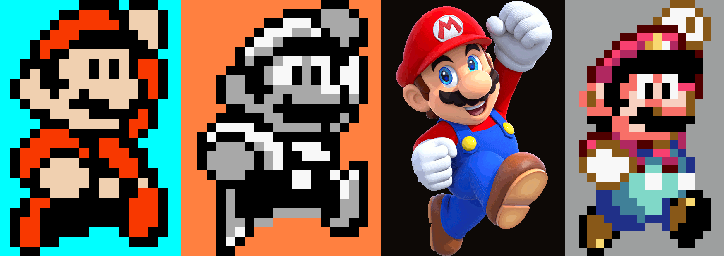
Pop quiz! Which of the following are 8-bit images?
Please excuse the fact that these aren’t in chronological order.
Believe it or not, only the second one from the right is 8-bit. “B-but, but the NES and the Gameboy were both 8-bit systems!” you say. Yes, well, maybe it’s time we actually examine what exactly “8-bit” means.
In Computer Imagery
Let’s start with what bits mean for pictures. There are two basic ways of composing pictures: color channels and indexing. In a picture that uses color channels, each color is represented by a mixture of primary colors with each primary color composing one of the image’s color channels. These colors are red, green, blue, and sometimes an additional “alpha” channel that represents opacity (i.e. how much you can’t see through it). Every pixel in the image is a combination of these channels.
The number of bits dedicated to each pixel is known as the image’s color depth. As you may know, bits are binary digits, hence the name (binary digit). Because of this, every sequence of bits can represent 2n values (where n is the number of bits used). That means an image with a color depth of three—which is to say one bit per channel—can have two shades of red (fully black and fully red), two shades of green, and two shades of blue, which combine for a total of eight (23) colors. In today’s day and age, most images either have a color depth of 24 for plain R.G.B. or 32 for R.G.B.A., dedicating eight bits (one byte) to each color channel. That means R.G.B. images these days can contain up to 16,777,216 colors. Any more than a byte per color channel results in diminishing returns.
The number of bits dedicated to each pixel is known as the image’s color depth.
As you can imagine, three bytes per pixel adds up quickly on a console that only has 2 kilobytes of video R.A.M. While it’s easy to forget in this age where most computers typically have four to sixteen gigabytes of R.A.M. and terabytes of storage, space—both memory and long-term storage—was a valuable commodity back in the 80’s and 90’s. That’s where color indexing comes into play. Instead of storing color values per pixel, indexed images have a set of color values stored in a lookup table (i.e. the palette) with each pixel being represented by a single number that refers back to a position in the lookup table. For instance, if the color in position 5 of the table is red, then every pixel with the value 5 will be displayed as red. While this would limit the number of colors in an 8-bit image to 256, that’s 256 out of any of the thousands or millions of 16-bit or 24-bit colors available.
So, knowing this, where does this leave the NES’s graphics? An NES sprite consists of four colors, three visible and one transparent. That makes NES sprites 2-bit sprites. Don’t look at me like that, it’s the truth!
Now I’m sure some of you are thinking, “well, just because the sprites are only 2-bit doesn’t mean NES graphics aren’t 8-bit. The NES could produce way more than four colors at a time!” Okay, while we’re stretching terms a bit (or more accurately, crumpling them up and chucking them into the fireplace), I’ll be generous. The NES used the YpbPr palette, which consisted of 64 colors. So if we were to hypothetically classify the NES’s graphics in regards to the total number of colors available, that would mean the NES has 6-bit graphics. To add insult to injury, only 54 of the colors are useful, as many of them are identical shades of black. That said, the NES did include an additional three tinting bits (one for each primary color). While this increases the theoretical number of colors to 432, the tint is applied globally, meaning all sprites and tiles on screen were tinted at the same time. So, in actuality, it really just had 8 sets of 54 colors. What are we at now, 9-bits?
All 64 colors the NES could produce prior to tinting.
What Does 8-Bit Really Mean Then?
So why is it we call sprites from the NES “8-bit” when they’re actually 2/6/9-bit? Simple, they were from games released on an 8-bit console. Of course, that begs the question: “what’s it mean when we say a console is 8-bit?” The number of bits ascribed to a console refers to its central processing unit. The NES used a Ricoh 2A03 processor (or its counterpart the 2A07, used in P.A.L. consoles), which is an 8-bit processor.
The CPU of the Nintendo Entertainment System.
So what’s makes an 8-bit processor an 8-bit processor? When someone says a processor is “X-bits”, they are referring to the processor’s word size. In computer science, the term word refers to the standard computational unit of a machine. That means an 8-bit processor has a word that’s eight bits long, which in turn means that the C.P.U. processes eight bits in one operation.
My System Has More Bits Than Yours!
Just how important is a system’s word size? These days, manufacturers don’t even mention their consoles’ word size, but back in the 80’s and 90’s, it was a major part of a platform’s marketing. The logic was if a system had a 16-bit C.P.U., it could process twice as much data as a console that only had an 8-bit C.P.U., right? Unfortunately, the reality isn’t that simple.
While technically a 16-bit C.P.U. processes twice as much data bit-wise as an 8-bit C.P.U. per calculation, we need to keep in mind what that data is actually representing. Consider the following binary numbers:
00011001
00000000 00011001
Both the 8-bit value and the 16-bit value equal 25, with each representing the contents of one word for an 8-bit and a 16-bit system, respectively. Notice how they appear identical save for the number of leading zeros? Words can be thought of like boxes: if the number placed inside is smaller than the box, then the excess space is filled with packing peanuts… or, zeros. This way, the processor doesn’t have to worry about how long the number’s binary representation is and instead just performs whatever calculations are needed on the entire word. All of that is to say that unless the calculation in question requires numbers that exceed the maximum value that can be represented with the number of bits in the system’s C.P.U., there isn’t actually any speed boost.
That said, when the largest number you can handle at one time is 255, those extra-bits really do make a difference, so maybe the 8-bit and 16-bit divide isn’t the best example.
In the end, the reason we call sprites from NES games “8-bit” isn’t because the graphics themselves are 8-bit, but because of a sort of linguistic cross-contamination. The systems of the 80’s and 90’s were advertised by exploiting consumer ignorance to turn technical terms into marketing buzzwords, resulting in the systems having much of their identity tied to these terms. Because of that, anything associated with the consoles from that era is going to be collectively referred to by the one unifying descriptor available: 8, 16, 32, or even 64-bit. In the end, it’s ultimately harmless; these terms have an understood meaning and are thus perfectly descriptive in the context in which they’re used. Really, the only real confusion this causes is that I’m somehow okay with it; normally I’m the type go on a long rant whenever anyone says “Ethernet cable” when they really mean “Cat-5”.
While Ryan Van Liere was in town for the launch of Nintendo Switch, Simeon and Scott decided to take him out for a night of fun at the local arcade. We played a lot of arcade games, Nintendo and others, and sunk a lot of quarters into the slots. Our skills, you ask? You’ll have to watch and see for yourself.
Shot by Alex Campbell
“Escape the Premises” Kevin MacLeod (incompetech.com) Licensed under Creative Commons: By Attribution 3.0 http://creativecommons.org/licenses/by/3.0/
Can you imagine what we’d do if we just beat the game while making this episode… accidentally?!
Can we make it into Ganon’s castle, with only early-game items and armor?! Ryan, Simeon, and Scott take turns with the pair of Joy-Con to see what they can do against the Malice and Guardians. Spoiler disclaimer: We approach the endgame, but do NOT meet the final boss.
Shot by Alex Campbell
“Escape the Premises” Kevin MacLeod (incompetech.com) Licensed under Creative Commons: By Attribution 3.0 http://creativecommons.org/licenses/by/3.0/
Needless to say, the weekend the Nintendo Switch debuted, I didn’t get much done. After the setup of the surprisingly small console, I immediately started playing Breath of the Wild. In my opinion, the introduction is the best in the series. I was instantly hooked and ended up playing until around 2 A.M. I have an embarrassing number of hours logged into the game already, and I only have about 1/3 of the map uncovered, and only one dungeon complete. Though I have a ways to go, I can already tell this game is special. A game like this doesn’t come around often, so I plan to cherish it. I could go on and on about my feelings so far for Breath of the Wild, but alas, this is about the Switch.
Looking out into the horizon for the first time is a magical experience
The next day wasn’t very different, with the exception that friends were planning on coming over to try out the system. Of course, I played Zelda all day leading up to that. When people started arriving, it was time to try 1-2-Switch. Let me say that this is probably the most fun I’ve had with a multiplayer game in a long time. The concept is a little strange at first, especially since it encourages you to look your opponent in the eyes (something us introverts can struggle with). This creates a somewhat awkward (yet hilarious) interaction. As we went through the games we realized we were not only having fun with the game, but having fun with one another. It’s clear this is what Nintendo was going for, and once you ease in and feel more comfortable with how the games work, it’s truly a blast.
This game is not only fun, but a great showcase of the Switch technology
After 1-2-Switch, we transitioned over to Snipperclips. Another multiplayer game where two players work cooperatively to solve different puzzles and accomplish different tasks. It’s a lot of fun. I also downloaded Shovel Knight: Treasure Trove, and haven’t even gotten to it because I’ve been so enveloped in the other games.
This console has some magic that the Wii U just didn’t have. I truly believe this is what Nintendo needed in terms of their position in the industry. That is, to not worry about competition, but rely on the best development in the industry and innovation. I’m also looking forward to Mario Kart 8 Deluxe and Splatoon 2 releasing in the coming months. Yes, I may be caught up in the whirlwind of hype and still in the “honeymoon phase” with Zelda, but my hope is fulfilled back in Nintendo. Now excuse me, I need to go play Zelda; it hurts to not be playing it.
With Nintendo fully revealing the Nintendo Switch TONIGHT, we couldn’t be more hyped! This is officially our last chance to make predictions pertaining to the launch of the console, its hidden features, and what we might see accompany the hardware at launch! Pass the time waiting for the Presentation by watching this episode and dropping your OWN predictions in the comments section! Related blog: 6 Ways Nintendo Can Nail the Switch Presentation https://twobuttoncrew.com/2017/01/08/6-ways-nintendo-can-nail-the-switch-presentation/
Shot by Alex Campbell
“Escape the Premises” Kevin MacLeod (incompetech.com)
Licensed under Creative Commons: By Attribution 3.0
http://creativecommons.org/licenses/by/3.0/
Sometimes, Nintendo gives us something good disguised as something we don’t want.
The newest entry in the Metroid Prime series has just been released, and the Nintendo fanbase has been in an outcry over it. Is this game worth a shot? Is it worth your time? Watch for all the details on Scott’s experience with the game.
Shot by Alex Campbell
“Reformat” Kevin MacLeod (incompetech.com) Licensed under Creative Commons: By Attribution 3.0 http://creativecommons.org/licenses/by/3.0/