#538 – In today’s unique episode, we’re pretending that we hold the power to decide a video game’s fate. Should it be franchised, and have multiple sequels moving forward? Should it be remasteres once and left at that? Or should it simply be left to die? We have to assign one fate to each group of three games… what would you choose? Let us know in the comments. “Escape the Premises” Kevin MacLeod (incompetech.com)
Licensed under Creative Commons: By Attribution 3.0
http://creativecommons.org/licenses/by/3.0/
#537 – Video games… kind of an expensive hobby, no? Ever wondered if gaming used to cost more back in the day, or if the prices have only gone up? When you take inflation of the US dollar into account, the information is quite interesting!
“Escape the Premises” Kevin MacLeod (incompetech.com)
Licensed under Creative Commons: By Attribution 3.0
http://creativecommons.org/licenses/by/3.0/
#536 – If you own a Nintendo Switch and you haven’t downloaded Thumper, YOU’RE DOING IT WRONG! This rhythm game on the eShop is worth all 2,000 pennies you’ll drop on this gem. You’ll be intrigued, you’ll be awed, you’ll be stunned, you’ll be challenged… do it. Go forth and Thump.
Footage Credit – SwitchForce “Escape the Premises” Kevin MacLeod (incompetech.com)
Licensed under Creative Commons: By Attribution 3.0
http://creativecommons.org/licenses/by/3.0/
For real though, is Scott just being a pansy? (GET IT!?)
#535 – TumbleSeed is a cute, adorable, STINKING DIFFICULT indie game on the Nintendo Switch. Your only task is to roll a seed to the top of the mountain, but the game does everything in its power to stop you. Games like this straddle a fine line between fun and frustrating… where does TumbleSeed land?
Footage Credit – Polygon, SwitchForce “Escape the Premises” Kevin MacLeod (incompetech.com)
Licensed under Creative Commons: By Attribution 3.0
http://creativecommons.org/licenses/by/3.0/
#534 – ARMS is all the rage! Are you guys playing ARMS? Are you ARMed? We are so AMPed on ARMS! This is the first of many clashes between Simeon and Scott… who are you betting on?
“Escape the Premises” Kevin MacLeod (incompetech.com)
Licensed under Creative Commons: By Attribution 3.0
http://creativecommons.org/licenses/by/3.0/
Star Fox Zero was kind of a disaster. Miyamoto was tasked with leading the development of a game that would prove the Wii U GamePad’s worth—a controller that featured dual analog sticks, NFC, all the face and shoulder buttons you could ask for, and… oh yeah, a second screen.
The master chef was given an armful of ingredients and told that he had to use them all, and what we got was not very tasty. The result: Complicated controls. Star Fox games used to be played with a single analog stick that controlled the vehicle’s movements (in all directions) as well as the aiming at the same time. In fact, the SNES accomplished this with only a D-Pad before the 64 version! The Wii U sequel(?) suffered from too many input methods when controls were spread out across both analog sticks and the gyroscope motion controller. It was simply too many leaps at once. The game was built around its “unique” control scheme and the types of puzzles that accompanied. Some interesting new ideas were birthed, and yes, players could overcome the learning curve and pilot effectively using the GamePad… even enjoy themselves… but for everyone who mastered the game, three other players were turned away by its obtuseness. Rehashing of story & scenarios. The developers under Miyamoto (with help from Platinum Games) put so much effort into the mechanics of this new Star Fox entry, that they neglected the storytelling and presentation aspect, opting yet again to return to the tired tale of Fox moping about his Dad, Peppy insensitively bringing him up, and killing Andross. The title “Zero” was meant to convey that this was not a true prequel or sequel, but a reimagining of the original.
The developers put so much effort into the mechanics of Star Fox Zero, that they neglected the storytelling and presentation aspect.
And at the end of the day, the gaming industry talked about Star Fox Zero for a few weeks. It got some good reviews from those who put up with its controls, got some bad reviews by the people who did not get it, and then people moved on. It had “zero” staying power, so to speak. Nintendo fans had been asking for more Star Fox, but we didn’t like the game that we got.
A deeper problem becomes clear: Sometimes, Nintendo will not make a game until they have a concept that uses their controllers in an “interesting” way. Don’t believe me? This is exactly what is happening with games like F-Zero right now. An unfortunate quote from the mouth of Miyamoto: “If we create a new type of controller interface, and we find a controller interface that’s particularly suited for F-Zero, then maybe we’ll do something with it in the future.”
This is a problem.
Mechanics-first development lends itself to some glaring issues…
Gimmicky games. There is only so much you can change about how video games are controlled over the span of a few decades. Sure, there is more than one way to skin a cat, but there are not unlimited ways. Analog sticks and buttons have become a mainstay in gaming for a reason: they’re good. Standard controllers have reliable, fast, easy methods of input that do not require huge learning curves. Sticking with the status quo allows players to forget that there is a controller in their hands and become immersed in the game itself. That immersion could manifest in a sense of awe at the world around their character, or even within the game’s story (if the game has a decent story worth paying attention to, that is). Abandoned franchises. Keeping a control scheme is no reason not to create a sequel. It is absurd.
Nintendo has one of the most valuable stables of intellectual properties and franchises on the planet, yet they historically do not give proper franchise care across the board. Games like the aforementioned F-Zero have not seen a sequel in a decade, and games like Metroid were experimented on so hard that the resulting explosion left the series locked away (until this year’s miraculous E3).
I appreciate Nintendo as innovators. Their foray into the early days of motion-control on Wii paid off with interesting new physical mechanics, and mixing up the Mario formula in Galaxy 1 & 2 resulted in some mind-bending gameplay mechanics.
My advice to Nintendo would be: “Hey—when you have a creative new take, act on it. When you don’t, that’s okay too! Still make games!” Denying sequels without new mechanics is a double standard. Nintendo does not always adhere to this mechanics-first mantra… they will quickly break it, in fact, if a franchise is printing enough money. New Super Mario Bros. and its rapid accompaniment of successors, much? Fire Emblem and its similarly-played versions, anyone? The Big N did not hold those games back for innovative sentiment.
And I am glad they didn’t, because as Nintendo fans… sometimes we just need MORE of the SAME! Like Advance Wars. Like Pikmin (of the “not hey” variety). The only reasonable conditions that I can see for creating a traditional follow-up are:
Include improvements over the last game.
Improve the PRESENTATION! (storyline, art style, you know… the things Nintendo usually recycles).
I will address one last thing here: If Nintendo gave us “more of the same,” we wouldn’t have Breath of the Wild. Good point! This is different: Prior to the revolution of open-world Zelda, the series’ formula was perfected.
Nintendo, Make sequels with the same mechanics until the formula is perfected, THEN innovate!
You will know when the formula is perfected because fans will stop asking for more and they will ask for a change.
Best way to win a debate: Pick a side and give your opponent the other one to argue for.
It’s amazing how many heavy-hitters the Nintendo Switch is getting in its first year. Some of Nintendo’s biggest franchises are being represented with all new entries featuring innovation and a high level of polish. That said, which game deserves the #1 sales spot when all is said and done? Will Breath of the Wild maintain its momentum from launch and stay king of the hill, or will Super Mario Odyssey become a runaway hit this holiday and dethrone the competition? We want your thoughts – vote in the poll by clicking the “i” icon!
“Escape the Premises” Kevin MacLeod (incompetech.com) Licensed under Creative Commons: By Attribution 3.0 http://creativecommons.org/licenses/by/3.0/
#533 – Super Mario Odyssey had a strong showing at this year’s E3, not to be outdone by Metroid! Mario and Cappy explored some wildly different scenery, in search of different currencies and different rewards than Stars, and… well, all around this game is very different! Oh, and don’t forget the T-Rex!
“Escape the Premises” Kevin MacLeod (incompetech.com) Licensed under Creative Commons: By Attribution 3.0 http://creativecommons.org/licenses/by/3.0/
#532 – The Nintendo Switch is picking up a little bit of steam with 3rd party developers, as they’ve had a short amount of time to react to the console’s wild success. At E3 2017, we saw the likes of Ubisoft, SEGA, Bethesda, and other developers bringing their most popular franchises to the Switch, and Nintendo was more than happy to showcase them during their Spotlight presentation. So, what did Simeon and Scott think about these titles? Watch and learn!
“Escape the Premises” Kevin MacLeod (incompetech.com) Licensed under Creative Commons: By Attribution 3.0 http://creativecommons.org/licenses/by/3.0/
#531 – Metroid fans are happy this year. Why? Because after years of neglect (and the abuse known as “Federation Force”), Samus is back in a big way! Sure, we may be a ways out from Prime 4’s actual release, but we have a real hope that can sustain us for a while. Not to mention, a brand new (old) 2D game hitting 3DS this September! Dreams came true this E3.
“Escape the Premises” Kevin MacLeod (incompetech.com) Licensed under Creative Commons: By Attribution 3.0 http://creativecommons.org/licenses/by/3.0/
#530 – Nintendo just had one of their best E3s ever, and it’s not even over yet. In the span of 25 minutes, they managed to blow the socks off most of their hardcore fans. They really pulled out some big guns this year! Simeon and Scott are here with their fresh impressions of Nintendo’s newest announcements, discussing their failed predictions, and talking over what excited and surprised them the most. Join in the E3 hype in the comments!
“Escape the Premises” Kevin MacLeod (incompetech.com) Licensed under Creative Commons: By Attribution 3.0 http://creativecommons.org/licenses/by/3.0/
#529 – This has been a long time coming. Scott has been noticing some very questionable behavior in Simeon, and there was nothing else to do but sit down and talk it out. Scott decided that it would be best to capture the confrontation on film, so that if worse came to worse, he’d have video proof. What ended up happening, he could never have expected. Watch what came of the intervention.
“Awkward Meeting” Kevin MacLeod (incompetech.com) Licensed under Creative Commons: By Attribution 3.0 http://creativecommons.org/licenses/by/3.0/
Though it’s E3 weekend, and so much is happening, I would like to turn focus to just one of Nintendo’s events: The ARMS Open Invitational. The Big N is getting into the spirit of the season by throwing a tournament for their upcoming title ARMS. Summer fighting game tournaments are nothing new, and since we’re about a month away from EVO 2017 (the biggest, grandest fighting game tournament of the year), I found it appropriate to celebrate all of the riot time festivities by inducting some of the best Pantendo (appearing on Nintendo consoles, including first, second, and third party) fighting games into the Nintendo Experience.
We’ll kick off with an old classic: Soul Calibur II for GameCube. Soul Calibur is a series of 3D fighting games that center around weapons-based combat as opposed to hand-to-hand. If you are familiar with the franchise, you know that they’re usually multi-platform and each platform has its own exclusive character(s). For the second offering, the Playstation 2 version contained Heihachi from the Tekken series, and the Xbox version had the Spawn comic book character. Fortunately, Nintendo fans got the best deal, and Link from the Legend of Zelda series was playable. For that appearance alone this game is worth playing.
The game was a solid fighter and was an arcade classic; perfect for both friendly and serious play. With the exception of Soul Calibur Legends for Wii (of which I had not heard until researching this blog, and is not even a fighting game), this was the only one of the series that made it to a Nintendo console. I suggest you hunt down this old gem and give it a shot.
Next up is a game that should not be foreign to anyone reading this blog: Super Smash Bros. Melee. Whether you prefer this specific version or not (it is not my personal favorite), you cannot deny its impact on Nintendo and Fighting Game Community (FGC) culture.
Official box art
Melee was released in 2001, and has remained relevant since, having what is possibly the longest, most-permeating tournament longevity of any fighting game ever. People continue to play competitively to this day, and it has found its way into the EVO tournament lineup six times (counting this year’s upcoming tournament) and has churned out record-breaking turnouts. Melee is the fighting powerhouse you cannot ignore.
Lastly, I would like to discuss a pushed-aside Wii gem known as Tatsunoko Vs. Capcom: Ultimate All-Stars.
The saga of TvC is an interesting, but sad tale. The original version of the game, Tatsunoko Vs. Capcom: Cross Generation of Heroes, saw some of Capcom’s best-known brawlers facing off against characters from popular Japanese anime studio Tatsunoko (probably best-known in the states for Karas and Samurai Pizza Cats). Since many of Tatsunoko’s characters were unfamiliar to the rest of the world, the game was only released in Japan and the Wii featured region lock, the rest of the world was missing out on a fighting game produced by the community’s best developer. The outcry was so great that Capcom not only decided to relent and release world-wide a year later, but to polish the game up and add new characters. Fighters who owned a Wii were overjoyed, but therein lie the crux. Many people who were serious about fighting games (especially Capcom fighters) had already found satisfaction in one of the other consoles (PS3 or Xbox 360) with Street Fighter IV, and with the announcement of Marvel Vs. Capcom 3 (for which TvC seemed a test run) for those consoles, there was little incentive to invest in this game. It soon faded into obscurity after reaching the EVO stage once in 2010.
All of this is a shame, because the game is not only technically challenging, but also one of the most balanced fighters ever made. If you scour the internet for TvC tier lists, you will find a few opinions. Almost all of them will rank the giants (Gold Lightan and PTX-40A) as dead last, or at least bottom tier. They’re a huge target, slow, and you do not get a partner to help you out. But if you look at the top eight finishers in the EVO tournament, you will see three of them used giants in their run to the top. In fact, you will see a lot of variety, which is not common in a lot of fighting games. You usually see a few characters over and over again because those characters have a natural advantage over the rest of the cast. TvC was one balanced mamma-jamma, and I love returning to it whenever I can.
… Can I get a chant? (Sequel! Sequel! Sequel! Sequel…)
That is all for this special fighting game edition of the Nintendo Experience. Pick these classics up and go the distance.
How long do we have to keep being right in order for us to become paid industry analysts that make snarky remakrs for a living?
#528 – Each year, before the Electronic Entertainment Expo, Simeon and Scott take a stab at a swath of predictions! Nintendo will be streaming some bombshell announcements during their press conference / Nintendo Direct, and we’ve created a bingo board to keep track of our correct predictions! Can we score 5 in a row? Middle space is free!
“Escape the Premises” Kevin MacLeod (incompetech.com)
Licensed under Creative Commons: By Attribution 3.0
http://creativecommons.org/licenses/by/3.0/
#526 – Sometimes, the side mode ends up being the best offering of the whole game! When the main story mode just isn’t good enough when compared to the side mode, wonderful things happen! Here is a short list of our favorite bonus modes in all Pantendo games. Footage Credit: Mario VS Luigi – SullyPwnz | Super Smash Bros. – RedFalconGames
“Escape the Premises” Kevin MacLeod (incompetech.com)
Licensed under Creative Commons: By Attribution 3.0
http://creativecommons.org/licenses/by/3.0/
After you save some serious Benjamins by following this advice, you might just head over to our Patreon page. ;)
#524 – We know how it is! Video games are expensive and cash is tight. That’s why you can’t just buy games from here, there, and everywhere all willy nilly! You gotta go in with a plan, know where you can score the best deal, and save some dough. Don’t buy another game until you watch this full episode!
“Escape the Premises” Kevin MacLeod (incompetech.com)
Licensed under Creative Commons: By Attribution 3.0
http://creativecommons.org/licenses/by/3.0/
We are not responsible for any first kisses that happen as a result of this episode.
#524 – If you were given the power to change one thing about a Nintendo console, which one would you pick and what would you change? Simeon and Scott are faced with many similar tough choices today – watch to see what they would decide! Comment below what you would change. Footage Credit: Super Smash Bros. Wii U Tripping – Master0fHyrule | Metroid Prime 3 Corruption SD vs HD – thepixelpress
“Escape the Premises” Kevin MacLeod (incompetech.com)
Licensed under Creative Commons: By Attribution 3.0
http://creativecommons.org/licenses/by/3.0/
Howdy, crew! Welcome back to That Was a Thing, where I take a look at strange and obscure pantendo games and paraphernalia!
The Wii: when it’s key feature, motion control, was first revealed, the first two uses that went through everyone’s mind were sword and gun. Not missing a beat for once, game developers were quick to cater to the public’s sociopathic expectations. Many of the Wii’s early titles utilized the Wiimote’s pointer to aim projectile weapons and its motion detection to swing melee weapons, and the results were undeniably mixed. One such game was Ubisoft’s Red Steel.
The game was fairly standard fair: girlfriend kidnapped by yakuza, go to Japan and shoot them, yada, yada, yada. What separated it from other first-person shooters was its motion-controlled swordplay. At various points in the game, the hero would have to fight in one-on-one katana duels. Long story short, it just didn’t work. Unfortunately, the Wiimote’s I.R. sensor and accelerometer simply weren’t enough to emulate the one-to-one precision players expected.
Which is why Nintendo invented the Wii MotionPlus! And this is where Red Steel 2 comes in. When Ubisoft saw the gyroscope add-on, they knew they had everything they needed to set things right. I seem to recall a lot of hype surrounding this game before it came out; retailers even offered preorder bonuses. I first heard about the game from the now defunct Nintendo Power magazine, and was immediately intrigued. This game was dripping with style and—just as important—it didn’t have anything to do with the first game, so I could jump in without missing anything. However, I wouldn’t get around to playing it until I got an extended trial of the late Blockbuster Video’s online rental service, and decided it was time I a gave it a shot.
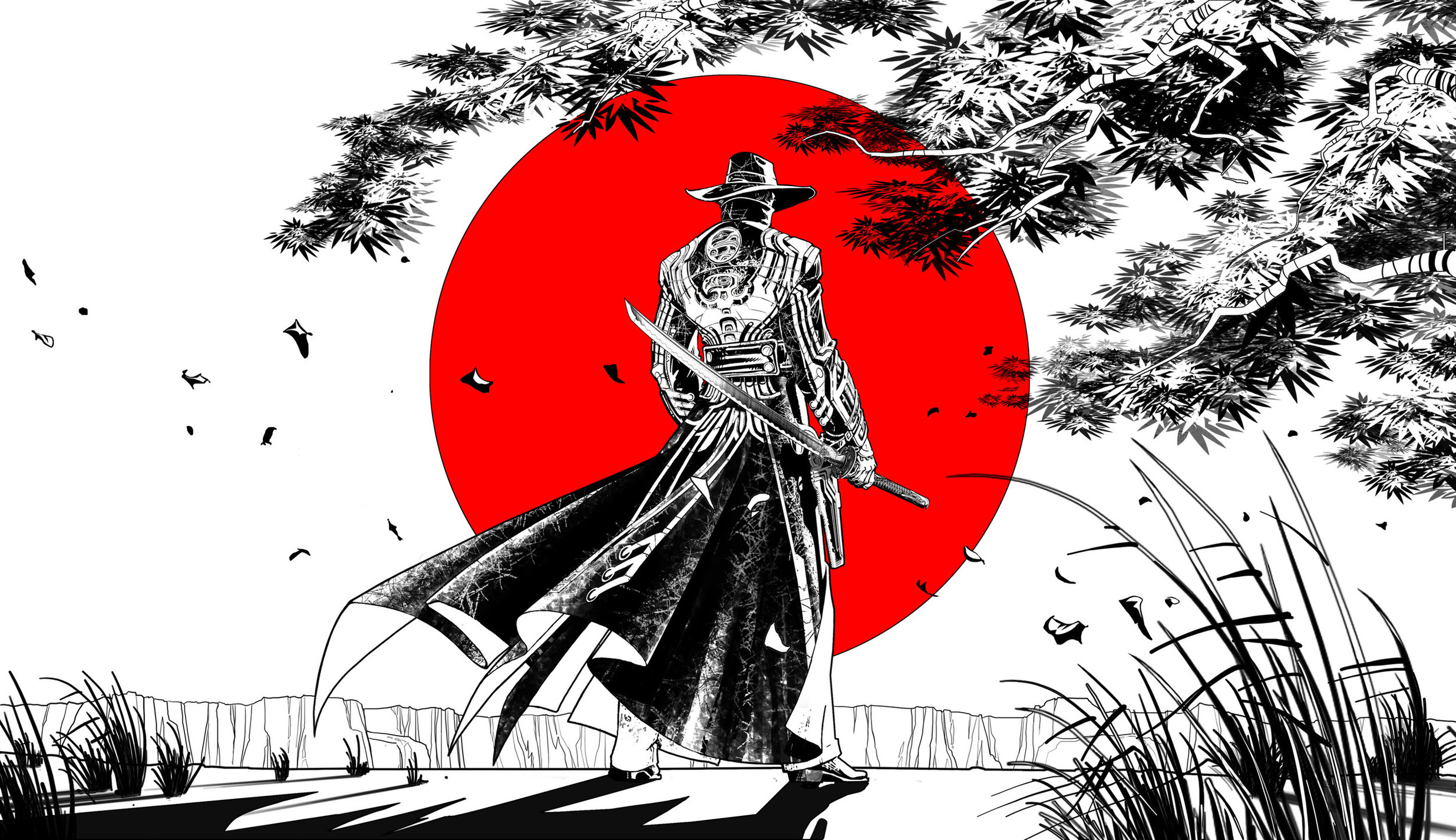
Nu-Western Post-Cyberpunk Japanimé
Let’s start at the beginning. The game opens with our hero waking up on the outskirts of town. As he slowly comes to, he notices his hands are tied. Tracing the rope, he quickly realizes he’s not just tied up, he’s tied to the back of one of his assailant’s motorcycles. Just woke up, and this day’s already turning out to be a drag.
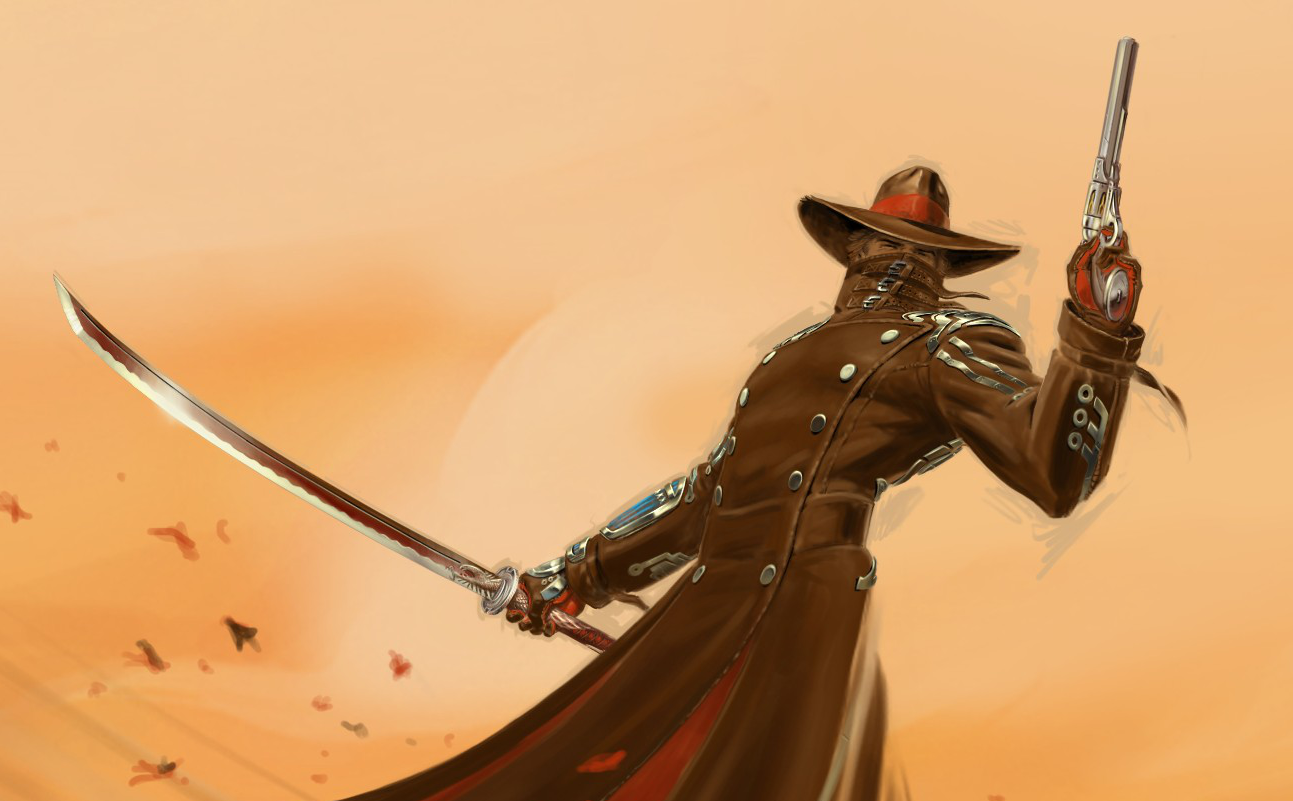
And this is how we’re introduced to the game: a gloriously over-the-top, first-person cutscene in which the hero is dragged into town, crashes the bike, and dusts himself off like he does this every day. While it admittedly takes a few minutes to get to gameplay, this intro nails the tone of the game and what players can expect right off the bat! You’re the toughest, badest son of a gun on the planet and you can bet your stetson every pinhead fool-enough to take a shot at you is going to make you prove it!
The intro nails the tone of the game and what players can expect right off the bat!
In fact, I’d say this game runs on distilled, unadulterated cool, and not in a “trying too hard” kind of way either. Even when parts of it seem hokey—or downright silly—the game presents its set-pieces with such confidence and commitment that the player really has no choice but to just go with it. While other games try to convince you they’re awesome, Red Steel 2 just leans in close, stares you right in the eye, and in a low, gravelly voice tells you it’s awesome.
On that note, let’s take a moment to talk about this game’s aesthetics. This game is a chocolate-and-peanutbutter-esque mashup of the wild west and samurai flicks, with the occasional dusting of cyberpunk. The game takes place some unspecified amount of time in the future in a dystopian Nevada. The environments you explore are a strange blend of old-west, feudal Japan, and run-down, futuristic towns. It’s not at all uncommon to see Cracker Barrel-esque country stores with tanukis on their signs right next to radio towers and hovering attack drones. Moreover, the plethora of destructible crates, trash bags, boxes, and barrels gives the environments a cluttered, grungy feel that reinforces the gritty tone of the game.
Just look at this guy! He’s Clint Eastwood mixed with Miyamoto Musashi left to marinade in anime overnight!
The game makes use of a heavily stylized visual design. While the Japanese influences on the plot and setting may lead some to call it anime-inspired at first glance, it really has more in common with comic books: bold lines, fairly realistic body proportions, and a deliberate visual roughness that complements the game’s visceral combat and tale of ambition and revenge. As to be expected with a western, the color palette includes a lot of earthy tones: browns, oranges, and sandy yellows. Fortunately, Red Steel 2 manages to avoid the pitfall of making all of its environments dingy brown, with several areas including—if not primarily consisting of—cool blues, grays, and greens. Clearly, the art team put a lot thought into making each area visually distinct from one another, as every stage either has a unique theme or makes use of color to distinguish itself. That said, all the themes are variations of cowboy, samurai, or industrial, so while each level is aesthetically distinct from one another, the constraints of the game’s themes do start to wear thin toward its conclusion.
Clearly, the art team put a lot thought into making each area visually distinct from one another.
While we’re on the topic of environments, one of my biggest complaints with the game’s visuals is that some of them don’t age very well. Between the murky textures and low-res models, a lot of the environments in this game don’t look very good close up. Fortunately, you’ll probably be too busy hacking-up dudes (who themselves look fine) or searching for loot to pay too much attention to such things.
Cutscenes are another weak point. To be fair, most cutscenes in this game are okay, but the ones that trigger when talking to one of the hero’s allies are just painful. These usually consist of a stationary camera shot with one lone character pacing back and forth while talking. And it is so boring. In the end, while I love the visual design, I suspect the artists weren’t given enough time or resources to fully realize it.
So what exactly is the story? You play as the last surviving member of the Kusagari clan, an outcast banished by the elders for…well, the game never actually says. There was a short “animated comic” online that serves as a prequel to the events of the game. You can still find it, but I wouldn’t bother, it’ll just leave you even more confused. The only revelation I got from it is that the hero is wearing a blue shirt under his signature duster.
Confusing backstories aside, the story really isn’t that complicated. First, you get your sword back from a gang leader, then you find out the real villain wants to make more swords like yours because it has special qualities. Along the way, you compile a cadre of companions. Truth be told, they’re exactly who you’d expect to find in this sort of game: the sword smith/kenjutsu sensei; the old, stubborn sheriff; the hacker girl; and the guy who’s going to double-cross you. The plot’s pretty cookie-cutter when you look at it separate from the game’s unique setting, but I’d argue that’s not really the point; this is an action game. So how is the action?
Hack and Shoot
Red Steel 2 is a first-person action game. I say “action game” instead of shooter because, well, this isn’t really a first-person shooter. Sure, you play from a first-person perspective and you shoot things, but once you get a sword, the guns take a backseat. No, at its core Red Steel 2 is a brawler with some F.P.S. trappings.
At it’s core Red Steel 2 is a brawler with some F.P.S. trappings.
During combat, players can freely switch between swinging a sword and shooting thugs with one of four guns. As to be expected, swinging the sword is accomplished by swinging the Wiimote and guns are fire using the B-trigger. Sword slashes are individual attacks in a specific direction instead of 100% one-to-one movements, making each swing a discrete action, much like a button press. While it may sound like a cop-out, this system actually works really well: this system discourages flailing and instead encourages you to make deliberate, decisive strikes, which ultimately gives each hit you land more impact.
This game is full of tough choices, like, “who do I shoot first?”
This game also showers you special abilities. Each one has its purpose, and figuring out how to combine them seamlessly is immensely satisfying. It also helps that most of them are very easy to perform. All special abilities are simply one swing direction and button combination, and because of the aforementioned motion registering method, the game has very little difficulty figuring out what it is you want to do.
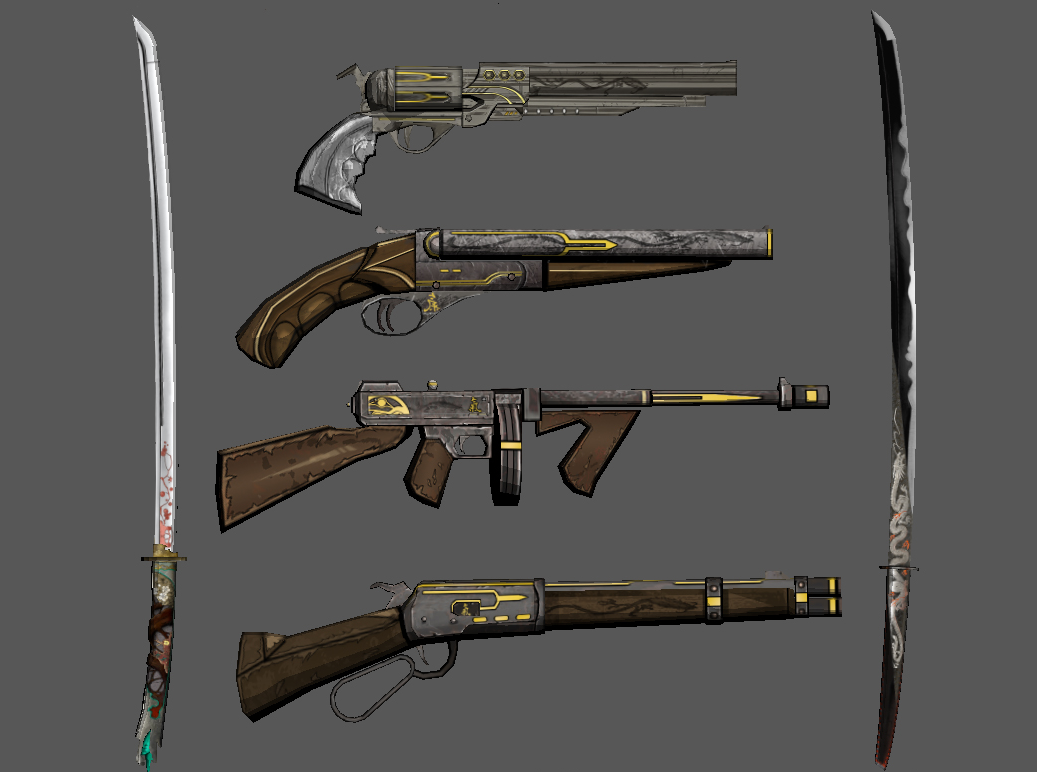
Gun fighting isn’t nearly as intricate. Simply point and pull the trigger. That’s not to say it isn’t fun; getting to smoothly switch between the two fighting styles is a blast. It gets even better once you start unlocking special attacks for your firearms and—of course—more guns. You start with just a revolver, but eventually get a sawed-off shotgun, a Tommy-gun, and finally a rifle. Of all the guns, the only one I don’t really like is the rifle: by the time you get it, it just doesn’t feel necessary. That’s not to say I never found a use for it, just that it doesn’t really stand-out.
Say hello to your new best friends.
Fighting is the most fun when you manage to get into a rhythm. Most fights aren’t terribly difficult, so the fun comes from trying to establish a sense of flow. Fights just look awesome in this game, with animations carrying a great sense of impact and frequent visual effects, like slow-motion, punctuating dodges, parries, and finishing blows. This means that once you get that flow, the fights almost look choreographed, especially if you make a conscious effort to make use of your diverse moveset. All of this is enhanced by the game’s first-person view. Because you experience gameplay entirely through the hero’s heterochromatic eyes, you never get to see what exactly it is the hero’s doing, letting your imagination run wild filling in the blanks.
But visceral acts of violence are only what you’ll be doing about half of the time. A good deal of the game is quietly exploring the levels looking for fights, money, or optional objectives. And I have to say, these quiet moments are what give this game its phenomenal pacing. Much like in Metroid Prime, F.E.A.R., or Half-Life, these exploration segments help to break up the action and give the player some breathing room, not to mention a chance to wind down between battles. These brief interludes never feel out of place, however. Walking the abandoned streets creates a rising sense of tension which makes you anticipate the next fight all the more, especially since your opponents tend to come out of nowhere.
Walking the abandoned streets creates a rising sense of tension which makes you anticipate the next fight all the more.
An odd quirk of these exploration segments is the occasional motion-based prompt. Every now and then, you’ll come across a combination safe or a dial that you’ll have to turn with the Wii remote. It’s never very challenging as you either need to tilt the remote at the appropriate angle and hold it there, in the case of dials, or press the A button to activate the tumblers, in the case of the safe. While it seemed perfectly natural when the Wii and the MotionPlus were still fairly recent, nowadays I can’t help but think it dates the game. Not necessarily in a bad way, mind you, but it certainly screams “Wii.”
Then there’s the upgrades, and—oh golly—are there a lot of them! You can upgrade your sword, your special abilities, your guns, the ammo for your guns, your coat, and even your hat! This is where money comes into play. You’ll come across a lot of cash, be it from completing missions, using special attacks to finish foes, finding secret collectibles, or just plain lying around. I can only assume part of what makes dystopian Nevada dystopian is inflation, ’cause you’ll find money flipping everywhere. And even then you’ll still have to go out of your way to get all of the upgrades available to you. Honestly, while I appreciate the effort, I can’t help but think the dev-team went a little overboard. While not being able to get everything in one run does encourage thinking about how you upgrade the Last Kusagari, it can be frustrating to obsessive types like myself, as this game doesn’t feature a “new game plus” option. Then again, maybe it’s for the best. Since enemies aren’t that strong to begin with, upgrading your weapons means they go down even quicker, thus revealing the tragic irony of this game: one-shotting an opponent is the ultimate buzzkill.
Riding into the Sunset
Red Steel 2 is a rip-roaring good time. From it’s sense of style to its fluid gameplay, the game knows what it wants to be. I think it succeeds partially because it’s so focused on nailing the core concept. That said, it is a bit of a one-trick pony. If you don’t like old-school, run-and-gun shooters or hack-and-slash games, then there is absolutely nothing here for you. It’s a great trick, and it doesn’t outstay its welcome, but the whole game is the same basic exploration and combat loop all throughout. It’s also not without some flaws. Aside from the ones I’ve already mentioned, the ending is pretty weak, the “challenge mode” is just a mission select with a tacked on scoring system, and there’s no post-game content or completion bonuses to add replay value. But I guess that—aside from the ending—all of those complaints just reinforce the notion that this game is about doing one thing and doing it well. This is—in my opinion—one of the best action games on the Wii and an excellent exhibition of what the system’s motion controls could do to enhance gameplay.
Here’s hoping there’ll be a Red Steel 3 on the Switch!