It’s True: Games ARE Made by Humans Scott’s Thoughts

Something especially cool happened at E3 2017. If you only watched Nintendo’s press conference, you missed it.
Shigeru Miyamoto came out on stage and promoted Mario + Rabbids. But even Miyamoto-san wasn’t the star of that show; Davide Soliani stole the spotlight.

Davide was the lead on developing Mario’s crossover with the Raving Rabbids. As you’ll remember, his passion project got leaked onto the internet and was met with a collective “huh?” from gamers.

It was a demoralizing period for his team, having poured months and months into crafting the perfect crossover that no one knew they wanted. The premature announcement was met with uncertainty.

The team pressed onward, through the disappointing turn of events, and made it to E3 where Kingdom Battle had its proper announcement and another shot at recognition. Nintendo lent Miyamoto for Ubisoft’s stage, as well as dedicated a slot of time in their Treehouse stream to showcase the game.

Sentiment around the game started to turn, but nothing so critical happened as when the camera at Ubisoft’s press conference focused in on Davide.

The developer had given Miyamoto the honor of introducing his game on stage, but Miyamoto turned the praise back to Davide and the crowd got to watch his reaction as tears streamed down his face.

The French game designer was overcome with emotion as his sweat equity had finally culminated in a finished product. But most every developer experiences that sensation. Davide also had the unique opportunity of getting to work with an industry idol, and partner with Nintendo on their own property. To see Miyamoto himself introduce a game that he had conceptualized brought him to tears.

“Don’t cry Ubisoft man” became a meme, a tee-shirt, and a rallying cry for those who wanted to show their support for Ubisoft’s crazy mash-up and the people responsible for creating it.

Sometimes, gamers just need a small reminder that humans create the software. Behind every work is a team of individuals with families, needs, and dreams.

For Davide’s sake, and those like him, measure your tone carefully when offering criticism online. The status quo is harsh, and it takes more effort to be constructive. Go the extra mile.

Are Monthly Switch Releases Sustainable? Scott’s Thoughts

Since Nintendo launched Switch in March, they’ve quickly built out the library with solid 1st party hits.

Select 3rd parties, and a swath of independent developers, have also been instrumental in filling out the gaps.

From Legend of Zelda: Breath of the Wild to Super Mario Odyssey, one can’t help but be impressed with how this hardware’s first year has been supported by stellar software.

For the first time in many years, consumers are actually starting to say “there are just too many good games. I wish they would delay some of these.”

Who can possibly manage to play Odyssey, Skyrim, and Xenoblade all back-to-back?

What’s more,  how will Nintendo maintain this breakneck development pace?

Here’s the important factor to keep in mind: Switch has a team of software designers about twice the size that Wii U had. Where did all these extra developers come from?
Well, Nintendo merged the 3DS and Wii U departments together shortly after R&D on Switch began, bringing home and portable development under one roof.

3DS is seeing it’s last days as more and more resources are allocated to developing new experiences on Nintendo’s hybrid console. And they’re selling like crazy.

I expect the manic pace to continue for the foreseeable future. It won’t be a gigantic new title like Super Mario Odyssey dropping each month, but I could see twelve releases spread over a year like so:

  • 2 Wii U/ ports (think: Smash Bros.)
  • 1 HD remake (think: Kid Icarus Uprising)
  • 1 Kirby
  • 1 Yoshi
  • 2 big franchise sequels (Mario, Metroid, Zelda, Donkey Kong, Splatoon, etc.)
  • 1 new IP (a la ARMS)
  • 1 partnership with a 3rd party (like Rabbids)
  • 1 collection (BoxBoy would work well)
  • 1 party game (people must be getting tired of 1-2-Switch, right?)
  • 1 crazy announcement no one could ever predict

And that’s twelve games right there. As you can see, it’s totally doable for the Big N to publish something every 4-5 weeks.
The only question remains: can our wallets and schedules keep up with the runaway hype-train?

Dreaming of NintendoCon

Maybe you’ve had the pleasure of attending a convention like PAX or Comic-Con and visiting Nintendo’s booth. Maybe you’ve even made it to E3 and gotten to explore a gigantic section of the show-floor dedicated to Nintendo and outfitted with scenes from Legend of Zelda or Mario.

Now, dream with me: NintendoCon, an entire convention dedicated to Nintendo.
Ingenious, right? If you can handle it, read on for my take on this imaginary event:

Location & Attractions

You know exactly where this needs to be held. That’s right; Super Nintendo World, their very own theme park. Why in the world not? When you’re not partaking in conventional (pun) activities, line up to get on Mario Go Karts or Donkey Kong’s Crazy Coaster.

Nintendo Direct Live

An event of this scale could surpass even Nintendo’s viewership at E3, and would be the perfect place to drop some huge announcements in a pre-recorded presentation, or even a live stage-show. Just picture the crowds as all of Nintendo’s biggest fans are gathered in one place, hanging on every word being spoken and erupting into crazed cheers as the Big N makes their dreams come true.

Previews

After the big announcements, attendees are released to queue up for demo stations. As they say, Playing is Believing and there’s nothing like hands-on time with unreleased games to get fans excited.

Nindies and 3rd Parties

Of course, Nintendo wouldn’t be the only brand represented at their convention. Developers of all sizes could register and set up booths to display their titles running on Switch or 3DS. Naturally, these lines would be much easier to get into and would bring a huge amount of diversity to the playable lineup.

Press Days

Let’s not forget the paid professionals, whose job it is to cover announcements and events. Press should be allowed to set up meetings, interviews, and playable sessions ahead of the public convention access. This would allow them to write up stories, as well as edit and produce videos, gearing up to publish them as soon as embargoes lift when NintendoCon commences in earnest.

Tournaments

eSports are picking up steam with the Big N, and the trend would continue here. The latest fighting games would be on display, with crowds, commentators, and coaches to complete the spectacle.

Panels

Every good convention has panels, where gamers can sit down, take a break from the hustle and bustle, and learn from industry experts. At NintendoCon, you would be able to watch developers of recently-released games, and titles still in development, discuss what it’s like to be a video game creator. Fans would gain insight on what challenges Nintendo’s internal teams face, as well as be able to take a peek behind-the-scenes of their favorite hobby. Who knows, maybe a few smaller reveals would sneak into these panels as well.

What do you think—would an event like this be irresistible? I hope I’ve painted a picture of how amazing a production like NintendoCon could be. Please lend your own thoughts and ideas in the comments. Hope to see you there in 2023!

What if Classic Editions were Switch Cartridges? Scott’s Thoughts

“It’s so hard to find the NES Classic Edition! Why can’t Nintendo just put all those games on a cartridge and call it a day?”
It was the same story with the Super Nintendo version.

Nintendo fans and collectors, left baffled by supply issues, often bemoan the fact that these collections of retro games aren’t made available for Switch.

What if Classic Editions weren’t miniature reproductions of the original consoles, but simple game carts or eShop downloads?

Pros:
+ More convenient
+ Cheaper
+ Portable
+ Easier to purchase
+ Less clutter

Cons:
– You don’t get the original controllers
– Only lasts one console generation
– Less of a collector’s item
– Not as nostalgic
– Well… you can’t hack it to add more games.

Personally, I’m really glad Nintendo chose to recreate the consoles. I’ve been wanting NES to return to store shelves for a decade, but I never predicted the genius of shrinking it down to the size of your palm and preloading it with games.

I can also now say that I own an SNES, which is the only console I missed while growing up.

It’s easy to beg Nintendo to make things more convenient and cut some corners, but the experience just wouldn’t be the same.

When Ignorance Isn’t Bliss Scott’s Thoughts

They say “ignorance is bliss,” which can be true.
If you’re enjoying a meal that accidentally touched the ground, you’re probably better off not knowing that.
We’re always within a small distance from insects, but if they’re not bothering us… ignorance is bliss.

Other times, being ignorant just leaves you feeling left out. Like for the gamer who’s never played a Final Fantasy title in their life, and the discussion turns to the series.

Here’s what it sounds like to me, someone who has never touched the popular RPG franchise:
“Oh man, when are we ever going to get the proper follow-up to Twelve?”
“You know, Three is actually Six in Japan.”
“I’m holding out hope for Fifteen Two.” (What is this, Cribbage?)
“Why did it take so long for Seven to get remastered?”
“One and Four are available on iOS, but you’ll have to buy an original PlayStation to access Five.” (Clearly, I’m making all of this up.)

Final Fantasy games are referred to simply by their number designation, which makes conversations around them even harder to follow for newcomers.

When people start talking FF, my eyes glaze over.

Sometimes I wonder if I should play the entire series just to be in the know.

The Secret Selling Point of the Switch Scott’s Thoughts

It’s not what you think it is.

It’s not the games. It’s not the price. It isn’t the user interface or the branding.

The secret selling point is that the Switch is fun to use.
It’s physically fun to play with.

That dumb snapping noise that plays in all the commercials? It underscores one of the core benefits of the experience.

Seeing the hardware’s multiple configurations raises intrigue, then the tactile feedback received when sliding the pieces together does all the convincing.

Nintendo used to say Playing is Believing, but they advanced this concept a step further by creating believers before the console even powers on.

There’s a 2D Breath of the Wild on Switch eShop Scott’s Thoughts

On the Nintendo Switch eShop, there’s a 2-dimensional Breath of the Wild for sale.

It’s called SteamWorld Dig 2.

This is an indie title by Image & Form. You don’t have to like steampunk culture or have beaten the original to enjoy this title, it stands on its own as a must-play.

Everything that you loved about the the open-world Zelda adventure is here, in this little downloadable title.

Strictly speaking, Dig 2’s genre is most like a Metroidvania, but fans of Breath of the Wild will feel right at home in the game’s underground caverns.

Did you like defeating shrines? You’re in luck; with caves, puzzles must be completed to earn collectibles and power-ups. Just like shrines, caves feature additional hidden secrets apart from the main objective, for explorers and completionists.

Like Link’s stamina mechanics, the main character (Dorothy) has meters for water and light that the player has to keep an eye on and take into account while trying to reach new areas.

The game can be played nonlinearly, any time you wish to take a break from the main plotline to enhance your strengths.

Filling in Hyrule’s map by locating towers is not unlike uncovering new caverns and locating fast-travel points.

Special abilities can be unlocked that are very similar to the Champion Abilities in Zelda. I activated an especially helpful modification in SteamWorld which I lovingly referred to right away as “Mipha’s Grace.” Even the HUD elements share attributes in common, like how the special abilities indicate on-screen when they are ready to be used.

Don’t miss this title! Even if you don’t feel like you’re ready for “another Breath of the Wild,” keep in mind that this game is much smaller. SteamWorld Dig 2 doesn’t overstay it’s welcome.

It’s also plenty unique, with a creative world, interesting characters, and fun gameplay loops that keep you coming back and digging deeper.

The Happiest Place on Earth

For many Nintendo fans, it is something of a rite of passage to visit the company’s only retail store in New York City. And when I mean “only”, I really mean it. The New York City store is the only retail storefront open to the public for Nintendo fans in the entire world. Every year, thousands of fans make the trek to the Big Apple to visit it. Why?

Because It’s Special

Nintendo New York (formerly known as the Nintendo World Store) is located in Rockefeller Plaza in the heart of the city. Before it transformed into a general Nintendo store, it was a Pokémon Center. For years, fans have made the drive or flight to visit the store. Sure, many come to New York for many other reasons, but stopping here is always a highlight. Some people, like myself, made the trip from Indiana specifically to go to the store, with other activities planned around it.

The store’s footprint is small… but it’s two stories, so the square footage is pretty sizable in the end. But the moment you walk in, you are in instant awe. Besides the eye-popping merchandise that smacks you in the face, the atmosphere and decorations just make you feel good.

Being the only Nintendo store in existence makes it special. It would still be special if others were to open up – which is what some fans are hoping for with the aforementioned renaming from Nintendo “World” Store to Nintendo “New York”. As it stands now, with only one store, it literally is akin to going to an amusement park, and you will look back on your visit there as fondly as if you had been to one.

Because It’s Fun

The Nintendo New York store is like nothing else. It is the hub of Nintendo goodness – one that you don’t even get when visiting the employees-only headquarters in Redmond, Washington, which I did when living in Seattle. If you are a longtime fan like myself, you will spend about a full minute just standing in the doorway with your mouth agape like I did. It is an amazing sight. The store just has a happy vibe to it – a Nintendo vibe, if you will. You are surrounded by beloved Nintendo characters, demo units, games, clothing and more. Much of the merchandise sold here is exclusive to the store. My traveling companion went wild in here when we went – she spent $471 before tax on plushies, T-Shirts, bags and more.

The store regularly holds fun launch events for major games. I was there in May of 2015, the day before the launch of the Wii U game Splatoon, and there was already a long line that stretched down the block in what would be almost 24 hours before the store opened on release day. They make game launches a huge deal with lots of fun, special guests, real life games and contests: they even held a mock fashion show for Style Savvy: Fashion Forward for instance. The pictures that accompany this post are from that time, and the interior has changed since the 2016 remodel.

On the second level you will find a small “museum” section. I believe they change them out every so often, but when I was there they had a section dedicated to the history of The Legend of Zelda with every imaginable game, manual, special edition console and accessories in a three section display case. In front of it was a “History of Nintendo Handhelds” exhibit with every portable console on display – even the obscure ones like the Game Boy Light (previously for sale only in Japan) and the Game Boy Micro. There were also a small aisle with individual cases for each of Nintendo’s home consoles from the NES to the Wii U.

The store is just flat out fun. It is fun to be in. I was in there for three full hours from 9am to just after noon, and it felt like I wasn’t there long enough. It’s a store that invites you to play and have fun, and celebrate Nintendo’s rich history without ever feeling too self-congratulatory. There is no Tom Nook stalking you around to pressure you to spend your bells on anything – you are free to be there as long as you want.

Because You Belong

Going to the store is not unlike going to a convention – everyone in there is a huge Nintendo fanatic, and it feels good to be around them. Your mileage may vary, but sometimes for me, it is tough to admit I am a Nintendo fan among my other gaming friends who specialize in Halo and Call of Duty. Nintendo is looked at as a console for kiddies, despite it being the original home to some of the best M-rated games ever like Eternal Darkness, the Resident Evil remake and Resident Evil 4. Admittedly, Nintendo has lagged behind in sheer hardware power for three console generations now, beginning with the Wii, then Wii U and now the Switch. But the draw of the Switch is its hybrid format of being a portable and a home console. I won’t talk about how awesome that is because if you like Nintendo, you are probably already aware.

But when you walk into Nintendo New York, you feel like you belong. No one will laugh at you for preferring Animal Crossing to Battlefield, or you spent over 100 hours playing Mario Kart 8 Deluxe instead of organizing your Destiny clan. And just like going to a Comic-Con, you don’t have to be ashamed of your preferences. The store encourages you to have fun and enjoy yourself, and there is no better place to do it than surrounded by Mushroom Kingdom pipe decorations and giant Bowser statues.

Because It’s the Happiest Place on Earth

Forget Disneyland. The Nintendo New York store is the happiest place on Earth. For all of the reasons I mentioned above – but the bottom line is that it is just fun. It’s like an amusement park without the lines (unless, of course, you are there for a game launch event). The employees are friendly. The shoppers are friendly. The music is friendly. The plushies are all smiling at you, and not in a creepy, Five Nights at Freddy’s way. It is an excuse for kids to be kids, and for adults to be kids again too, because it’s impossible not to become awash in memories of your own childhood when in the store and seeing everything they have to offer.


Eric “Flapjack” Ashley has been a Nintendo fan for almost his entire life! While he also has a special place in his heart for Sega, it is Nintendo that gets him worked up and the franchises that capture his imagination and wonder. Flapjack is hopelessly in love with Animal Crossing. When he is not playing video games, he is a social media guru, assisting numerous organizations with their outreach and promotions, and he is also a big horror movie buff. Follow him on Twitter and Instagram: @flapjackashley.

2017: One of the Best Gaming Years in History?

Fall is already upon us. Leaves are changing, the air is becoming cool and crisp, and good games are seemingly being released left and right. Alas, this blog is not about the season, but about 2017 as a whole. Yes, we have a few more months before it wraps up, but in less than a week, Nintendo’s juggernaut, Super Mario Odyssey will finally be released. I for one cannot wait to sink my teeth into this game. Having already received a perfect score, I think we are in for a fun ride. That being said, I want to focus on what has already been released, and why I think 2017 has been one of the most glorious years for gaming in recent history.

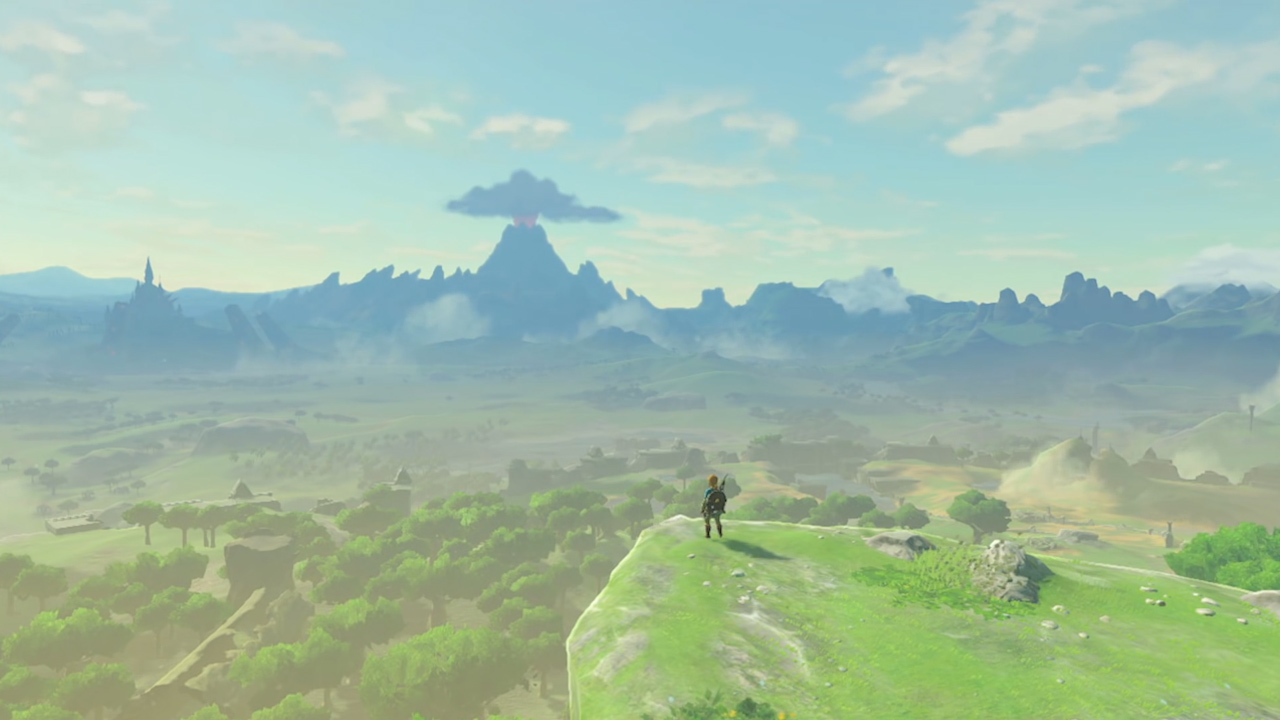
Nintendo is a company that fans expect a lot of. They always seem to set the bar of quality game design higher and higher. Take Breath of the Wild for instance. This game takes the best aspects of the franchise and capitalizes on what makes it great. I felt no greater sense of adventure since I was a young kid playing Super Mario 64 or Ocarina of Time for the first time. This is undoubtedly special, and why so far Breath of the Wild is currently* game of the year for me.

*subject to change

A franchise that was essentially brought back from the dead this year is Metroid. Samus Returns does everything that I was hoping it would. Appealing visuals and tight controls, along with the new melee addition, make for a really addictive journey. I would love to see the developer have free reigns and make a brand-new Metroid game.

This year in particular, smaller, more tightly knit developers are also getting more attention. Sonic Mania is living proof that sometimes, fans know exactly what is best for a franchise. The game was made by only a handful of inspired and passionate people, and look what resulted. The same can be said for the recently released Cuphead. Though not on a Nintendo platform, I couldn’t pass this one up. The 1930’s art style is one that I have never seen before in a game, and pushing through the brutally hard difficulty is so worth it only to experience more. My point is, gamers are starting to appreciate the hand crafted, quality approach, and developers are responding.

A Game of Year Contender for sure. Competition is fierce this year.

The release of the Switch was also monumental, and completely necessary, to erase painful memories of the Wii U era. I love that Nintendo doesn’t feel the need to compete with competitors by powerful processing or graphics, but with intuitive design. A portable home system is something that will pave the way for years to come. When Nintendo becomes irreverent in the industry, Nintendo is at its strongest. We were also fortunate enough to get the SNES classic, so I can replay some of my favorite games of all time the way they were meant to be played.

Perhaps I consider 2017 so impressive because it made franchises relevant again. It made Nintendo relevant again. No, we didn’t get a new Animal Crossing game or a Pikmin game (at least not the type I’d want to see), but we did get a plethora of games that were not afraid to redefine themselves. When I look back on the year and reflect, I see a year of revitalization. A year of redefining what gamers actually want: quality.

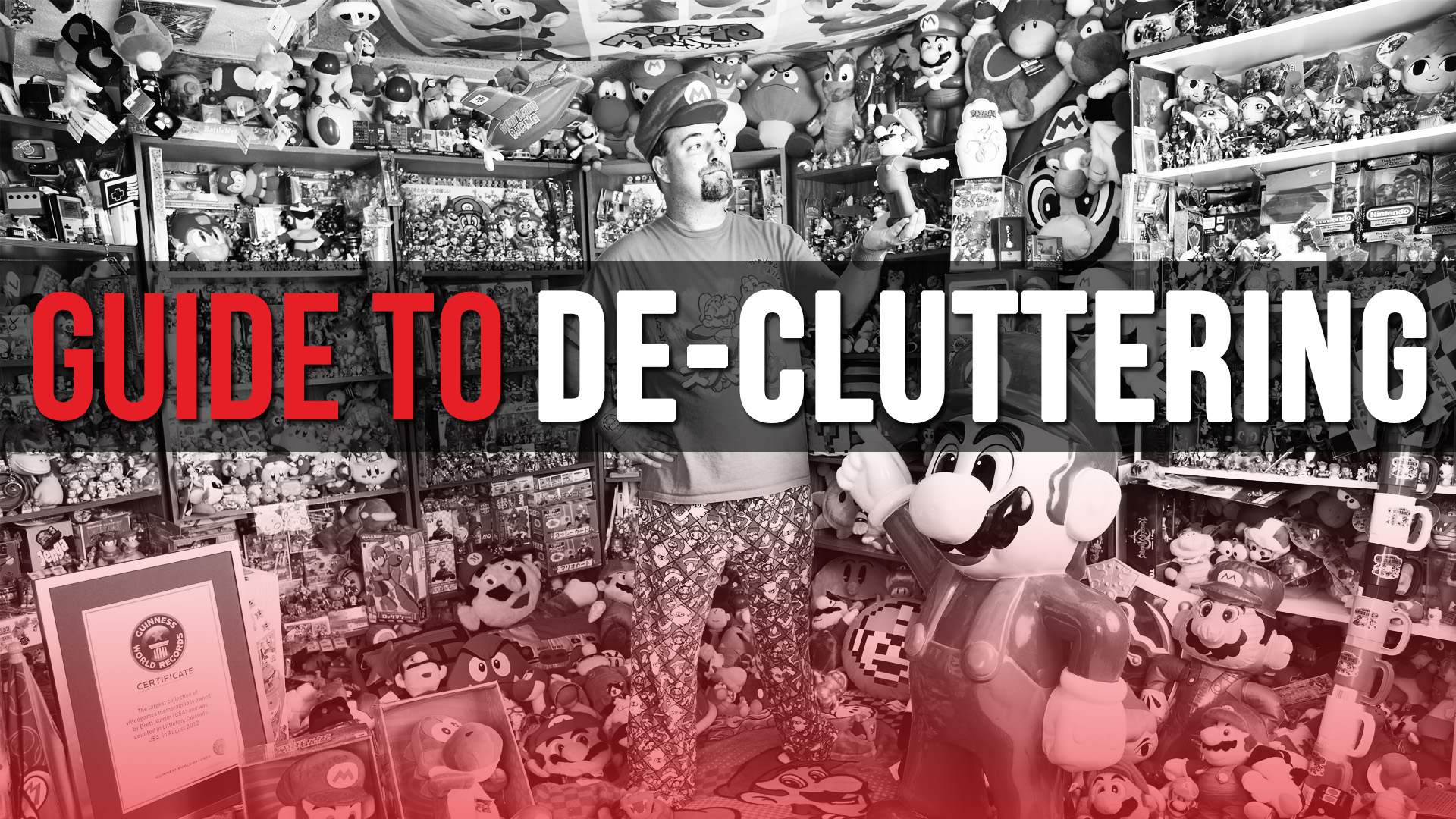
Do I NEED This?: A Gamer’s Guide to De-Cluttering

Recently I have been looking to downsize my video game collection. I am giving away and selling some old consoles, games, and accessories (blasphemy, I know). The fact is, I am a pack rat, but there are just some games that I do not play anymore, and I need to do some de-cluttering. I have had to think long and hard before I made the really difficult decision to toss some of the games in my closet, but the experience has been a freeing one. Not only do I have less “junk” lying around the house, but I no longer feel bound to my possessions, which is extremely freeing. So, if the thought of getting rid of a single game in your collection has you mumbling incoherently in the fetal position, let a fellow gamer lend you a hand.

These are the questions I ask myself of each game/piece of equipment I come across in my sorting adventures.

Do I even like this game?

I have a hard time getting rid of any game. I see that, as a thing, it has to have some sort of monetary value. I purchased it (or it was a gift to me), and, therefore, somebody spent good money on this! I cannot just throw it out, can I?

Well, it turns out I can. I do not really care for sports games, though my older brother did. I have cut a good portion of my clutter size down by being honest with myself, saying, “He might have liked this, and I might have had a good time or two, but I would rather be playing something else if I had the choice.” Remember the good times, but do not be afraid that your memories will fall out of your head if you get rid of something.

I almost wish I had kept this game it was so bad.

Does it work?

This is a similar question to the one above but is usually in reference to hardware. We either think, “I put money/time into this, even though it is broken.” Sometimes we try to rationalize, “I am going to get this fixed, someday!” even though you have no intention (much less the time or money) to actually fix it. I am not saying that broken equipment never has enough sentimental value to keep it solely “for old times’ sake”, but, like with bad games, if the memory is that important to you, it will not go away because your busted GameCube is in the dumpster.

How long has it been vs. how long have I had it?

This one is extremely practical. I have Wii games that I have had for years but never play anymore. They are going out with my next batch of games to be pawned at a small, but reasonable price.

Some games I have, though, just have not been given the chance to outstay their welcome. On one hand, I have hardly played Super Smash Bros. for 3DS since the release of the Wii U version. On the other hand, the game is only a few years old, and I have not had the chance, necessarily, to go “back” to it yet. Maybe I will want Smash Bros. on the go sometime soon. If I am asking myself that in ten years, however, I might have to take a second look.

There is another side to this, of course. Scott has been in the mood to sell his games soon after purchase because he does not see himself returning to the title. He gets the biggest bang for his buck by reselling right away, as opposed to seeing the game collect dust, and trying to get rid of it after the game is out of date.

Do I have this game in a more convenient form (Virtual Console, collections/anthologies, etc.)?

“But this is the original NES cartridge! Playing it on a modern console, even though it has been perfectly faithfully been ported, is just not the same!” This is one that, as a pack rat, I have had to wrestle with constantly. I am getting rid of many of my NES cartridges because I have them on collection elsewhere. Yes, this even includes some of my original series Mega Man games (but not my world record Mega Man 6 cart. That thing is getting framed or something). Collections are not only a great way to make accessing your games more convenient, but they also pave the way to downsizing, which is a good thing.

Is this an outdated version?

This question does not apply to most genres, as, usually, each version of a game brings something completely unique to the table. Fighting games, on the other hand, are often outdated by the next version. Is Marvel Vs. Capcom 3 REALLY worth keeping when you have the Ultimate version? Sure, there is a UI difference, but balancing patches and new characters have just made the update a better game. Let it go.

Do I have alternative console methods?

Because I have a Retron 3 I will probably be getting rid of my NES and SNES. The only downside to saying goodbye to them would be my inability to use my wireless NES multitap (though, if I got a wired one, my problem would be no more).

Retrons and similar consoles allow for ease of access and space saving. Retrons even allow you to use the original console’s controllers.

Also, you might have access to an emulator, like a Raspberry Pi. Not that I am advocating illegal emulation. Or admitting that I use my Raspberry Pi for emulation. I am not.

… Admitting it, that is.

These are some of the considerations that I used in sorting through my video game collection. Take it from someone who has been there: the process may be difficult, but the rewards are well worth it. Tune in next time as we discuss proper console dusting techniques!

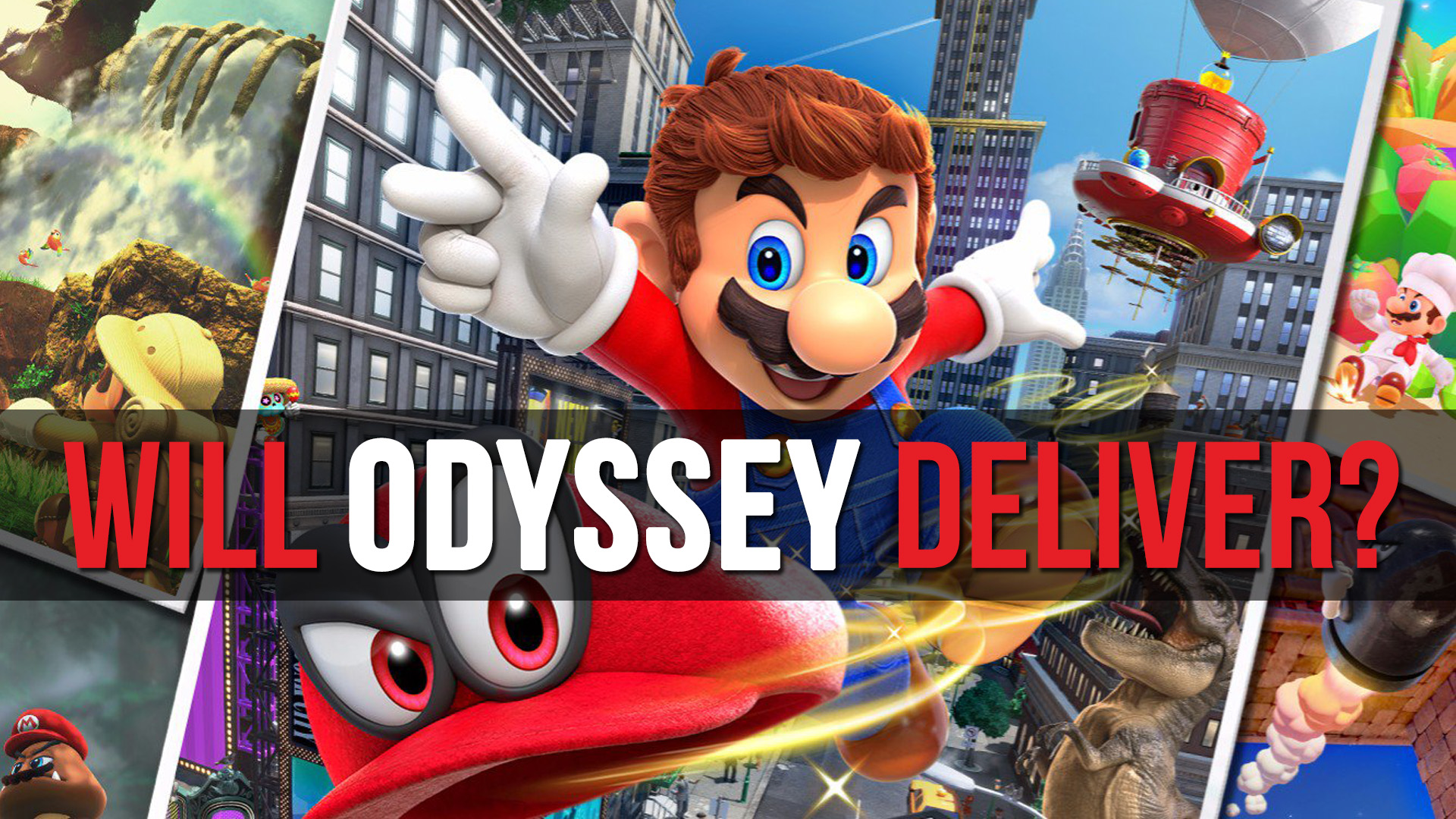
Will Odyssey Deliver on the Mario Formula?

It’s hard to believe, but this month marks another monumental game release from Nintendo! Joining the ranks of games discussed for decades like Super Mario Bros., Super Mario World, and Super Mario 64 is the newest game we won’t stop talking about for generations: Super Mario Odyssey. Link did a fantastic job carrying Nintendo’s new console through its infancy, but the torch is being passed to the plumber himself. Buckle up folks, this is gonna be big.

There’s no doubt Odyssey will sell millions, even a few tens of millions, or that it will be a hot topic for the entire Switch lifespan and beyond. But that’s not to say it’s a guaranteed hit. What we don’t know yet is: will it be good? Will it be truly great?

The potential is there. The track-record is evident in the series’ preceding entries. All Mario needs to do is avoid a few pitfalls, stick to what has worked, and wow us from time to time. A combination of tried-and-true best practices and fresh experiences will create a masterpiece.

Half of the puzzle has already been completed. The fresh ingredients: totally accounted for. We won’t be left wanting for any wow-factor, as already evidenced by numerous surprising trailer moments: Mario jumping out of a realistic city street’s manhole, Mario’s hat being alive, the game has T-Rexes… just to name a few.

Today, what I’m concerned with is this: Did the developers keep what worked from previous entries in the series? From the short time I’ve played Mario’s new adventure, and from what I’ve seen of others’ gameplay, I’m not so sure. I keep looking for those non-negotiable Super Mario elements, and unfortunately, some of them aren’t evident. Take a look for yourself.

Tight Controls

If we choose to ignore the Arcade Mario Bros. title, we can safely say that the Mario series has always featured tight controls. Whether you were making pixel-perfect adjustments with a D-Pad, or performing aerial cartwheels with an analog stick, the player always had complete and finite control over the mustachioed hero’s movements. However, Nintendo is pushing a control scheme on this game that will prove to be unideal. They say that disconnected Joy-Con with motion controls is the best way to experience Odyssey. However, that leaves us with the Switch’s signature small sticks (or S.S.S.S. for short). The analogue sticks on Switch aren’t very tall, and thus have a reduced range of motion. That’s fine for games like Breath of the Wild, where your character is often traversing in the same direction for long periods. But for intricate platforming, more range is needed.

I would recommend the Pro Controller as an alternative, but we run into further complications with that scheme, just like we do in Handheld mode: motion controls disappear (good), and are replaced with complicated combinations (bad). You would think with all the face- and shoulder-buttons at the Switch’s disposal, simple assignments would suffice, but unfortunately, performing the spinning-Cappy-throw (for example) requires you to physically spin Mario in a circle before hitting the Cappy button.

Another area you will notice the absence of tight controls is in 2D segments—you know—the really cool-looking 8-bit graffiti art portions? As attractive as those look in trailers, it’s really weird and off-putting to play with a modern controller. Imagine trying to navigate the original Super Mario Bros. with an analogue stick, and you’ll get an idea of the sensation. Furthermore, 3D “rules” of Mario still apply during these retro levels, which means running into a Goomba doesn’t make you shrink down, but you lose part of your life meter instead, resulting in a feeling of disconnect.

Level Design

If there’s one thing Super Mario Maker proved, it’s that we all have a long way to go in becoming level designers. The community generated courses simply caused me to appreciate Nintendo’s internal team more, who have proved time and time again that they can carefully craft experiences that will pull newcomers and veterans through to the end. Each level in a Mario game has clear goals, features, and themes. In Super Mario Odyssey, this clear-cut level design might be ditched in favor of an overly-open, sprawling collection of miniature attractions. Places to earn Moons are abundant, which could be a detriment to more meaningful challenges.

Progression Structure

To be perfectly honest, I’m most concerned about this one. We just discussed the plethora of Moons that this game contains, and it doesn’t excite me. 120 Power Stars was a lot to collect in Mario 64, but it was manageable thanks to a cohesive overworld that guides you to specific worlds, and specific tasks within those worlds. The developers of this new Switch title tout the fact that gameplay is returning to a sandbox nature, but that implementation can be taken too far.

In past Mario games, you know if you’re missing something. You know if a world is incomplete, and if a level was too difficult to clear for the time being.

In Odyssey you are provided with a list of Moons collected (with dates), but how will you know where new ones are? How will you know if you got all the Moons in a certain area, except one that you’re missing one in the corner? How much backtracking will be involved, and how many Moons will I pass up simply because I didn’t think to ground-pound a certain summit, or break an inconspicuous box?

You see, I’m a Shrine kind of guy. I love counting down from 120, hearing my Sheikah Slate alert me to a Shrine’s proximity as I enter a new area of the map… but you’ll never catch me trying to collect all the Korok Seeds. And I’m afraid that Moons are more akin to Seeds than Shrines. I hope I’m wrong.

Power-Ups

Gotta love Mario’s power-ups, right? Fire Flowers, Capes, Penguin Suits, Boo Mushrooms, and more! Well, they’re gone, folks. At least, that’s what this quote from the game’s producer heavily implies:
So when we wanted to create Mario games this time around we wanted to focus on the actions Mario can do and in previous Mario games he was able to get power-ups and new abilities. But this time around when we were making many different prototypes and changed our approach that found capturing or “possessing” enemies worked well so we stuck with that. -Mr. Koizumi

It’s unfortunate, to see such a mechanic go. In 2D Mario games, getting a Super Mushroom and earning that feeling of added security and power is iconic. In 3D titles, power-ups haven’t ever been as strongly implemented, but as a result, getting a Fire or Ice Flower felt like a treat. These elements have been discarded in favor of Cappy.

Gimmicks

Speaking of Cappy, he’s the new gimmick! New entries often feature a defining “gimmick,” be it Yoshi, Fludd, or over-the-top new power-ups like the Cat Suit. These open up whole new gameplay opportunities and dictate much of the level design. Odyssey’s most prominent and promising mechanic is Capture, which satisfies this aspect of the Mario formula nicely.
Let’s just hope Cappy doesn’t turn out to be the new Navi, eh?

Music

Mario music typically accomplishes two things. One: it’s catchy, and it gets stuck in your head. Two: it provides strong location associations. You can close your eyes and know exactly when Mario is underwater, in a dessert, or in Bowser’s castle. Did you just hear each of those themes in your head? I haven’t seen enough to know if Odyssey will deliver on this front, but there’s a good chance it will.

Enemies & Bosses

Baddies in the Mushroom Kingdom are always fun to stomp, and they don’t usually get repetitive or bothersome like the creatures in Metroid: Samus Returns. Hopefully, this game’s design will still lend itself to some combat, rather than just Capturing the majority of enemies in sight.

Bosses, while providing a spectacle, are typically an easy three-hit affair. This is an area where the new Switch title could easily improve upon tradition, and make boss encounters more intricate and memorable.

Charm

What would a Mario game be without charm? Character design, animations, music, and polish all create a compound for charm. Mario may be formidable when facing the forces of evil, but he’s equally adorable.

So… what’s this about real tyrannosaurus rexes roaming around? And realistic, proportionate humans walking alongside Mario in New Donk City?

I’m really questioning these design choices, and have been ever since the game was revealed.

Conclusion

Overall, Super Mario Odyssey appears to be a hodge-podge.
That’s the word for it. Just a big stew of locations, art-styles, new and old Mario sensibilities, and certainly a gigantic mix of objectives and tasks.

Will such a recipe, with that many ingredients, actually turn out well? I sure hope so, because I’m a day-one customer and lifetime Mario fan. I do trust Nintendo, but I’m not fully sold on this new direction, and I know I won’t be unless I take the game home and it proves me wrong. If that happens, I’ll update you! Fortunately, I’m entering the experience with low expectations, and that’s the safest posture to take. We’ll find out on October 27th!

What Does “8-Bit” Mean?

Ah, pixel art…Nothing says “video games” quite like a 32×32 pixel sprite. Retro sprites are a fascinating art form: unlike many other mediums, the conventions of pixel art were born of technical limitations, not creative freedom. While the nuances of the medium are often lost on modern developers, who see the limitations as an excuse to churn out overly simplistic animations, classic games would often feature impressively detailed animation frames. To this day, even single frames of these animations are downright iconic and instantly recognizable to fans around the world, something that few other animated works can boast!

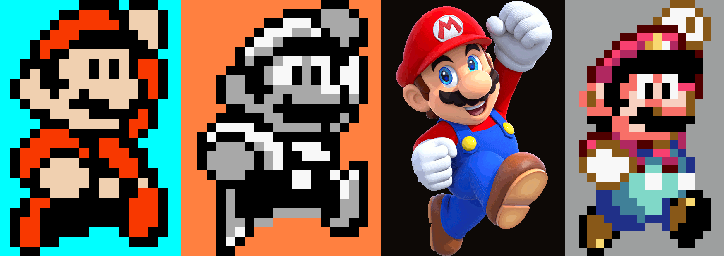
Pop quiz! Which of the following are 8-bit images?

Probably should've added some negative space to the top and bottom...
Please excuse the fact that these aren’t in chronological order.

Believe it or not, only the second one from the right is 8-bit. “B-but, but the NES and the Gameboy were both 8-bit systems!” you say. Yes, well, maybe it’s time we actually examine what exactly “8-bit” means.

In Computer Imagery

Let’s start with what bits mean for pictures. There are two basic ways of composing pictures: color channels and indexing. In a picture that uses color channels, each color is represented by a mixture of primary colors with each primary color composing one of the image’s color channels. These colors are red, green, blue, and sometimes an additional “alpha” channel that represents opacity (i.e. how much you can’t see through it). Every pixel in the image is a combination of these channels.

The number of bits dedicated to each pixel is known as the image’s color depth. As you may know, bits are binary digits, hence the name (binary digit). Because of this, every sequence of bits can represent 2n values (where n is the number of bits used). That means an image with a color depth of three—which is to say one bit per channel—can have two shades of red (fully black and fully red), two shades of green, and two shades of blue, which combine for a total of eight (23) colors. In today’s day and age, most images either have a color depth of 24 for plain R.G.B. or 32 for R.G.B.A., dedicating eight bits (one byte) to each color channel. That means R.G.B. images these days can contain up to 16,777,216 colors. Any more than a byte per color channel results in diminishing returns.

The number of bits dedicated to each pixel is known as the image’s color depth.

As you can imagine, three bytes per pixel adds up quickly on a console that only has 2 kilobytes of video R.A.M. While it’s easy to forget in this age where most computers typically have four to sixteen gigabytes of R.A.M. and terabytes of storage, space—both memory and long-term storage—was a valuable commodity back in the 80’s and 90’s. That’s where color indexing comes into play. Instead of storing color values per pixel, indexed images have a set of color values stored in a lookup table (i.e. the palette) with each pixel being represented by a single number that refers back to a position in the lookup table. For instance, if the color in position 5 of the table is red, then every pixel with the value 5 will be displayed as red. While this would limit the number of colors in an 8-bit image to 256, that’s 256 out of any of the thousands or millions of 16-bit or 24-bit colors available.

So, knowing this, where does this leave the NES’s graphics? An NES sprite consists of four colors, three visible and one transparent. That makes NES sprites 2-bit sprites. Don’t look at me like that, it’s the truth!

Now I’m sure some of you are thinking, “well, just because the sprites are only 2-bit doesn’t mean NES graphics aren’t 8-bit. The NES could produce way more than four colors at a time!” Okay, while we’re stretching terms a bit (or more accurately, crumpling them up and chucking them into the fireplace), I’ll be generous. The NES used the YpbPr palette, which consisted of 64 colors. So if we were to hypothetically classify the NES’s graphics in regards to the total number of colors available, that would mean the NES has 6-bit graphics. To add insult to injury, only 54 of the colors are useful, as many of them are identical shades of black. That said, the NES did include an additional three tinting bits (one for each primary color). While this increases the theoretical number of colors to 432, the tint is applied globally, meaning all sprites and tiles on screen were tinted at the same time. So, in actuality, it really just had 8 sets of 54 colors. What are we at now, 9-bits?

Note the conspicuous lack of yellow. No wonder Sakurai wanted Kirby to be pink!
All 64 colors the NES could produce prior to tinting.

What Does 8-Bit Really Mean Then?

So why is it we call sprites from the NES “8-bit” when they’re actually 2/6/9-bit? Simple, they were from games released on an 8-bit console. Of course, that begs the question: “what’s it mean when we say a console is 8-bit?” The number of bits ascribed to a console refers to its central processing unit. The NES used a Ricoh 2A03 processor (or its counterpart the 2A07, used in P.A.L. consoles), which is an 8-bit processor.

Looks kind of like one of those "Hexbugs" I see on TV.
The CPU of the Nintendo Entertainment System.

So what’s makes an 8-bit processor an 8-bit processor? When someone says a processor is “X-bits”, they are referring to the processor’s word size. In computer science, the term word refers to the standard computational unit of a machine. That means an 8-bit processor has a word that’s eight bits long, which in turn means that the C.P.U. processes eight bits in one operation.

My System Has More Bits Than Yours!

Just how important is a system’s word size? These days, manufacturers don’t even mention their consoles’ word size, but back in the 80’s and 90’s, it was a major part of a platform’s marketing. The logic was if a system had a 16-bit C.P.U., it could process twice as much data as a console that only had an 8-bit C.P.U., right? Unfortunately, the reality isn’t that simple.

While technically a 16-bit C.P.U. processes twice as much data bit-wise as an 8-bit C.P.U. per calculation, we need to keep in mind what that data is actually representing. Consider the following binary numbers:

  • 00011001

  • 00000000 00011001

Both the 8-bit value and the 16-bit value equal 25, with each representing the contents of one word for an 8-bit and a 16-bit system, respectively. Notice how they appear identical save for the number of leading zeros? Words can be thought of like boxes: if the number placed inside is smaller than the box, then the excess space is filled with packing peanuts… or, zeros. This way, the processor doesn’t have to worry about how long the number’s binary representation is and instead just performs whatever calculations are needed on the entire word. All of that is to say that unless the calculation in question requires numbers that exceed the maximum value that can be represented with the number of bits in the system’s C.P.U., there isn’t actually any speed boost.

That said, when the largest number you can handle at one time is 255, those extra-bits really do make a difference, so maybe the 8-bit and 16-bit divide isn’t the best example.


In the end, the reason we call sprites from NES games “8-bit” isn’t because the graphics themselves are 8-bit, but because of a sort of linguistic cross-contamination. The systems of the 80’s and 90’s were advertised by exploiting consumer ignorance to turn technical terms into marketing buzzwords, resulting in the systems having much of their identity tied to these terms. Because of that, anything associated with the consoles from that era is going to be collectively referred to by the one unifying descriptor available: 8, 16, 32, or even 64-bit. In the end, it’s ultimately harmless; these terms have an understood meaning and are thus perfectly descriptive in the context in which they’re used. Really, the only real confusion this causes is that I’m somehow okay with it; normally I’m the type go on a long rant whenever anyone says “Ethernet cable” when they really mean “Cat-5”.

Sonic is Back!

Let me begin with a disclaimer: I am a total Sonic the Hedgehog amateur and have very little experience with the games. I grew up with NES and SNES, while my neighbor across the street had Genesis consoles. This allowed us to get the best of both worlds without actually having to own both consoles. I was always a “Mario guy”, but when we wanted to get our Sonic fix, we would go to my neighbor’s house and play it there. That’s about the extent of my history with Sonic – I recall the first game, Sonic 2, and Sonic and Knuckles, but only vaguely. I have no history with the 3D games after I rented one as a kid and instantly felt ripped off. It’s a franchise I have always wanted to get into, but I just never felt the timing was right. Well, until now (I know, I jumped on the bandwagon).

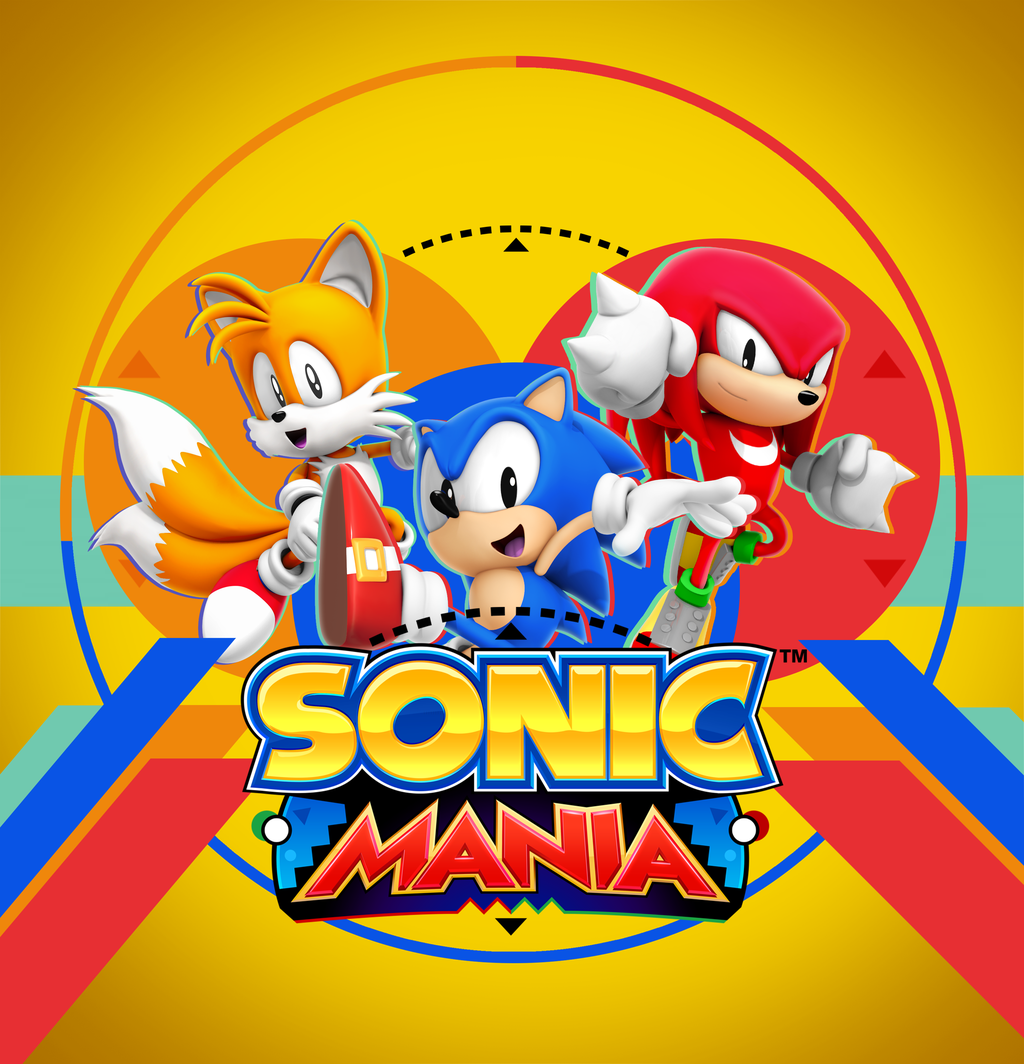
Sonic Mania was everything I was hoping a new Sonic game would be. The developers (a small group of Sonic Fans), did an absolutely wonderful job of making the game appeal to series vets and newcomers alike.

You can tell this game was made with care by people with a passion for the blue hedgehog.

From the intro cinematic to the easter eggs, this game is bursting with fan appeal. With my lack of experience, I know I missed a handful of references, but the level design in this game is what kept it so fresh for me. If you aren’t aware, the level mix has old and new levels. The developers did such a nice job that half the time I couldn’t even tell if a level was new or a classic. Beyond that, it’s fast-paced, but not too fast. It’s tricky, but not too difficult. Everything about this game feels just right. The levels never grow tedious, and all of your skills are tested in the final level for a grand finale.

It’s apparent that everything in the game was handcrafted with care.

Even though it has been over a decade since I touched a Sonic game, after playing Mania for only a few hours, I felt like a veteran. Playing the game is so empowering, and it just makes you want to keep playing. At first, I was tremendously terrible at the ball collecting bonus stages and the race mode, but after a while, I found myself looking forward to these variations. Something about unlocking all of the bonus content and collecting those Chaos Emeralds just feels so good. Considering the many hours I put into this game, the $20 price point makes it a great value. Not to mention some of the music is among the best I’ve heard in recent years.

This game is filled with action-packed fun.

It will be interesting later this year when Sonic Forces releases as it will give Sega insight as to what the fans actually want. Will the developers be eager to create more classic sidescrollers, or will they continue to ride the rails and release 3D games? I believe the success of Sonic Forces will answer that question. One thing I do know is that Mania set a pretty high bar. Who knew that all Sonic needed to be revitalized in the eyes of gamers was a little fan service and a lot of passion. Regardless of the outcome, one thing is for certain; Sonic has a new fan.

The Metroid Conspiracy

Warning: The following blog contains spoilers for both Metroid Fusion and Metroid: Other M.

A while back, I made a cryptic remark along the lines of, “it’s almost as if Other M was an attempt to rewrite Fusion in hopes of removing the latter from the series continuity.” While the announcement of two new Metroid games at E3 back in June was exciting—and certainly bodes well for the franchise—I can’t help but think something’s off about the whole thing. This is just a hypothesis, but I think Nintendo really did try to retcon Metroid Fusion!

Motive

But why would the Big N try to remove Fusion from the series continuity? Well, first let me just point out that the Metroid series is rather unique among Nintendo’s repertoire in that it actually observes continuity. Unlike other series that either only present plots that span a few games before moving on to another setting (such as Fire Emblem) or are designed “gameplay-first” with timelines being a mere afterthought (e.g. Zelda), the events of each Metroid game are closely tied to those of the games previous to it. So unlike other series, plot developments have consequences moving forward.

The events of each Metroid game are closely tied to those of the games previous to it.

This makes Fusion problematic for a company that’s rather fond of maintaining status quo. Metroid Fusion shakes up the series in a couple ways. Firstly, it ditches the heroine’s iconic appearance, potentially disrupting the franchise’s branding. Samus now sports a rubbery, blue suit instead of her iconic orange, metal suit and pilots a spindly, purple spacecraft instead of her more rounded, orange ship. Moreover, Fusion ends with her still using this equipment. Even when she regains her powers from SA-X, Samus is still wearing the fusion suit, now just with an orange color palette.

I can't tell you how happy I was to find two pictures of Samus in striking the same pose in different suits.
Years of branding makes one of these more marketable than the other.

Of course, this isn’t that big of a deal, as redesigns are reversible or even welcome at times (I’m looking at you Breath of the Wild). No, the biggest problem is what the game does to the continuing Metroid storyline. Metroid Fusion ends with Samus directly defying the Galactic Federation. She not only destroys their metroid breeding program, but foils their attempts to weaponize the X-parasites. By the end of the game, she’s most likely angered some very powerful people. I think it’s safe to say that after Fusion, Samus is a wanted criminal.

Metroid Fusion has far reaching consequences for the series, fundamentally changing the relationships between the Metroid universe’s various factions and thus the types of stories that can be told. This presents an intimidating challenge, as these new stories would require the writers to accept that they can’t rely on the plot conventions of previous games. Furthermore, shifting the focus to combating a corrupt industrial-military complex instead of the unilaterally evil space pirates may radically alter the tone of the series, potentially alienating fans.

Method

I’ve already gone on at length about how Other M is essentially a retelling of Fusion, but let’s look at one of the ways the two are different: the ending. As mentioned, Fusion ends with Sammy triumphantly thwarting the federation’s misguided efforts to weaponize the lifeforms of SR-388. Other M ends on a much more somber note; after Ms. Aran and co. manage to defeat the malevolent (and possibly “just misunderstood”) A.I. controlling the bottle ship, the federation arrives and starts sweeping up. Samus is allowed to go freely, but knows that the federation will take whatever data it can find and continue to research bio-weapons. It has a very different “you can’t beat the system” kind of feel to it.

Other M‘s ending has a very different “you can’t beat the system” kind of feel to it.

Other M‘s ending is much more open ended: Samus isn’t implied to be an enemy of the state, thus allowing her to take more jobs from the federation. This means that if Other M replaced Fusion, Nintendo could easily continue with the typical Metroid plot structure of taking assignments from the federation, which in turn means future games need not revolve around governmental conspiracies.

Supporting Evidence

This brings us to the present day. Nintendo has just released a remake of Metroid II: Return of Samus and Metroid Prime 4 is on the horizon…somewhere. Notice anything strange about that? One’s a remake and the other is a continuation of the Prime series. For those of you who don’t know, the Metroid Prime games take place between the events of Metroid and Metroid II. That means they’re technically prequels and don’t continue the story. Fusion is the last entry on the Metroid timeline; there hasn’t been an actual continuation of the overarching narrative in fifteen years! I think it’s safe to say Nintendo either isn’t interested in continuing the story, or just doesn’t know how.

There hasn’t been a continuation of the overarching narrative in fifteen years!

See You Next Mission?

In a weird way, I’m actually glad Other M received so much criticism. If it had been a resounding success, Fusion may have been quietly removed from the series’s continuity. While I’m positive that Nintendo feels like they’ve painted themselves into a corner, I think Fusion sets up a fascinating and fresh new direction for the franchise’s story. Yeah, it’d have a different tone from the games before, but I think the acclaim Fusion got for incorporating horror elements proves that the series is capable of tonal evolution. Unfortunately, with things as they are, I’m losing hope we’ll ever see a proper Metroid 5

Why Smash Bros. Is Awesome

Two months ago I wrote about why Smash Bros. is stupid. While I stand by what I said, I think it is time to balance out the conversation. There are so many problems with the Smash Bros. series, but there are so many things to love as well. These are just a few reasons to love these games.

  • The Characters. While there are a few characters on everyone’s wishlist that have not made it to a game yet (I’m looking at you, real Geno), Nintendo has done a pretty awesome job bringing out the best fighters from their own games as well as characters from other companies. When they confirmed Sonic in Brawl, I completely lost my mind. The same thing happened again when they showed Mega Man in Smash 4. They even polled the players to ask what characters they wanted to see as DLC, and they listened! Even if you were not familiar with a character when they introduced them (like the Fire Emblem characters), it would be nearly impossible to think of playing these games without them.
  • The uniqueness of each game. Many people complain about Melee being too fast-paced, or Brawl being too janky, but, honestly, I do not think the series would be complete without every single (official) iteration. The original demonstrated that fighting games did not have to be put in a box. Melee showed just how serious a Nintendo fighter could be. Brawl showed how a fighting game’s story mode could be fun and interesting, and gave us the ability to customize it to no end. The 3DS version allowed us to take it on the go (also, one of the top players in our region used his 3DS as a controller on the Wii U version because he was more comfortable with it at the time). The Wii U offering gave us everything we want in a modern fighting game, including online play, balancing patches, and worthwhile DLC.
  • Custom combos. Any fighting game worth its salt has some sort of combo system; one attack leads into another to create a devastating string of hits. Smash Bros is like that, but there isn’t a set system. Any combo has to be “discovered”, and not only that, but almost all of them are situational and can be performed at certain damage percentages. This means that you have to be creative as time progresses; you cannot just use the same combo over and over without any chance of dropping it. Smash Bros. is exciting, dynamic, and will never be formulaic because of this custom combo system.
  • Killing people with Luigi’s down taunt. Hahahaha… Hahaha… HAHAHA! That is great.
  • Low tier heroes. Now, I know that this is nothing new to the fighting game scene, but there is always something exciting about seeing a player do well who plays a character you do not see played often, or a character often considered “bad”. Watching someone tear through the bracket with Ganondorf or seeing Nairo switch to Bowser for certain matchups gets everyone hype! One of my all time favorite memories was a thrown-together tournament in the Brawl days at my college. I made it to grand finals with Ike, and I was up against one of the top players in the region, playing Peach. I ended up winning the match, using my low-tier character. Years later, Scott had the chance to talk with him, and he still recalled the event, mentioning I had a great Ike. That victory meant so much to me, not just for who my opponent was, but for the obstacle I overcame as someone who played a “bad” character.
  • Jank. Yes, I know this was on my list of things that made Smash Bros. stupid, but who does not love to see a nice jank compilation? Things happen in Smash Bros. that would never happen in other fighting games, simply because of the variables involved. A hitbox that extends far past what it should? OK. Characters that randomly start glowing? Sure! Samus’s Up-B killing at 15% or less? Why not?! Part of the fun of Smash Bros. is wondering what unpredictable thing you’re going to see next…. and then raging about it.
  • The Subspace Emissary. I already mentioned this, but, did you know that Brawl had a story mode? It was even pretty good! In fact, probably the most common complaint I hear about Smash 4’s transition from Brawl is that it did not carry over a story mode. It felt like they put time and effort into the stages and the bosses, and might have made a complete game by itself (maybe at a discounted price). I have not played it in a long time, but I can still remember specific parts of the story and how epic the scale of it was.
  • D1. Who does not like D1? No one, that’s who. (He’s the guy that we get the DEEEESSSSSTTTRRRRRRUCTION meme from. If you’ve never heard of it, well, I can’t help you!)
  • A million ways to play. When I play Smash Bros. I typically play it one of two ways: tournament rules singles and tournament rules doubles. I enjoy that. But even if I did not, I would never run out of ways to play Smash Bros.! Break the targets, arcade mode, all items on, custom stages, events, eight players, amiibo, weird token-pushy-offy game, story, board the platforms, Crazy Orders (or whatever it is called), coins, All-Star, multi-man, handicaps, three-on-one, metal+stamina… the list goes on! You could play the different Smash modes forever and never see it all. There are things to collect, secrets to unlock, and styles to invent. Whatever way you play games, the Smash Bros. series has something to offer you.

There are so many things to love about the Smash Bros. series that I could never list them in a readable blog. Share in the comments below what you love about Smash Bros.

Streaming Nintendo Games – Needlessly Complex

So, you want to stream Nintendo games, huh? I don’t blame you! They make the best first party games. An incredible amount of polish and attention to detail goes into every title that the Japanese game developer publishes.

The origin of these games does bring up an interesting point to consider, however: there’s quite a big culture difference between Nintendo and many of their competitors in the market. They make weird decisions that don’t always make sense to their fans here in America, Europe, or elsewhere around the globe. Sometimes the ways that Nintendo interacts with their fans can only be described as “backward.”

Let me put it bluntly: they don’t make it easy for you to stream their content. You’re in for a bit of an uphill battle, but don’t let me discourage you! It’s totally possible to get a stream up and running for your Nintendo console.

Well – as long as we’re talking about a home console and not a portable.

For 3DS games, you’re out of luck. You basically have to have a development kit to get any kind of capture device rigged up to your handheld.

So let’s keep the discussion focused on their home consoles. And away we go!

Streaming As A Nintendo Fan

I’m about as big a fan of Nintendo as you can get. I buy everything they release and I make videos about their stuff on a daily basis. My free time is devoted to this company, which is why I hope you’ll understand when I say I’ve never even touched an Xbox One or PlayStation 4 controller. I don’t think I’ve even been in the same room as one (I need to diversify my friends).

But I hear that Microsoft and Sony fans have it a bit easier with streaming. PS4 has a share button that you just press to start your broadcast? Those guys are spoiled!

Nintendo has never catered to streaming culture. They’ve never made it easy to stream their games – it’s not built into the hardware in any way. That is… until now (hopefully!). You see, there is a Share button on their newest product, the Nintendo Switch. It’s still not equipped with built-in streaming capabilities; it only takes screenshots until a future update expands its use.

They say that some form of video sharing is on its way, so let’s keep our fingers crossed.

That’s not to say that Nintendo’s hardware prevents you from streaming – you can still arrange a setup that works. For me, I have a Live Gamer Portable device that accepts HDMI (for Wii U, Switch) and AV (Wii). It works very well, and I was able to purchase it for around $100. Not bad to get started with streaming Nintendo games!

Nintendo Creators Program

But not so fast. You see, Nintendo doesn’t like you uploading footage of their games to YouTube and making a profit on it.

There’s nothing they can really do about the ad revenue you receive as you are live on YouTube Gaming or Twitch, but they will seize the AdSense you would normally get off replays.

Your videos with Nintendo content will get flagged instantaneously – you won’t even have time to adjust your video titles, descriptions, or make them go live before they’re claimed by the Big N.

This is one of the main frustrations that Nintendo fans experience as they get into streaming. Why? Because many other companies just aren’t like this. And that’s because they view streamers as “free advertising,” which makes sense. YouTubers and streamers are what game developers call “influencers,” because they/we get the word out about video games. We play the ones we like (usually) and the audience sees us having a great time! Many publishers thank streamers for showing off their product so much.

Nintendo doesn’t see it that way. They see videos featuring their IP and decide that they should control who gets the ad money.

Thankfully, they don’t take it all. The company offers the Nintendo Creators Program which ultimately allows you to receive a portion of the profits from your YouTube videos, whether they are replays from a live stream or original content featuring gameplay property they own.

You sign up for the NCP with your Google account, and you’re faced with two options.

The Limited Options

You can either register your entire channel under the NCP banner, or you can choose to submit flagged videos individually and request part of your revenue back.

Option 1 allows you to receive 60%, and option 2 qualifies you for 50%. Keep in mind, these cuts are taken from the portion not already kept by YouTube itself.

The problem is, option 1 is basically fit for no one but Nintendo’s own YouTube channel. If you register your entire channel, you’re not allowed to feature gameplay from any other company other Nintendo.

Yep – you’re locked into Nintendo gameplay videos if you want to earn the greater portion of your revenue back.

So, inevitably, you’ll choose option 2 and submit each video flagged by Nintendo, and hope they agree to split the profit with you.

The Abysmal List

The reason I say “hope” is because not even every Nintendo game qualifies for this rev-share model. Buried within the NCP program is what they call a whitelist (link for your convenience). Games that are on this list qualify for submission!

Why Nintendo limits this list, I have no idea.

The entire Super Smash Bros. series is notably absent, which drives me nuts because it has a thriving eSports scene and Nintendo should be throwing those fans a bone. Smash players are Nintendo’s most dedicated, hardcore, loyal customers. How do I know? Because they still haul around their Gamecubes and 50 pound CRT televisions to play Super Smash Bros. Melee!

NES Remix for Wii U is whitelisted.
NES Remix 2 is not.

…What?

I’m sorry, I can’t make sense of it for you. I wish I could.

The Principal

After you jump through a few hoops, you’ll be set. Once you get past the NCP registration and the hardware setup, a lot of this nonsense kind of fades into the back of your mind as you start enjoying the games on their own merit and connect with your audience.

Should Nintendo be more understanding to streamers? Yes, they should. But they could also just seize all profits and choose not to offer the NCP, so I won’t complain too much.

The slice of advertising revenue isn’t really worth it to Two Button Crew, so we turned advertising off in favor of receiving support through Patreon. Ads aren’t the only way to make money playing games!

I don’t want to worry about the ad revenue – I just want to have fun playing Nintendo games and making friends with my viewers. Like I said, I’m a dedicated Nintendo fan. I run a YouTube channel that puts out daily content – discussions, reviews, streams – you name it. Check us out at Two Button Crew – we cover the latest developments in the Nintendo sector every single day, and we have literally hundreds of videos for you to browse in the backlog! We’d love to see you around and welcome you to the Crew.

DLC – Is it Actually Doing the Industry a Favor?

I finally got around to playing Breath of the Wild’s First DLC pack and I had a lot of fun with it. When I finished it though, I started thinking whether or not DLC is really essential to enhance the experience of the game, or is it something that company’s feel obligated to do now, because it may look bad if they don’t. Obviously, there are different types of DLC out there, including but not limited to: enhancements (BoTW DLC Pack 1), additional story elements (BoTW DLC Pack 2), new modes, etc. I get that the advantage of DLC is that companies can release their games without further delay if they want to make an addition to the game but it is too late to fit it in the release schedule, and DLC can make a game last longer. But is that also opening the door for companies to release “unfinished” games? Nintendo themselves have even expressed disinterest in DLC in the past, saying that they want the consumer to have the full experience up front, but the tide has apparently turned.

A while back, I recall a company releasing DLC that was actually already loaded on to the original disc. Long story short, this created a huge controversy, and ever since, DLC has had sort of a negative tone to it, for me at least. The fact that you could buy the disc and not truly own all of its content seemed, well, cheap. I know that this is a rare case, but I consider it a turning point for this type of additional content. Just the idea of adding something after the fact makes me question the motive and ethics in general.

But from a positive viewpoint, DLC can drastically increase the life of a game if done right. I’m hoping the second DLC pack for Breath of the Wild, The Champion’s Ballad, will add a lot more to the game and justify the $20 price I paid for both DLC packs. Considering $20 is 1/3 of the price of the entire game, I’m expecting a lot of content. I do think it’s smart for Nintendo to “sell” the DLC a little more by releasing amiibo with it, hence the four Champion amiibo, which do look amazing. In my opinion, the more DLC can stand alone, the better it is. Yes, add-ons and enhancements are nice, but I think it’s tougher to pay for those compared with actual, fresh content. I do want to disclaim that this is in no way a review of The Master Trials DLC.

Mario Kart 8 is another game that comes to mind. I loved the bonus tracks included in the DLC, but I still can’t help but think they should have been included in the actual game. My fear, and point of this blog is that DLC in general, if not done right, can only decrease the value of the consumer dollar. Nintendo has surely jumped on the DLC bandwagon, and I think they are still in the experimentation phase. It seems like when it comes to releasing content after the fact, more developers have been getting away with charging more for less. At least that’s how things seem to be trending. The Master Trials was a fun motivator for me to get back in the game, but I really felt like it should have been included in the first place. Hopefully, the Champion’s Ballad proves to be a breath of fresh air (that pun was intended).

The Champion’s Ballad is scheduled to release this Holiday Season

It seems like the DLC trend Nintendo has been riding is here to stay. It will be interesting to see how it evolves.

The Golden Age of Gaming

Remember the good old days?

Longtime fans of Nintendo will often reference the past fondly, maybe even going so far as to say that the company has since lost its way.
Look, I get it. We named this brand “Two Button Crew” out of our nostalgia for Nintendo’s first game console and its simple controls.
But before we continue focusing our infatuation with what has been, I’d like to pose a question: What if the Golden Age is actually now? Have you stopped to wonder if we could be experiencing Nintendo’s best efforts currently?
I think so. Allow me to prove it by examining each era individually, and by the end, you might just agree!

NES

A strong case can be made for Nintendo’s debut home console. It made arcade-worthy experiences accessible in the home; revolutionary at the time. The hardware and controllers were simple and intuitive, and developers used the limitations of the day in creative ways. The resulting game library was expansive, full of memorable games that were easy to pick up, but difficult to conquer. We owe the NES generation for nearly all of the franchises we continue to enjoy.

SNES

The Super Nintendo period was one of refinement and perfection. Just as the console received a “Super” upgrade, so did each of Nintendo’s tentpole series. The Holy Trinity of Super Mario World, Legend of Zelda: A Link to the Past, and Super Metroid is a trifecta of “Best Game Ever” contenders. Titles like these succeeded by taking the formulae of previous games and maturing and enhancing them.

Nintendo 64

How we played video games was forever changed. Dimensionality increased by 50% with the introduction of polygonal 3D, and with the help of the analog stick, we were invited into Nintendo’s imaginative worlds with an all-new plane of immersion.
Another innovation must be credited to the 64: Group gaming. Yes, multiplayer modes existed previously, but this console fully realized the idea by including four controller ports and bringing people together with games like Mario Kart 64, Super Smash Bros., and the Mario Party series.

GameCube

This era was all about modernization. Nintendo’s competitors were beginning to steal the spotlight with their specs, and the Big N didn’t want to fall behind. However, they still wanted to provide the affordable alternative, so the resulting console suffered a bit of a hardware identity crisis. The upgrade from N64 was similar to the one seen between NES and SNES, where the approach remained largely the same but games improved alongside technology.
Nintendo was not afraid to experiment with software on GameCube, bringing us fresh experiences like Luigi’s Mansion, Pikmin, and Animal Crossing. Many classics from this era like Super Smash Bros. Melee, Metroid Prime, and Paper Mario: The Thousand Year Door are viewed as best-in-series games, and are begging to be played to this day.

Wii

Nintendo’s brand awareness exploded. A video game console with two letter i’s became a household name overnight, and Nintendo wasn’t ready. Production of the motion-controlled units couldn’t keep up with demand, and the company had to reevaluate their target audience on the fly. Development and marketing efforts were split between catering to core Nintendo fans and the newly-tapped blue ocean markets. It was great to see Nintendo topping the charts, but some of the decisions came across as tone-deaf to longtime Nintendo fans, like their focus on casual experiences during gaming press conferences.
Certainly, some strong titles were released during this era like Super Mario Galaxy, Metroid Prime 3: Corruption, and Excite Truck (don’t look at me like that!), but the console was crippled by its outdated, low-res graphics and weak online support.

Wii U

The misbegotten console. In a clear attempt to capitalize on Wii’s success, the branding stayed along with attempts to appeal to the casual crowd. What Nintendo did not anticipate was how sharply those users would pivot to mobile gaming. By the time Nintendo shifted their focus back to their faithful followers to deliver core titles like Super Smash Bros. for Wii U, Super Mario 3D World, and Star Fox Zero, it was too late. Slow sales lead to a lack of 3rd Party and Indie games, leaving fans to wait for 1st Party releases while Nintendo delievered the best games on its more successful 3DS handheld.
Wii U’s GamePad controller was useful for (spatially-limited) off-TV gaming, but its other implementations often got in the way of fun by splitting players’ attention across two screens. Solid software attempts weren’t enough to save Nintendo from the lack of buzz around their system. This console generation firmly knocked Nintendo off their pedestal and left them hungry.

Switch

At present day, Nintendo has launched their new console/handheld hybrid and are following it up with a stream of top-notch software. Legend of Zelda: Breath of the Wild paired with the sleek hardware made an enticing match. Splatoon 2 and Mario Kart 8 Deluxe brought the best experiences from Wii U to where more gamers could enjoy them. A level of hype surrounds Switch that hasn’t been seen since the Wii days over a decade ago, only this time… Nintendo fans are the ones generating the noise. Nintendo appears to be pulling out all the stops to support Switch with mainline entries in their top IP, from Super Mario Odyssey this holiday to Metroid Prime 4 and a Pokemon RPG in the future. If this is how the first few years look, imagine what we’ll be talking about in half a decade.
Indies love the platform… 3rd Parties are coming into the fold… Nintendo hit a real home run with this one, having crafted a console this a joy to play, feel, dock, and reconfigure.

I declare the Golden Age of Gaming… NOW!
We’re living it today, The momentum that Nintendo has entered into this console generation with is insane.
Many people “got it” the instant they watched the reveal trailer. Some critics doubted it at launch, but in the time since, the console has earned its way into the hearts of many unsuspecting fans.

And I believe it’s here to stay. We will likely see more iterative updates for Switch hardware, in line with what Nintendo has always fone with their handhelds. Joy-Con XL, anyone? Switch VR Headset?

Grab yourself some games and enjoy them with friends! Nintendo’s going all in on Switch, so do the same.
Enjoy the Golden Age of Gaming.

Embrace the good new days.

Why “The Crew” is the Best

TBC’s regular viewers (the Crew) are truly the people who make Two Button Crew work. If you are reading this, you are probably one of them. If you are not, we welcome all with open arms (more on that later)! With such a growing community, I thought it would be helpful to remind myself what makes our community unique.

  • Faithfulness:

With the exception of a few, TBC’s videos have had consistent views, which means that the same viewers come back day after day to watch our videos. Recently, Scott and I have gone back and looked at the low points of our daily show. But I realized that, even when our videos were not our best efforts, our fans were always there, watching faithfully… Except for the Mystery Block. No one watched the Mystery Block.

Highway run…

Our overall channel views (which just recently crossed the 100,000 mark. Yay!) and comments section corroborate this fact; many of our regulars comment on all of our videos. Speaking of YouTube comments…

  • Kindness:

Something that is so common in many communities, no matter what type, is toxicity. People tend to tear each other down and apart much more than they like to build each other up. The Crew has been nothing short of amazing in this aspect. Comments on our videos are nearly always positive, whether it is a compliment or a criticism; all of it is done with grace. It was recently suggested to me that we add a “rules” section to our Discord. My first reaction was, “Yeah, that’s a really good idea. Why haven’t we done that already?” Then I realized that it was because we have not had to worry about such problems before. Just this last week seven of you recommended Scott for a gaming journalism position on Twitter to IGN. Seven! Kindness like this is a unique characteristic for a gaming community. As the Crew grows, I hope this is something we never lose.

  • Progression

The last element I want to focus on is something I like to call progression. Everyone starts out watching a single video (I wonder how many of you can remember which one it was!); this is the “peruser” phase. A peruser is shopping around to see what channel is worth investing in. After a few views, a peruser might become a subscriber and enter the Crew. From here, subscribers become faithful watchers and commenters. Some of the Crew, after spending some time in the family, might even take the next step into patronage; this means that they not only believe that the Crew is worth investing their time but also their resources. This is crazy to me, and I am so grateful that there are so many who have taken that step. Beyond this, some (*cough* Glen *cough) have even become content creators for TBC. Not every member of the Crew finds his way into the inner circle, but it amazes me to see fans make their progression further into the Crew.

The Crew should go down in the history books as the greatest internet-based community ever. Thank you so much for supporting TBC.

Manual Transition

If you’re old enough to remember printed game manuals, you’ve probably heard gamers joke about how superfluous they were. Ever since the mid 90’s, games have featured in-game tutorials and, even then, most people are smart enough to figure out the basics just by fiddling with the controller for a few seconds. They were utterly redundant. And yet, just about everyone admits that the first thing they did when they bought a new game as a kid was read those blasted booklets cover to cover. I know I did.

Nowadays, print manuals have been phased out in favor of in-game tutorials and digital guides accessible with a few, quick button presses. But just because something’s extinct doesn’t mean it’s not worth studying. Let’s take a look at how game manuals evolved over the years.

Kids love extinct things!
These have been gone for eons, and yet every natural history museum has to have at least one.

I’ll be limiting this examination to one mainline Mario title per console generation: Super Mario Bros., Super Mario World, Super Mario 64, Super Mario Sunshine, and Super Mario Galaxy 2. Why? Because contrary to popular belief I actually have a life, and to do this properly is way more work than even I’m willing to put out.

Printing

The most noticeable difference between manuals at first glance is their physical construction. The original Super Mario Bros.‘s manual is approximately 5.2×4 inches, which is considerably smaller the manuals of later generations, which all average to roughly 4.6×7 inches. Of course, size differences pale in comparison to the actual printing. With the exception of the cover and the gold Nintendo Seal of Approval on the first page, Super Mario Bros.‘s manual is entirely in black and white. Later generations would feature full color print for their manuals. Moreover, much more thought was given to how the pages were laid out, with sentences no longer being split between pages and more organic placement of text and illustrations. The last item of note is Super Mario Galaxy 2‘s manual is written in three languages: English, French, and Spanish. As to be expected, this tripled the booklet’s thickness.

Story

Back in the day, the only way to know a game’s plot often times was reading it in the game’s manual. Even after games started to become self-contained by providing opening cinematics, manuals continued to provide brief summaries of the game’s premise.

As to be expected, the plot summary of the first Super Mario Bros. is short and to the point. It describes what happens, without going into much detail as to how or why. Moreover, we don’t get to see things from any character’s point of view. Because of this, the narration has a sense of detachment from the plight of the hero, giving the plot summary a matter-of-fact tone. In short, it’s not so much a story as it is a plot.

In short, it’s not so much a story as it is a plot.

By contrast, Super Mario World‘s story uses a limited third-person narrative, presenting the story from Mario and Luigi’s perspective. The characters are presented as, well, characters: they’re given motives, emotions, and even dialog. Moreover, the story is actually presented as a narrative, with events playing out in sequence. Interestingly, the story (in the North American manual, at least), makes reference to the events of Super Mario Bros. 3, indicating that SMB3 is canonical despite Miyamoto stating it was all a stage-play…

Super Mario 64 continues the increased focus on narrative, notably by spending two whole pages on story! The story starts with a dose of self-awareness by asking, “Is there no end to the constant feuding between Mario and Bowser?” Afterward, the plot is told entirely from Mario’s perspective, with frequent interjections from the man himself. These quips from Mario are actually a bit jarring for anyone used to Mario’s modern portrayal, as they actually communicate some personality. It seems at this point Nintendo wasn’t afraid to let Mario be his own character instead of a stand-in for the player. Other than that, the story unfolds much like Super Mario World’s, which is to say a narrative instead of a plot. Interestingly, Mario 64 and Super Mario World‘s stories both include some overlap with what the player would see during gameplay.

It seems at this point Nintendo wasn’t afraid to let Mario be his own character instead of a stand-in for the player.

Super Mario Sunshine‘s story section is somewhere between the style of Super Mario Bros. and its super Nintendo and N64 predecessors, mostly leaning toward the former. While it attempts to convey the story with the sense of drama of Super Mario World and Mario 64, it only describes things in broad strokes. Like Super Mario Bros., there’s no focus on characters, instead favoring a description of events from an outside perspective. I assume this is in part due to the inclusion of cutscenes in the game itself. Since this was the first Mario game to be almost entirely self-contained when it came to plot, Nintendo probably thought it would be redundant to put information in the manual that the player would receive in-game.

Lastly, Super Mario Galaxy 2 somehow manages to beat even Super Mario Bros. in brevity. It doesn’t even set up the story’s conflict. All we learn from it is that Mario’s been invited to the castle and meets a Luma along the way. That’s it. The Prologue page actually devotes more space to character bios than story, which—given the game’s focus on gameplay over any semblance of plot—is probably appropriate.

Controls and Gameplay

The most important part of a game, and thereby the most important part of a game manual, is the gameplay. Gameplay and controls vary from game to game, even within the same franchise. As such, these sections are going to differ quite a bit on the granular level. Seeing as this is an examination of the evolution of game manuals and not the Mario series, I’m going to look at the big picture: what’s emphasized and how those instructions are written.

So right off the bat, I noticed something peculiar about the way pre-2000’s manuals were written. Often times when explaining controls or specific actions, the manuals often phrase actions in terms of Mario and not the player. For example, when listing the uses for the A-button, the Super Mario World manual says it “Makes Mario jump,” instead of, say, “Makes you jump.” Sunshine and Galaxy 2‘s manuals instead phrase controls and player actions in terms of the player, using terms like “when you touch an enemy” and so on.

This is interesting as conveys the idea that—despite the player controlling him—Mario is his own separate entity, with the player simply giving him instructions rather than Mario being an extension of the player. That said, I would be remiss to not mention that the pre-2000’s manuals were inconsistent in this trend, often alternating between describing actions as being performed in third-person (i.e. Mario) and second-person (i.e. the player). Also interesting is that while Mario Galaxy 2‘s manual exclusively describes the actions Mario can perform in second-person, actions that Yoshi can perform are exclusively third-person, indicating that the player isn’t the character he’s controlling, he is Mario.

This conveys the idea that—despite the player controlling him—Mario is his own separate entity.

Older games take a very different approach to describing gameplay. Both Super Mario Bros. and Super Mario World go into great detail about everything: defeating enemies, items, kicking shells, using the weird pink ramps in Mario World, everything. Super Mario 64‘s manual spends most of its pages explaining analog movement, items, and how to progress through the game, with basic concepts like stomping on enemies being mostly glossed over. Sunshine‘s gameplay section is almost exclusively about all of the different moves and actions Mario can perform, only briefly touching on game progression or items. Lastly, while the Galaxy 2 manual mostly lists moves, it does go into more detail when explaining the mechanics of recurrent items and stage features like checkpoint flags than the previous 3D games.

I don't know why, though; it all makes perfect sense. Hitting something from below knocks it over, stomping on something hurts it, and kicking turtle shells turns them into balistic missiles capable of defeating entire armies.
Early manuals explained every facet of the game.

Personally, seeing how ideas and perspectives have changed over the last 30+ years is fascinating. We’ve seen Nintendo promote Mario as a character, only to make a 180 and make him a simple stand-in for the player. Then there’s getting to see what they thought was important for each game: back when Mario was first introduced, stomping on enemies, kicking shells, and so forth were new ideas, and the manuals tried to explain everything they could. Later games trusted that the player was familiar enough with the series—or video games in general—to figure out how to use their abilities and instead focused on the basic controls and the game’s new ideas, such as Mario 64‘s analog movement.

Unfortunately, this is where the story ends; Nintendo phased out print manuals during the Wii U era in favor of digital manuals, and now with the Switch, we don’t even have those. It’s a shame really, because, as I’ve just shown, even if you don’t need a manual to play a game or understand its plot, you can still learn from it.