Several months ago while at a used game store, my older brother found and bought a copy of Minority Report: Everybody Runs for the GameCube, the licensed tie-in game for the 2002 film, Minority Report. His rationale was that he thought it’d be good for a laugh. Then we more or less forgot about it until a few weeks ago. My two brothers and I were hanging out one evening when Kyle, the aforementioned eldest, suggested we play the game and pass around the controller. Not having anything better to do, we shruggingly agreed. I have to admit, my brother was right: the game is absolutely hilarious in all the wrong ways. Read more Minority Report: Everybody RunsA Masterpiece of Ludo-Narrative Dissonance ›
With Nintendo Labo announced, something that is sure to change the way we view how video games control, I find it appropriate to look back on some of the times that Nintendo flipped game control on its head. Now, obviously, not every time Nintendo ventures into an unexplored frontier is a smashing success, but they are usually the only company “daring” enough to branch out as far as they do. Games like WarioWare: Twisted, Kirby’s Tilt ‘n’ Tumble, and 1-2-Switch brought a whole new dimension to gaming that took the geniuses from the Big N to complete. Today, I will be adding three new games to the Nintendo Experience that challenged the boundaries of what it meant to be “in control”. (If you are not sure what the “Nintendo Experience” is, check out the previous blog posts).
Donkey Konga was Nintendo’s attempt at jumping into the (then-budding) rhythm genre. It was a little more entry-level than staples like Dance Dance Revolution or Guitar Hero, a little more immersive than Parappa the Rapper, and, of course, containing that Nintendo charm. Overall, it was an average game with mediocre covers of classic songs, but it did give birth to the DK Bongo peripheral. Once you had enough of Donkey Konga and its sequel (and tried it out on Smash Bros.), there did not seem to be much use for the hunk of plastic; I mean, if you consider the size-to-button ratio, you are losing the space-saving-game.
Donkey Kong Jungle Beat (GameCube)
Leave it to Nintendo to make a deep, compelling platformer that only uses two buttons. Consumers had the option to buy the whole package, including the bongos, or just the disc if you had the bongos already (you could also play it with the normal GameCube controller, but where’s the fun in that?). This game was fantastic, and is a must-play for fans of Nintendo that want that truly unique hybrid experience.
Wii Sports (Wii)
What more can I say about Wii Sports than has already been said? Motion controls may not have turned out how we thought they would (only seeing wide application currently paired with VR or AR), but it was really nothing before Wii Sports. Now, it is true that there was motion control games before Wii Sports, and that the Wiimote was not 1:1 like we (at least, I) thought, but from the first time I picked up this game, my view of what video games could be was never the same. I do not think I need to elaborate too much further, as I can almost be certain that everyone reading this blog has either played this or, at least, its sequel, Wii Sports Resort, and had a similar life-altering experience.
Metroid Prime 3: Corruption (Wii)
Just as Twilight Princess rolled the dice with motion controls in a beloved Nintendo franchise, Metroid Prime 3 similarly pioneered how the Wiimote would handle first person shooters. Other FPS’s had released on the Wii by the time Prime 3 was released, but those could not be compared to what Corruption brought to the table: not in genre, and certainly not in successful execution. In fact, Prime 3 controlled so great that Nintendo decided to re-release all three games of the trilogy with the new Wiimote controls. The world it created and the story it tells are fantastic as well, but the way Samus controls in the new age was forever revolutionized by this fantastic piece of Nintendo history.
These are just a few examples of Nintendo’s abstractly-controlled masterpieces. What are some of your favorites? The Nintendo Experience continues to grow…
For some time now, fans of Nintendo have debated what should be done about 3DS:
“Just let it die.”
“Leverage the fanbase! Make more exclusives!”
“KILL IT! KILL IT NOW WITH HOLY FIRE!”
In the March 8th Nintendo Direct, the Big N made their intentions clear:
3DS will continue to receive ports and remakes into 2019.
Absolutely perfect for the younger generation who aren’t old enough to have played the originals.
Captain Toad, Sushi Striker, Luigi’s Mansion, Mario & Luigi, not exclusives. All playable elsewhere. It services the install base but doesn’t lock out gamers who have moved on.
I expected a port of Super Smash Bros. for Wii U in 2018. Smash development cycles are too long, and we would never get new entries this close together… those were my thoughts entering into the March 8th Nintendo Direct.
I was wrong; it’s a brand new game.
There are still skeptics, or fans who are simply being cautious not to jump to conclusions. But Nintendo laid it out plainly for us:
The game has a working title (not simply “Super Smash Bros. for Switch” in the Smash 4 branding.)
Nintendo chose to forgo the transition used at the beginning of every Smash 4 trailer
SmashBros.com has been completely started over from scratch
The trailer shows only vague outlines of a cast with fewer than 20 characters, not the entire Smash 4 ensemble waiting to welcome the Inklings
It’s really happening. It’s a new console generation, a new Smash Bros. website, a new series of character reveals (who’s staying, who’s leaving, and who’s arriving?)—friends, it’s a new Super Smash Bros. game.
And the cherry on top? 2018.
It seems impossible. How would Nintendo have time to develop a new title from the ground up? The Wii U and 3DS entries only came out during the tail end of 2014.
The answer: The developers probably didn’t start from scratch. For one thing, this new game could very well use the Smash 4 engine. They finally struck the perfect balanced formula that resonated with casual players and eSports alike (not easy), so Sakurai and his team won’t be quick to abandon the engine.
Smash 5 likely won’t launch with a beefy lineup of 50 characters, either. I think the group of brawlers shown in the trailer was deliberately small.
Super Smash Bros. could easily be sold to us as a service. Think of all the popular games these days that add content gradually—the “Splatoon approach,” if you will.
I wouldn’t be surprised to see Smash launch alongside Nintendo’s paid online service in September to help promote the program. I also would not be surprised if Smash, in September, feels like a half a game.
Sakurai could keep the hype train of character reveals steaming along the tracks for—well—years!
P.S. Why didn’t Nintendo save this bombshell announcement for E3? Because it’s going to be the central theme of their booth, and booth decorations are literally impossible to prevent from leaking. We knew about Breath of the Wild and Odyssey before Nintendo decked out their corner of E3 in previous years, and the same will go for Smash this time. The lid is going to be absolutely blown off this game at E3 2018, only months ahead of launch!
Cuphead was one of my favorite games released in 2017. Everything about it I adored. From the 1930 cartoon style visuals right out of the old Fleischer cartoons to the big band jazz ensembles to the cutthroat difficulty, this game has it all. Alas, it’s not on the Switch, or any Nintendo console for that matter, so you may be wondering why it’s appearing here. The reason is I believe that Cuphead would be an amazing fit on the Switch, and I hope it opens the door to other creative talent to hit the Switch in the future. Before you comment, “But Matt, Cuphead will never come to the Switch because Microsoft helped Studio MDHR fund the game”, I’m aware, so please don’t. The focus of this blog is to simply discuss why Cuphead would be a great fit for the Switch and what sets it apart from most other Indie titles.
It doesn’t take one long to figure out that there are a plethora of Indie titles on the Switch. Unfortunately, for me at least, it’s like wading through a dumpster trying to find jewels. I’m not saying that Indie developers should be discouraged from putting games up, nor dissing any one game in particular. But the majority of the games posted seem as though the developer put almost no thought or effort into the art direction, and some of these games even carry a $20 price tag. It baffles me that someone can put time and effort into something they obviously care about, but aren’t willing to go the extra mile to make it great. I know that indie developers have to deal with an extraordinarily reduced budget, and they don’t have a lot of time to work with. I really do get that, but there is no excuse for some of the games I have seen.
Every boss battle is fresh and meticulously crafted
What makes Cuphead stand out? Well, for one, the level of polish is evident. It looks and feels nearly perfect. Never have I thought that I would enjoy playing a 1930’s cartoon so much. Even though it’s old, it’s new. It’s a fresh concept and they took a risk that paid off. Whenever the debate arises whether or not videogames are art (this discussion warrants its own blog), it’s games like Cuphead that I think of. Next, the difficulty. Yes, to this day, I have over 400 deaths. That is what it took for me to complete my expert run, and not once did I get upset. For every single one, I accounted for a mistake that I made. Once I corrected my mistake, I moved on until I made the next mistake, where I learned and moved on progressively until a boss or level was defeated.
So what is my point? Simply put, Quality > Quantity. I would rather have one game that takes 3 years to complete than 100 games that take 3 months to complete. I’m not saying that all developers need to remortgage their homes, or draw everything frame by frame like the Moldenhauers of Cuphead, but just a little more time on the presentation and polish go a long way. My hope is that Cuphead will encourage developers to try unique art styles and better yet, follow their dreams. Gamers want quality games where passion is oozing out of everything seen on screen. Unfortunately, Cuphead will likely never see the light of day on the Switch, even though it would be a phenomenal addition to a fairly lackluster Indie library. Nonetheless, hopefully game designers are inspired and this will translate into better quality games. Perhaps you agree, or alternately you’ve been eating up the Switch eShop and loving it. That’s fine too. Whatever the case, I think we can all agree that gamers will always appreciate the extra mile. Hopefully Cuphead and Mugman will pave the way for the future, without dealing with the devil.
A few months ago, I decided to pick up an Arcade Archives title, Garou: Mark of the Wolves. I was feeling that fighting game itch, and eight bucks didn’t seem like that much scratch. Moreover, I’d never indulged in any of SNK’s classic fighting catalog, so I figured—if nothing else—it’d be an educational experience. So how is it? Arcade Perfect!
And that’s the problem.
For those of you who’re too young to remember when arcades were a big deal—which, come to think of it, largely applies to me as well—”arcade perfect” was a marketing buzzword used to describe home-console ports of arcade games. It meant that nothing was compromised (graphics, music, sound, and so on) when porting the game to consoles. See, arcade machines tended to be a bit beefier than home-consoles, as they weren’t just entertainment but also a business investment for store owners.As to be expected, the term has largely fallen out of use due to the declining relevance of arcades, but still gets thrown around from time to time, especially in arcade compilations like the upcoming Street Fighter collection.
“Arcade perfect” was a marketing buzzword that meant that nothing was compromised when porting the game to consoles.
Ultimately, my biggest gripe with Garou: Mark of the Wolves isn’t a design issue, it’s that the version on the eShop is literally just the arcade version running on an emulator. While there’s nothing wrong with that, per se, it does mean it’s missing many of the features that have been standard in home-ports since before the arcade version was even released. Honestly, it makes me question whether “arcade perfect” is really that good of a benchmark.
First of all, the game doesn’t have a training mode. The only single player content is arcade mode, meaning you have to learn the ins and outs of this game’s mechanics as the computer is mugging you for your (virtual) quarters. This wouldn’t be so bad if the game was a simple, straightforward one-on-one fighting game like Street Fighter 2, but that’s not the case. Garou was released in 1999, meaning it subscribes to the Street Fighter 3 school of design: master the incredibly precise timing of the parries and cancels or be content seeing your opponent’s win quote for the seventeenth time.
The game doesn’t have a training mode: you have to learn the game’s mechanics as the computer is mugging you for your virtual quarters.
Along the same lines is the lack of a proper move list. Granted, the emulator’s menu has a move list for each character, but each combatant only gets a limited amount of space, meaning that isn’t enough space for every move. If you want to know all of a character’s techniques, you’ll need to look up the commands online.
I could go on, but I think I’ve made my point. Of course, I’m looking at this from a modern perspective; what were home-ports like back in 1999? Well, while arcade versions usually had better hardware, the home version gave the developers the opportunity to fine-tune the game and add additional content. New characters weren’t uncommon, and it was standard practice to remix/remaster the soundtrack for the home version: Virtua Fighter 2, the Tekken series, and Garou: Mark of the Wolvesitself all had superior sounding music in their respective home-console versions.
More fleshed out versions of the game exist.
Maybe I’m taking the term a bit too literally, but the more I think about, the more I think “arcade perfect” is a pretty flimsy accomplishment. I by no means regret buying Garou: Mark of the Wolves, and I don’t think there’s anything wrong with the Arcade Archive series, but no matter how good the games or their emulation is, staying 100% true to the originals can leave a game lacking. Ultimately, what’s perfect for the arcades isn’t perfect for the home experience.
Nintendo has removed the lid on their latest innovation: Labo. This new way of interacting with video games—through cardboard—could not have been predicted. I always allow room for Nintendo to surprise me with something that would never occur to me, and once again, they did not disappoint. We’ll be unboxing our boxes this April.
Or will we? I’m still not completely sold on the concept. This is no fault of Nintendo’s marketing department; the messaging for Labo is clear: kids and kids-at-heart get to Make, Play, and Discover functioning cardboard creations with the technological help of Nintendo Switch.
I’m no longer a kid, and my heart is still trying to decide how old it is. Were I to invest in multiple sets of cardboard kits, I would definitely need to find a place where I could tuck my creations away to keep them out of my cat’s reach. She would utterly destroy my hard work, and then meow at me with a mischievous glint in her kitty eyes.
But there’s the distinct chance that Nintendo could release Labo kits in the future that would be irresistible. Labo is all about imagination and creativity, right? For the purposes of this blog, I’ve let my imagination run wild and conceived 5 Labo Toy-Con I Would Insta-Buy…
Arcade Stand
You know this needs to be a thing. Arcade games are coming back in a big way thanks to Nintendo Switch. ACA (Arcade Archives) have been releasing arcade ports like crazy, and recently started porting some first-party Mario content as well. Additionally, indies have made a few unique offerings on eShop like Mutant Mudd Collection’s “Mudd Blocks,” Pinball FX, and more—all playable in portrait orientation. If Nintendo were to officially support portrait arcade games by creating a cardboard stand for the console… man, that would be totally tubular!
Camera
Here, I’m essentially asking Nintendo to please give me cheap DSLR lessons. Video games have been a good teacher to me before (I learned the basics of drums on Wii Music with two motion controllers and a balance board for foot pedals). And after kids get done learning piano on a cardboard keyboard, why not move on to photography? Nintendo actually showed a brief glimpse of this product in the initial Labo trailer, though it won’t be available as a product in either of the launch kits. A Joy-Con was shown both in the lens and the main body of the camera. If Nintendo could “gamify” learning the foundations of photography; aperture, exposure… lens… speed? See, I clearly need some help in this department and pointing a cardboard camera at some Pokemon on my TV might just do the trick.
Samus Aran’s Arm Cannon
Did I just blow your mind? Because with a cardboard Samus Canon, you can bet that some heads would be exploding. Imagine shooting with 1:1 pointer controls, but instead of holding a remote in your hand, your arm is the weapon. And with a mounted Joy-Con within reach, you’d be able to use your free hand for inputs like changing beams, calling in an attack from your gunship, and more. Just like our favorite bounty hunter does in-game.
Don’t get me wrong; I’m not saying that I want to play through Metroid Prime 4 dressed up like a poor cosplayer. The Prime series must be treated with great care and respect. But a Labo spinoff title (a la Nintendo Land) would be incredibly enticing.
Poltergust / Flashlight Combo
With a new coat of paint and a few different extensions, the Robot suit’s backpack could easily be transformed into Luigi’s Poltergust Vacuum. Having donned Luigi’s equipment, we would be scouring haunted mansions like never before. We’d be in the action. We’d be flashing lights and sucking baddies like no tomorrow. And HD Rumble could make us feel like we’re actually lugging around specters on our spines.
VR Goggles
While first viewing Nintendo’s promotional video for Labo, I thought that VR was becoming a reality for Nintendo fans. I was wrong, and the headset I saw was simply a decorative visor for Project Giant Robo—I mean—the cardboard robot suit. It’s probably wise for Nintendo to hold off on Virtual Reality for the time-being. With the Switch tablet’s 720p resolution, it’s not quite pixel-dense enough to hold up under the demands of VR. However, I believe that Switch and Labo are both initiatives that will last longer than a single traditional console generation. In 5 years, we might have a 4K Switch and a nice cardboard set of goggles to hold it. When that happens, Nintendo will transport us to another world.
There you have it! 5 Toy-Con that would be in my cart before I could say “Lab…Oh…No…”
What do you want Nintendo to craft from cardboard in the future?
It has almost been a full year since Breath of the Wild was released. My intention is to not beat a dead horse by writing about my love for this game again, but rather discuss how it’s holding up just short of a year later. As sappy as it sounds, I still remember exactly how I felt when I first booted up the game and stepped foot on the Great Plateau. This was an entire world for me to explore, and the Great Plateau served as the training wheels to my stunning adventure ahead. There were no tutorials to get my feet wet. It was a matter of exploration, failure, and most importantly, education. You had to learn how to fight, when to run (a strategy much more relevant in this Zelda game than any other in my opinion), how to glide, how to cook, how to climb, and so much more. For the majority of these, I learned by failing, and that is the reason why I am still playing the game today. A year later, and I am still learning things.
Despite over a hundred hours, there is still so much to be discovered.
At this point in my adventure, I have about 140 hours of gameplay in. I have about 200 Korok seeds, completed all Shrines, both main and DLC, completed Trial of the Sword, and finished the game. One would think this would be close to the end of the road, but I still want to keep coming back. Of course I am finding Korok seeds all over to add to my count and zooming around on my Master Cycle Zero like it’s a guilty pleasure, but I’m also learning. Every time I play I discover a new location. I learn more recipes. I meet new people. Just recently I was roaming around at night and started hearing some ominous music playing. Music I haven’t heard in my previous 100+ hours in the game. I was baffled what it was until I finally ran into the culprit: Kilton the Monster Parts Merchant. It is absolutely astonishing to me that after everything in this game that I have accomplished, there is still so much to educate myself on and explore. After meeting Kilton, I have the pleasure of doing it with a sweet Lynel mask.
A year ago I wrote about Breath of the Wild being a special game. Present day, I can not only confirm that, but add to it. Breath of the Wild has to be in the top five games I have ever had the pleasure of playing, if not the top spot. I never thought that Wind Waker would ever be dethroned, but this might do it. I can’t say for sure because I still have so much to explore in Breath of the Wild, and I’m just not satisfied putting it down. A year later and I feel as I haven’t mastered the game. There is still so much to learn. My hope is that Nintendo keeps releasing DLC, but that’s hard to predict at this point. Whether or not this is the case, I know I will be riding around on my Master Cycle Zero rocking a Lynel mask for hours to come.
Sequels typically have one of three purposes. They are either meant to continue a story, to make a game more “current” or sensible to modern trends (we see this often with fighting games), or to simply improve the original. Usually, a combination of those three purposes can be seen when a sequel is announced with new features or characters to make you want to buy the next edition; I mean, if it were the same game, or an intentionally worse game, there would be little motivation to purchase it. Sometimes, the sequel is different enough to motivate us to return to it regularly, whether that be for the story, level design, or some other reason. For many games, though, especially in competitive series, when a sequel is released the previous title is abandoned almost completely. I find it helpful, occasionally to return to the oft-inferior predecessors to see just how far we have come and maybe appreciate something we lost along the way to where we are now.
Today, I will be comparing Mario Kart 8 Deluxe on Switch to Super Mario Kart for SNES. It is handy that Nintendo has just re-released the latter via SNES Classic, so if you want to experience the difference that 20+ years makes to a sequel, Nintendo has made it easier (as long as you can get your hands on one)! There are so many ways in which the series has improved, but I would like to focus on the ways that the original has some advantages over the most recent entry. Also note, some of these features are shared by other entries in the series but were phased out at some point along the way.
1. Simplicity
I know that “simplicity” is my fancy word for “fewer features”, but hear me out. When you boot up Mario Kart 8, you are greeted with a host of options and customization possibilities which the game may or may not explain to you. Yes, the options may seem primitive, and MK8D has its own options to make it easier for newcomers, but it is still a lot to process when you first boot it up.
With SMK, there are eight characters, each with their own attributes. No need to worry about whether the kart choice is the best or whether your tires are giving you the best advantage. Each character is a little different. Mario and Luigi are well-rounded, while Bowser takes it slower but has much more control. It makes it easy for someone who has never played to pick up a controller and not have to worry about harming their chances with a customization choice.
2: “Retry” button
Flow is important in multiplayer games. You want to keep the action quickly moving with few interruptions. In MK8D you first have to set the number of races in each set, which means you have a definite start and end to the set. After those races, the game kicks you out to the main menu and you start over again. In SMK, unless you decide to play a cup, the game sets you loose to play as many races as you want in a row, only keeping an overall win counter.
When my wife and I play Mario Kart, we often find ourselves wanting a rematch on the same track. MK8D kicks you back to the track select screen each time (a product of setting the number of races you play), whereas SMK gives you the option for an immediate replay without any loading time. I know this seems like a nit-pick, but having to go back through a menu when you want a quick rematch takes you out of the experience a little bit.
3: Donkey Kong Jr.
It has been a while since this little guy has been swept under the rug. A forgotten relic of a bygone era. Rest in peace, little buddy.
4: The Feather
Now, I know the feather is present in MK8D, but they removed it from the racing mode, which took away much of its usefulness. Need to make a shortcut? Use a feather. Need to cut a corner especially tight? Use a feather. Need to get out of the way of a red shell? … Well, that leads into my next point.
5: Dodging
Items are kind of the bane of my existence in MK8D. If someone hurls a red shell at you (unless you have properly-placed protection, of course), it will hit you. It will snake around just about every corner and object, break all speed barriers, and it will hit you. In SMK, as long as you are paying attention, you can duck around a corner to outsmart it. You can fly into the air using a feather, because, as it should be, shells stay on the ground. Also, if you are especially skilled (or lucky), you can place a well-timed hop to dodge a shell on its way toward you. The newest entry removes just about any skill element to this dynamic. Your fate is sealed.
6: NO BLUE SHELL
Ever been bumping along in first place, no one is around, you are having the lap of a lifetime. Then, the dinging starts. You know what that means…
When the Blue Shell is coming for you.
The blue shell is on its way to ruin your day. Now, I do want to point out two things. One, the blue shell was implemented to give everyone a chance at winning a race. But does that mean the blue shell should be as common as it is? Perhaps once every third race is more appropriate (as more of a “Hail Mary” than an “Oh, I’ll just wait till whoever is in last throws one”). Second, MK8 did introduce the “boom box” (I honestly do not care what its actual name is) to give the assaultee a possible defensive mechanism. These seem to be more rare than the blue shells, though.
Super Mario Kart, if I am not mistaken, is the only game in the series without the blue shell. This means that not only is the game kind to beginners (keeping the options simple so they can jump in right away), but it also rewards the skill of experienced players without punishing them for their hard work.
Mario Kart 8 Deluxe is a great game to play, and I recommend it if you have not yet picked it up. Sometimes we fail to appreciate the features we have lost along the way, though, and I am glad we will always have the classics.
It’s hard to resist. When a Nintendo Direct leak or rumor starts circulating, the wish-lists and pie in the sky dreams quickly follow.
Over-hyping a Direct is just asking to be ran over by the hype-train.
How often have you felt that crushing disappointment when your favorite obscure series didn’t get a sequel out of nowhere, or when Nintendo didn’t suddenly adopt Xbox Live and rebrand it?
Here’s the key to contentment as a Nintendo fan: “I will wait patiently for the next Nintendo Direct, and I will keep an open mind. I will probably be interested in a few of the announcements, other games won’t be for me, and I’ll have hopes leftover for next time.”
Super Smash Bros. Brawl was a Wii game that I played to death—I’m surprised the disk never shattered after all the hours I put into it.
700, if you’re wondering.
What can I say! I was living at home with few responsibilities, bonding with friends and family, and playing competitively (for TENS of dollars).
Some people’s skin crawls at the thought of playing Brawl in a tournament setting, and they do have a point. The game was criminally imbalanced and was never blessed with a single patch.
Unless, of course, you count “unofficial” patches, like Balanced Brawl. If Nintendo ever did patch Smash Bros. on Wii, they surely would have blocked this batch of homebrew.
Balanced Brawl was a set of adjustments that could be loaded in via SD card. You could go to the Stage Builder mode and then the screen would suddenly be covered in data that would look like you were hacking into the Matrix. Things loaded for a minute, and then you’d be ready to play some balanced matches.
Meta Knight was hit with a nerf hammer from the heavens. Link could kill with his bow and arrow. All things considered, it was a pretty good effort. Still not perfectly fine-tuned, but it was fun to mod an official Nintendo game.
I’ve gone on record multiple times defending my decision to buy physical Switch games whenever possible.
For all the big releases, you get your decision: cartridge or download. Launch day. Choose your adventure.
Unfortunately, it’s proven pretty difficult to stick to my guns with indie games, which have complicated the buying process by releasing digitally way earlier that the physical version comes out. This is the case for Axiom Verge, Mutant Mudds, Overcooked, and more.
I want to support developers by paying the higher price-tag. I want the neat physical goodies they’re including in the box. I want the ability to sell my copy if I don’t end up liking it… but that requires a lot of waiting, which has its downsides if you’re a game reviewer that needs to be in on the conversation as it’s happening in real-time.
Matters are made worse when indie companies are wishy-washy about the potential release of a physical cartridge, either saying “we’ll see how it sells digitally” OR just announcing that a physical edition is coming after customers have already downloaded their game (Rocket League). Now I’m stuck with the digital version, and the hours I’ve put into my save-file.
We need Switch developers and publishers to be more forthright about upcoming physical releases, and to close that release date gap.
There are a few great games coming out on 3DS lately, which is sad.
Why is it sad that stellar software is being brought to a Nintendo platform? Well—because it’s Nintendo’s “old” platform. The Switch owners’ sentiment is largely we’ve moved on. Bring the game to Switch.
3DS is now a low-resolution, outdated, clunky, extra-device-with-battery that needs to be charged… And I can’t bring myself to buy games for it. Here’s what I’m missing out on:
Detective Pikachu (this game isn’t even in three dimensions for goodness sake!)
Mario Party: The Top 100
Rhythm Heaven Mega Mix (even though it went on sale for 50% off to try and entice me even more)
Mega Man Legacy Collection 1 & 2
BoxBoy sequels
Chicken Wiggle
Thankfully, some of the above items are confirmed Switch ports. The rest, I can only hope.
On December 14th, Atooi launched Mutant Mudds collection for $15. It contains the 1) Deluxe version of the original game, 2) the Super Challenge title, and 3) a new puzzle game called Mudd Blocks.
The developer even allowed pre-purchasing during the week leading up to release. Here’s the awesome part, though: the game was discounted for those who purchased the game before launch!
At 33% off, you could get the whole package for $10 by essentially “pre-ordering.” On December 14th, the price went back up to $15.
This is how brands gain loyal customers.
Many other creators will release a game, be disappointed by sales, and slash prices in a few weeks or months. The problem with this (common) method is that it burns those who supported the game, bought early, and paid full price.
Essentially, it teaches customers “don’t buy from me on launch day; prices will be lower soon.”
Mutant Mudds did it right be incentivizing early adopters and loyal fans to get the best deal up front.
P.S. I didn’t take the plunge on this offer. Some fans of the studio waited to pay full price on launch day, and others (like myself) are holding out for the physical version to launch!
One year ago, Nintendo held a live-streamed stage show in Tokyo, Japan. It was a multi-regional effort, with groups of translators working feverishly behind the scenes to help introduce the world to Nintendo Switch… I remember the day fondly.
We had been told the new console was supposed to come out sometime in March, and all we had was a brief video of the hardware being played by a group of attractive millenials—not a lot to go off. We had no idea as to the extent of the Joy-Con’s abilities, which games were going to be launch titles, what would come in the hardware box, how everything would be priced… it was an odd situation to be in as a Nintendo fan, planning to purchase the Switch in two months’ time, but being largely in the dark.
It was good to see Nintendo president Kimishima take the stage. Although he had stepped into the role shortly after Iwata’s passing, this January presentation was truly the first time that the company’s new leader addressed fans directly.
He’s not a showman; Kimishima is more of a down-to-earth businessman. He demonstrated some smart presentation skills by outlining all the important details first: release date, price, region-locking (or lack thereof!), and paid online services were all touched on at the beginning.
I’ve been trained over the years that when Nintendo says “release date March” that it usually means “launching around March 31st, might as well be April” so the earlier-than-expected release date of March 3rd instantly pleased me. The console’s price point was satisfying (though I’m still taken aback by how much accessories cost). Shortly after setting the facts straight, the president stepped aside and allowed developers to take over the show and focus on the fun!
I was on board with Switch from the moment the show began. One of the first things described about the new console is how it was conceived of a combination of elements from Nintendo’s past consoles; a little DNA from all prior systems made its way into the formation of Nintendo Switch. Throughout the show, I was quite surprised how much of the Wii I recognized in the Joy-Con controllers and games like 1-2-Switch.
It was really fun seeing the wide variety of software being developed for Switch. We finally got closure on some of the initial teases with Mario kart and Splatoon, figuring out which games were sequels and which were ports. Nintendo sure dragged out the Breath of the Wild release date, though—clearly having a bit of fun at the audience’s expense. (When the jibing ends with the revelation that we get a gigantic open-world Zelda game at console launch, we quickly forgive them for stringing us along.)
My attention was rapt on the presentation from start to finish. Fellow Crew member Ryan had to work during the live stream, so he entrusted me with his online accounts and payment information in order to snag a pre-order in his absence. I was refreshing webpages like a madman, hoping that Nintendo would allow their retailers to take pre-orders that night and praying that I could go through the checkout process fast enough.
I needed TWO consoles, one for myself and one for my poor friend who had the remainder of a night shift left before he could catch up on the news. Here’s the problem, though: we weren’t expecting the neon Joy-Con bundle to be announced, so now I didn’t know what to pre-order (I couldn’t reach him by phone)! I was even having trouble making up my own mind as to which bundle I preferred.
Best-Buy updated their website with Switch pre-orders and my fingers flew across the keyboard like a blur. Before I let out my pent-up breath, two neon Switch consoles were in my digital shopping cart. Proud of myself for securing the goods, I went to lay down and try to get some sleep after all the wild excitement.
A few hours later, Ryan gets home and starts watching the Switch presentation. I receive a text that reads “Please tell me you ordered the grey Joy-Con bundle!”
Let’s talk about Bomberman. Introduced in 1983, the Bomberman series has established itself as one of the iconic franchises of gaming, and for good reason. Nearly every system under the sun has at least one entry in the franchise. Moreover, the series has garnered a reputation for its simple, fast-paced, top-down puzzle gameplay and is best known for its frantic multiplayer mayhem.
Bomberman Hero is a single-player, third-person, action platformer. Developed and published by the now defunct Hudson Soft, the game was released for the N64 in 1998. As with any departure from formula, fans are split on whether or not this game is any good. So why the out-of-left field platformer game? Well, as it turns out, Bomberman Hero was originally planned to be a Bonk game.
As with any departure from formula, fans are split on whether or not this game is any good.
You know, Bonk the Caveman? Anyone? No? Well, now you see why they decided to go with Bomberman instead. Point is, the Bonk series were platformers, so this game’s a platformer.
I rented this game several times as a kid, and I remember having mixed feelings about it. On one hand, I greatly appreciated the fact that—unlike Bomberman 64—I could jump freely, a hang-up I developed from my mostly platformer diet at the time. On the other hand, I remember the game feeling cryptic, alien, and everything in the game’s environments feeling just a bit off. It was both fascinating and a little off-putting.
I actually made it pretty far in, though, which was unusual for me back then as I usually stuck to the first few levels of games. Unfortunately, I never could quite beat it, getting stuck on the boss of the penultimate world. I never forgot about it, though. For whatever reason, this game stuck around in the back of my mind since my childhood. Then, just a few months ago, I stumbled across it in my town’s GameXchange for a mere ten dollars.
Ten bucks for closure? Heck yeah!
Plot
The story begins with Princess Millian and her robot companion, Pibot, escaping their home world, Primus Star. The Garaden Empire, who have recently invaded Primus Star, are hot on their heels. Turns out the princess has stolen a data disk that contains information on…something important, I’m sure, and the empire wants it back. She gets captured, but before that gives Pibot the disk and instructs him to seek the aid of Bomberman.
So it’s basically Star Wars. Yeah, I take issue with this. Not so much that they’re referencing something popular, or even outright copying it in places. It’s just that everyone parodies Star Wars. Basing a plot on Star Wars isn’t just plagiarism, it’s clichéd plagiarism! In the end, I suppose it’s ultimately harmless. No one’s going to play this game for its story anyway, and besides, who doesn’t love Star Wars?
Basing a plot on Star Wars isn’t just plagiarism, it’s clichéd plagiarism!
Where was I? Oh right. Pibot’s ship crash lands, leading Bomberman to go investigate and learn about the Garaden Empire’s activities. From there, Bomberman and Pibot travel from planet to planet trying to rescue Princess Millian, only for her to be whisked away by the empire at the last second. Rinse and repeat a la Super Mario Bros.
Yeah, something like that…
Presentation
In regards to models and textures, the game is on par with most games of the era, and the simplistic nature of Bomberman’s design works well with the graphical limitations. The environments convey the intended mood quite well for the most part, but rarely have much in terms of personality.
The real issues are technical. The game’s frame-rate dips often, especially when there’s multiple explosions on screen, which, considering this is Bomberman we’re talking about, is often. Pop-in is also a noticeable issue for levels set along the Z-axis. Such levels aren’t terribly common, however, as most of the level design is either horizontal or vertical.
The music is a whole other story. The soundtrack, composed by longtime Bomberman series composer Jun Chikuma, is probably my favorite part of this game! The drum and bass inspired soundtrack gives this game a very distinct musical identity. Moreover, the otherworldly sound of BombermanHero‘s music fits perfectly with the game’s many alien worlds and bizarre environments. My only complaint is the song selection itself is pretty slim, and of the few songs some get used way more often than others. I really hope you like the song “Redial” because you’re going to be hearing that one a lot (also, I can’t be friends with you if you don’t).
The soundtrack is probably my favorite part of this game!
Between the soundtrack and the bizarre enemy designs, my initial impression that this game was weird was spot on. I’m surprised, too. Usually when I remember a game feeling surreal or mysterious, it’s just a product of my youthful imagination and inexperience; once I revisit it as an adult, it loses that mystique and intrigue. Nope, this game definitely retains that “fever dream” flavor after all these years.
Gameplay
As stated before, Bomberman Hero is a third-person 3D platformer. Bomberman can run, jump, throw bombs, drop bombs, and kick bombs. It took awhile for me to get used to Bomberman’s controls: he not only moved faster than I expected, but felt very heavy. In retrospect, it’s not that Bomberman carries much weight, it’s that he has weight to begin with. Yep, Bomberman has just a little inertia when he moves, which actually feels really good when you get the hang of it. By the end of the game, I was using Bomberman’s momentum to do cool stuff like jump in one direction while chucking bombs in another.
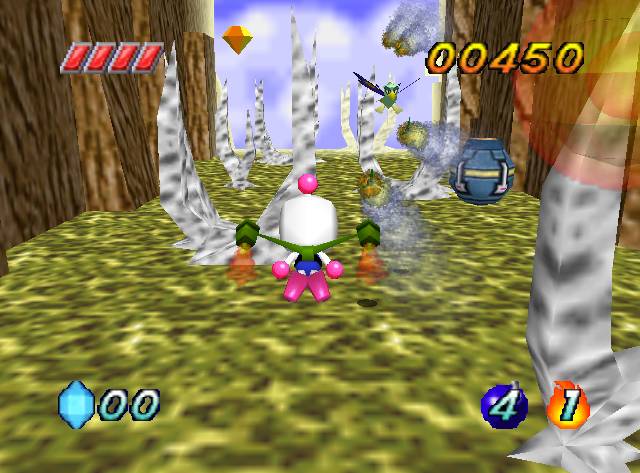
A typical gameplay moment from Bomberman Hero.
Another unexpected but welcome aspect of the game is its level design. Instead of huge sprawling sandboxes for the player to navigate, the stages are typically linear and fairly constrained, being concise and usually only requiring the player to move in one direction: forward, up, right, etc. Again, I think this works well. Each stage is bite sized and rarely overstays its welcome.
That is until you reach a vehicle stage. Bomberman Hero features four vehicles-like pieces of equipment for Bomberman to use: a jet-pack, a submarine, a helicopter, and an underutilized snowboard. While I like the helicopter alright, I don’t think too highly of the rest. They just feel awkward and a little out of place. To make things worse, the B button no longer attacks and is instead used to maneuver each vehicle in some way, which tripped me up on numerous occasions. While I can appreciate the variety they offer, these segments were a chore compared to the core gameplay.
If you squint really hard, it’s kind of like Star Fox…
Unfortunately, my grievances with this game’s design don’t stop at the vehicle stages. This game is very fond of “gotchas”. There are plenty of traps that only seem to exist to stick it to first time players, such as missiles that launch out of destroyed crates. Of course, traps aren’t a problem for cautious players who take their time to look before they leap.
There are plenty of traps that only seem to exist to stick it to first time players.
The real problem is it’s not always possible to look before you leap. The game’s camera mostly stays in a fixed position relative to Bomberman: angle and distance. Because the player’s view is so constrained, seeing what’s to the left or right or above and below is difficult. Remember how I mentioned most levels aren’t set along the Z-axis? That’s great if you want to hide the technical limitations of the game’s engine, but it leads to several situations where enemies can fire at the player before he can even see them. The game does offer some very limited camera controls: the player can rotate the camera by pressing the up, left, and right C buttons…but only while standing still. Seriously, why not just have the camera stay angled the way the player tells it to be until told otherwise?
While we’re on the subject of the game’s camera, boss battles are the one time the camera doesn’t stay in a fixed position. To the game’s credit, it tries to always keep Bomberman and the boss in the frame; the key word here is tries. For whatever reason, the camera is rather lethargic, not wanting to exceed a certain speed of rotation. That said, it works most of the time, with the constant motion only being a little disorientating. When it does screw up, however, you’ll be fighting the camera more than the boss.
At times, you’ll be fighting the camera more than the bosses.
Ending
So after traversing four planets, Bomberman finally catches up with Princess Millian. She asks Bomberman to return the disk that he apparently obtained from Pibot and was carrying this whole time. Bomberman obliges only to find out the Millian he’s talking to isn’t the real Millian and you totally saw that coming didn’t you? Well, the bad guys take the disk and use it to revive their leader, Bagular…whoever that is. Cue one more world, a boss rush, and kicking Bagular’s butt. The game ends with the princess giving Bomberman a medal and a “thank you” kiss while Pibot expresses envy.
Well that was underwhelming…If I didn’t know any better, I’d say there was some sort of secret, unlockable, true ending…
Wait, there is? Okay, now we’re talking! What do I have to do? Find all of the collectible bonus items…and get a perfect score on every level of the game?
To YouTube!
In all seriousness, it’s only worth your time if you really like the game and have the time to 100% it. The true ending amounts to nothing but a non-sequiter plot twist that extends the game by a scant three levels, one of which is a…jetpack stage. While the ending cinematic for beating the true final boss is slightly cooler, it doesn’t add anything to the overall narrative.
In the end, Bomberman Hero is great platformer that feels distinct from its contemporaries. The game’s by no means perfect, but most of the issues it has were more the result of the time it was made than poor design choices on the developers’ part, most notably the camera. Aside from the vehicle stages, the game feels very focused, with its tight controls and concise level design. In my debatably humble opinion, this is a game that deserves a spot in any N64 collector’s library.
I’m really glad I shelled out those ten dollars: finally having closure on this bizarre blast from my past is more than enough bang for my buck.
The Nintendo “Polish.” It’s a designation that we award to first-party games for having a unique and nearly indescribable quality. We know well that Nintendo is weird and quirky, creating games and marketing to customers off the beaten path of their competitors… but Nintendo is also special in the way that they develop their games.
If you or I were to fall into a coma for the next 5 years, and someone handed us two games featuring brand new IPs, one first-party and one third-party, we’d be able to tell instantly which came from the Big N.
Nintendo games have an aura, an essence, a feeling of high quality and value that is much harder to quantify than other measures seen in the typical game review like graphical fidelity, music, replay value and the rest.
Polish is something I’ve appreciated for years, and never taken the time to put into words… until now! By the end of this blog, you will know what it is about Nintendo games that sets them apart from the industry standard.
Onboarding
Most companies fail at introducing new players to their game in one of two ways. 1) Overdoing it by overwhelming the player with long, text-heavy tutorials. 2) Dropping people into their game with no information, relying on trial-and-error to be the teacher.
Nintendo strikes a beautiful balance and teaches players one concept at a time without holding their hand. Ever since the first Goomba in Super Mario Bros., it’s been clear what is harmful and what’s helpful, and most importantly: what’s expected of the player.
Menus
No one does a menu like Nintendo. I distinctly remember purchasing Scribblenauts for DS after it had won a handful of glowing awards at an E3 showing. And Scribblenauts was a revolutionary game… it just lacked that Nintendo polish, and it was apparent to me before I even got into the first level. When I tapped the “New Game” button with my stylus, the user interface didn’t react. In a moment my file was created, but for that brief second I wondered if I needed to tap the screen again. Conversely in a Nintendo game, each button you press on the menu has a tactile feel created from a combination of audio-visual cues that lets you know you’re on the right track. A good menu is warm, inviting, organized, and easy to navigate. Attention to detail at every level is a hallmark of a polished game.
Nudging
Gamers don’t like to be bossed around. Giant, flashing arrows pointing to your next destination detract from a feeling of exploration and discovery. Additionally, players do not enjoy floundering about an open world aimlessly, clueless as to the next steps needed to advance a storyline. Sadly, many developers fall prey to these corner-cutting traps. Nintendo has mastered the art of “nudging” a player from point A to point B, dropping a breadcrumb trail of hints along the way that makes you, the player, feel responsible and smart for figuring out what to do. Endless hours of QA testing is invested into these first-party titles, ensuring that there’s no way to get stuck or lost while you explore on your own, carefully avoiding preachy NPCs at the same time.
Clarity
Thanks to Nintendo’s “mechanics-first” development approach, their games start out as a single idea, and end up as a final product that promotes that idea. You can’t accuse a Nintendo game for not knowing what it wants to be, or for throwing too much at the wall to see what sticks. Playing a Nintendo game is so focused, it feels like a laser beam pointed at the bullseye of a target. This sensation can be felt as you notice the carefully pronounced spoken dialogue that never has any muffled voice-acting, the fact that your next objective is never hidden, and that each world your character enters has a pronounced theme and motif.
Bug Squashing and Delays
There’s a motto in Nintendo’s Kyoto headquarters that goes something like “We release when ready.” Nintendo fans have bemoaned many a game delay, when really we should be thanking Nintendo for pushing release dates back. It’s not like Reggie is reclining in his office, laughing maniacally that you have to wait a few more months to play the game you were anticipating. They’re a business. They’d love to put more games on shelves and rake in more money. It’s just that Nintendo is one of the few companies that chooses to bite the bullet and keep games under wraps until they’re ready for you to unwrap them. Many publishers think they can’t afford to release their title later than sooner, but the reality is, shipping unfinished products damages your reputation. Nintendo games are viewed as high value products for a reason!
Emphasis
There’s one common theme that first-party software emphasizes above all else: fun. Nintendo’s emphasis on fun is their guiding North Star that prevents them from veering off the path of polish. When gamers’ fun is prioritized, you don’t make bad decisions and put anti-consumer garbage into games like loot boxes and pay-to-win mechanics. Nintendo’s commitment to enjoyment goes hand-in-hand with their seal of quality.
Looks like we have a clearer picture of the Nintendo Polish; what it is that makes their games so unique, pleasant, and friction-free. I would be remiss not to mention that there are clear exceptions… Metroid: Other M’s Adam Malkovich constantly telling players what to do… games like the Xenoblade series that have a steep learning curve and aren’t known for their quick onboarding…
That’s why this guide to Polish was made to be a general overview. I’d welcome your take on specific examples where Nintendo did it well and when they didn’t—post them in the comments!
There are also examples of “Nontendo” developers who polished their games to a degree we’d expect from a first-party title. See: These games could pass as first party.
I think all companies should endeavor to add a bit more “Nintendo Polish” to their project!
In the coming year, as we forge into the fast-approaching unknown, may the enjoyment we derive from our leisure activities grow. Whenever those opportunities present themselves, however often or not, may they find us smiling. I hope that we find games that make us happy. For some it will be our favorite developers’ newest creative endeavors. Others will rely on retro titles revisited for the “nth” occasion. Console loyalists, PC gamers, mobile gamers, all. May 2018 be a year of gratitude for the art in our medium.
Lastly, may 2018 be the year in which we play together, more than any year before. The love of a community amplifies mirth. Join me in raising a glass (filled whatever it is you toast with). To the Crew and all other gamers out there. May we have a blessed 2018.
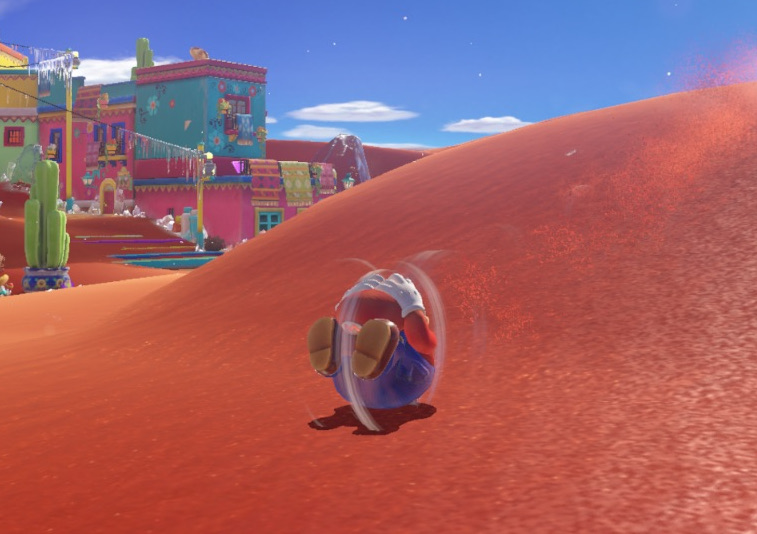
Super Mario Odyssey is out and—surprise, surprise—it’s good. As expected, Mario’s as athletic as ever, with a myriad of moves and abilities that not only elevate his already impressive jumping skills but greatly extend his lateral movement options, as well. One of my personal favorites is Mario’s new ability that allows him to curl up into a ball and roll along the ground like some sort of armadillo or hedgehog or something. It’s like some sort of…spinning dash!
Mario doing his best tumbleweed impression.
Wait a second…Great Gunpei’s Ghost! Super Mario Odyssey is the best 3D Sonic game ever!
Between the rolling technique and how Mario can preserve his speed through precise platforming, there are portions of Super Mario Odyssey that feel like the classic, momentum-based 2D Sonic gameplay in three dimensions. This is especially noticeable in timed segments such as the Koopa free-running missions where obtaining and maintaining Mario’s forward momentum by achieving fluidity of motion is essential. Much like classic Sonic, Super Mario Odyssey has a great sense of flow, which is something most 3D Mario titles can’t really boast.
There are portions of Super Mario Odyssey that feel like the classic, momentum-based 2D Sonic gameplay in three dimensions.
What is Momentum?
Okay, so before we can understand how Super Mario Odyssey achieves such an excellent sense of flow, we need to know what momentum is. In physics, momentum is the product of an object’s velocity and mass. In terms of video games, this means games that feature momentum-based mechanics have a few elements:
The protagonist has mass.
Mass implies the character has inertia.
Inertia implies the character does not instantly accelerate and the character does not instantly decelerate. Moreover, the greater an object’s momentum, the more difficult it is to alter its course.
Some games that exhibit these traits:
Asteroids: One of the earliest examples of momentum-based mechanics. The player’s ship does not accelerate instantly, but gradually, and continues to move even after the player has stopped using the ship’s thrusters. Moreover, altering the path of the ship requires substantial effort at high speeds.
Super Mario Bros.: Mario accelerates quickly, but not instantaneously. He either jogs to a stop if he is running too fast or skids to a halt when trying to change direction.
Sonic the Hedgehog: Sonic carries a lot of inertia. He accelerates slowly and must either skid to a halt or let his momentum slowly peter out.
Momentum as a Resource
In platformers like Mario and Sonic, the majority of the game’s challenge comes from executing precise acrobatics to navigate through the game’s various stages and their respective perils. Not only does the inclusion of momentum-based mechanics give the characters a satisfying sense of weight, but it adds an extra element of challenge. Because the character doesn’t move at top speed right away, building enough momentum to cross large gaps, find secrets, and ultimately complete the stage is an integral part of the game’s challenge.
So basically, in games that utilize momentum and inertia as mechanics, momentum is not only useful, but also—to some extent—scarce. This essentially makes it another kind of resource to be managed, much like health, ammo, or money. If you don’t mind the forced metaphor (all for the sake of a really cool, if not somewhat pretentious sounding, title), momentum is the currency of movement in Mario, Sonic, and similar games.
Essentially, momentum is another kind of resource to be managed.
Running with the fiscal metaphor, the value of this currency is different depending on the game: in Mario games, for instance, momentum is less critical in most situations than it is in Sonic games. That’s not to mention Sonic’s slightly slower acceleration and worse traction means manipulating his momentum takes more effort without the aid of outside forces or Sonic’s signature spin-dash—producing a greater scarcity of the desired momentum. This means that the plumber’s economy of motion has a higher saturation of momentum that has less demand than the hedgehog’s momentum, thus Mario’s momentum is generally less valuable by comparison.
Flow
With all of that out of the way, I can start unpacking what I meant by Mario Odyssey’s sense of flow. Flow—for the sake of this discussion, at least—means the smooth transition from one state of motion to another. Flow is important to games, even those that don’t heavily utilize momentum-based mechanics, though not in the way you’d think. People typically like flow, so when the player character takes damage, their flow is interrupted. This brief moment in which the player loses control and their character’s momentum suddenly shifts subconsciously communicates to the player that they’ve made a mistake.
Flow is the smooth transition from one state of motion to another.
This is why it’s typically not advisable to interrupt the game’s flow for something positive. Mario is a bit odd about this as many games do pause momentarily when the player snags a power-up, but the fact that the player’s momentum isn’t lost and instead continues a half second later may have something to do with why it’s not typically seen as an issue. But that’s really a minor nit-pick compared to the plumber’s more egregious violation of these principles: most notably the star-spin from Super Mario Galaxy and its sequel. Mario’s momentum completely stops as he lifts a short distance upward, leaving him with little ability to steer himself. This is awkward when combined with normal jumps, but it completely breaks any sort of flow when Mario is using a technique like the long jump. Mario goes from flying forward to barely having any lateral movement what-so-ever; it feels like running head-first into a wall, to be honest.
At first glance, these two moves seem similar, but they’re very different in practice.
Super Mario Odyssey does away with this in two ways. First of all, Mario doesn’t lose much—if any—forward momentum when throwing Cappy. Secondly, Mario can immediately launch himself forward with his jumping dive maneuver. Between these two factors, it’s possible for a skilled player to utilize Cappy as jump-assistance without losing his forward momentum. As mentioned in this article’s introduction, this is used to great effect in the game’s timed missions and Koopa races, where Mario has to build up speed using the rolling maneuver and then hold onto to it through precise platforming and clever use of his aerial repertoire.
While Mario Odyssey is by no means a perfect game, the controls and Mario’s own acrobatic aptitude are spot on. In true Mario fashion, the mere act of moving is fun, especially when you get into a good rhythm and can bound across the game’s colorful locales uninterrupted. It’s also interesting to see Mario take a page from Sonic’s playbook and adopt a rolling maneuver that allows him to travel faster than he can on foot at the cost of control. Hopefully someone at Sega is paying attention, because that’s an idea worth stealing back!
P.S. In case you’re wondering, this is the actual greatest 3D Sonic game ever.