Perhaps one of the greatest movements in the history of the game industry is the rise of indie development in the late 2000’s. With the advent of widespread digital distribution, increase in instructional content available on the internet, and the introduction of affordable game development software suites, such as the Unity or Unreal engines, game development opened up to be available to the general public, and not just those lucky few who managed to get hired at an established studio. Likewise, said established studios were freed from the need to secure funding from large publishing companies to keep their doors open via crowd funding services such as Kickstarter or the topically named Indie-Go-Go.
Back in August, I finally managed to complete Super Mario Odyssey. While I found much to love about it—the gorgeous and eclectic visuals, the fast-paced story, the fact that Mario is weird again, the myriad of accessibility features, etc., etc.—there was a reason it took me nearly two years to complete. While I definitely intend to replay the game’s story someday, I can say with confidence that completing it is a task I will never undertake again.
As the number of remaining moons dwindled, so too did my enthusiasm. In fact, by the end of my run, I was having more fun grinding for coins in Luigi’s Balloon World so that I could afford the last few moons needed to max out the counter than I did hunting for the ones populating the game’s various worlds. Why was that, and what could Nintendo have done differently to avoid the slog? That’s exactly what I intend to answer in this edition of Spit Shine. Read more Super Mario OdysseySpit Shine ›
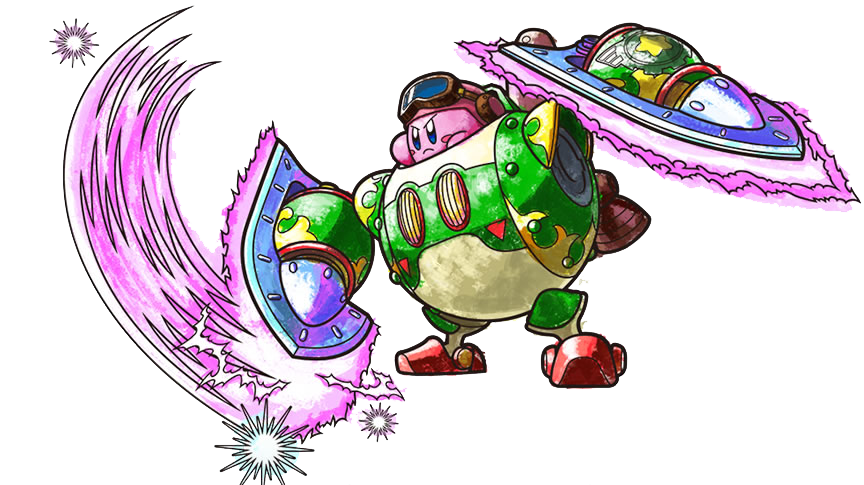
This last June, Kirby: Planet Robobot was released state-side, quickly receiving praise from critics and fans alike. Needless to say—being the avid Kirby fan that I am—I jumped on it six months after the fact because I wanted to complete Mario & Luigi: Paper Jam first. What? Grad school doesn’t leave me with much time to spend on getting through my backlog, okay? Regardless, I’d say, without hesitation, that this is the best of the “modern-style” Kirby games that started with Return to Dreamland. Great music, enough of a plot to keep things interesting, lots of fan-service, and a gimmick that actually meshes with the core gameplay instead of being an intrusive pace-killer. And as with any Kirby game, it features new powers! And they…kind of suck, to be honest.
And as with any Kirby game, Planet Robobot features new powers! And they kind of suck, to be honest.
Okay, now that I’ve gotten the requisite suck pun out of the way, let’s talk powers. Kirby’s copy abilities were first introduced in Kirby’s Adventure, released in 1993 for the Famicom and NES. These abilities gave Kirby a single attack that imitated the ability of an enemy character. The concept remained much the same until Kirby Super Star in 1996 when most—but not all—copy abilities were given a variety of techniques the pink protagonist could perform based on what button combination the player inputted. Some abilities have traditionally had very few individual attacks, while others let the player revel in a vast array of possibilities. For the most part, entries in the franchise have followed one of the two aforementioned schemes, with the Super Star style being more prevalent as well as what the recent titles use.
So, let’s examine how the evolution of this system effects powers individually and each game’s gameplay as a whole.
Number of Attacks
As stated before, the number of available moves in each ability’s repertoire has increased from the copy mechanic’s introduction. In Kirby’s Adventure, each power only had one attack (though one could argue backdrop and U.F.O. are exceptions). This allowed players to easily pick their favorites and avoid those they didn’t like. This also, unfortunately, meant that powers easily got stale and that few, if any, abilities stood out as particularly fun. Strangely, I’d argue that the game made it work; since no one power (or at the least, commonly available one) stood out as “the fun one” the player wasn’t inclined to become attached to what he currently had, meaning he would be more willing to part with it, making for more dynamic gameplay.
Kirby’s Adventure only provided one page for it’s copy ability descriptions, most of it flavor text.
Kirby Super Star changed this by assigning multiple attacks to most copy abilities. This drastically changed the dynamic as now each power became far less situational. Copy abilities on average had somewhere between four and seven attacks and a list of them was conveniently provided on the pause screen. I must commend the designers, as most of the abilities are fun to use with only a handful of duds. That said, the expanded move set does mean players are going to find some abilities more fun than others, meaning they’ll be less willing to part with them which ultimately discourages the varied gameplay Kirby’s Adventure had.
Then there’s the current generation of Kirby games. For brevity’s sake, I’m only going discuss the current gen powers featured in Kirby: Planet Robobot (and probablytotally not because I’m too lazy to switch cartridges on my 3DS or boot up my Wii). The number of moves for this new set of powers typically weighs in around eight to eleven, with a few of the attacks being variations of or similar in function to others. This produces a state of decision paralysis when trying to learn the new abilities, especially when two attacks are similar. For the majority of new abilities, I would look at the move list and think to myself, “surely there’s a proper time or context for this attack.” Unfortunately, there often isn’t, at least not that I can see. Notably, most of the older abilities are similar to their previous iterations, if not completely untouched. In my opinion, this makes the classics more approachable gameplay-wise as most of them are easier to learn with attacks that have a clear and easily understood purpose. The one new copy ability in the game I genuinely liked, ESP, happened to be the one with the simplest move set.
Coincidentally, this ability’s costume also resembles one of my favorite powers from Kirby Super Star.
Copy Ability Versatility and Variety
So what does having a wide array of moves do for Kirby’s copy abilities? In short, more moves theoretically increases the versatility of the ability. If one move allows Kirby to easily dispatch a foe in front of him and another move defeats opponents above him, the player is equipped to handle two different scenarios. There are two main factors in determining a copy ability’s versatility: range and what I like to call “angle of attack”, with the presence of a defensive ability making for a third factor of nominal importance.
There are two main factors in determining a copy ability’s versatility: range and what I like to call “angle of attack”.
Range is self-explanatory; it’s simply how far the attack reaches. Short range attacks require Kirby to be near his target to be effective; long range allows Kirby to rain cute death upon his foes from a safe distance. Simple. Angle of attack isn’t much more complicated. Heck, I’ve already given an example of it in the previous paragraph. It simply determines where the opponent has to be for the attack to hit him. In the context of Kirby, there four basic angles of attack: upwards, sideways, downwards, and radius attacks—the last of which refers to attacks that strike in all directions (they’re common enough to warrant their own classification). Of the two, angle of attack has the most influence over an ability’s versatility.
As I’m sure you’ve already figured out, the copy abilities in Kirby’s Adventure provide only one angle of attack of set range. High-jump attacks opponents above Kirby at close-range (though Kirby covers a long distance in the process), while spark attacks enemies within a short radius of Kirby. Kirby Super Star expands the role of most copy powers, allowing Kirby to make use of multiple angles of attack with a single ability. That said, most powers are still limited in range or angle of attack, requiring the player to plan around his ability’s limitations or find one more suited for the situation at hand. For the ones that do provide good coverage of all angles, they are usually rare or have some sort of drawback, like yo-yo’s long attack animations.
Here’s where my second issue with more recent copy abilities comes into play: they’re too well rounded. Most of the new abilities include attacks for every angle and often times multiple ranges too. Lacking weaknesses actually makes them less fun, not necessarily because it makes the game too easy (it’s Kirby; it’s always easy) but because they all feel very samey. Even some of the older powers have received similar revisions, like the unnecessary addition of an upward attack to the stone ability’s move list. Admittedly, this is a rather technical complaint and probably doesn’t apply to everyone.
Lacking weaknesses actually makes copy abilities less fun.
Refinement is a Subtractive Process
Despite most of its new powers not being particularly interesting, Planet Robobot actually does adhere to the limited copy ability design that I’m advocating, specifically the robobot powers. Each robobot copy ability has a very limited moveset, and as a result, each one feels unique. And just so it’s clear that I’m not being a nostalgia-blind curmudgeon, I like most the ideas for each ability (leaf and archer were long overdue), and I think if Hal streamlined the abilities so that they fulfilled a unique niche, instead of every niche, they would have some real winners.
The robobot armor’s sword ability only has three attacks. Three incredibly satisfying, easy-to-use attacks.
For those familiar with my previous work, these points probably sound quite similar to my second article, The Streamlined Turnabout. While feature-rich games and mechanics are great (especially from a marketing perspective), continually adding ideas runs the risk of producing bloat. Much like cutting and polishing a diamond to make it shine, video games can greatly benefit from the occasional trim.
About the Author: Glen is a lifelong Nintendo fan whose love of video games has inspired him to pursue a career in computer programming. He is currently studying for his masters in Computer Science at Oklahoma State University. His first Kirby game was Kirby 64, which led to a lot of confusion when trying to figure out how to make combo abilities in Kirby Super Star.
Disclaimer: I am not a doctor nor an expert on sleep disorders. This article is for entertainment purposes and should not be consulted for medical advice. If you are suffering from a sleep disorder, please consult a specialist.
It’s January again, a time of year when many people resolve to improve themselves and their lives. Long-time Nintendo fans are no strangers to the subject of self improvement. From the Brain Age games to the recent Ring Fit Adventure, Nintendo has a history spanning over a decade of releasing products to improve the health and cognitive well-being of their fan base. There was even a time not too long ago that the Big N toyed with the idea of building a third pillar to their business around the idea of quality-of-life consumer electronics. The only product in this line that we fans ever even heard about, however, was a device that was supposed to improve the user’s quality of sleep. As someone who has trouble maintaining a healthy sleep cycle, I was disappointed when they announced that the project had been canceled.
Now that I think about it, though, I’m not the only one with an odd circadian rhythm. One of Nintendo’s most iconic characters has exhibited strange and potentially worrisome sleep behaviors on multiple occasions: Mario. Ever since his landmark 3D debut, Super Mario 64, Mario has often been depicted as nodding off in a matter of minutes if left inactive. This leads to me wonder: how does he do it, and is it cause for concern? Read more Mario’s Express Ticket to SubconAn Examination of Mario’s Sleep Habits ›
I’ve mentioned it a few times on the podcast, but I love the Virtua Fighter series. Unfortunately, as a Nintendo fan, that puts me in a difficult position. See, the Virtua Fighter series has been absent from Nintendo consoles. There is, however, one noteworthy exception to this history of Nintendo exclusion: the action-R.P.G. spin-off game, Virtua Quest.
Virtua Quest was developed jointly by Tose co. and Sega AM2 and published by Sega. It was released in Japan under the name Virtua Fighter Cyber Generation: Ambition of Judgement Six on August 26, 2004 for the PlayStation 2 and GameCube. It was later released in North America on January 18, 2005. As mentioned before, it was a departure from the standard Virtua Fighter series in that the game is a beat-em-up with R.P.G. elements.
My history with this game is a little different than previous installments of That Was a Thing, as I’ve never actually played this game before. Well, not the full version at least. I knew about it way back when it first came out, due it being playable at the GameCube demo kiosk at my local Target. At the time, I thought the idea of a martial-arts-based action-adventure game was intriguing, but after seeing the middling review scores it received in the now-defunct Nintendo Power magazine, I ultimately decided to pass on it.
It wouldn’t be until a few years ago once I got into the Virtua Fighter series that I developed a renewed interest in this title. After over a year of searching, I finally stumbled across it while revisiting the GameXChange in my old, grad-school stomping grounds. Read more Virtua QuestThat Was a Thing ›
I arrived at the airport around 9 A.M. Upon entering, I was greeted by two young raccoons who immediately got to work arranging my trip. We boarded the plane not long after that. Once finished suffering a long, boring flight during which there was nothing to do except watch an informational video and avoid eye contact with the other passengers, we arrived on the island. The two young raccoons informed the other residents and me that there was an orientation meeting nearby and that our presence was requested. Needing to retrieve my tent and other supplies, I begrudgingly followed the others to what appeared to be a construction site. There a middle-aged raccoon delivered a droll and poorly-rehearsed corporate monolog. Read more Hideaway IslandAn Animal Crossing: New Horizons Narrative Let’s Play ›
The Nintendo “Polish.” It’s a designation that we award to first-party games for having a unique and nearly indescribable quality. We know well that Nintendo is weird and quirky, creating games and marketing to customers off the beaten path of their competitors… but Nintendo is also special in the way that they develop their games.
If you or I were to fall into a coma for the next 5 years, and someone handed us two games featuring brand new IPs, one first-party and one third-party, we’d be able to tell instantly which came from the Big N.
Nintendo games have an aura, an essence, a feeling of high quality and value that is much harder to quantify than other measures seen in the typical game review like graphical fidelity, music, replay value and the rest.
Polish is something I’ve appreciated for years, and never taken the time to put into words… until now! By the end of this blog, you will know what it is about Nintendo games that sets them apart from the industry standard.
Onboarding
Most companies fail at introducing new players to their game in one of two ways. 1) Overdoing it by overwhelming the player with long, text-heavy tutorials. 2) Dropping people into their game with no information, relying on trial-and-error to be the teacher.
Nintendo strikes a beautiful balance and teaches players one concept at a time without holding their hand. Ever since the first Goomba in Super Mario Bros., it’s been clear what is harmful and what’s helpful, and most importantly: what’s expected of the player.
Menus
No one does a menu like Nintendo. I distinctly remember purchasing Scribblenauts for DS after it had won a handful of glowing awards at an E3 showing. And Scribblenauts was a revolutionary game… it just lacked that Nintendo polish, and it was apparent to me before I even got into the first level. When I tapped the “New Game” button with my stylus, the user interface didn’t react. In a moment my file was created, but for that brief second I wondered if I needed to tap the screen again. Conversely in a Nintendo game, each button you press on the menu has a tactile feel created from a combination of audio-visual cues that lets you know you’re on the right track. A good menu is warm, inviting, organized, and easy to navigate. Attention to detail at every level is a hallmark of a polished game.
Nudging
Gamers don’t like to be bossed around. Giant, flashing arrows pointing to your next destination detract from a feeling of exploration and discovery. Additionally, players do not enjoy floundering about an open world aimlessly, clueless as to the next steps needed to advance a storyline. Sadly, many developers fall prey to these corner-cutting traps. Nintendo has mastered the art of “nudging” a player from point A to point B, dropping a breadcrumb trail of hints along the way that makes you, the player, feel responsible and smart for figuring out what to do. Endless hours of QA testing is invested into these first-party titles, ensuring that there’s no way to get stuck or lost while you explore on your own, carefully avoiding preachy NPCs at the same time.
Clarity
Thanks to Nintendo’s “mechanics-first” development approach, their games start out as a single idea, and end up as a final product that promotes that idea. You can’t accuse a Nintendo game for not knowing what it wants to be, or for throwing too much at the wall to see what sticks. Playing a Nintendo game is so focused, it feels like a laser beam pointed at the bullseye of a target. This sensation can be felt as you notice the carefully pronounced spoken dialogue that never has any muffled voice-acting, the fact that your next objective is never hidden, and that each world your character enters has a pronounced theme and motif.
Bug Squashing and Delays
There’s a motto in Nintendo’s Kyoto headquarters that goes something like “We release when ready.” Nintendo fans have bemoaned many a game delay, when really we should be thanking Nintendo for pushing release dates back. It’s not like Reggie is reclining in his office, laughing maniacally that you have to wait a few more months to play the game you were anticipating. They’re a business. They’d love to put more games on shelves and rake in more money. It’s just that Nintendo is one of the few companies that chooses to bite the bullet and keep games under wraps until they’re ready for you to unwrap them. Many publishers think they can’t afford to release their title later than sooner, but the reality is, shipping unfinished products damages your reputation. Nintendo games are viewed as high value products for a reason!
Emphasis
There’s one common theme that first-party software emphasizes above all else: fun. Nintendo’s emphasis on fun is their guiding North Star that prevents them from veering off the path of polish. When gamers’ fun is prioritized, you don’t make bad decisions and put anti-consumer garbage into games like loot boxes and pay-to-win mechanics. Nintendo’s commitment to enjoyment goes hand-in-hand with their seal of quality.
Looks like we have a clearer picture of the Nintendo Polish; what it is that makes their games so unique, pleasant, and friction-free. I would be remiss not to mention that there are clear exceptions… Metroid: Other M’s Adam Malkovich constantly telling players what to do… games like the Xenoblade series that have a steep learning curve and aren’t known for their quick onboarding…
That’s why this guide to Polish was made to be a general overview. I’d welcome your take on specific examples where Nintendo did it well and when they didn’t—post them in the comments!
There are also examples of “Nontendo” developers who polished their games to a degree we’d expect from a first-party title. See: These games could pass as first party.
I think all companies should endeavor to add a bit more “Nintendo Polish” to their project!
As some of you may recall, A few months ago, there was a lot of hoopla about an unofficial P.C. port of Super Mario 64. Fans had managed to decompile and reverse engineer the source code of Mario 64 and made the necessary changes to compile and run the game on Windows. So why is this such a big deal when we can already play N64 games using emulators? Conversely, what’s it matter that the games in the Super Mario 3D All-Stars Collection are emulated and not ported? What’s the difference between porting and emulating? And why would developers choose one over the other? Read more Emulation vs. Porting ›
We’ve all been there. Maybe you just entered a new shrine in Breath of the Wild or you got enough moons to go to the next kingdom in Super Mario Odyssey. Whatever game it is, you press the confirm button, eager to see what’s next, only to be met with a mostly blank screen and the words:
Now loading…
Slumping back in your seat (assuming you’re not playing at a rooftop party and sitting on the parapet), you glare intently at the message, brow furrowed. After a long and agonizing five seconds, you can’t help but wonder, “what on earth is taking so long?”
And I intend to answer just that, and many more questions, in the following article! No waiting necessary! Read more Loading Questions ›
Hey crew, we have an announcement to make. We have decided to end Two Button Crew. With the release of episode 40 of the podcast, we’ve agreed now would be an appropriate time to bring things to a close. The podcast started with an overview of The Legend of Zelda: Breath of the Wild, so it only seems fitting to bookend it with an episode on the game’s sequel, Tears of the Kingdom. That and, while the Switch is far from dead, it does feel like this generation is winding down, making this a good time to wrap things up.
We’re also not as young as we used to be. Our lives have changed quite a lot over the years and there’s plenty to keep us busy: Ryan and Scott are fathers, Simeon has moved to another state, and I (Glen) have landed a job as a game programmer. With everything going on in our lives, we just don’t have the time for this project that we used to.
Moreover, many of us have other projects we’d like to pursue. Scott has written two fantasy novels: Spire of Tyranny and Gates of Eternity. He’s also currently in talks to work on future video game-related books. I, myself, have recently started my own company, Loksi Games (pronounced Lōk-see) and published an addon for the Unity Asset Store. Additionally, I’ve also been working in my spare time on my own game. And let’s not forget Nathan has his own let’s play channel, Nathan Blake Games.
Scott and Simeon started the Two Button Crew YouTube show way back on May 21, 2015, over eight years ago. I myself have been a part of the crew for roughly seven and a half years. I can only speak for myself, but there were a slew of projects that I had planned but never got around to making: editorials, “That Was a Thing” articles, and a very ambitious Chibi-Robo retrospective where I would’ve reviewed every game in the series. Still, when I look back, it’s crazy how much we’ve done over the years:
A daily talk show with over 800 episodes
Reviews of games, books, and hardware
Blogs ranging from editorials to retrospectives and even fan fiction
Gaming live streams
Let’s plays
Collaborations with prominent Nintendo content creators including GameOver Jesse, Lucas M. Thomas, Shesez, and Matthew Taranto
Two Button Crew has been an amazing experience. Even though I know it’s the right decision, I’m sad to see it come to an end. But instead of lamenting its passing, I think it’s better to be grateful for being a part of something so ambitious, wholesome, and fun. I’m grateful for the friends I’ve made, for the opportunity to express myself, and for the knowledge that there are people out there who are interested in what I have to say. We’re also grateful for all of our fans who have supported us over the years: CrazyK, Dan Tappan, Enrique Lopez, Flapjack, GameOver Jesse, Jay Man, Liep, Matthew Mason, Paul Washke, Rachel Wakelin, SciSci, SparklingCyanide, Thierry, TmacMusic, and—of course—you.
Let’s talk about Bomberman. Introduced in 1983, the Bomberman series has established itself as one of the iconic franchises of gaming, and for good reason. Nearly every system under the sun has at least one entry in the franchise. Moreover, the series has garnered a reputation for its simple, fast-paced, top-down puzzle gameplay and is best known for its frantic multiplayer mayhem.
Bomberman Hero is a single-player, third-person, action platformer. Developed and published by the now defunct Hudson Soft, the game was released for the N64 in 1998. As with any departure from formula, fans are split on whether or not this game is any good. So why the out-of-left field platformer game? Well, as it turns out, Bomberman Hero was originally planned to be a Bonk game.
As with any departure from formula, fans are split on whether or not this game is any good.
You know, Bonk the Caveman? Anyone? No? Well, now you see why they decided to go with Bomberman instead. Point is, the Bonk series were platformers, so this game’s a platformer.
I rented this game several times as a kid, and I remember having mixed feelings about it. On one hand, I greatly appreciated the fact that—unlike Bomberman 64—I could jump freely, a hang-up I developed from my mostly platformer diet at the time. On the other hand, I remember the game feeling cryptic, alien, and everything in the game’s environments feeling just a bit off. It was both fascinating and a little off-putting.
I actually made it pretty far in, though, which was unusual for me back then as I usually stuck to the first few levels of games. Unfortunately, I never could quite beat it, getting stuck on the boss of the penultimate world. I never forgot about it, though. For whatever reason, this game stuck around in the back of my mind since my childhood. Then, just a few months ago, I stumbled across it in my town’s GameXchange for a mere ten dollars.
Ten bucks for closure? Heck yeah!
Plot
The story begins with Princess Millian and her robot companion, Pibot, escaping their home world, Primus Star. The Garaden Empire, who have recently invaded Primus Star, are hot on their heels. Turns out the princess has stolen a data disk that contains information on…something important, I’m sure, and the empire wants it back. She gets captured, but before that gives Pibot the disk and instructs him to seek the aid of Bomberman.
So it’s basically Star Wars. Yeah, I take issue with this. Not so much that they’re referencing something popular, or even outright copying it in places. It’s just that everyone parodies Star Wars. Basing a plot on Star Wars isn’t just plagiarism, it’s clichéd plagiarism! In the end, I suppose it’s ultimately harmless. No one’s going to play this game for its story anyway, and besides, who doesn’t love Star Wars?
Basing a plot on Star Wars isn’t just plagiarism, it’s clichéd plagiarism!
Where was I? Oh right. Pibot’s ship crash lands, leading Bomberman to go investigate and learn about the Garaden Empire’s activities. From there, Bomberman and Pibot travel from planet to planet trying to rescue Princess Millian, only for her to be whisked away by the empire at the last second. Rinse and repeat a la Super Mario Bros.
Yeah, something like that…
Presentation
In regards to models and textures, the game is on par with most games of the era, and the simplistic nature of Bomberman’s design works well with the graphical limitations. The environments convey the intended mood quite well for the most part, but rarely have much in terms of personality.
The real issues are technical. The game’s frame-rate dips often, especially when there’s multiple explosions on screen, which, considering this is Bomberman we’re talking about, is often. Pop-in is also a noticeable issue for levels set along the Z-axis. Such levels aren’t terribly common, however, as most of the level design is either horizontal or vertical.
The music is a whole other story. The soundtrack, composed by longtime Bomberman series composer Jun Chikuma, is probably my favorite part of this game! The drum and bass inspired soundtrack gives this game a very distinct musical identity. Moreover, the otherworldly sound of BombermanHero‘s music fits perfectly with the game’s many alien worlds and bizarre environments. My only complaint is the song selection itself is pretty slim, and of the few songs some get used way more often than others. I really hope you like the song “Redial” because you’re going to be hearing that one a lot (also, I can’t be friends with you if you don’t).
The soundtrack is probably my favorite part of this game!
Between the soundtrack and the bizarre enemy designs, my initial impression that this game was weird was spot on. I’m surprised, too. Usually when I remember a game feeling surreal or mysterious, it’s just a product of my youthful imagination and inexperience; once I revisit it as an adult, it loses that mystique and intrigue. Nope, this game definitely retains that “fever dream” flavor after all these years.
Gameplay
As stated before, Bomberman Hero is a third-person 3D platformer. Bomberman can run, jump, throw bombs, drop bombs, and kick bombs. It took awhile for me to get used to Bomberman’s controls: he not only moved faster than I expected, but felt very heavy. In retrospect, it’s not that Bomberman carries much weight, it’s that he has weight to begin with. Yep, Bomberman has just a little inertia when he moves, which actually feels really good when you get the hang of it. By the end of the game, I was using Bomberman’s momentum to do cool stuff like jump in one direction while chucking bombs in another.
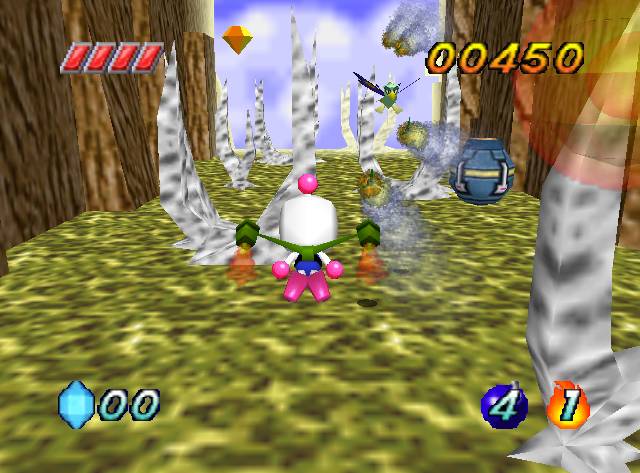
A typical gameplay moment from Bomberman Hero.
Another unexpected but welcome aspect of the game is its level design. Instead of huge sprawling sandboxes for the player to navigate, the stages are typically linear and fairly constrained, being concise and usually only requiring the player to move in one direction: forward, up, right, etc. Again, I think this works well. Each stage is bite sized and rarely overstays its welcome.
That is until you reach a vehicle stage. Bomberman Hero features four vehicles-like pieces of equipment for Bomberman to use: a jet-pack, a submarine, a helicopter, and an underutilized snowboard. While I like the helicopter alright, I don’t think too highly of the rest. They just feel awkward and a little out of place. To make things worse, the B button no longer attacks and is instead used to maneuver each vehicle in some way, which tripped me up on numerous occasions. While I can appreciate the variety they offer, these segments were a chore compared to the core gameplay.
If you squint really hard, it’s kind of like Star Fox…
Unfortunately, my grievances with this game’s design don’t stop at the vehicle stages. This game is very fond of “gotchas”. There are plenty of traps that only seem to exist to stick it to first time players, such as missiles that launch out of destroyed crates. Of course, traps aren’t a problem for cautious players who take their time to look before they leap.
There are plenty of traps that only seem to exist to stick it to first time players.
The real problem is it’s not always possible to look before you leap. The game’s camera mostly stays in a fixed position relative to Bomberman: angle and distance. Because the player’s view is so constrained, seeing what’s to the left or right or above and below is difficult. Remember how I mentioned most levels aren’t set along the Z-axis? That’s great if you want to hide the technical limitations of the game’s engine, but it leads to several situations where enemies can fire at the player before he can even see them. The game does offer some very limited camera controls: the player can rotate the camera by pressing the up, left, and right C buttons…but only while standing still. Seriously, why not just have the camera stay angled the way the player tells it to be until told otherwise?
While we’re on the subject of the game’s camera, boss battles are the one time the camera doesn’t stay in a fixed position. To the game’s credit, it tries to always keep Bomberman and the boss in the frame; the key word here is tries. For whatever reason, the camera is rather lethargic, not wanting to exceed a certain speed of rotation. That said, it works most of the time, with the constant motion only being a little disorientating. When it does screw up, however, you’ll be fighting the camera more than the boss.
At times, you’ll be fighting the camera more than the bosses.
Ending
So after traversing four planets, Bomberman finally catches up with Princess Millian. She asks Bomberman to return the disk that he apparently obtained from Pibot and was carrying this whole time. Bomberman obliges only to find out the Millian he’s talking to isn’t the real Millian and you totally saw that coming didn’t you? Well, the bad guys take the disk and use it to revive their leader, Bagular…whoever that is. Cue one more world, a boss rush, and kicking Bagular’s butt. The game ends with the princess giving Bomberman a medal and a “thank you” kiss while Pibot expresses envy.
Well that was underwhelming…If I didn’t know any better, I’d say there was some sort of secret, unlockable, true ending…
Wait, there is? Okay, now we’re talking! What do I have to do? Find all of the collectible bonus items…and get a perfect score on every level of the game?
To YouTube!
In all seriousness, it’s only worth your time if you really like the game and have the time to 100% it. The true ending amounts to nothing but a non-sequiter plot twist that extends the game by a scant three levels, one of which is a…jetpack stage. While the ending cinematic for beating the true final boss is slightly cooler, it doesn’t add anything to the overall narrative.
In the end, Bomberman Hero is great platformer that feels distinct from its contemporaries. The game’s by no means perfect, but most of the issues it has were more the result of the time it was made than poor design choices on the developers’ part, most notably the camera. Aside from the vehicle stages, the game feels very focused, with its tight controls and concise level design. In my debatably humble opinion, this is a game that deserves a spot in any N64 collector’s library.
I’m really glad I shelled out those ten dollars: finally having closure on this bizarre blast from my past is more than enough bang for my buck.
Note: The following article was written in February of 2022. As such, its contents represent the author’s opinions on the original GameBoy Advance version of Sigma Star Saga and may not be reflective of the game’s updated re-release, Sigma Star Saga DX.
Novelty is a powerful thing. While there’s value in perfecting an existing concept, the gaming public flock to new ideas like chickens to a carton of expired blueberries. There’s just one problem: coming up with new ideas is hard! One simple, time-honored trick for coming up with original gameplay hooks is to simply graft together two unrelated, existing ideas. This is the premise behind genre-mashup games. Metroidvania and first-person shooter? Metroid Prime! Mix together a third-person shooter with a real-time tactics game and you get Battalion Wars. What happens when you combine a side-scrolling shoot-em-up with an R.P.G.? You get the subject of today’s edition of That Was a Thing, Sigma Star Saga. Read more Sigma Star SagaThat Was a Thing ›