#550 – Out of nowhere, Linkle appeared and paved the way for a female Link. Simeon and Scott sit down today to discuss the issue of Link and gender. Will Linkle ever star in her own game? Should the Hero of Hyrule reincarnate as a woman in a future game? WHY NOT?
Footage credit: Direct-Feed Games
“Escape the Premises” Kevin MacLeod (incompetech.com)
Licensed under Creative Commons: By Attribution 3.0
http://creativecommons.org/licenses/by/3.0/
Are you so familiar with Nintendo controllers that you could recognize individual buttons without looking?! That’s exactly what Simeon and Scott are attempting today, while blindfoldedly shoving fingers into gaming input devices. Who will win?
“Escape the Premises” Kevin MacLeod (incompetech.com)
Licensed under Creative Commons: By Attribution 3.0
http://creativecommons.org/licenses/by/3.0/
Longtime fans of Nintendo will often reference the past fondly, maybe even going so far as to say that the company has since lost its way.
Look, I get it. We named this brand “Two Button Crew” out of our nostalgia for Nintendo’s first game console and its simple controls.
But before we continue focusing our infatuation with what has been, I’d like to pose a question: What if the Golden Age is actually now? Have you stopped to wonder if we could be experiencing Nintendo’s best efforts currently? I think so. Allow me to prove it by examining each era individually, and by the end, you might just agree!
NES
A strong case can be made for Nintendo’s debut home console. It made arcade-worthy experiences accessible in the home; revolutionary at the time. The hardware and controllers were simple and intuitive, and developers used the limitations of the day in creative ways. The resulting game library was expansive, full of memorable games that were easy to pick up, but difficult to conquer. We owe the NES generation for nearly all of the franchises we continue to enjoy.
SNES
The Super Nintendo period was one of refinement and perfection. Just as the console received a “Super” upgrade, so did each of Nintendo’s tentpole series. The Holy Trinity of Super Mario World, Legend of Zelda: A Link to the Past, and Super Metroid is a trifecta of “Best Game Ever” contenders. Titles like these succeeded by taking the formulae of previous games and maturing and enhancing them.
Nintendo 64
How we played video games was forever changed. Dimensionality increased by 50% with the introduction of polygonal 3D, and with the help of the analog stick, we were invited into Nintendo’s imaginative worlds with an all-new plane of immersion.
Another innovation must be credited to the 64: Group gaming. Yes, multiplayer modes existed previously, but this console fully realized the idea by including four controller ports and bringing people together with games like Mario Kart 64, Super Smash Bros., and the Mario Party series.
GameCube
This era was all about modernization. Nintendo’s competitors were beginning to steal the spotlight with their specs, and the Big N didn’t want to fall behind. However, they still wanted to provide the affordable alternative, so the resulting console suffered a bit of a hardware identity crisis. The upgrade from N64 was similar to the one seen between NES and SNES, where the approach remained largely the same but games improved alongside technology.
Nintendo was not afraid to experiment with software on GameCube, bringing us fresh experiences like Luigi’s Mansion, Pikmin, and Animal Crossing. Many classics from this era like Super Smash Bros. Melee, Metroid Prime, and Paper Mario: The Thousand Year Door are viewed as best-in-series games, and are begging to be played to this day.
Wii
Nintendo’s brand awareness exploded. A video game console with two letter i’s became a household name overnight, and Nintendo wasn’t ready. Production of the motion-controlled units couldn’t keep up with demand, and the company had to reevaluate their target audience on the fly. Development and marketing efforts were split between catering to core Nintendo fans and the newly-tapped blue ocean markets. It was great to see Nintendo topping the charts, but some of the decisions came across as tone-deaf to longtime Nintendo fans, like their focus on casual experiences during gaming press conferences.
Certainly, some strong titles were released during this era like Super Mario Galaxy, Metroid Prime 3: Corruption, and Excite Truck (don’t look at me like that!), but the console was crippled by its outdated, low-res graphics and weak online support.
Wii U
The misbegotten console. In a clear attempt to capitalize on Wii’s success, the branding stayed along with attempts to appeal to the casual crowd. What Nintendo did not anticipate was how sharply those users would pivot to mobile gaming. By the time Nintendo shifted their focus back to their faithful followers to deliver core titles like Super Smash Bros. for Wii U, Super Mario 3D World, and Star Fox Zero, it was too late. Slow sales lead to a lack of 3rd Party and Indie games, leaving fans to wait for 1st Party releases while Nintendo delievered the best games on its more successful 3DS handheld.
Wii U’s GamePad controller was useful for (spatially-limited) off-TV gaming, but its other implementations often got in the way of fun by splitting players’ attention across two screens. Solid software attempts weren’t enough to save Nintendo from the lack of buzz around their system. This console generation firmly knocked Nintendo off their pedestal and left them hungry.
Switch
At present day, Nintendo has launched their new console/handheld hybrid and are following it up with a stream of top-notch software. Legend of Zelda: Breath of the Wild paired with the sleek hardware made an enticing match. Splatoon 2 and Mario Kart 8 Deluxe brought the best experiences from Wii U to where more gamers could enjoy them. A level of hype surrounds Switch that hasn’t been seen since the Wii days over a decade ago, only this time… Nintendo fans are the ones generating the noise. Nintendo appears to be pulling out all the stops to support Switch with mainline entries in their top IP, from Super Mario Odyssey this holiday to Metroid Prime 4 and a Pokemon RPG in the future. If this is how the first few years look, imagine what we’ll be talking about in half a decade.
Indies love the platform… 3rd Parties are coming into the fold… Nintendo hit a real home run with this one, having crafted a console this a joy to play, feel, dock, and reconfigure.
I declare the Golden Age of Gaming… NOW! We’re living it today, The momentum that Nintendo has entered into this console generation with is insane.
Many people “got it” the instant they watched the reveal trailer. Some critics doubted it at launch, but in the time since, the console has earned its way into the hearts of many unsuspecting fans.
And I believe it’s here to stay. We will likely see more iterative updates for Switch hardware, in line with what Nintendo has always fone with their handhelds. Joy-Con XL, anyone? Switch VR Headset?
Grab yourself some games and enjoy them with friends! Nintendo’s going all in on Switch, so do the same.
Enjoy the Golden Age of Gaming.
#587 – We haven’t seen the New Super Mario Bros. games in a little while, but is that such a bad thing? Nintendo was leaning heavily into the multiplayer aspects of these games, but many gamers found it surprisingly frustrating to share the screen with their friends. Maybe Mario just isn’t a well-suited series for multiplayer. Let’s discuss it! Footage credit: TheRunawayGuys, WiiLikeToPlay
“Escape the Premises” Kevin MacLeod (incompetech.com) Licensed under Creative Commons: By Attribution 3.0 http://creativecommons.org/licenses/by/3.0/
So, you want to stream Nintendo games, huh? I don’t blame you! They make the best first party games. An incredible amount of polish and attention to detail goes into every title that the Japanese game developer publishes.
The origin of these games does bring up an interesting point to consider, however: there’s quite a big culture difference between Nintendo and many of their competitors in the market. They make weird decisions that don’t always make sense to their fans here in America, Europe, or elsewhere around the globe. Sometimes the ways that Nintendo interacts with their fans can only be described as “backward.”
Let me put it bluntly: they don’t make it easy for you to stream their content. You’re in for a bit of an uphill battle, but don’t let me discourage you! It’s totally possible to get a stream up and running for your Nintendo console.
Well – as long as we’re talking about a home console and not a portable.
For 3DS games, you’re out of luck. You basically have to have a development kit to get any kind of capture device rigged up to your handheld.
So let’s keep the discussion focused on their home consoles. And away we go!
Streaming As A Nintendo Fan
I’m about as big a fan of Nintendo as you can get. I buy everything they release and I make videos about their stuff on a daily basis. My free time is devoted to this company, which is why I hope you’ll understand when I say I’ve never even touched an Xbox One or PlayStation 4 controller. I don’t think I’ve even been in the same room as one (I need to diversify my friends).
But I hear that Microsoft and Sony fans have it a bit easier with streaming. PS4 has a share button that you just press to start your broadcast? Those guys are spoiled!
Nintendo has never catered to streaming culture. They’ve never made it easy to stream their games – it’s not built into the hardware in any way. That is… until now (hopefully!). You see, there is a Share button on their newest product, the Nintendo Switch. It’s still not equipped with built-in streaming capabilities; it only takes screenshots until a future update expands its use.
They say that some form of video sharing is on its way, so let’s keep our fingers crossed.
That’s not to say that Nintendo’s hardware prevents you from streaming – you can still arrange a setup that works. For me, I have a Live Gamer Portable device that accepts HDMI (for Wii U, Switch) and AV (Wii). It works very well, and I was able to purchase it for around $100. Not bad to get started with streaming Nintendo games!
Nintendo Creators Program
But not so fast. You see, Nintendo doesn’t like you uploading footage of their games to YouTube and making a profit on it.
There’s nothing they can really do about the ad revenue you receive as you are live on YouTube Gaming or Twitch, but they will seize the AdSense you would normally get off replays.
Your videos with Nintendo content will get flagged instantaneously – you won’t even have time to adjust your video titles, descriptions, or make them go live before they’re claimed by the Big N.
This is one of the main frustrations that Nintendo fans experience as they get into streaming. Why? Because many other companies just aren’t like this. And that’s because they view streamers as “free advertising,” which makes sense. YouTubers and streamers are what game developers call “influencers,” because they/we get the word out about video games. We play the ones we like (usually) and the audience sees us having a great time! Many publishers thank streamers for showing off their product so much.
Nintendo doesn’t see it that way. They see videos featuring their IP and decide that they should control who gets the ad money.
Thankfully, they don’t take it all. The company offers the Nintendo Creators Program which ultimately allows you to receive a portion of the profits from your YouTube videos, whether they are replays from a live stream or original content featuring gameplay property they own.
You sign up for the NCP with your Google account, and you’re faced with two options.
The Limited Options
You can either register your entire channel under the NCP banner, or you can choose to submit flagged videos individually and request part of your revenue back.
Option 1 allows you to receive 60%, and option 2 qualifies you for 50%. Keep in mind, these cuts are taken from the portion not already kept by YouTube itself.
The problem is, option 1 is basically fit for no one but Nintendo’s own YouTube channel. If you register your entire channel, you’re not allowed to feature gameplay from any other company other Nintendo.
Yep – you’re locked into Nintendo gameplay videos if you want to earn the greater portion of your revenue back.
So, inevitably, you’ll choose option 2 and submit each video flagged by Nintendo, and hope they agree to split the profit with you.
The Abysmal List
The reason I say “hope” is because not even every Nintendo game qualifies for this rev-share model. Buried within the NCP program is what they call a whitelist (link for your convenience). Games that are on this list qualify for submission!
Why Nintendo limits this list, I have no idea.
The entire Super Smash Bros. series is notably absent, which drives me nuts because it has a thriving eSports scene and Nintendo should be throwing those fans a bone. Smash players are Nintendo’s most dedicated, hardcore, loyal customers. How do I know? Because they still haul around their Gamecubes and 50 pound CRT televisions to play Super Smash Bros. Melee!
NES Remix for Wii U is whitelisted.
NES Remix 2 is not.
…What?
I’m sorry, I can’t make sense of it for you. I wish I could.
The Principal
After you jump through a few hoops, you’ll be set. Once you get past the NCP registration and the hardware setup, a lot of this nonsense kind of fades into the back of your mind as you start enjoying the games on their own merit and connect with your audience.
Should Nintendo be more understanding to streamers? Yes, they should. But they could also just seize all profits and choose not to offer the NCP, so I won’t complain too much.
The slice of advertising revenue isn’t really worth it to Two Button Crew, so we turned advertising off in favor of receiving support through Patreon. Ads aren’t the only way to make money playing games!
I don’t want to worry about the ad revenue – I just want to have fun playing Nintendo games and making friends with my viewers. Like I said, I’m a dedicated Nintendo fan. I run a YouTube channel that puts out daily content – discussions, reviews, streams – you name it. Check us out at Two Button Crew – we cover the latest developments in the Nintendo sector every single day, and we have literally hundreds of videos for you to browse in the backlog! We’d love to see you around and welcome you to the Crew.
Maybe Mario party 15 will finally be good at this pace!
#591 – Mario Party is a floundering series. Numerous sequels hit store shelves in regular intervals, and Nintendo has been experimenting lately with its formula, hoping that the next game would be the one to solve the series’ declining popularity. Unfortunately, Nintendo has yet to strike gold since basically Mario Party 3 on the Nintendo 64. Simeon and Scott are here to diagnose the problems and figure out what Mario needs to do in order to get back to partying in earnest!
Pre-high-speed internet culture may be foreign to you, and we may be nostalgic, but we’d never go back.
#520 – Unlocking stuff used to be the highlight of the gaming experience. It was like finding a buried treasure with each new character or stage discovered. Nowadays, especially with party games, the hunt is less and less exciting. Should Nintendo keep this pattern?
Footage Credit: Super Smash Bros. – The Co-Op Clan | Mario Kart DS – Thomas J. Ashwell
“Escape the Premises” Kevin MacLeod (incompetech.com) Licensed under Creative Commons: By Attribution 3.0 http://creativecommons.org/licenses/by/3.0/
The Legend of Zelda: Breath of the Wild is huge. Not just in terms of the scale and scope of the world it presents to players, but also in terms of its reception in the gaming industry. It’s received numerous perfect scores from critics and the Switch version of the game has reportedly sold more copies than the Switch itself. It’s a big flipping deal, and yet…I couldn’t throw myself into it. In the first episode of The TBCast, I stated that—while I thoroughly enjoyed this game—it didn’t even rank in my top three Zelda games. While I aired several of my grievances with the game’s design in that discussion (some of which will be making an encore appearance here), I never got around to going into detail on my biggest complaint about how the game was structured. But before I can explain what that hang-up is, we need to discuss a concept important to game design and narrative media in general.
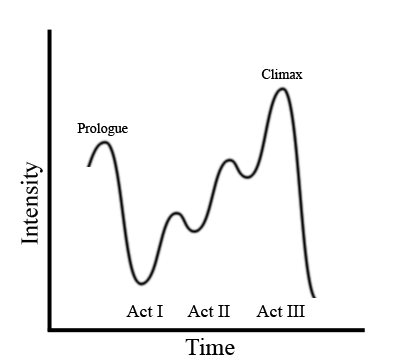
Ladies and gentlemen, I present to you the interest curve! An interest curve is a graphical representation of the excitement and engagement the audience of a work experiences throughout the duration of said work. The peaks of the curve represent moments of high excitement and intrigue, while the lows represent the story’s slower, quieter moments. While lows sound like they should be avoided, an optimal curve actually alternates between highs and lows, never staying in one or the other too long. The reason for this is that human beings (who are most game developers’ primary demographic) tend to get acclimated to things pretty quickly. Even action can get boring or even tiresome if there’s too much of it.
A depiction of an idealized interest curve. Note how it starts with a bang, alternates/rises in the middle, and includes falling action at the end to provide closure.
That’s not to say that interest shouldn’t slowly increase over time. The base level of interest—that is to say, how far down the graph dips—should increase as a game progresses. If the graph dips down further at the end than it did at the beginning, then the game feels like it screeches to a halt, thus killing the player’s sense of progression (*cough* Triforce pieces *cough*). Finally, the story shouldn’t end on the climax, but instead include a gentle falling action to give the player a sense of closure—commonly known as the denouement (pronounced day-noo-Maw…it’s French). Without a denouement, a story’s ending feels abrupt and rushed.
If you’ve ever heard a reviewer talk about a game having a good “gameplay cycle”, he or she is referring to this concept—most likely without even realizing it!
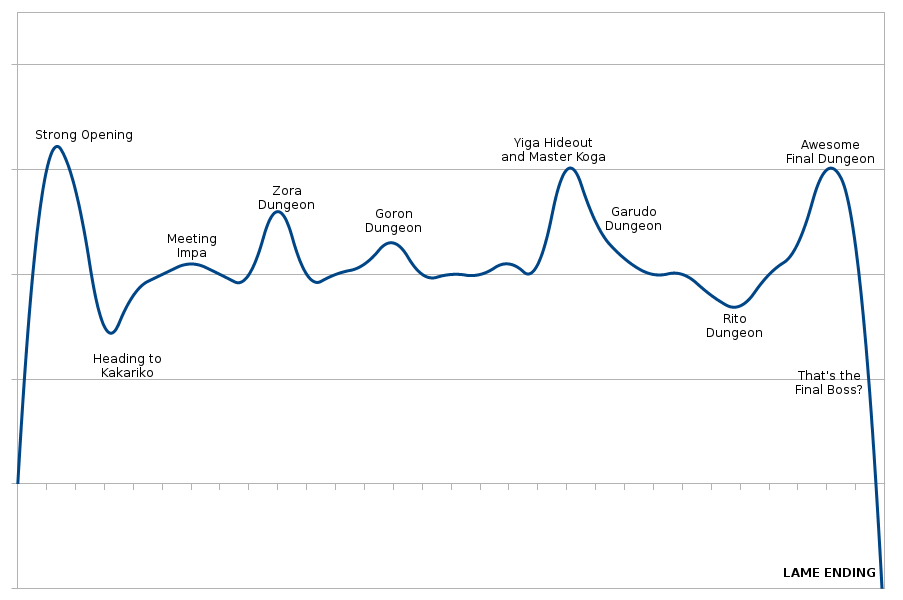
So what’s all this have to do with Breath of the Wild? Well, my primary issue is its interest curve looks something like this:
NOTE: The time between dungeons has been greatly compressed for the sake of legibility. Just increase them by a factor of five or six and you should be good.
Oh gosh, this is a mess…After a great introduction, everything just sort of flatlines. Now to be fair, this is based on my personal experience with the game, but even when the order of events are swapped around, I think this pattern basically holds true. The game’s overall arc seems to just maintain a complacent constant; there’s very little escalation, evolution, or extrapolation of the ideas the game presents. This ultimately leads to the game feeling repetitive.
The game’s overall arc seems to just maintain a complacent constant…
So what happened? What are some ways that Breath of the Wild hamstrings its overarching interest curve? What could they have done better? Let’s take a look, shall we?
The Main Quests
The easiest way to create a good cycle of engagement is to carefully craft a brilliant narrative and guide the player through it in a thoughtfully paced linear sequence…the whole point of Breath of the Wild is to not do that. That’s not necessarily a bad thing, however. My favorite Zelda game, The Legend of Zelda: a Link Between Worlds, was at the time of its release notable for being very open-ended. And that game had me hooked the whole time! So clearly, a carefully guided plot isn’t necessary.
That said, there are some notable differences between the the overarching structure of BotW and ALBW. For starters, A Link Between Worlds keeps the series’s usual two-part structure: in this particular instance the first half taking place in the light world, then after a plot twist the second half takes place in the dark world. This means that while the story doesn’t advance much throughout the halves of A Link Between Worlds individually, the events that link both halves of the game still give it the opportunity to raise the stakes of the game’s narrative thus raising the interest curve’s baseline mid-game. This compromise allows the player to pick how he wants to complete his adventure, while simultaneously ensuring the narrative escalates in a natural fashion.
Breath of the Wild, on the other hand, doesn’t follow this two-act structure. Instead, it features a main quest primarily consisting of two parts: awakening the Divine Beasts and the search for Link’s lost memories. Let’s start with the Divine Beasts. The Divine Beast quest is fairly modular, what with each part technically being optional. This means each segment aims to have a similar level of challenge and importance to the overall plot, consequently flattening the interest curve. While A Link Between Worlds‘ dungeons faced a similar issue, as stated before, having a discernible half-way point lets the game escalate the challenge and perceived stakes between the first half and the second making for a more engaging narrative, something Breath of the Wild‘s structure doesn’t.
Another trick A Link Between Worlds used to keep players from noticing the fairly steady baseline engagement throughout each act was the number of dungeons to complete. The concept of an interest curve is scalable, meaning it can apply to a level or chapter as well as a complete work. To this end, dungeons act as climaxes for the (for lack of a better term) chapters of the game they appear in. With several dungeons, the player is constantly experiencing the rising and falling action of finding a dungeon, completing the requirements to gain entry, and then clearing the dungeon and slaying its boss. So long as this cycle isn’t repeated too many times, this cycle sustains the player’s interest until he completes all of the dungeons and moves on to the next plot arc of the game. The problem is that the dungeons in Breath of the Wild are both short and very few and far between. This means that this part of the game is either over too quickly, or these local engagement highs are very spread out (as they were when I played the game).
The concept of an interest curve is scalable. To this end, dungeons act as climaxes for the chapters of the game they appear in.
Compounding with these issues are how the memory quest is presented. If the player follows the early quests in the manner the game suggests, he’ll quickly wind up with both the Divine Beast quest and the lost memory quest at the same time. They’re both very lengthy and the benefit of the latter is never really made clear (Spoiler: it changes the game’s ending and little else). This makes it hard for the player to prioritize which one to attempt first. I think the developers wanted players to search for memories intermittently (which is how I completed it), but this makes both quests feel very disjointed, unfocused, and the memory quest far less consequential to the overall experience. Honestly, I think the memory quest should’ve been saved until after the player completed all of the Divine Beast quests: by that point, the player would already be very familiar with Hyrule’s landmarks, making for a shorter quest that required the player to apply their knowledge, instead of one where they wander around looking for the N.P.C. that tells them where to look. It also would provide a makeshift second act, which would give the player a better sense of progression, pace, and momentum.
Anticlimax
Okay, on a macro scale, the game only manages to provide a complacent sense of pace, but the interest curve is a scalable model, right? So, how does it fair on a more granular level. Well…it is admittedly better moment to moment, but even then there are times where it outright shoots itself in the foot. Some of the moments of the game that should be exciting, epic, or climatic were memorable precisely because of how underwhelming they were when they play out.
Case in point, the Master Sword: in all prior Zelda games in which the “blade of evil’s bane” appears, getting the darn thing was a major plot point and consequently required some effort on the player’s part. As a result, it’s a big moment. In Breath of the Wild, the only real challenge is figuring out how to get to it. The game does provide some cutscenes upon discovering it and after obtaining it to try to hype it up, which is a good start, but the method in which the player does obtain it feels tacked on, like the quest was an afterthought.
Cutscenes are no substitute for a good quest. If I didn’t have to work for it, I don’t feel like I’ve earned it.
Previously, the player had to collect some items that represented the three virtues of the Triforce—power, wisdom, and courage—to prove their worth, but in this game all they have to do get enough hearts to pull the sword out of its pedestal without dying (it drains hearts to attempt). For any player that is actively looking for shrines, that’s something that’s going to happen in normal gameplay regardless. This means the quest for the Master Sword could be over as soon as the player finds where it’s hidden. This makes the quest’s pacing lopsided and its conclusion anticlimactic, especially for players used to the way previous games devote large portions of their respective stories to acquiring the Master Sword. Instead of an epic moment of triumph that’s built up to, it’s something on the player’s laundry list to be checked back on periodically. “Am I strong enough? No? ‘Kay, see ya after another four shrines!”
To make matters worse, there are three shrines dedicated to said virtues hidden throughout Hyrule. Why didn’t the game include those in the quest to get the Master Sword? I’d guess it probably had something to do with time constraints, but it still feels like a missed opportunity to provide a memorable and unique quest to the player. How much cooler would it be to have to scour the land to find the shrines and overcome a unique trial for each shrine related to the its respective attribute? Now I know some of you are probably saying, “but it’s a callback to the first Zelda,” to which I say, “so?” If the callback is really that important, they simply could’ve just done both methods.
Speaking of weapons, weapon durability also brings with it problems. While I admit finding new types of weapons is exciting, finding weapons themselves gets boring, especially in the game’s second half. One of the exciting aspects of finding a new weapon or item in previous Zelda titles was the understanding that Link was now innately more powerful. He had a new ability that made him more capable in combat or exploration that opened up new possibilities for the rest of the game. Not so in Breath of the Wild. That excitement quickly fades as the player realizes that the shiny new weapon he found will eventually break. In essence, weapons are just temporary power-ups like mushrooms or fire-flowers in Mario. Consequentially, players ultimately have less attachment to—and thereby less investment in—weapons than they would if weapons didn’t degrade.
In essence, weapons are just temporary power-ups like mushrooms or fire-flowers in Mario.
As a point of comparison, let’s examine clothing. Unlike weapons, clothing doesn’t break. This immediately makes clothing a more interesting item as it stays with the player as long a he wishes to keep it in his inventory. More over, it can be upgraded. This adds an element of mystery and intrigue to clothing as certain items gain additional bonuses when upgraded to a certain point. As a result, receiving clothing is exciting and immediately gets the player invested.
Now, I understand why the developers made weapons break. As several critics and apologists have already pointed out, having weapons be fragile forces the player to experiment with different weapon types and thus learn to be versatile in his fighting style. Again, I think a compromise would be fairly easy. Simply let the player find (after much effort) weapons that don’t break. Unlike other weapons, however, they would start off weak and need to be upgraded to be viable against the game’s stronger opponents. Even then these unbreakable weapons would only be upgradable to the point of straddling medium and upper tier, meaning if the player wanted to deal serious damage or utilize special effects (like elemental damage) he would have to stick to breakable weapons. See, that would at least make some of the weapons worth a darn!
I’d like to end this section with the ending. Don’t worry, I’m not going into specifics…because I don’t have to! If you’ve ever beaten a Zelda game before, I don’t think I can spoil this ending. It hits all of the beats, except—unlike other Zelda titles—it adds almost nothing of its own to the mix, making it feel more like the skeletal framework of a standard Zelda ending. It’s lackluster, boring, and predictable. It’s a real shame too, because pacing issues aside, this is otherwise one of the best written Zelda titles to date.
If you’ve ever beaten a Zelda game before, I don’t think I can spoil this ending.
Variety
Yet another way to keep the player engaged is to provide variety. As stated before, humans get acclimated to stimulus very quickly, so anything monotonous quickly loses people’s interest. To this end, Breath of the Wild features a huge world full of varied environments and unique landmarks…but then completely gives up when it comes enemies and shrines.
Three of the game’s main enemy types—bokoblins, moblins, and lizalfos—are basically all just variations of the same template. Moreover, each region just reuses variations from the same small pool of enemy types. While combat isn’t the main draw of the game, the fact that a hoard of monsters on one corner of the map looks and acts almost identical to a hoard of monsters on the complete opposite side of the world-space makes engagements incredibly boring and repetitive. Heck, even all of the dungeon bosses are basically palette swaps of each other! What makes this especially strange is that there is a lot of variety from region to region when it comes to flora and fauna. What gives, Nintendo? You clearly were able to populate each region with unique creatures. Why not extend that creativity to the enemy design?
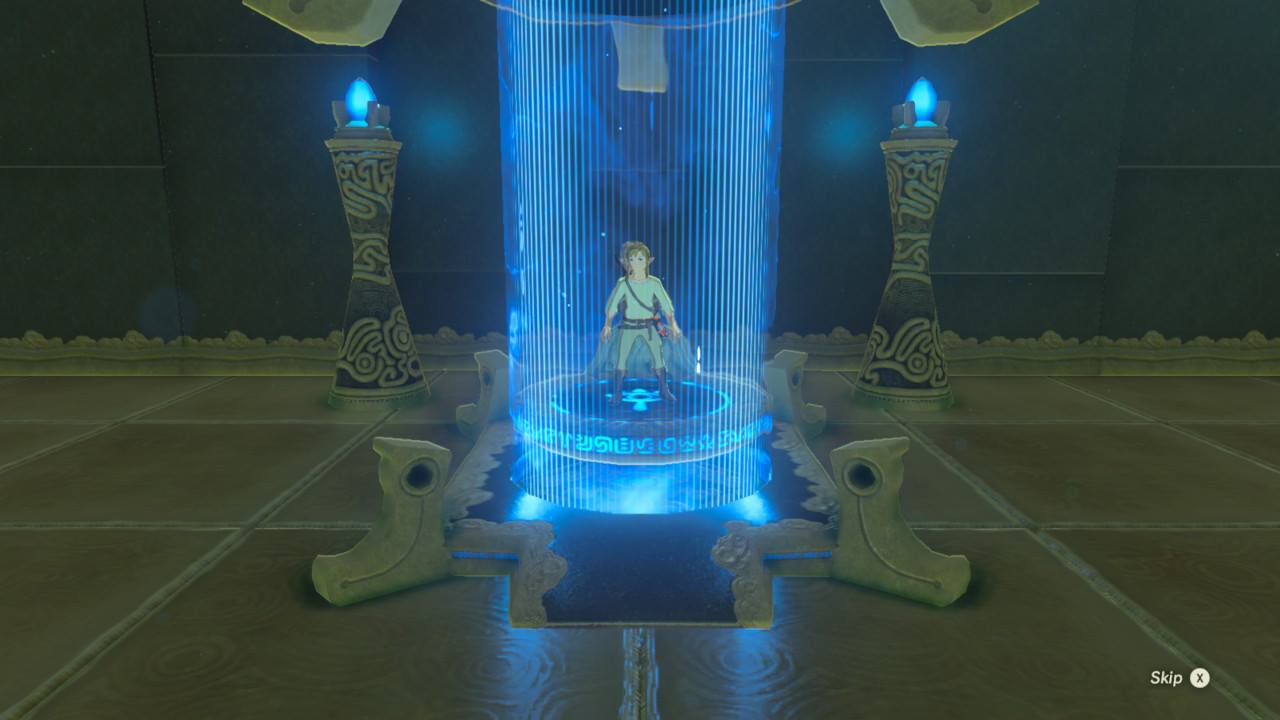
Then there’s the shrines: they all look and SOUND THE SAME! *Ahem* Excuse me. If you’re an O.C.P.D. completion-nut like yours truly, you will get sick of the foggy blue corridors and slow, ponderous music of the shrines. If you complete all the shrines, you will have heard that stupid shrine theme at least 120 times! That’s not to say there isn’t variety in the puzzles; oh no, the shrine puzzles are great. But would it kill them to come up with more than one shrine aesthetic? Maybe have puzzle shrines and combat shrines differentiated by their visual and audio design. Or perhaps have the shrines’ interiors vary from region to region, showing that even though they were all built by the Sheikah, each regions’ sense of aesthetics subtly influenced the shrines’ construction (that’s just good world building).
Despite an excellent variety of puzzles, every shrine looks exactly the same.
The Consequences of Heroism
Now that I’ve ticked off all of the Zelda fanboys, undoubtedly invoking the wrath of their Yiga assassins, let me talk about something Breath of the Wild did right—at least part of the time. Something that I love seeing, especially in open-world games, is the game’s world responding to my actions. A while back, I praised the first Battalion Wars for making me feel like my actions had a direct impact on the game’s progression. This is a concept I like to call “letting the player happen to the world.”
In most games, the player is an entity that reacts to the game’s environments (i.e. “the world happening to the player”). This is fine for level-based action games, but in narrative-heavy adventures or open-world games, this tends to make the player’s actions feel inconsequential—like everything is basically just meaningless busy-work. While I still think Breath of the Wild has room for improvement in this regard, it does at least actively contextualize many of the player’s actions.
I want to happen to the world, not let the world happen to me.
First, there’s the Divine Beasts themselves. After clearing an area’s dungeon, not only does the disaster afflicting the area cease in typical Zelda fashion, but the Divine Beast become visible for miles around. Next is the fact that the items and enemies scale in proportion to how far the player is in the game. These both give the game a much needed sense of progression. That said, I wouldn’t say either is anything mind blowing. Because the effects of the Divine Beasts are almost entirely localized, finishing a dungeon only really effects the region it’s found in. It would be far more interesting to see characters start to wander around more and more as Link made Hyrule safer to travel. For instance, wouldn’t it be cool if a Rito merchant showed up in Hateno Village after finishing the Rito dungeon? If they threw in a line about him feeling more at ease traveling now that the Divine Beast was no longer rampaging, it would go a long way toward giving the player a sense that his actions actually matter.
A great example of what I’m talking about would be the Yiga Assassins. At one point in the Divine Beast quests, the player has to infiltrate the Yiga H.Q. Not only is this section a great set-piece on its own merits, but it triggers a change in the Yiga’s behavior. After defeating their master, Kohga (one of the best characters and certainly the best boss in the game), the Yiga assassins go from passively waiting for Link to stumble into ambushes to actively hunting him down in an attempt to get revenge. While I’m sure many players found the constant random ninja attacks annoying, the fact that a specific action I took had a logical effect on the way a certain class of foe behaved absolutely delighted me!
No wonder the Yiga want to avenge him: this guy was awesome.
A Game of Little Moments
To Breath of the Wild‘s credit, it does a much better job of creating and maintaining a healthy interest curve on a more granular level. Individual quests, shrines, and subplots are well structured when viewed on their own, leading me to my conclusion that Breath of the Wild is a game of little moments. Despite the grandeur advertised, the game’s best moments come in small packages: the little references, the ways it rewards out of the box thinking, the clever quest design, surprisingly mature writing, etc.
That said, it still fails to feel like it grows or evolves. From my experience, this is actually a pretty common issue with open-world games. While the individual components work well, they don’t come together in a cohesive fashion. That said, compared to the other (admittedly few) open-world games I’ve played, Breath of the Wild really is a cut above the rest. I don’t mean to convince anyone that this game isn’t good. Heck, I’ll say it just to be clear: go play it if you haven’t already. It’s worth your time. But I fear all of the critical praise and 10/10’s may gloss over the obvious (to me, at least) issues that need to be addressed in future games. As I see it, the series is standing on a precipice: from here it can either take off soaring or tumble into another rut.
#537 – Video games… kind of an expensive hobby, no? Ever wondered if gaming used to cost more back in the day, or if the prices have only gone up? When you take inflation of the US dollar into account, the information is quite interesting!
“Escape the Premises” Kevin MacLeod (incompetech.com)
Licensed under Creative Commons: By Attribution 3.0
http://creativecommons.org/licenses/by/3.0/
We think Kass will be playing an instrumental part in finding the game’s shrines!
At the Game Awards, Nintendo’s Reggie Fils-Aimé took the stage and introduced a brand new look at the upcoming Legend of Zelda: Breath of the Wild for Wii U and Nintendo Switch. We couldn’t be more excited about this game, so getting the all-new trailer AND Let’s Play video from the Treehouse was a big treat. We’re here to pick apart the footage and bring you our favorite discoveries!
Shot by Alex Campbell
“Escape the Premises” Kevin MacLeod (incompetech.com) Licensed under Creative Commons: By Attribution 3.0 http://creativecommons.org/licenses/by/3.0/
Maybe Nintendo will make a Nintendo Reacts video to our reaction video reacting to their Making Of video!
Nintendo put out a short series of videos documenting the development process of their latest and greatest title: Legend of Zelda: Breath of the Wild. We watched all of them and took down some notes to discuss, like what the biggest takeaways were and what some of the coolest ides were that got cut from the final game. Did you enjoy this behind-the-scenes look from the Big N? Let us know in the comments!
“Escape the Premises” Kevin MacLeod (incompetech.com) Licensed under Creative Commons: By Attribution 3.0 http://creativecommons.org/licenses/by/3.0/
Contrary to popular opinion from the outside, being a Nintendo fan is not always mushrooms and sunshine. It can be unforgiving, inviting ridicule from fellow gamers, the gaming community, message board commenters, and even friends and family. But being a Nintendo fan is always worth it for me, which leads to the question I get a lot: Why Do You Like Nintendo?
From Sega to Nintendo
My gaming history stretches back to the glorious 16-bit Console Wars between the Nintendo and Sega. I owned both, but I got more use out of my Sega Genesis because kids at school would make fun of me if they knew I liked Nintendo. Sega was cool. Sega was hip. Sonic was fast with attitude and Mario was slow and boring. Secretly, I liked Nintendo as well, but my heart was with Sega. I also owned a Nintendo 64, but I had a Sega Saturn as well and that was my priority. This lasted all the way until the Dreamcast was discontinued, and my gaming tastes defaulted back to Big N.
The current console at that time was the GameCube, which ended up being Nintendo’s second lowest selling home console in history. Sony’s PlayStation brand and Microsoft’s Xbox were the new hip kids on the block, and Nintendo was accused of being a kiddie machine. Outside of a few games that were geared towards a mature gamer – like the then-GCN exclusive Resident Evil 4, Geist and a few others… the GameCube got most of its milage out of family friendly games. If you didn’t like twenty Mario Party games, the GameCube was not for you.
But it was during this era something was rekindled inside me. While Sony and Microsoft began to push online gaming, Nintendo doubled down and continued to focus on the fun of couch multiplayer – games you can play with friends in person and have a blast.
During the very successful Wii era, Nintendo’s dedication to multiplayer games was at its peak. Wii Sports, perhaps the best pack-in game ever, was a prime example of the kind of fun video games could represent. Despite how much it can be ridiculed now, I defy anyone to say that their first few times playing Wii Sports was not fun. It was a lot of fun. That’s what propelled the Wii to sales of over 100 million worldwide.
The Wii U somewhat faltered in this aspect, but the new Switch console has put a heavy emphasis on it again, with games like Mario Kart 8 Deluxe, ARMS and Splatoon 2 all out within the first few months of the system’s debut. Gaming is fun again.
Soooo, Why Do I Love Nintendo?
All that being said, I love Nintendo because, to me, it just represents a good time. When I think of the PlayStation 4 or the Xbox One, I think of shooters like Call of Duty or games like Grand Theft Auto. I’m not saying those games have no worth, or that they aren’t entertaining or even visually astounding… but when I want to just have a fun time with friends, or a game I can just pick up and play at any given moment without an investment of 40 hours a week I choose Nintendo. Gaming shouldn’t always feel like a chore where I am punching a time clock to advance.
Certainly, Nintendo does have games that fall into that category. The recent and highly-reviewed The Legend of Zelda: Breath of the Wild does for sure as it is an adventure game much in the style of Skyrim, but where I feel Nintendo separates itself from its competitors is how that genre of games isn’t all they have. There are more than just adventure and sports games on the Switch this year. There is also fun.
Take a very simple game like Snipperclips, a co-op puzzle game in which you play as pieces of paper and you have to snip each other in order to match certain shapes or get objects from one side of the screen to the other. It sounds simple enough, but its magic is in the gameplay. I haven’t had so much fun in a co-op game in a long time… it was fun, funny, and charming – and challenging as well, as the game progressed. It’s a game that you and your significant other can play, or your younger sibling or cousin. It is the epitome of what beloved Nintendo President Satoru Iwata always believed video games should be – It’s fun for everyone.
Nintendo’s roster of happy characters and cute enemies just bring a smile to my face. I’ve used this word before, but looking at the E3 trailer for the upcoming Super Mario Odyssey is just pure magic. It is what I call “Nintendo Magic.” Playing their games can make anyone forget their troubles for an amount of time and make everyone feel like a kid again. Personally speaking, I struggle with depression and anxiety, so my choice to play games of this nature is not only a preference but a very meaningful choice as well. Nintendo makes me smile.
Their first-party games are consistently of very high quality. Sometimes their franchises don’t progress enough, but then they hit you with a Breath of the Wild or a Super Mario Odyssey, which completely changes your expectations and takes you by surprise. And I will never get tired of them.
Standing Strong
It isn’t easy being a Nintendo fan. When the two other major consoles are blowing the doors off the building with the latest Call of Duty, Metro or Assassin’s Creed games, Nintendo creates buzz with Mario or cartoonish characters like in ARMS. This comes with a price, because Nintendo and their fans are easy targets. Buying some Nintendo content can result in a mocking comment from a cashier – a friend recently told of a McDonald’s cashier laughing when he went to order a Mario Happy Meal toy to complete his collection. Playing Nintendo games can mean ridicule from people who like to point out that Nintendo’s consoles dating back to the Wii have not been in the same league as competing systems as far as power and graphics.
All of this, though, can make fans even more dedicated. There is a reason that small groups popped up around the world in major cities for 3DS gamers to swap streetpasses and puzzle pieces and play Mario Kart 7 with each other. There is a reason why holding a meet-up for the newest Animal Crossing game attracted more than dozens of people at every stop during a Nintendo Mall Tour. There is a reason why VANS made a very successful line of Nintendo themed shoes last summer. There is a reason why people love their franchises so much that just a simple title card for Metroid Prime 4 at E3 made the internet meltdown in a frenzy of wild, screaming excitement. There is a reason why people love the company so much that even PR reps (like Bill Trinen or Kit and Krysta from Nintendo Minute) are elevated to near-celebrity status. There is a reason that Nintendo can get away with having one single retail store in New York City and fans will travel from all over to visit it as if they were going to Disney World. The ridicule and snubbing we tend to get from other gamers and game publishers who skip developing games for Nintendo systems just makes me feel like connecting with other Nintendo fans is a major event. We are a community of fans who feel slighted in one way or another, and it makes us feel like we are all in this together. It is so much fun to get in a group of fellow fans and just talk about anything and everything. Attending a Nintendo Switch Preview Event in Chicago this past February was fun in part because of trying out the then-yet-to-be-released system, but largely because of being surrounded by fans, talking about games, seeing people dressed up in Nintendo cosplay, and just being one with the excited community. It was not unlike the feeling you get going to a Comic-Con – it just felt right.
Nintendon’t Sometimes, and That’s Okay
This is not to say that competing systems don’t have dedicated communities or “fun” games, nor does it mean that Nintendo is perfect and doesn’t have any faults. But Nintendo doesn’t play by anyone’s rules but their own. Sometimes that can be a bad thing, but I feel it is mostly a positive. They focus on fun, they focus on being together, and they focus on gaming together. There is a level of fun that online playing just can’t compete in comparison to couch multiplayer. Hitting someone with a red shell in Mario Kart, or stealing all of their stars in Mario Party may be the source of “ruined friendship” memes, but the competition of playing right next to a friend is just a level of satisfaction that can’t be matched. Even though I enjoy a fair share of “mature” games, I will almost always choose the fun of Super Mario Odyssey over the carnage of a Grand Theft Auto. And I will definitely choose a company that will always continue to offer those games to me even when they offer the M-rated stuff.
The Nintendo Magic is why I fell in love with Nintendo. It’s why I put up with some of their occasionally questionable decisions. Their games, characters, and universe just never cease to make me smile and it makes me happy… and isn’t that what gaming is supposed to be about?
Eric “Flapjack” Ashley has been a Nintendo fan for almost his entire life! While he also has a special place in his heart for Sega, it is Nintendo that gets him worked up and the franchises that capture his imagination and wonder. Flapjack is hopelessly in love with Animal Crossing. When he is not playing video games, he is a social media guru, assisting numerous organizations with their outreach and promotions, and he is also a big horror movie buff. Follow him on Twitter and Instagram: @flapjackashley.
Season pass used to be a bad word – now Nintendo’s saying it all the time!
Breath of the Wild may be receiving perfect scores from around the industry, but its recent DLC expansion pass announcement was not met with as much enthusiasm. Simeon and Scott take a look at Nintendo’s downloadable content track record today before discussing the promise of added content for Link’s newest adventure. How are you feeling about the opportunity to pay to play more of Hyrule’s open world? Sound off in the comments below!
Shot by Alex Campbell
“Escape the Premises” Kevin MacLeod (incompetech.com) Licensed under Creative Commons: By Attribution 3.0 http://creativecommons.org/licenses/by/3.0/
It’s nothing personal, Wii U… it’s not you, it’s us.
As we discussed yesterday, with a brand new console coming (expensive in itself), it’s also accompanied by many accessories and other opportunities to spend your hard-earned cash. Well, that money needs to come from somewhere, so what about selling your older games and consoles… say… your Wii U? Will you really be playing it anymore? Does it really have THAT many truly exclusive games? We’ve collected the definitive lists of pros and cons – watch, then make up your mind and proceed with confidence! Shot by Alex Campbell “Escape the Premises” Kevin MacLeod (incompetech.com)
Licensed under Creative Commons: By Attribution 3.0
http://creativecommons.org/licenses/by/3.0/
For the low low price of $250, YOU TOO can wait in line at E3 2017!
Two big pieces of news recently exploded on to the scene for Nintendo fans! E3 is being opened to the public?! Zelda Breath of the Wild is getting a season pass for DLC? What world are we living in, anyway? We’re here with our impressions on the news. Is E3 worth paying $250 to attend? Did Nintendo mess up with their announcement of the Zelda DLC by debuting it too early? All these thoughts, and more, inside the video!
Shot by Alex Campbell
“Escape the Premises” Kevin MacLeod (incompetech.com) Licensed under Creative Commons: By Attribution 3.0 http://creativecommons.org/licenses/by/3.0/
Breath of the Wild is gearing up to take even more of our money! Ooh boy!
DLC is just a fact of life now! The gaming industry has fully adopted the post-launch expansion practice, and Nintendo is finally on board. We’re not too far off from our first dose of expanded Zelda content, so let’s start dreaming of what it could be like!
“Escape the Premises” Kevin MacLeod (incompetech.com) Licensed under Creative Commons: By Attribution 3.0 http://creativecommons.org/licenses/by/3.0/
Wait until you get to the part of the review where Simeon talks about the phase… glitch… gun… zapper-thingy.
Simeon has the full scoop on the Metroid-like Indie game called Axiom Verge. It’s available for Wii U and it just may be worth your time – watch to get his complete impressions!
Shot by Alex Campbell
“Escape the Premises” Kevin MacLeod (incompetech.com) Licensed under Creative Commons: By Attribution 3.0 http://creativecommons.org/licenses/by/3.0/
Can you imagine what we’d do if we just beat the game while making this episode… accidentally?!
Can we make it into Ganon’s castle, with only early-game items and armor?! Ryan, Simeon, and Scott take turns with the pair of Joy-Con to see what they can do against the Malice and Guardians. Spoiler disclaimer: We approach the endgame, but do NOT meet the final boss.
Shot by Alex Campbell
“Escape the Premises” Kevin MacLeod (incompetech.com) Licensed under Creative Commons: By Attribution 3.0 http://creativecommons.org/licenses/by/3.0/
The Legend of Zelda: Breath of the Wild has been out for a month and a half now and I still haven’t beaten it. That’s because after 70 hours I’m intentionally not finishing it quite yet as I don’t want this amazing experience to end. Even now, before experiencing the end-game, I have to wonder: how in the world will Nintendo follow up this masterpiece?
Dungeons
The few main dungeons BotW does have are really good and unique, but their lack of themes that we’re used to combined with overall length of dungeons is something that could be improved upon. Majora’s Mask and Wind Waker both had fewer dungeons than your average Zelda, but thy had more character and intricacy. This is a common thing I’ve heard from fans, and I expect Nintendo to step up the dungeon game in Link’s next open-air outing.
Weapons
I love the wide variety of weapons available, but they don’t last quite long enough. I appreciate the fact that it forces you to use different weapons and switch up your playstyle, but if I find a really great weapon it’s always so hard for me to use it as I don’t want it to break. I hope weapons continue to break in future games as well, but once you leave the beginning area of the game the weapons should last much longer.
Items/Abilities
You get all of your key ways of traversing and puzzle solving before you leave the tutorial area this time around. Once again, Nintendo did the right thing for this game by giving all control over to the player. Next time traditional items such as the Grappling Hook, Mole Mits and Ball & Chain make could a return while still giving the player freedom. The way they could do this is color code the key items, and the entrance to certain dungeons and mini-dungeons that require certain items will be color coded (think colored doors in Metroid). The players can still explore how they want, but will have to leave areas for later once they collect the right items.
Nintendo has already said that Link will continue his adventures in an open-air Hyrule, so here’s hoping they can change up a few little things that will make a huge difference in the future. Until then I’ll have to finish Breath of the Wild… someday.
It would have made FAR too much sense to play the games in chronological order! Nah!
Today is Scott’s 23rd Birthday, and to celebrate, Simeon is giving him the chance to display his skills in all 5 official Super Smash Bros. games. 64, Melee, Brawl, 3DS, and Wii U are all included in this challenge, and the player that wins the majority of rounds is declared the Ultimate Super Smash Bro. Simeon wouldn’t dare humiliate Scott on his Birthday, now would he?
Shot by Alex Campbell
“Escape the Premises” Kevin MacLeod (incompetech.com) Licensed under Creative Commons: By Attribution 3.0 http://creativecommons.org/licenses/by/3.0/