On December 14th, Atooi launched Mutant Mudds collection for $15. It contains the 1) Deluxe version of the original game, 2) the Super Challenge title, and 3) a new puzzle game called Mudd Blocks.
The developer even allowed pre-purchasing during the week leading up to release. Here’s the awesome part, though: the game was discounted for those who purchased the game before launch!
At 33% off, you could get the whole package for $10 by essentially “pre-ordering.” On December 14th, the price went back up to $15.
This is how brands gain loyal customers.
Many other creators will release a game, be disappointed by sales, and slash prices in a few weeks or months. The problem with this (common) method is that it burns those who supported the game, bought early, and paid full price.
Essentially, it teaches customers “don’t buy from me on launch day; prices will be lower soon.”
Mutant Mudds did it right be incentivizing early adopters and loyal fans to get the best deal up front.
P.S. I didn’t take the plunge on this offer. Some fans of the studio waited to pay full price on launch day, and others (like myself) are holding out for the physical version to launch!
It really happened! What started as a rumor, and turned it to a leak, finally materialized as a bona fide mini-presentation from Nintendo themselves, outlining what kind of games we can expect to be playing between now and E3. It wasn’t half-bad!
“Exit the Premises” Kevin MacLeod (incompetech.com) Licensed under Creative Commons: By Attribution 3.0 http://creativecommons.org/licenses/by/3.0/
One year ago, Nintendo held a live-streamed stage show in Tokyo, Japan. It was a multi-regional effort, with groups of translators working feverishly behind the scenes to help introduce the world to Nintendo Switch… I remember the day fondly.
We had been told the new console was supposed to come out sometime in March, and all we had was a brief video of the hardware being played by a group of attractive millenials—not a lot to go off. We had no idea as to the extent of the Joy-Con’s abilities, which games were going to be launch titles, what would come in the hardware box, how everything would be priced… it was an odd situation to be in as a Nintendo fan, planning to purchase the Switch in two months’ time, but being largely in the dark.
It was good to see Nintendo president Kimishima take the stage. Although he had stepped into the role shortly after Iwata’s passing, this January presentation was truly the first time that the company’s new leader addressed fans directly.
He’s not a showman; Kimishima is more of a down-to-earth businessman. He demonstrated some smart presentation skills by outlining all the important details first: release date, price, region-locking (or lack thereof!), and paid online services were all touched on at the beginning.
I’ve been trained over the years that when Nintendo says “release date March” that it usually means “launching around March 31st, might as well be April” so the earlier-than-expected release date of March 3rd instantly pleased me. The console’s price point was satisfying (though I’m still taken aback by how much accessories cost). Shortly after setting the facts straight, the president stepped aside and allowed developers to take over the show and focus on the fun!
I was on board with Switch from the moment the show began. One of the first things described about the new console is how it was conceived of a combination of elements from Nintendo’s past consoles; a little DNA from all prior systems made its way into the formation of Nintendo Switch. Throughout the show, I was quite surprised how much of the Wii I recognized in the Joy-Con controllers and games like 1-2-Switch.
It was really fun seeing the wide variety of software being developed for Switch. We finally got closure on some of the initial teases with Mario kart and Splatoon, figuring out which games were sequels and which were ports. Nintendo sure dragged out the Breath of the Wild release date, though—clearly having a bit of fun at the audience’s expense. (When the jibing ends with the revelation that we get a gigantic open-world Zelda game at console launch, we quickly forgive them for stringing us along.)
My attention was rapt on the presentation from start to finish. Fellow Crew member Ryan had to work during the live stream, so he entrusted me with his online accounts and payment information in order to snag a pre-order in his absence. I was refreshing webpages like a madman, hoping that Nintendo would allow their retailers to take pre-orders that night and praying that I could go through the checkout process fast enough.
I needed TWO consoles, one for myself and one for my poor friend who had the remainder of a night shift left before he could catch up on the news. Here’s the problem, though: we weren’t expecting the neon Joy-Con bundle to be announced, so now I didn’t know what to pre-order (I couldn’t reach him by phone)! I was even having trouble making up my own mind as to which bundle I preferred.
Best-Buy updated their website with Switch pre-orders and my fingers flew across the keyboard like a blur. Before I let out my pent-up breath, two neon Switch consoles were in my digital shopping cart. Proud of myself for securing the goods, I went to lay down and try to get some sleep after all the wild excitement.
A few hours later, Ryan gets home and starts watching the Switch presentation. I receive a text that reads “Please tell me you ordered the grey Joy-Con bundle!”
Our viewers couldn’t get enough of Sonic Mania! Simeon and Scott pick up where Scott and his Dad left off last week. Simeon is an old-school Sonic semi-pro, and this game is bringing back the feels!
“Exit the Premises” Kevin MacLeod (incompetech.com) Licensed under Creative Commons: By Attribution 3.0 http://creativecommons.org/licenses/by/3.0/
We drove 6 hours and got 2 boxes of Super Mario Cereal, so what did we decide to do? A boring taste-test? No! We went full on “Olympics” with this new crunchy, marshmallowy goodness. Watch as Simeon and Scott compete in 5 different feats of strength, agility, accuracy, and endurance to win the gold medal.
“Exit the Premises” Kevin MacLeod (incompetech.com) Licensed under Creative Commons: By Attribution 3.0 http://creativecommons.org/licenses/by/3.0/
We’ve got some big news this week, including a very convincing leak (or fake) about Switch UI 5.0.0. Simeon and Scott discuss newly announced games making there way over to the Nintendo Switch, which is now the fastest selling home console in United States history!
“Exit the Premises” Kevin MacLeod (incompetech.com) Licensed under Creative Commons: By Attribution 3.0 http://creativecommons.org/licenses/by/3.0/
Somehow, Simeon and Scott were coerced into making this terrible video of themselves playing Just Dance on Nintendo Switch. What can we say? Whatever the patrons want, the patrons get. Join us as we give Just Dance 2018 and 2017 a spin, which is pretty accurate considering the motions we’re doing with our Joy-Con! Enjoy, and please DON’T share with any of your friends.
“Exit the Premises” Kevin MacLeod (incompetech.com) Licensed under Creative Commons: By Attribution 3.0 http://creativecommons.org/licenses/by/3.0/
For 2016, our game of the year awards were complete sarcasm. All we could come up with were jokes. 2017 is a way different story, however, thanks to the Nintendo Switch and its excellent line-up of year one support from Nintendo, indies, and 3rd parties alike. Buckle up as we dish out 2018 individual awards to a wide variety of well-deserving games!
“Exit the Premises” Kevin MacLeod (incompetech.com) Licensed under Creative Commons: By Attribution 3.0 http://creativecommons.org/licenses/by/3.0/
In this week’s Nintendo News, it looks like two big Switch games aren’t getting any further content updates… Breath of the Wild and ARMS are both complete games as of today. We also take a look at some rumored upcoming Switch games that Amazon partially leaked. Hype!
“Exit the Premises” Kevin MacLeod (incompetech.com) Licensed under Creative Commons: By Attribution 3.0 http://creativecommons.org/licenses/by/3.0/
SteamWorld Heist: Ultimate Edition recently released on the Nintendo Switch eShpop! It’s a single-player affair, but that doesn’t mean Simeon and Scott can’t take turns and have just as much fun! This is a stretegy game along the lines of Mario + Rabbids or Worms. By the end of this video, you should know if the game is for you or not! We also have a review on our channel if you need more information!
“Exit the Premises” Kevin MacLeod (incompetech.com)
Licensed under Creative Commons: By Attribution 3.0
http://creativecommons.org/licenses/by/3.0/
With 2017 coming to a close, it’s time to remember the year fondly. We’ll quickly set our sights on 2018 as well, theorizing what Nintendo’s next moves will be as well as discussing what needs to change about the current Switch situation. Happy New Year everyone, and thanks for being a part of the Podcast Crew! Ready for more TBC Podcast? We are an ad-free show, and you can support us on Patreon: http://patreon.com/twobuttoncrew Get Your Daily Nintendose of Fandom on our YouTube channel: https://www.youtube.com/TwoButtonCrew “Exit the Premises” Kevin MacLeod (incompetech.com)
Licensed under Creative Commons: By Attribution 3.0
http://creativecommons.org/licenses/by/3.0/
SteamWorld Heist is an indie game developed by Image & Form, who brought us the immensely popular SteamWorld Dig game and its sequel.
Heist takes place after the events of Dig 2, as our robotic characters struggle to cling to existence after Planet Earth has been shattered.
Resources are scarce, and that’s why our trusty Steambot pirate leader Piper and her scrappy crew are exploring space and raiding enemy ships for loot.
The objective of the game is to enter a series of procedurally generated ships, accomplish certain missions like obtaining epic swag, rescuing robots in distress, or destroying big baddies.
Combat consists of moving your characters behind cover, lining up shots, and firing weapons that you’ve collected from across space. Many times, destroying all enemies is not a requirement for success, so it pays to play smart and keep the mission in mind.
Along your journey, you will collect a plethora of weapons in many categories and a ragtag bunch of crew members with different abilities. It’s up to you to determine your loadout for each mission, and any characters that survive the ensuing encounters will gain more experience points and level up.
Controls are flawless. Whether you’re playing with Joy-Con, Pro Controller, or even touching the screen without the need for any buttons, the game adapts to the way you want to play. You can gain a bit more accuracy by aiming with the touch screen if you prefer, even if you play the rest of the game with analog sticks and buttons.
Gameplay in SteamWorld Heist is turn-based, but fast-paced and exciting during the player’s turn. Aiming is a nonstop challenge that gets easier with experience, and as you learn how your character’s “breathe” and move naturally as you line up a shot. Sometimes, I wished that I could speed up the enemies’ turn, especially when multiple Scrappers and turrets were on screen. A “zoom-out” button also would have been helpful for scouting a ship, but panning around works fine.
It’s hard to complain about the graphics in this game, which are high definition with a stylized art approach. Presentation is equally good, with quick load times, a driving atmospheric soundtrack, simple user interface, and genuinely funny and clever writing that endears you to the characters and their world.
SteamWorld Heist: Ultimate Edition boasts a healthy amount of content, including DLC previously sold on other platforms. A large range of difficulty settings promises replayability, as well as New Game+ mode unlocked after beating the game (which took me over 10 hours). The downloadable content adds a playable character, interesting side-missions, and a load of hats with pop-culture references.
Simeon and I both played through this title simultaneously, and it was really fun to compare our loadouts, including all the optional characters Simeon unlocked while I was impatiently pressing through the main storyline. Exploration and strategizing is rewarded in this title!
SteamWorld Heist is easily recommendable to everyone that enjoyed Mario + Rabbids, the Worms series, or previous SteamWorld games. Heist has more limited movement options than Kingdom Battle, but is also available for the lower launch price of $20 on the Switch eShop, launching December 28th. To sum it up, it’s a challenging, rewarding, interesting, smooth, expansive game for a great value. Two Button Crew awards SteamWorld Heist: Ultimate Edition an 8.25 out of 10. Buy it!
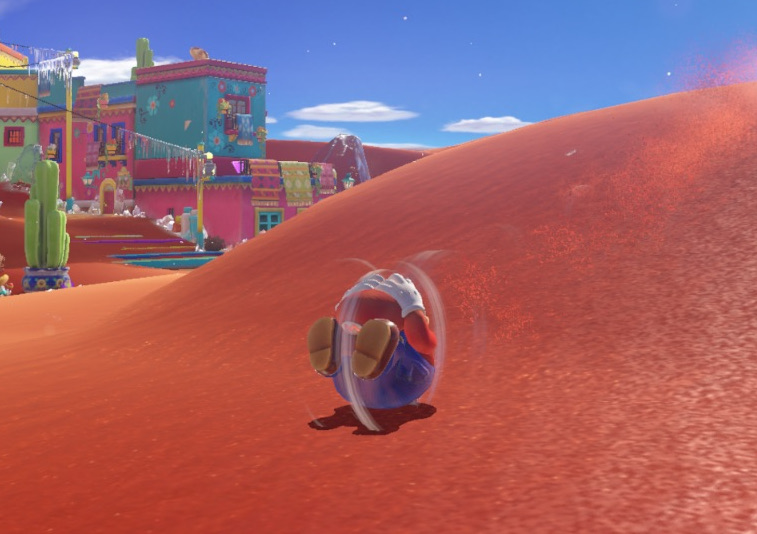
Super Mario Odyssey is out and—surprise, surprise—it’s good. As expected, Mario’s as athletic as ever, with a myriad of moves and abilities that not only elevate his already impressive jumping skills but greatly extend his lateral movement options, as well. One of my personal favorites is Mario’s new ability that allows him to curl up into a ball and roll along the ground like some sort of armadillo or hedgehog or something. It’s like some sort of…spinning dash!
Mario doing his best tumbleweed impression.
Wait a second…Great Gunpei’s Ghost! Super Mario Odyssey is the best 3D Sonic game ever!
Between the rolling technique and how Mario can preserve his speed through precise platforming, there are portions of Super Mario Odyssey that feel like the classic, momentum-based 2D Sonic gameplay in three dimensions. This is especially noticeable in timed segments such as the Koopa free-running missions where obtaining and maintaining Mario’s forward momentum by achieving fluidity of motion is essential. Much like classic Sonic, Super Mario Odyssey has a great sense of flow, which is something most 3D Mario titles can’t really boast.
There are portions of Super Mario Odyssey that feel like the classic, momentum-based 2D Sonic gameplay in three dimensions.
What is Momentum?
Okay, so before we can understand how Super Mario Odyssey achieves such an excellent sense of flow, we need to know what momentum is. In physics, momentum is the product of an object’s velocity and mass. In terms of video games, this means games that feature momentum-based mechanics have a few elements:
The protagonist has mass.
Mass implies the character has inertia.
Inertia implies the character does not instantly accelerate and the character does not instantly decelerate. Moreover, the greater an object’s momentum, the more difficult it is to alter its course.
Some games that exhibit these traits:
Asteroids: One of the earliest examples of momentum-based mechanics. The player’s ship does not accelerate instantly, but gradually, and continues to move even after the player has stopped using the ship’s thrusters. Moreover, altering the path of the ship requires substantial effort at high speeds.
Super Mario Bros.: Mario accelerates quickly, but not instantaneously. He either jogs to a stop if he is running too fast or skids to a halt when trying to change direction.
Sonic the Hedgehog: Sonic carries a lot of inertia. He accelerates slowly and must either skid to a halt or let his momentum slowly peter out.
Momentum as a Resource
In platformers like Mario and Sonic, the majority of the game’s challenge comes from executing precise acrobatics to navigate through the game’s various stages and their respective perils. Not only does the inclusion of momentum-based mechanics give the characters a satisfying sense of weight, but it adds an extra element of challenge. Because the character doesn’t move at top speed right away, building enough momentum to cross large gaps, find secrets, and ultimately complete the stage is an integral part of the game’s challenge.
So basically, in games that utilize momentum and inertia as mechanics, momentum is not only useful, but also—to some extent—scarce. This essentially makes it another kind of resource to be managed, much like health, ammo, or money. If you don’t mind the forced metaphor (all for the sake of a really cool, if not somewhat pretentious sounding, title), momentum is the currency of movement in Mario, Sonic, and similar games.
Essentially, momentum is another kind of resource to be managed.
Running with the fiscal metaphor, the value of this currency is different depending on the game: in Mario games, for instance, momentum is less critical in most situations than it is in Sonic games. That’s not to mention Sonic’s slightly slower acceleration and worse traction means manipulating his momentum takes more effort without the aid of outside forces or Sonic’s signature spin-dash—producing a greater scarcity of the desired momentum. This means that the plumber’s economy of motion has a higher saturation of momentum that has less demand than the hedgehog’s momentum, thus Mario’s momentum is generally less valuable by comparison.
Flow
With all of that out of the way, I can start unpacking what I meant by Mario Odyssey’s sense of flow. Flow—for the sake of this discussion, at least—means the smooth transition from one state of motion to another. Flow is important to games, even those that don’t heavily utilize momentum-based mechanics, though not in the way you’d think. People typically like flow, so when the player character takes damage, their flow is interrupted. This brief moment in which the player loses control and their character’s momentum suddenly shifts subconsciously communicates to the player that they’ve made a mistake.
Flow is the smooth transition from one state of motion to another.
This is why it’s typically not advisable to interrupt the game’s flow for something positive. Mario is a bit odd about this as many games do pause momentarily when the player snags a power-up, but the fact that the player’s momentum isn’t lost and instead continues a half second later may have something to do with why it’s not typically seen as an issue. But that’s really a minor nit-pick compared to the plumber’s more egregious violation of these principles: most notably the star-spin from Super Mario Galaxy and its sequel. Mario’s momentum completely stops as he lifts a short distance upward, leaving him with little ability to steer himself. This is awkward when combined with normal jumps, but it completely breaks any sort of flow when Mario is using a technique like the long jump. Mario goes from flying forward to barely having any lateral movement what-so-ever; it feels like running head-first into a wall, to be honest.
At first glance, these two moves seem similar, but they’re very different in practice.
Super Mario Odyssey does away with this in two ways. First of all, Mario doesn’t lose much—if any—forward momentum when throwing Cappy. Secondly, Mario can immediately launch himself forward with his jumping dive maneuver. Between these two factors, it’s possible for a skilled player to utilize Cappy as jump-assistance without losing his forward momentum. As mentioned in this article’s introduction, this is used to great effect in the game’s timed missions and Koopa races, where Mario has to build up speed using the rolling maneuver and then hold onto to it through precise platforming and clever use of his aerial repertoire.
While Mario Odyssey is by no means a perfect game, the controls and Mario’s own acrobatic aptitude are spot on. In true Mario fashion, the mere act of moving is fun, especially when you get into a good rhythm and can bound across the game’s colorful locales uninterrupted. It’s also interesting to see Mario take a page from Sonic’s playbook and adopt a rolling maneuver that allows him to travel faster than he can on foot at the cost of control. Hopefully someone at Sega is paying attention, because that’s an idea worth stealing back!
P.S. In case you’re wondering, this is the actual greatest 3D Sonic game ever.
Forget my two front teeth. All I want for Christmas is a solid online infrastructure for Nintendo Switch!
Add Friends
Can friend codes please go die in a deep, dark, flaming, sulfury smelling hole? Thanks.
There’s no reason that friend codes should still exist. They’re long, impersonal, impractical, and not used in any other modern technological setting.
See Friends
Nintendo has historically been all about the “couch multiplayer” experience, but it’s time those sensibilities were extended to online play. Their preferences don’t excuse them for providing trash solutions over the Internet. When my friend comes online to play a game, I get a little pop-up in the top left corner of my screen… but that’s it! I can’t tap on it, can’t spectate their session, can’t send them a message… nothing. Nintendo could also bring competitive leaderboard features to the forefront by notifying me when my scores are broken by a friend, even before I pop the cartridge in!
Join Friends
It should be easy to play online with my friends, no matter which mode. It should also be painless to make sure we’re on the same Splatoon team, rather than randomly being pitted against each other. Nintendo has always brought friends together, so let’s write the extra lines of code necessary to facilitate that when we aren’t in the same room.
Talk to Friends
Tools. That’s all we need! We just require the tools to speak to our friends, the tools to monitor or restrict that usage for our children, and the ability to use our own equipment. You won’t catch me dead with that horrid squid dongle with a web of cables running every which way… keep it simple.
It shouldn’t matter if we’re playing the same game, either. System-wide party chat has been solved for a couple console generations, so the Big N needs to jump on the bandwagon.
I’m not being too demanding because Nintendo’s competitors have all of this covered already. This is nothing new.
Nintendo starts charging for online play in 2018, and the ramp-up hasn’t looked very promising with how they’ve handled their mobile app and voice chat so far. For crying out loud, Discord has even gone on record saying that Nintendo could contract them to handle this whole infrastructure! There are no more excuses. They have to get this right if they think fans will subscribe to their service.
We did it. We banded together in secret and set Simeon up with his own Nintendo Switch. Simeon is a faithful YouTuber who has been creating Nintendo content for years, day in and day out. But 2017 hasn’t been easy on him and he hasn’t been able to afford his own Switch console. We thought that was wrong; as someone who reports on the latest Nintendo news, we thought Simeon deserved the latest and greatest. That’s why TBC viewers from all over the world pooled their funds to buy him a surprise package including the console, games, and accessories. A sincere thanks to all of those who have supported Simeon (and Scott) over the years. The Crew is the best.
“Exit the Premises” Kevin MacLeod (incompetech.com)
Licensed under Creative Commons: By Attribution 3.0
http://creativecommons.org/licenses/by/3.0/
I’ve heard that phrase every day since the system launched. But what does it mean?
What makes a game perfect for Switch? I started getting a little confused when I heard it simultaneously applied to games like Legend of Zelda: Breath of the Wild and Picross. Two completely different, polar opposite experiences.
Is the Switch perfect for long, single-player adventures because you can chip away at them whenever you have time, on the go?
Is the Switch perfect for bite-sized games that you can boot up and score a quick-win in a couple minutes?
Is Nintendo’s new console a match made in heaven for single player games that you can hold up close and personal?
Or is it perfect for multiplayer, competitive games in a LAN setting?
The answer, of course, is yes. Yes to all of the above. Nintendo seems to have caught lightning in a bottle and created a piece of kit that’s begging to have every new release, multiplatform game, indie title, and definitive edition developed for or ported to it.
There has never been a home console or portable that draws games toward it with such a magnetic force, attracting a diverse collection of titles at that.
A new phenomenon has started to happen where multiplatform announcements are discussed as “coming to Switch and other platforms.”
$50. That’s how much it costs to buy half a controller in the Nintendo Switch era.
Don’t get me wrong! I like the Joy-Con. They’re packed with a lot of technology with plenty of inputs, HD rumble, NFC read/write, and weirdest of all: an IR camera.
This useless feature was announced in January, and was shown off with the ability to detect rock-paper-scissors motions. I don’t know about you, but I can play rock-paper-scissors in real life, and I’m not particularly eager to face off against a computer opponent.
Oh, and I can’t forget the 1-2-Switch implementation in Eating Contest, which totally works and no one is ever frustrated with.
Sigh.
As usual, Nintendo went overboard and had one too many ideas with their new hardware. The Wii Classic Controller clip comes to mind.
Infrared has been used successfully on Wii, for pointer controls, and on 3DS for amiibo accessory connectivity. This is not one of those times.
Most platformer games usually have one common goal in place: collecting. Whether it be jinjos, jiggies, stars, or moons, these games are usually referred to as “collectathons”. In order to bulk up the experience, or add more to the game, is it safe to simply add more things to collect? How do developers keep the experience fresh? If you missed the spoiler warning for Super Mario Odyssey in the title and don’t want anything to be spoiled, now is the time to stop reading.
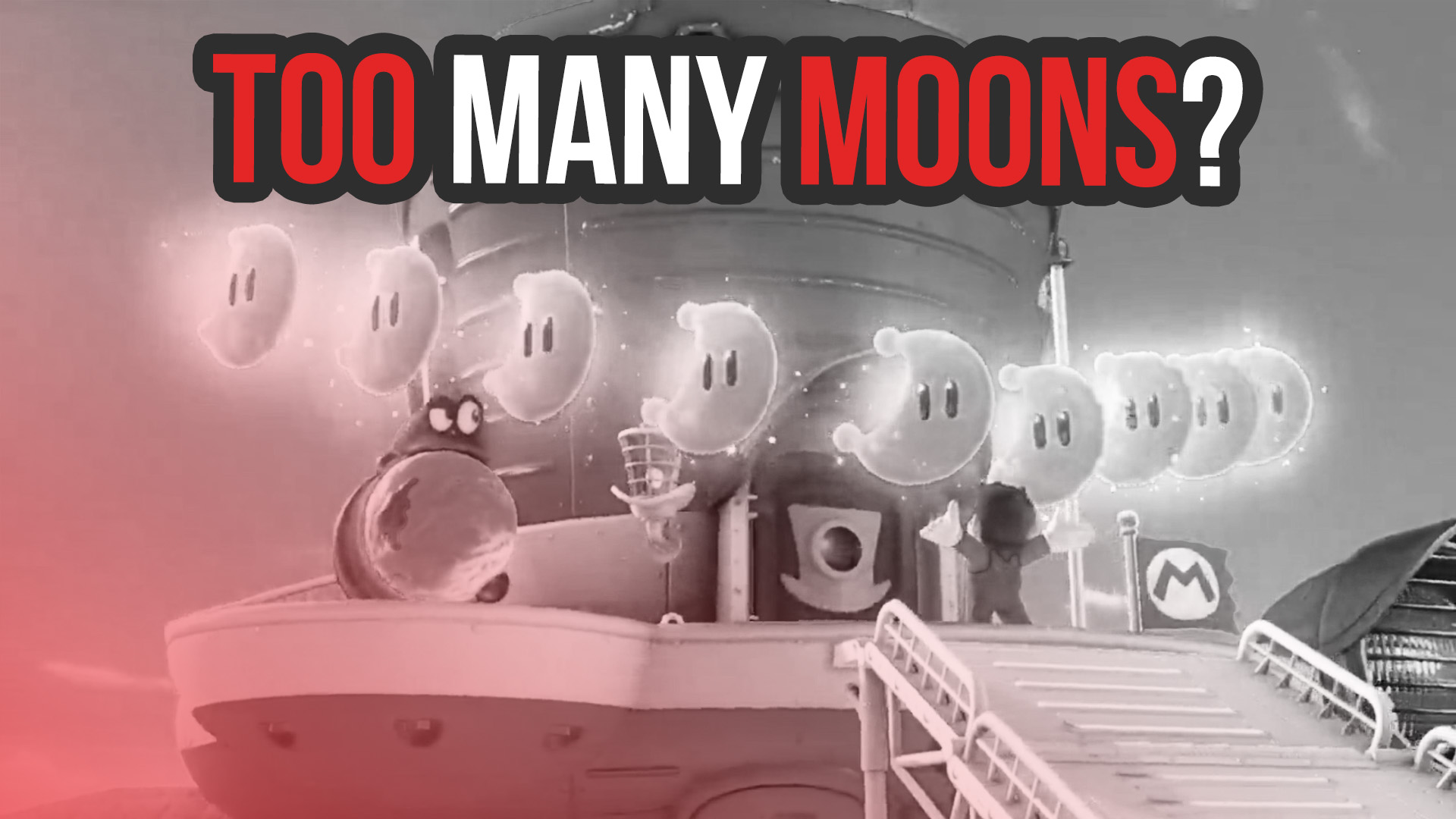
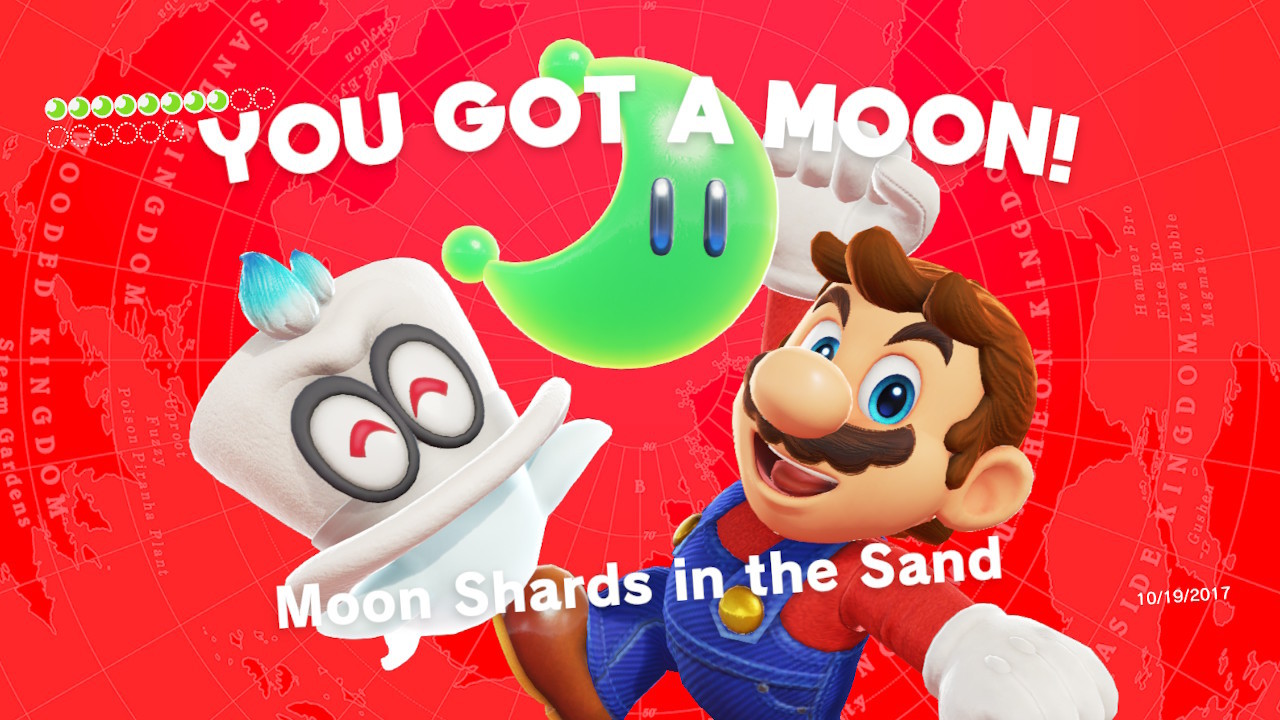
There are 999 moons to collect in Super Mario Odyssey (not counting all the additional moons that you can buy, but those don’t count toward the maxed out 999 moons that can power your Odyssey). It’s true that every moon is a little different, but when you boil it down, there are some recurring ways to get most of the moons, with little uniqueness. Some moons are collected by ground-pounding a certain area, dressing up in a specific costume, walking in a perfect circle, stacking Goombas, finding paintings, racing, etc. Despite this repetition, and the vast number of moons spread across the world, I never got sick of the experience. In my 45 hours spent, I collected everything I could, and the experience never felt stale or like I was crawling my way through.
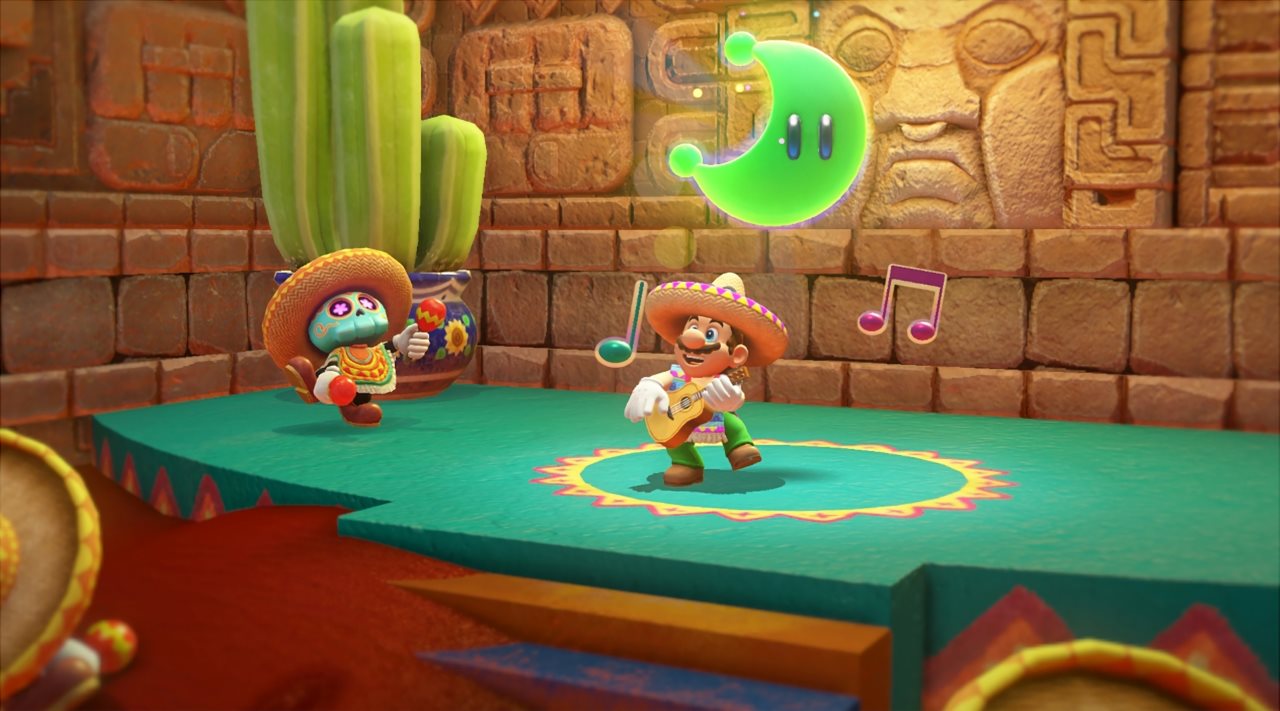
For me, this game ended at the perfect time. Anything more, and the experience likely would have started to decline. Nintendo found the sweet spot, and I think that is largely in part due to the differences in the levels. No two areas were similar in any way, and I appreciate that Nintendo didn’t play it safe with their usual grass, desert, snow/ice, mountain, and lava worlds. Starting out in the Cap Kingdom is so different than anywhere that Mario started his adventure in the past, and the sense of adventure really sparked as soon as I entered the Cascade Kingdom for the first time. The Dia de los Muertos tie-in to the Sand Kingdom was also a nice touch. The Metro Kingdom is something that I was skeptical about, as it gave me vibes of Sonic ’06, but it was done so well. Sometimes I still just go back and run around that giant playground. Even Bowser’s Kingdom looks like it never has, with a Japanese Dojo style theme. Simply wanting to experience every meticulously crafted level is what kept me going to the pursuit of 999 moons. The reason this didn’t feel like a collectathon to me is that I wasn’t motivated by the desire to collect more moons, but rather exploring and being immersed in the environment.
A game shouldn’t be driven by collecting, but exploring.
I realized that these games don’t get their longevity from the number of things to collect, but from the quality of their worlds. In Odyssey, Nintendo found the perfect balance. After I inserted that 999th moon into the Odyssey and saw the cap resting on Peach’s castle, I felt a great sense of accomplishment, and at that time, I was ready to be done. Not done exploring and playing around in the worlds, but done collecting moons. To answer my initial question: is 999 moons too many? In this game, no. In any other game, it probably would be. It all depends on the quality and creativity of the world. Not to mention that throughout my entire 45 hour completion play through, I had a pretty dumb smile on my face (except during a few moons – looking at you, Dark Side).
Nice photobomb, Captain Toad.
I just want to conclude with a more personal note: thank you as always for your time to read these blogs. I know your time is valuable, and when I write these blogs I try to approach with a fresh or new perspective, as there is already so much circulating the internet about games. So thank you, and I wish you safe and happy Holidays. Hopefully it’s not only spent with Mario on his incredible odyssey, but with family.
Samus has been all over the galaxy, answering distress calls everywhere from overrun space stations to giant baby bottles.
Her contemporaries (Mario and Link) have had huge shake-ups in their respective series, much needed to avoid fatigue and bring something fresh. Where does Samus need to go from here?
Earth.
Samus needs to land on planet Earth and defend it from invading aliens.
That’s how this series can mature and raise the stakes all in one fell swoop. It’s great that she’s a solitary and silent hero, and I know the Metroid series is lauded for its isolation and atmosphere. But…
We can’t just keep fighting Ridley and Space Pirates over and over, acting surprised when the Metroid race is not extinct (again).
The entire game doesn’t have to be set on Earth, either. She can speed off in her gunship to stop a planetary attack from being launched—that kind of thing!
I don’t expect a monumental shift like this to occur in Metroid Prime 4, because that wouldn’t be a logical way to proceed after the trilogy. However, the Metroid franchise will need to take a big step sooner or later.
Although this series of games was born at the same time that most of Nintendo’s IP were created in the NES era, Metroid titles always sell surprisingly low compared to their peers. The Big N needs to shake things up and attract mainstream attention to this series, or it will probably always exist in a state of sales flux with long periods between sequels.
Metroid could also benefit from dropping the “Metroid” name. It’s weird to have a franchise named after a common enemy (like Goomba Odyssey or Bokoblin of the Wild) and only serves to box in the developers’ creativity.
SteamWorld Heist: Ultimate Edition is coming to Nintendo Switch! Also announced as a multiplatform game from Capcom: Street Fighter 30th Anniversary Collection. Which announcement are you most of excited about? Let us know in the comments!
“Exit the Premises” Kevin MacLeod (incompetech.com)
Licensed under Creative Commons: By Attribution 3.0
http://creativecommons.org/licenses/by/3.0/