#587 – We haven’t seen the New Super Mario Bros. games in a little while, but is that such a bad thing? Nintendo was leaning heavily into the multiplayer aspects of these games, but many gamers found it surprisingly frustrating to share the screen with their friends. Maybe Mario just isn’t a well-suited series for multiplayer. Let’s discuss it! Footage credit: TheRunawayGuys, WiiLikeToPlay
“Escape the Premises” Kevin MacLeod (incompetech.com) Licensed under Creative Commons: By Attribution 3.0 http://creativecommons.org/licenses/by/3.0/
#538 – In today’s unique episode, we’re pretending that we hold the power to decide a video game’s fate. Should it be franchised, and have multiple sequels moving forward? Should it be remasteres once and left at that? Or should it simply be left to die? We have to assign one fate to each group of three games… what would you choose? Let us know in the comments. “Escape the Premises” Kevin MacLeod (incompetech.com)
Licensed under Creative Commons: By Attribution 3.0
http://creativecommons.org/licenses/by/3.0/
Maybe Mario party 15 will finally be good at this pace!
#591 – Mario Party is a floundering series. Numerous sequels hit store shelves in regular intervals, and Nintendo has been experimenting lately with its formula, hoping that the next game would be the one to solve the series’ declining popularity. Unfortunately, Nintendo has yet to strike gold since basically Mario Party 3 on the Nintendo 64. Simeon and Scott are here to diagnose the problems and figure out what Mario needs to do in order to get back to partying in earnest!
We have stepped into the time machine. We brought you a souvenir from the past!
#542 – Something Nintendo dedicates a lot of time, money, and effort to, but most fans don’t pay attention to: their website. Yes, they’ve been updating their home on the web for many years, and it’s seen a ton of different iterations. Those iterations? We’ve found the most interesting ones and put them into this video for you!
“Escape the Premises” Kevin MacLeod (incompetech.com)
Licensed under Creative Commons: By Attribution 3.0
http://creativecommons.org/licenses/by/3.0/
The SNES Classic Edition has been unveiled, but not in enough detail!
On June 26th, Nintendo announced that it will be following up the popular NES Classic Edition with an SNES successor. At an MSRP of $80 and containing 21 games, this bundle of 16-bit nostalgia is liable to fly off shelves as quickly as Nintendo can stock them. However, there is still some information about this mini console that is shrouded in mystery and could affect gamers’ buying decisions.
Controller Cords and Ports (Answered!) Immediately following Nintendo’s announcement of the SNES Classic Edition, questions of the controllers’ cord length and connectivity method surfaced. Thankfully, so did some answers! Nintendo confirmed that the controller cables will be about 5 feet long, an extra 2 ft. compared to the previous Classic console.
It also became clear that the SNES controller ports on the front of the unit are simply for aesthetic accuracy. Due to Wii Classic Controller and Classic Controller Pro compatibility noted on the SNES website, it is confirmed the controllers will plug in with the same type of ports utilized by NES Classic Edition and Wii. So questions of the controllers can be put to rest!
Just How Limited is this Edition? The NES Classic Edition was notoriously hard to find last Holiday season and through the remainder of its short production run. Nintendo cites a misjudgment of demand as the reason for that inconvenience, but it also came to light that the system was meant to be sold as a limited run (and actually got extended as its popularity became evident).
How many Super Nintendo units are going to be manufactured is unknown, but Nintendo insists that more units will be made available than its NES counterpart. Though they won’t commit to any production past the 2017 calendar year, they are making an effort to avoid shortages. Understandably so: with sales data on the NES Classic, Nintendo will try to leave less money on the table now that the market has now been proven for these throwback consoles. Additionally, the new system is going on sale several weeks earlier than the NES did, so Nintendo appears to be gearing up for more availability going into Q4.
Will Nintendo Allow Proper Preorders? A missing piece of this puzzle is preorders. Fans of retro gaming were disappointed when preorders never opened up for the NES Classic Edition, and quantity was too limited on launch day and during the restocks that followed. Taking preorders would certainly alleviate much of this frustration, as Nintendo can gauge interest and adjust production accordingly. Allowing gamers to pre-purchase the console would also help avoid common issues with scalpers, and get the 16-bit console into the hands of true Nintendo fans.
Amazon may offer their own form of preorders (like Amazon UK did, and quickly sold out, for this very product), but whether they have actual shipment quantities to allocate remains to be seen. Unfortunately, Amazon has been known to cancel orders when they do not receive as many units from Nintendo as they hoped. Nintendo needs to have strong communication and systems in place with retailers for this product to be a true success, and avoid the frustration that their product distribution has become known for.
How Will the User Interface be Improved? The NES Classic shipped with a perfectly serviceable user interface, allowing players to quickly scroll through the catalog of games, change visual filters, and create restore points while playing. It didn’t leave much to be desired, except one thing: the main menu was only accessible via the console’s Reset button. That is markedly less convenient than the Home buttons Nintendo fans have grown accustomed to since the Wii era. The Super Nintendo’s Reset button will probably retain this functionality as well, but a controller button-combination (like Select + Start) for quick access to the menu would be a welcome addition.
Will Nintendo Have a Different Stocking Stuffer? Many fans expected Nintendo to follow up the NES Classic Edition with another entry in the Classics brand, but it came as a surprise when Nintendo announced its release date to be considerably earlier in the calendar year. The Mini NES was clearly intended to be a Holiday impulse-buy (which would have worked if the inventory was there), but now that the SNES will launch on September 29th, it raises the question of Nintendo’s Black Friday strategy. Will there be an alternate “stocking stuffer” to occupy Christmas lists around the globe, or will Nintendo opt to increase their marketing efforts for the system as Thanksgiving gets closer?
Do the Regional Versions Feature Different Games? (Partially Answered!) The NES Classic Edition featured 30 games, and the list of titles differed from region to region. It was unclear if that would be the same case again until Nintendo of Japan officially announced the Super Famicom Mini. We learned that, yes, 4 different games made the cut (and 4 will remain exclusive to North America and Europe).
In PAL territories, SNES titles were originally made with a slightly lower frame-rate to match the local television sets of the time. On modern HDTVs, this difference is noticeable and can be bothersome. We don’t know which software versions Nintendo of Europe will implement in this new collection, and these are the types of technical specification questions Nintendo tends to leave unanswered.
Will There Be an N64 Classic Edition? What About Handhelds? Rather than just a one-off run of NES systems, the Classics label is now a brand of products for Nintendo. And with two consoles being remade in as many years, it begs the question: “What’s next?” Nintendo 64 follows, but introduces more controller ports, polygonal 3D graphics, and more complicated control schemes that vary from game to game. Nintendo won’t be able to release a Classics console annually for much longer before they catch up to the Nintendo Switch, or the scope outgrows what is reasonable for an impulse-buy product.
An alternate course of action would be to release Handheld Classic Editions, starting with the GameBoy! Grab some Pokemon games, Tetris, Metroid, Kid Icarus (maybe throw in a backlit screen and wireless multiplayer if we’re getting really crazy) and you’ve got yourself an affordable chart-buster.
Clearly, there is a lot that we don’t know! As we wait for answers, let’s take a step back and anticipate all the great things that have been confirmed: Dual controllers in the box? Check! Unreleased Star Fox 2? Check! September release date? Check!
What information are you desperate to know about the SNES Classic Edition? Sound off in the comments below!
#557 – Star Fox 2 is making a triumphant first coming this fall on the SNES Classic Edition! Wow, who would have thought? (Oh yeah; we predicted it.) It’s time to brush up on our SF2 knowledge and make sure we’ve got the history lesson straight before we play it. This video will set you right up!
Footage credit: ShiryuGL
“Escape the Premises” Kevin MacLeod (incompetech.com)
Licensed under Creative Commons: By Attribution 3.0
http://creativecommons.org/licenses/by/3.0/
#561 – As Reggie once said, Nintendo fans are “insatiable.” We really can’t deny it. As soon as we learned the NES Classic Edition was being made, we celebrated alright… but fans quickly turned their focus to the prospect of a Super Nintendo Entertainment System reboot. And now that we’re getting THAT this holiday, what else could we think about besides the Nintendo 64? So many must-plays debuted in 64 bits that the list practically writes itself. Watch us read off our picks for inclusion!
Footage credit: Diddy Kong Racing Wizpig Race – William5000000 | F-Zero X – arronmunroe | Goldeneye 007 – CasaRetro | Paper Mario – NomComms | Pokemon Snap – DazzaBound
“Escape the Premises” Kevin MacLeod (incompetech.com)
Licensed under Creative Commons: By Attribution 3.0
http://creativecommons.org/licenses/by/3.0/
If you’re old enough to remember printed game manuals, you’ve probably heard gamers joke about how superfluous they were. Ever since the mid 90’s, games have featured in-game tutorials and, even then, most people are smart enough to figure out the basics just by fiddling with the controller for a few seconds. They were utterly redundant. And yet, just about everyone admits that the first thing they did when they bought a new game as a kid was read those blasted booklets cover to cover. I know I did.
Nowadays, print manuals have been phased out in favor of in-game tutorials and digital guides accessible with a few, quick button presses. But just because something’s extinct doesn’t mean it’s not worth studying. Let’s take a look at how game manuals evolved over the years.
These have been gone for eons, and yet every natural history museum has to have at least one.
I’ll be limiting this examination to one mainline Mario title per console generation: Super Mario Bros., Super Mario World, Super Mario 64, Super Mario Sunshine, and Super Mario Galaxy 2. Why? Because contrary to popular belief I actually have a life, and to do this properly is way more work than even I’m willing to put out.
Printing
The most noticeable difference between manuals at first glance is their physical construction. The original Super Mario Bros.‘s manual is approximately 5.2×4 inches, which is considerably smaller the manuals of later generations, which all average to roughly 4.6×7 inches. Of course, size differences pale in comparison to the actual printing. With the exception of the cover and the gold Nintendo Seal of Approval on the first page, Super Mario Bros.‘s manual is entirely in black and white. Later generations would feature full color print for their manuals. Moreover, much more thought was given to how the pages were laid out, with sentences no longer being split between pages and more organic placement of text and illustrations. The last item of note is Super Mario Galaxy 2‘s manual is written in three languages: English, French, and Spanish. As to be expected, this tripled the booklet’s thickness.
Story
Back in the day, the only way to know a game’s plot often times was reading it in the game’s manual. Even after games started to become self-contained by providing opening cinematics, manuals continued to provide brief summaries of the game’s premise.
As to be expected, the plot summary of the first Super Mario Bros. is short and to the point. It describes what happens, without going into much detail as to how or why. Moreover, we don’t get to see things from any character’s point of view. Because of this, the narration has a sense of detachment from the plight of the hero, giving the plot summary a matter-of-fact tone. In short, it’s not so much a story as it is a plot.
In short, it’s not so much a story as it is a plot.
By contrast, Super Mario World‘s story uses a limited third-person narrative, presenting the story from Mario and Luigi’s perspective. The characters are presented as, well, characters: they’re given motives, emotions, and even dialog. Moreover, the story is actually presented as a narrative, with events playing out in sequence. Interestingly, the story (in the North American manual, at least), makes reference to the events of Super Mario Bros. 3, indicating that SMB3 is canonical despite Miyamoto stating it was all a stage-play…
Super Mario 64 continues the increased focus on narrative, notably by spending two whole pages on story! The story starts with a dose of self-awareness by asking, “Is there no end to the constant feuding between Mario and Bowser?” Afterward, the plot is told entirely from Mario’s perspective, with frequent interjections from the man himself. These quips from Mario are actually a bit jarring for anyone used to Mario’s modern portrayal, as they actually communicate some personality. It seems at this point Nintendo wasn’t afraid to let Mario be his own character instead of a stand-in for the player. Other than that, the story unfolds much like Super Mario World’s, which is to say a narrative instead of a plot. Interestingly, Mario 64 and Super Mario World‘s stories both include some overlap with what the player would see during gameplay.
It seems at this point Nintendo wasn’t afraid to let Mario be his own character instead of a stand-in for the player.
Super Mario Sunshine‘s story section is somewhere between the style of Super Mario Bros. and its super Nintendo and N64 predecessors, mostly leaning toward the former. While it attempts to convey the story with the sense of drama of Super Mario World and Mario 64, it only describes things in broad strokes. Like Super Mario Bros., there’s no focus on characters, instead favoring a description of events from an outside perspective. I assume this is in part due to the inclusion of cutscenes in the game itself. Since this was the first Mario game to be almost entirely self-contained when it came to plot, Nintendo probably thought it would be redundant to put information in the manual that the player would receive in-game.
Lastly, Super Mario Galaxy 2 somehow manages to beat even Super Mario Bros. in brevity. It doesn’t even set up the story’s conflict. All we learn from it is that Mario’s been invited to the castle and meets a Luma along the way. That’s it. The Prologue page actually devotes more space to character bios than story, which—given the game’s focus on gameplay over any semblance of plot—is probably appropriate.
Controls and Gameplay
The most important part of a game, and thereby the most important part of a game manual, is the gameplay. Gameplay and controls vary from game to game, even within the same franchise. As such, these sections are going to differ quite a bit on the granular level. Seeing as this is an examination of the evolution of game manuals and not the Mario series, I’m going to look at the big picture: what’s emphasized and how those instructions are written.
So right off the bat, I noticed something peculiar about the way pre-2000’s manuals were written. Often times when explaining controls or specific actions, the manuals often phrase actions in terms of Mario and not the player. For example, when listing the uses for the A-button, the Super Mario World manual says it “Makes Mario jump,” instead of, say, “Makes you jump.” Sunshine and Galaxy 2‘s manuals instead phrase controls and player actions in terms of the player, using terms like “when you touch an enemy” and so on.
This is interesting as conveys the idea that—despite the player controlling him—Mario is his own separate entity, with the player simply giving him instructions rather than Mario being an extension of the player. That said, I would be remiss to not mention that the pre-2000’s manuals were inconsistent in this trend, often alternating between describing actions as being performed in third-person (i.e. Mario) and second-person (i.e. the player). Also interesting is that while Mario Galaxy 2‘s manual exclusively describes the actions Mario can perform in second-person, actions that Yoshi can perform are exclusively third-person, indicating that the player isn’t the character he’s controlling, he is Mario.
This conveys the idea that—despite the player controlling him—Mario is his own separate entity.
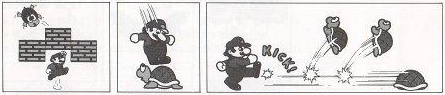
Older games take a very different approach to describing gameplay. Both Super Mario Bros. and Super Mario World go into great detail about everything: defeating enemies, items, kicking shells, using the weird pink ramps in Mario World, everything. Super Mario 64‘s manual spends most of its pages explaining analog movement, items, and how to progress through the game, with basic concepts like stomping on enemies being mostly glossed over. Sunshine‘s gameplay section is almost exclusively about all of the different moves and actions Mario can perform, only briefly touching on game progression or items. Lastly, while the Galaxy 2 manual mostly lists moves, it does go into more detail when explaining the mechanics of recurrent items and stage features like checkpoint flags than the previous 3D games.
Early manuals explained every facet of the game.
Personally, seeing how ideas and perspectives have changed over the last 30+ years is fascinating. We’ve seen Nintendo promote Mario as a character, only to make a 180 and make him a simple stand-in for the player. Then there’s getting to see what they thought was important for each game: back when Mario was first introduced, stomping on enemies, kicking shells, and so forth were new ideas, and the manuals tried to explain everything they could. Later games trusted that the player was familiar enough with the series—or video games in general—to figure out how to use their abilities and instead focused on the basic controls and the game’s new ideas, such as Mario 64‘s analog movement.
Unfortunately, this is where the story ends; Nintendo phased out print manuals during the Wii U era in favor of digital manuals, and now with the Switch, we don’t even have those. It’s a shame really, because, as I’ve just shown, even if you don’t need a manual to play a game or understand its plot, you can still learn from it.
#572 – Nintendo fans are starting to grow in number again. But there for a while, it was a lonely title to have. Often misunderstood by our Microsoft and Sony brethren, Nintendo fans have to band together and stick together. We have a lot in common, after all, and that’s what this video is all about! Identifying ourselves as who we are: Nintendo fans.
“Tech Live” & “Escape the Premises” Kevin MacLeod (incompetech.com)
Licensed under Creative Commons: By Attribution 3.0
http://creativecommons.org/licenses/by/3.0/
I guess we’ll have to wait 384 years to see what this cryptic message means.
#576 – L Is Real. Those 3 mysterious words have echoed in our minds since the Nintendo 64 days, where they showed up in Super Mario 64 and later in Ocarina of Time. But the question still stands: what does it mean? This video goes out to Crew member Rachel!
Footage credit: The Easter Egg Hunter “Escape the Premises” Kevin MacLeod (incompetech.com)
Licensed under Creative Commons: By Attribution 3.0
http://creativecommons.org/licenses/by/3.0/
#577 – The Directional Pad is something that many gamers take for granted, but it really was a novel invention at the time that Nintendo introduced it. While it’s been largely taken out of the spotlight by analog sticks, the digital input solution still has its own merits. We’re going to discuss its inception, the Nintendo patent, and what their competitors did in response. It’s another interesting history lesson brought to you by Two Button Crew!
“Escape the Premises” Kevin MacLeod (incompetech.com) Licensed under Creative Commons: By Attribution 3.0 http://creativecommons.org/licenses/by/3.0/
With the autumn season upon us, what initially comes to mind? For most, probably colder weather, leaves falling, pumpkin spice x (where x = everything), hoodies, haunted houses, Halloween, and so on. I greatly appreciate the fall season and everything that comes with it. In fact, it’s probably my favorite season. But for me, it’s more than black cats and apple cider. It’s a time where I can enjoy certain types of video games at their best. Nintendo is absolutely fantastic at creating games that burst with seasonal energy. That is; games that display the best a season has to offer.
Of course, every game does it differently. Being the season that it is, I’ll start with the original Luigi’s Mansion for the GameCube. This game is built around one theme: a haunted house. My October would not be complete if I didn’t spend a weekend replaying through this game with the lights off. Not because it’s terrifying, but because for me, this is how the game should be played. I just get so much more out of it. Playing this game on a hot mid-summer night, or when snow is flying just doesn’t feel right. When running through the mansion vacuuming up ghosts and exploring dark rooms, I want to be able to look out my window and see colorful leaves. Another fall favorite of mine is Paper Mario: The Thousand Year Door. Why? This answer why may not be as obvious, but here it is: the chapter “For Pigs the Bell Tolls.” Yes, I know that there is a chapter where Mario travels to a tropical island and where there is snow, but making the trek to the Creepy Steeple (about 5 times), to me, is the most defining chapter. Everything about that section: the music, the characters, the lighting, the setting, creates a perfect Halloween experience.
Admittedly, I am biased when it comes to what season a game should be played because some of it has to do when the game came out, and my nostalgia for a game always peaks based on what time of the year I played through it and enjoyed it for the first time. The Thousand Year Door was released in October (yes, I may be a bit weird about my timely nostalgia). But seriously, if you haven’t experienced this glorious gem, there is no better time than now, and when you get to chapter 4, you’ll know exactly what I’m talking about.
And of course, there are games like Animal Crossing, where the game is set up to follow the time of year no matter what, so it can be played to the maximum level of enjoyment all year. This game has become immensely popular, and I attribute that a lot to what I referred to above as seasonal energy. It just feels right. Nintendo was brilliant to realize this and capitalize off of it. I remember playing the game and running around my town on Halloween looking for Jack, hearing my real world doorbell ring, and passing out candy to kids. This created a full 360° experience for me, and I’ll never forget it.
I won’t make a complete list of games I like to play during specific seasons, but here are just a few others that really stick out: Mario Baseball (spring/summer), Super Mario Sunshine (summer), Banjo Kazooie (fall/winter), Resident Evil 4 (fall), Splatoon (summer), Pikmin (any season – these games capture them all greatly), Wii Sports Resort (summer), Legend of Zelda: The Wind Waker (all but winter), and Kirby’s Epic Yarn (winter).
Lastly, the intention of this write-up is not to tell you when you can and can’t enjoy a game. Of course, this is 100% subjective, and everyone is going to have a different take. If you enjoy cleaning off Isle Delfino in the middle of winter to get some virtual sun and cure those winter blues, more power to you. I would love to hear comments about certain times of year you prefer what games, or if you don’t care at all and anytime is the best time. Now excuse me as I eat a freshly picked honey crisp apple and take on King Boo.
About the author: Matt has been a Nintendo fan since 1996 after his parents got him a Nintendo 64 with Super Mario 64. His love for gaming took off from there with games such as Diddy Kong Racing and Banjo Kazooie. When not playing video games, Matt can be found cycling, golfing, playing with his cat, reading math books, and partaking in anything nerdy. Once in a great while, he even may play a game that is… gulp… out of season.
Longtime fans of Nintendo will often reference the past fondly, maybe even going so far as to say that the company has since lost its way.
Look, I get it. We named this brand “Two Button Crew” out of our nostalgia for Nintendo’s first game console and its simple controls.
But before we continue focusing our infatuation with what has been, I’d like to pose a question: What if the Golden Age is actually now? Have you stopped to wonder if we could be experiencing Nintendo’s best efforts currently? I think so. Allow me to prove it by examining each era individually, and by the end, you might just agree!
NES
A strong case can be made for Nintendo’s debut home console. It made arcade-worthy experiences accessible in the home; revolutionary at the time. The hardware and controllers were simple and intuitive, and developers used the limitations of the day in creative ways. The resulting game library was expansive, full of memorable games that were easy to pick up, but difficult to conquer. We owe the NES generation for nearly all of the franchises we continue to enjoy.
SNES
The Super Nintendo period was one of refinement and perfection. Just as the console received a “Super” upgrade, so did each of Nintendo’s tentpole series. The Holy Trinity of Super Mario World, Legend of Zelda: A Link to the Past, and Super Metroid is a trifecta of “Best Game Ever” contenders. Titles like these succeeded by taking the formulae of previous games and maturing and enhancing them.
Nintendo 64
How we played video games was forever changed. Dimensionality increased by 50% with the introduction of polygonal 3D, and with the help of the analog stick, we were invited into Nintendo’s imaginative worlds with an all-new plane of immersion.
Another innovation must be credited to the 64: Group gaming. Yes, multiplayer modes existed previously, but this console fully realized the idea by including four controller ports and bringing people together with games like Mario Kart 64, Super Smash Bros., and the Mario Party series.
GameCube
This era was all about modernization. Nintendo’s competitors were beginning to steal the spotlight with their specs, and the Big N didn’t want to fall behind. However, they still wanted to provide the affordable alternative, so the resulting console suffered a bit of a hardware identity crisis. The upgrade from N64 was similar to the one seen between NES and SNES, where the approach remained largely the same but games improved alongside technology.
Nintendo was not afraid to experiment with software on GameCube, bringing us fresh experiences like Luigi’s Mansion, Pikmin, and Animal Crossing. Many classics from this era like Super Smash Bros. Melee, Metroid Prime, and Paper Mario: The Thousand Year Door are viewed as best-in-series games, and are begging to be played to this day.
Wii
Nintendo’s brand awareness exploded. A video game console with two letter i’s became a household name overnight, and Nintendo wasn’t ready. Production of the motion-controlled units couldn’t keep up with demand, and the company had to reevaluate their target audience on the fly. Development and marketing efforts were split between catering to core Nintendo fans and the newly-tapped blue ocean markets. It was great to see Nintendo topping the charts, but some of the decisions came across as tone-deaf to longtime Nintendo fans, like their focus on casual experiences during gaming press conferences.
Certainly, some strong titles were released during this era like Super Mario Galaxy, Metroid Prime 3: Corruption, and Excite Truck (don’t look at me like that!), but the console was crippled by its outdated, low-res graphics and weak online support.
Wii U
The misbegotten console. In a clear attempt to capitalize on Wii’s success, the branding stayed along with attempts to appeal to the casual crowd. What Nintendo did not anticipate was how sharply those users would pivot to mobile gaming. By the time Nintendo shifted their focus back to their faithful followers to deliver core titles like Super Smash Bros. for Wii U, Super Mario 3D World, and Star Fox Zero, it was too late. Slow sales lead to a lack of 3rd Party and Indie games, leaving fans to wait for 1st Party releases while Nintendo delievered the best games on its more successful 3DS handheld.
Wii U’s GamePad controller was useful for (spatially-limited) off-TV gaming, but its other implementations often got in the way of fun by splitting players’ attention across two screens. Solid software attempts weren’t enough to save Nintendo from the lack of buzz around their system. This console generation firmly knocked Nintendo off their pedestal and left them hungry.
Switch
At present day, Nintendo has launched their new console/handheld hybrid and are following it up with a stream of top-notch software. Legend of Zelda: Breath of the Wild paired with the sleek hardware made an enticing match. Splatoon 2 and Mario Kart 8 Deluxe brought the best experiences from Wii U to where more gamers could enjoy them. A level of hype surrounds Switch that hasn’t been seen since the Wii days over a decade ago, only this time… Nintendo fans are the ones generating the noise. Nintendo appears to be pulling out all the stops to support Switch with mainline entries in their top IP, from Super Mario Odyssey this holiday to Metroid Prime 4 and a Pokemon RPG in the future. If this is how the first few years look, imagine what we’ll be talking about in half a decade.
Indies love the platform… 3rd Parties are coming into the fold… Nintendo hit a real home run with this one, having crafted a console this a joy to play, feel, dock, and reconfigure.
I declare the Golden Age of Gaming… NOW! We’re living it today, The momentum that Nintendo has entered into this console generation with is insane.
Many people “got it” the instant they watched the reveal trailer. Some critics doubted it at launch, but in the time since, the console has earned its way into the hearts of many unsuspecting fans.
And I believe it’s here to stay. We will likely see more iterative updates for Switch hardware, in line with what Nintendo has always fone with their handhelds. Joy-Con XL, anyone? Switch VR Headset?
Grab yourself some games and enjoy them with friends! Nintendo’s going all in on Switch, so do the same.
Enjoy the Golden Age of Gaming.
This episode is TOTALLY different from our Best Villains episode – trust us!
#580 – Baddies – can’t live with ’em, can’t live without ’em. Today, we’re talking about the chiefs of all baddies, the Bosses. But we’ve already featured our favorite villains in a previous episode of TBC, so today we are focusing on the best battles themselves – the conflicts that were memorable for their setting, challenge, build-up, or conclusion. Enjoy!
Footage credit: PunkDemonNeo, Boss Fight Database, Hazey A, AquaChannelerChris
“Escape the Premises” Kevin MacLeod (incompetech.com)
Licensed under Creative Commons: By Attribution 3.0
http://creativecommons.org/licenses/by/3.0/
While Ryan Van Liere was in town for the launch of Nintendo Switch, Simeon and Scott decided to take him out for a night of fun at the local arcade. We played a lot of arcade games, Nintendo and others, and sunk a lot of quarters into the slots. Our skills, you ask? You’ll have to watch and see for yourself.
Shot by Alex Campbell
“Escape the Premises” Kevin MacLeod (incompetech.com) Licensed under Creative Commons: By Attribution 3.0 http://creativecommons.org/licenses/by/3.0/
We’re throwing it all the way back to Super Mario Bros. on NES! The Nintendo Entertainment System: Classic Edition is getting busted out for some “not-so-speedy” speedrunning of this original 8-bit platformer that started it all.
“Exit the Premises” Kevin MacLeod (incompetech.com) Licensed under Creative Commons: By Attribution 3.0 http://creativecommons.org/licenses/by/3.0/
With Breath of the Wild sweeping our Game of the Year Awards, we thought it appropriate to go back “in time” and play a game from the past… A Link to the Past, to be precise. This SNES Classic is a gem, even by today’s standards. With modern games like Blossom Tales still taking nods from ALttP, it’s clear that this title was made to stand the test of time.
“Exit the Premises” Kevin MacLeod (incompetech.com) Licensed under Creative Commons: By Attribution 3.0 http://creativecommons.org/licenses/by/3.0/
Super Mario RPG is one of Simeon’s favorite games! Modern-day Mario RPGs have since lost their way, but it’s always a good time when you throw it back to this Nintendo/Square partnership. Simeon will even show us a few impressive secrets along the way!
“Exit the Premises” Kevin MacLeod (incompetech.com) Licensed under Creative Commons: By Attribution 3.0 http://creativecommons.org/licenses/by/3.0/
Thank goodness for unlimited electricity on desert islands.
We’ve all been asked some form of this question before: If you were stranded on a desert island, what would you take with you? This time, your only choices are video games, and you have unlimited power supply but no WiFi. Yes, the choice is tough. But Simeon and Scott thought this through and have come up with some of the strongest candidates. What game would you take? Comment below!
“Escape the Premises” Kevin MacLeod (incompetech.com) Licensed under Creative Commons: By Attribution 3.0 http://creativecommons.org/licenses/by/3.0/
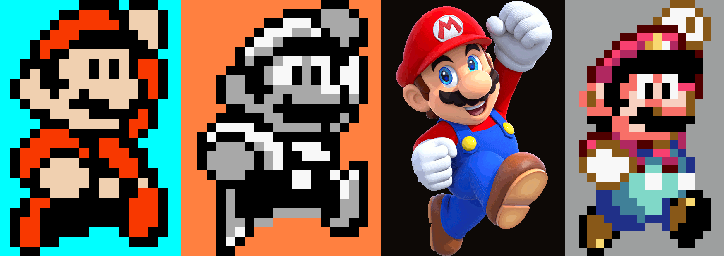
Ah, pixel art…Nothing says “video games” quite like a 32×32 pixel sprite. Retro sprites are a fascinating art form: unlike many other mediums, the conventions of pixel art were born of technical limitations, not creative freedom. While the nuances of the medium are often lost on modern developers, who see the limitations as an excuse to churn out overly simplistic animations, classic games would often feature impressively detailed animation frames. To this day, even single frames of these animations are downright iconic and instantly recognizable to fans around the world, something that few other animated works can boast!
Pop quiz! Which of the following are 8-bit images?
Please excuse the fact that these aren’t in chronological order.
Believe it or not, only the second one from the right is 8-bit. “B-but, but the NES and the Gameboy were both 8-bit systems!” you say. Yes, well, maybe it’s time we actually examine what exactly “8-bit” means.
In Computer Imagery
Let’s start with what bits mean for pictures. There are two basic ways of composing pictures: color channels and indexing. In a picture that uses color channels, each color is represented by a mixture of primary colors with each primary color composing one of the image’s color channels. These colors are red, green, blue, and sometimes an additional “alpha” channel that represents opacity (i.e. how much you can’t see through it). Every pixel in the image is a combination of these channels.
The number of bits dedicated to each pixel is known as the image’s color depth. As you may know, bits are binary digits, hence the name (binary digit). Because of this, every sequence of bits can represent 2n values (where n is the number of bits used). That means an image with a color depth of three—which is to say one bit per channel—can have two shades of red (fully black and fully red), two shades of green, and two shades of blue, which combine for a total of eight (23) colors. In today’s day and age, most images either have a color depth of 24 for plain R.G.B. or 32 for R.G.B.A., dedicating eight bits (one byte) to each color channel. That means R.G.B. images these days can contain up to 16,777,216 colors. Any more than a byte per color channel results in diminishing returns.
The number of bits dedicated to each pixel is known as the image’s color depth.
As you can imagine, three bytes per pixel adds up quickly on a console that only has 2 kilobytes of video R.A.M. While it’s easy to forget in this age where most computers typically have four to sixteen gigabytes of R.A.M. and terabytes of storage, space—both memory and long-term storage—was a valuable commodity back in the 80’s and 90’s. That’s where color indexing comes into play. Instead of storing color values per pixel, indexed images have a set of color values stored in a lookup table (i.e. the palette) with each pixel being represented by a single number that refers back to a position in the lookup table. For instance, if the color in position 5 of the table is red, then every pixel with the value 5 will be displayed as red. While this would limit the number of colors in an 8-bit image to 256, that’s 256 out of any of the thousands or millions of 16-bit or 24-bit colors available.
So, knowing this, where does this leave the NES’s graphics? An NES sprite consists of four colors, three visible and one transparent. That makes NES sprites 2-bit sprites. Don’t look at me like that, it’s the truth!
Now I’m sure some of you are thinking, “well, just because the sprites are only 2-bit doesn’t mean NES graphics aren’t 8-bit. The NES could produce way more than four colors at a time!” Okay, while we’re stretching terms a bit (or more accurately, crumpling them up and chucking them into the fireplace), I’ll be generous. The NES used the YpbPr palette, which consisted of 64 colors. So if we were to hypothetically classify the NES’s graphics in regards to the total number of colors available, that would mean the NES has 6-bit graphics. To add insult to injury, only 54 of the colors are useful, as many of them are identical shades of black. That said, the NES did include an additional three tinting bits (one for each primary color). While this increases the theoretical number of colors to 432, the tint is applied globally, meaning all sprites and tiles on screen were tinted at the same time. So, in actuality, it really just had 8 sets of 54 colors. What are we at now, 9-bits?
All 64 colors the NES could produce prior to tinting.
What Does 8-Bit Really Mean Then?
So why is it we call sprites from the NES “8-bit” when they’re actually 2/6/9-bit? Simple, they were from games released on an 8-bit console. Of course, that begs the question: “what’s it mean when we say a console is 8-bit?” The number of bits ascribed to a console refers to its central processing unit. The NES used a Ricoh 2A03 processor (or its counterpart the 2A07, used in P.A.L. consoles), which is an 8-bit processor.
The CPU of the Nintendo Entertainment System.
So what’s makes an 8-bit processor an 8-bit processor? When someone says a processor is “X-bits”, they are referring to the processor’s word size. In computer science, the term word refers to the standard computational unit of a machine. That means an 8-bit processor has a word that’s eight bits long, which in turn means that the C.P.U. processes eight bits in one operation.
My System Has More Bits Than Yours!
Just how important is a system’s word size? These days, manufacturers don’t even mention their consoles’ word size, but back in the 80’s and 90’s, it was a major part of a platform’s marketing. The logic was if a system had a 16-bit C.P.U., it could process twice as much data as a console that only had an 8-bit C.P.U., right? Unfortunately, the reality isn’t that simple.
While technically a 16-bit C.P.U. processes twice as much data bit-wise as an 8-bit C.P.U. per calculation, we need to keep in mind what that data is actually representing. Consider the following binary numbers:
00011001
00000000 00011001
Both the 8-bit value and the 16-bit value equal 25, with each representing the contents of one word for an 8-bit and a 16-bit system, respectively. Notice how they appear identical save for the number of leading zeros? Words can be thought of like boxes: if the number placed inside is smaller than the box, then the excess space is filled with packing peanuts… or, zeros. This way, the processor doesn’t have to worry about how long the number’s binary representation is and instead just performs whatever calculations are needed on the entire word. All of that is to say that unless the calculation in question requires numbers that exceed the maximum value that can be represented with the number of bits in the system’s C.P.U., there isn’t actually any speed boost.
That said, when the largest number you can handle at one time is 255, those extra-bits really do make a difference, so maybe the 8-bit and 16-bit divide isn’t the best example.
In the end, the reason we call sprites from NES games “8-bit” isn’t because the graphics themselves are 8-bit, but because of a sort of linguistic cross-contamination. The systems of the 80’s and 90’s were advertised by exploiting consumer ignorance to turn technical terms into marketing buzzwords, resulting in the systems having much of their identity tied to these terms. Because of that, anything associated with the consoles from that era is going to be collectively referred to by the one unifying descriptor available: 8, 16, 32, or even 64-bit. In the end, it’s ultimately harmless; these terms have an understood meaning and are thus perfectly descriptive in the context in which they’re used. Really, the only real confusion this causes is that I’m somehow okay with it; normally I’m the type go on a long rant whenever anyone says “Ethernet cable” when they really mean “Cat-5”.