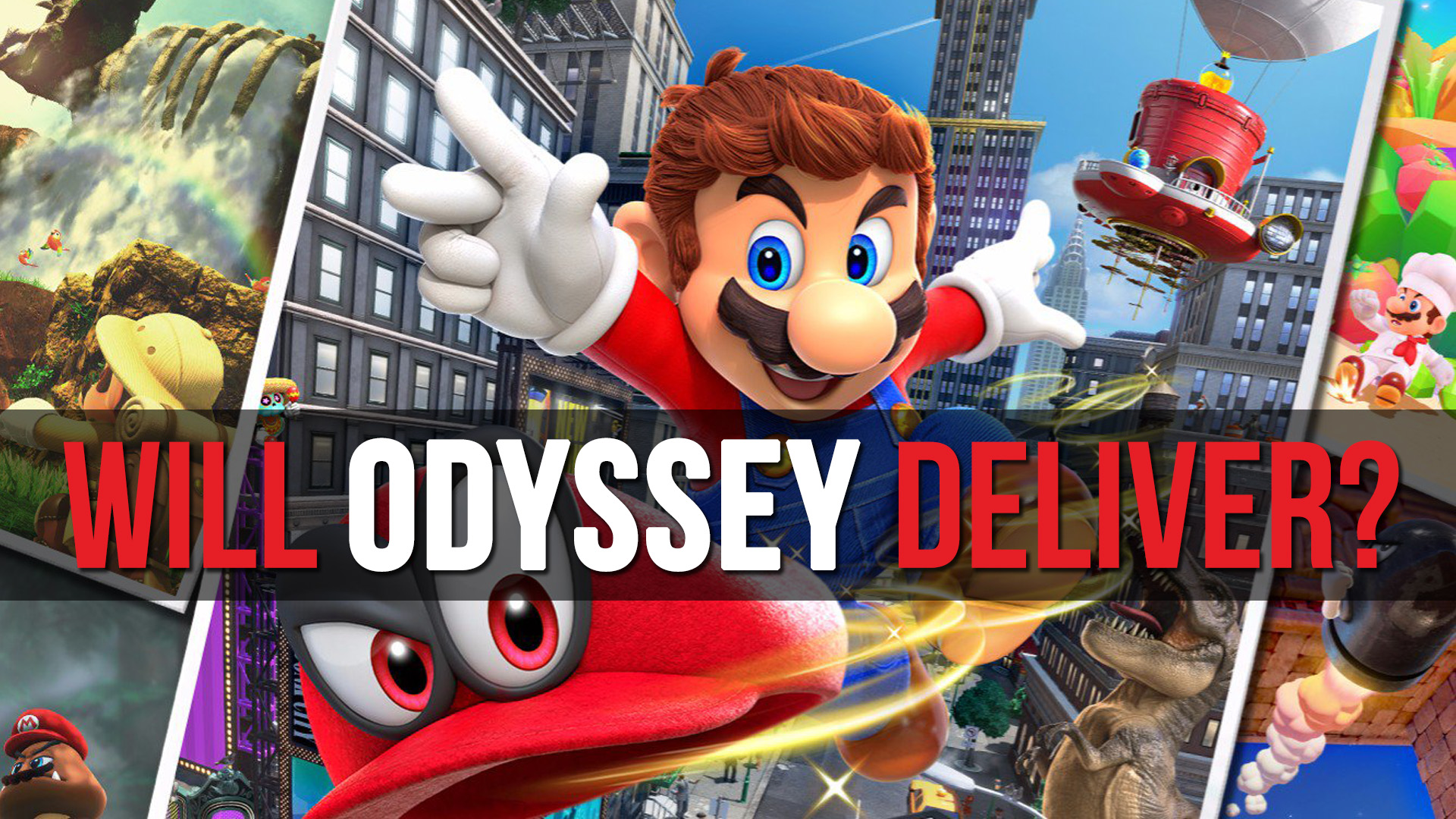
Will Odyssey Deliver on the Mario Formula?

It’s hard to believe, but this month marks another monumental game release from Nintendo! Joining the ranks of games discussed for decades like Super Mario Bros., Super Mario World, and Super Mario 64 is the newest game we won’t stop talking about for generations: Super Mario Odyssey. Link did a fantastic job carrying Nintendo’s new console through its infancy, but the torch is being passed to the plumber himself. Buckle up folks, this is gonna be big.

There’s no doubt Odyssey will sell millions, even a few tens of millions, or that it will be a hot topic for the entire Switch lifespan and beyond. But that’s not to say it’s a guaranteed hit. What we don’t know yet is: will it be good? Will it be truly great?

The potential is there. The track-record is evident in the series’ preceding entries. All Mario needs to do is avoid a few pitfalls, stick to what has worked, and wow us from time to time. A combination of tried-and-true best practices and fresh experiences will create a masterpiece.

Half of the puzzle has already been completed. The fresh ingredients: totally accounted for. We won’t be left wanting for any wow-factor, as already evidenced by numerous surprising trailer moments: Mario jumping out of a realistic city street’s manhole, Mario’s hat being alive, the game has T-Rexes… just to name a few.

Today, what I’m concerned with is this: Did the developers keep what worked from previous entries in the series? From the short time I’ve played Mario’s new adventure, and from what I’ve seen of others’ gameplay, I’m not so sure. I keep looking for those non-negotiable Super Mario elements, and unfortunately, some of them aren’t evident. Take a look for yourself.

Tight Controls

If we choose to ignore the Arcade Mario Bros. title, we can safely say that the Mario series has always featured tight controls. Whether you were making pixel-perfect adjustments with a D-Pad, or performing aerial cartwheels with an analog stick, the player always had complete and finite control over the mustachioed hero’s movements. However, Nintendo is pushing a control scheme on this game that will prove to be unideal. They say that disconnected Joy-Con with motion controls is the best way to experience Odyssey. However, that leaves us with the Switch’s signature small sticks (or S.S.S.S. for short). The analogue sticks on Switch aren’t very tall, and thus have a reduced range of motion. That’s fine for games like Breath of the Wild, where your character is often traversing in the same direction for long periods. But for intricate platforming, more range is needed.

I would recommend the Pro Controller as an alternative, but we run into further complications with that scheme, just like we do in Handheld mode: motion controls disappear (good), and are replaced with complicated combinations (bad). You would think with all the face- and shoulder-buttons at the Switch’s disposal, simple assignments would suffice, but unfortunately, performing the spinning-Cappy-throw (for example) requires you to physically spin Mario in a circle before hitting the Cappy button.

Another area you will notice the absence of tight controls is in 2D segments—you know—the really cool-looking 8-bit graffiti art portions? As attractive as those look in trailers, it’s really weird and off-putting to play with a modern controller. Imagine trying to navigate the original Super Mario Bros. with an analogue stick, and you’ll get an idea of the sensation. Furthermore, 3D “rules” of Mario still apply during these retro levels, which means running into a Goomba doesn’t make you shrink down, but you lose part of your life meter instead, resulting in a feeling of disconnect.

Level Design

If there’s one thing Super Mario Maker proved, it’s that we all have a long way to go in becoming level designers. The community generated courses simply caused me to appreciate Nintendo’s internal team more, who have proved time and time again that they can carefully craft experiences that will pull newcomers and veterans through to the end. Each level in a Mario game has clear goals, features, and themes. In Super Mario Odyssey, this clear-cut level design might be ditched in favor of an overly-open, sprawling collection of miniature attractions. Places to earn Moons are abundant, which could be a detriment to more meaningful challenges.

Progression Structure

To be perfectly honest, I’m most concerned about this one. We just discussed the plethora of Moons that this game contains, and it doesn’t excite me. 120 Power Stars was a lot to collect in Mario 64, but it was manageable thanks to a cohesive overworld that guides you to specific worlds, and specific tasks within those worlds. The developers of this new Switch title tout the fact that gameplay is returning to a sandbox nature, but that implementation can be taken too far.

In past Mario games, you know if you’re missing something. You know if a world is incomplete, and if a level was too difficult to clear for the time being.

In Odyssey you are provided with a list of Moons collected (with dates), but how will you know where new ones are? How will you know if you got all the Moons in a certain area, except one that you’re missing one in the corner? How much backtracking will be involved, and how many Moons will I pass up simply because I didn’t think to ground-pound a certain summit, or break an inconspicuous box?

You see, I’m a Shrine kind of guy. I love counting down from 120, hearing my Sheikah Slate alert me to a Shrine’s proximity as I enter a new area of the map… but you’ll never catch me trying to collect all the Korok Seeds. And I’m afraid that Moons are more akin to Seeds than Shrines. I hope I’m wrong.

Power-Ups

Gotta love Mario’s power-ups, right? Fire Flowers, Capes, Penguin Suits, Boo Mushrooms, and more! Well, they’re gone, folks. At least, that’s what this quote from the game’s producer heavily implies:
So when we wanted to create Mario games this time around we wanted to focus on the actions Mario can do and in previous Mario games he was able to get power-ups and new abilities. But this time around when we were making many different prototypes and changed our approach that found capturing or “possessing” enemies worked well so we stuck with that. -Mr. Koizumi

It’s unfortunate, to see such a mechanic go. In 2D Mario games, getting a Super Mushroom and earning that feeling of added security and power is iconic. In 3D titles, power-ups haven’t ever been as strongly implemented, but as a result, getting a Fire or Ice Flower felt like a treat. These elements have been discarded in favor of Cappy.

Gimmicks

Speaking of Cappy, he’s the new gimmick! New entries often feature a defining “gimmick,” be it Yoshi, Fludd, or over-the-top new power-ups like the Cat Suit. These open up whole new gameplay opportunities and dictate much of the level design. Odyssey’s most prominent and promising mechanic is Capture, which satisfies this aspect of the Mario formula nicely.
Let’s just hope Cappy doesn’t turn out to be the new Navi, eh?

Music

Mario music typically accomplishes two things. One: it’s catchy, and it gets stuck in your head. Two: it provides strong location associations. You can close your eyes and know exactly when Mario is underwater, in a dessert, or in Bowser’s castle. Did you just hear each of those themes in your head? I haven’t seen enough to know if Odyssey will deliver on this front, but there’s a good chance it will.

Enemies & Bosses

Baddies in the Mushroom Kingdom are always fun to stomp, and they don’t usually get repetitive or bothersome like the creatures in Metroid: Samus Returns. Hopefully, this game’s design will still lend itself to some combat, rather than just Capturing the majority of enemies in sight.

Bosses, while providing a spectacle, are typically an easy three-hit affair. This is an area where the new Switch title could easily improve upon tradition, and make boss encounters more intricate and memorable.

Charm

What would a Mario game be without charm? Character design, animations, music, and polish all create a compound for charm. Mario may be formidable when facing the forces of evil, but he’s equally adorable.

So… what’s this about real tyrannosaurus rexes roaming around? And realistic, proportionate humans walking alongside Mario in New Donk City?

I’m really questioning these design choices, and have been ever since the game was revealed.

Conclusion

Overall, Super Mario Odyssey appears to be a hodge-podge.
That’s the word for it. Just a big stew of locations, art-styles, new and old Mario sensibilities, and certainly a gigantic mix of objectives and tasks.

Will such a recipe, with that many ingredients, actually turn out well? I sure hope so, because I’m a day-one customer and lifetime Mario fan. I do trust Nintendo, but I’m not fully sold on this new direction, and I know I won’t be unless I take the game home and it proves me wrong. If that happens, I’ll update you! Fortunately, I’m entering the experience with low expectations, and that’s the safest posture to take. We’ll find out on October 27th!

Do I NEED This?: A Gamer’s Guide to De-Cluttering

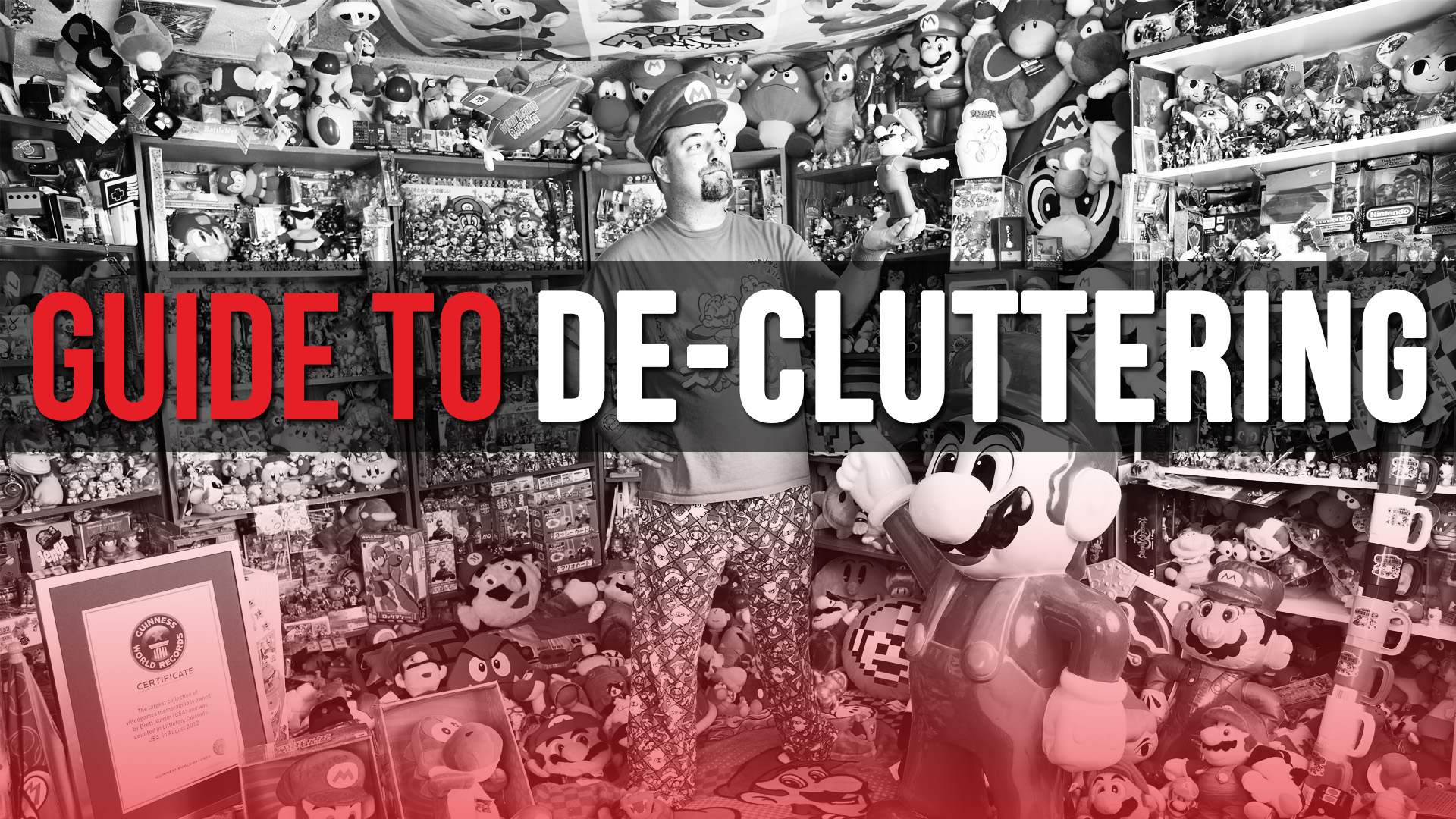
Recently I have been looking to downsize my video game collection. I am giving away and selling some old consoles, games, and accessories (blasphemy, I know). The fact is, I am a pack rat, but there are just some games that I do not play anymore, and I need to do some de-cluttering. I have had to think long and hard before I made the really difficult decision to toss some of the games in my closet, but the experience has been a freeing one. Not only do I have less “junk” lying around the house, but I no longer feel bound to my possessions, which is extremely freeing. So, if the thought of getting rid of a single game in your collection has you mumbling incoherently in the fetal position, let a fellow gamer lend you a hand.

These are the questions I ask myself of each game/piece of equipment I come across in my sorting adventures.

Do I even like this game?

I have a hard time getting rid of any game. I see that, as a thing, it has to have some sort of monetary value. I purchased it (or it was a gift to me), and, therefore, somebody spent good money on this! I cannot just throw it out, can I?

Well, it turns out I can. I do not really care for sports games, though my older brother did. I have cut a good portion of my clutter size down by being honest with myself, saying, “He might have liked this, and I might have had a good time or two, but I would rather be playing something else if I had the choice.” Remember the good times, but do not be afraid that your memories will fall out of your head if you get rid of something.

I almost wish I had kept this game it was so bad.

Does it work?

This is a similar question to the one above but is usually in reference to hardware. We either think, “I put money/time into this, even though it is broken.” Sometimes we try to rationalize, “I am going to get this fixed, someday!” even though you have no intention (much less the time or money) to actually fix it. I am not saying that broken equipment never has enough sentimental value to keep it solely “for old times’ sake”, but, like with bad games, if the memory is that important to you, it will not go away because your busted GameCube is in the dumpster.

How long has it been vs. how long have I had it?

This one is extremely practical. I have Wii games that I have had for years but never play anymore. They are going out with my next batch of games to be pawned at a small, but reasonable price.

Some games I have, though, just have not been given the chance to outstay their welcome. On one hand, I have hardly played Super Smash Bros. for 3DS since the release of the Wii U version. On the other hand, the game is only a few years old, and I have not had the chance, necessarily, to go “back” to it yet. Maybe I will want Smash Bros. on the go sometime soon. If I am asking myself that in ten years, however, I might have to take a second look.

There is another side to this, of course. Scott has been in the mood to sell his games soon after purchase because he does not see himself returning to the title. He gets the biggest bang for his buck by reselling right away, as opposed to seeing the game collect dust, and trying to get rid of it after the game is out of date.

Do I have this game in a more convenient form (Virtual Console, collections/anthologies, etc.)?

“But this is the original NES cartridge! Playing it on a modern console, even though it has been perfectly faithfully been ported, is just not the same!” This is one that, as a pack rat, I have had to wrestle with constantly. I am getting rid of many of my NES cartridges because I have them on collection elsewhere. Yes, this even includes some of my original series Mega Man games (but not my world record Mega Man 6 cart. That thing is getting framed or something). Collections are not only a great way to make accessing your games more convenient, but they also pave the way to downsizing, which is a good thing.

Is this an outdated version?

This question does not apply to most genres, as, usually, each version of a game brings something completely unique to the table. Fighting games, on the other hand, are often outdated by the next version. Is Marvel Vs. Capcom 3 REALLY worth keeping when you have the Ultimate version? Sure, there is a UI difference, but balancing patches and new characters have just made the update a better game. Let it go.

Do I have alternative console methods?

Because I have a Retron 3 I will probably be getting rid of my NES and SNES. The only downside to saying goodbye to them would be my inability to use my wireless NES multitap (though, if I got a wired one, my problem would be no more).

Retrons and similar consoles allow for ease of access and space saving. Retrons even allow you to use the original console’s controllers.

Also, you might have access to an emulator, like a Raspberry Pi. Not that I am advocating illegal emulation. Or admitting that I use my Raspberry Pi for emulation. I am not.

… Admitting it, that is.

These are some of the considerations that I used in sorting through my video game collection. Take it from someone who has been there: the process may be difficult, but the rewards are well worth it. Tune in next time as we discuss proper console dusting techniques!

Rise and Fall of Nintendo Power

We’re going to take a break from making NF videos after this one, so make sure to enjoy it and drop a comment!


Before NF, there was NP. Nintendo Power was a long running magazine, originally produced in-house at Nintendo. Over the publication’s many years, it evolved and changed with time as well as with new ownership. Simeon and Scott from Two Button Crew are here today to jog our memories on Nintendo Power’s storied history!

Footage credit: Nestalgia

“Escape the Premises” Kevin MacLeod (incompetech.com)
Licensed under Creative Commons: By Attribution 3.0
http://creativecommons.org/licenses/by/3.0/

Steam-Rolling Through Dig 2!


It’s the first installment of Let’s Play Switch! Simeon and Scott sit down to take SteamWorld Dig 2 for a spin, the newly released digging Metroidvania Nindie title. Is it worth your $20? Yes! Is it worth you watching this entire video? Yes again!

“Escape the Premises” Kevin MacLeod (incompetech.com)
Licensed under Creative Commons: By Attribution 3.0
http://creativecommons.org/licenses/by/3.0/

Future of 2D Metroid, Wii Shop, Mega Man?!


In the first-ever installment of Live Show News, we’ve got our crystal balls out to talk about the ~future~ of video games! Wii Shop Channel? Mega Man? 2D Metroid? It’s all here, and discussed by Simeon and Scott!

“Escape the Premises” Kevin MacLeod (incompetech.com)
Licensed under Creative Commons: By Attribution 3.0
http://creativecommons.org/licenses/by/3.0/

Why Smash Bros. Is Awesome

Two months ago I wrote about why Smash Bros. is stupid. While I stand by what I said, I think it is time to balance out the conversation. There are so many problems with the Smash Bros. series, but there are so many things to love as well. These are just a few reasons to love these games.

  • The Characters. While there are a few characters on everyone’s wishlist that have not made it to a game yet (I’m looking at you, real Geno), Nintendo has done a pretty awesome job bringing out the best fighters from their own games as well as characters from other companies. When they confirmed Sonic in Brawl, I completely lost my mind. The same thing happened again when they showed Mega Man in Smash 4. They even polled the players to ask what characters they wanted to see as DLC, and they listened! Even if you were not familiar with a character when they introduced them (like the Fire Emblem characters), it would be nearly impossible to think of playing these games without them.
  • The uniqueness of each game. Many people complain about Melee being too fast-paced, or Brawl being too janky, but, honestly, I do not think the series would be complete without every single (official) iteration. The original demonstrated that fighting games did not have to be put in a box. Melee showed just how serious a Nintendo fighter could be. Brawl showed how a fighting game’s story mode could be fun and interesting, and gave us the ability to customize it to no end. The 3DS version allowed us to take it on the go (also, one of the top players in our region used his 3DS as a controller on the Wii U version because he was more comfortable with it at the time). The Wii U offering gave us everything we want in a modern fighting game, including online play, balancing patches, and worthwhile DLC.
  • Custom combos. Any fighting game worth its salt has some sort of combo system; one attack leads into another to create a devastating string of hits. Smash Bros is like that, but there isn’t a set system. Any combo has to be “discovered”, and not only that, but almost all of them are situational and can be performed at certain damage percentages. This means that you have to be creative as time progresses; you cannot just use the same combo over and over without any chance of dropping it. Smash Bros. is exciting, dynamic, and will never be formulaic because of this custom combo system.
  • Killing people with Luigi’s down taunt. Hahahaha… Hahaha… HAHAHA! That is great.
  • Low tier heroes. Now, I know that this is nothing new to the fighting game scene, but there is always something exciting about seeing a player do well who plays a character you do not see played often, or a character often considered “bad”. Watching someone tear through the bracket with Ganondorf or seeing Nairo switch to Bowser for certain matchups gets everyone hype! One of my all time favorite memories was a thrown-together tournament in the Brawl days at my college. I made it to grand finals with Ike, and I was up against one of the top players in the region, playing Peach. I ended up winning the match, using my low-tier character. Years later, Scott had the chance to talk with him, and he still recalled the event, mentioning I had a great Ike. That victory meant so much to me, not just for who my opponent was, but for the obstacle I overcame as someone who played a “bad” character.
  • Jank. Yes, I know this was on my list of things that made Smash Bros. stupid, but who does not love to see a nice jank compilation? Things happen in Smash Bros. that would never happen in other fighting games, simply because of the variables involved. A hitbox that extends far past what it should? OK. Characters that randomly start glowing? Sure! Samus’s Up-B killing at 15% or less? Why not?! Part of the fun of Smash Bros. is wondering what unpredictable thing you’re going to see next…. and then raging about it.
  • The Subspace Emissary. I already mentioned this, but, did you know that Brawl had a story mode? It was even pretty good! In fact, probably the most common complaint I hear about Smash 4’s transition from Brawl is that it did not carry over a story mode. It felt like they put time and effort into the stages and the bosses, and might have made a complete game by itself (maybe at a discounted price). I have not played it in a long time, but I can still remember specific parts of the story and how epic the scale of it was.
  • D1. Who does not like D1? No one, that’s who. (He’s the guy that we get the DEEEESSSSSTTTRRRRRRUCTION meme from. If you’ve never heard of it, well, I can’t help you!)
  • A million ways to play. When I play Smash Bros. I typically play it one of two ways: tournament rules singles and tournament rules doubles. I enjoy that. But even if I did not, I would never run out of ways to play Smash Bros.! Break the targets, arcade mode, all items on, custom stages, events, eight players, amiibo, weird token-pushy-offy game, story, board the platforms, Crazy Orders (or whatever it is called), coins, All-Star, multi-man, handicaps, three-on-one, metal+stamina… the list goes on! You could play the different Smash modes forever and never see it all. There are things to collect, secrets to unlock, and styles to invent. Whatever way you play games, the Smash Bros. series has something to offer you.

There are so many things to love about the Smash Bros. series that I could never list them in a readable blog. Share in the comments below what you love about Smash Bros.

Maga Man Trivia – Can We Stump the Pro?


Simeon is a bit of a Mega Man whiz. He’s a speedrunner and all-around know-it-all when it comes to the Blue Bomber. But can Scott scour the internet for obscure details about the franchise to take Simeon by surprise? Watch and see!

“Escape the Premises” Kevin MacLeod (incompetech.com)
Licensed under Creative Commons: By Attribution 3.0
http://creativecommons.org/licenses/by/3.0/

Mega Man X – Newb Vs. Pro


In our previous Mega Man Trivia episode, we proved that Simeon is a master of Mega Man knowledge. This video, today, is here to prove that Simeon’s got just as much skill in-game as he does outside. And for your comparison pleasure, we have Scott, who will contrast Simeon’s awesomeness with pure newbishness.

“Escape the Premises” Kevin MacLeod (incompetech.com)
Licensed under Creative Commons: By Attribution 3.0
http://creativecommons.org/licenses/by/3.0/

So… Let’s try this “Stardew Valley” Thing


Scott’s grandpa just died and left him a farm (Two Button Crew Farm, to be precise) to inherit. After clearing out some dead branches, bushes, and rocks, Scott was ready to plant a few parsnips. But he has no idea what he’s doing, and there’re a bunch of neighbors in the city nearby that he’s yet to meet. Oh, and he hasn’t eaten in 7 days. How will Scott survive? Watch to find out!

“Escape the Premises” Kevin MacLeod (incompetech.com)
Licensed under Creative Commons: By Attribution 3.0
http://creativecommons.org/licenses/by/3.0/

Back to Mario Kart’s SNES Roots!


Simeon grew up with Super Mario Kart, but Scott’s only played it once. This should be interesting. We start with a grand prix and end with a fierce balloon battle. Watch until the end for something you probably never wanted to see!

“Escape the Premises” Kevin MacLeod (incompetech.com)
Licensed under Creative Commons: By Attribution 3.0
http://creativecommons.org/licenses/by/3.0/

Top 10 Daily Show Episodes (#351-600)


Before the Live Show, Simeon and Scott hosted Your Daily Nintendose of Fandom on their YouTube channel by uploading a Nintendo related video every day. It was a blast, and it’s time to look back on the final 250 episodes and celebrate the Top 10 videos from that period. Join us as we laugh, cry, and remember the Daily Show!

“Escape the Premises” Kevin MacLeod (incompetech.com)
Licensed under Creative Commons: By Attribution 3.0
http://creativecommons.org/licenses/by/3.0/

Innovation vs. Iteration Scott's Thoughts

Innovation: to revolutionize, change, transform, or evolve.

Iteration: to repeat, improve, patch, or expand.

Historically, Nintendo is a very iterative company. Most of their characters and concepts came from the mid-80s, when the company created its first batch of games for NES.

For many subsequent generations, they’ve followed the formulae, making a Mario game. A Zelda game. A Metroid game. Sequels got marginally better, improving upon past issues.

They’ve been honing their craft. Perfecting.

The only problem with this tradition is that it’s not very exciting. People start saying things like “if you’ve played one, you’ve played them all,” and “they keep recycling the same story over and over again.”

Nintendo Wii was the company’s first major hardware innovation in a long time—and they knew it, naming it codename “Revolution.” We were starting to see a brand that was ready to transform the gaming industry. Funny enough, the console’s success caused the console-maker to follow up with a safe “half-step” successor, but the masses weren’t listening anymore.

The good news is: innovative Nintendo is back, and that culture is seeping into their most beloved franchises. Breath of the Wild and Odyssey took a big leap in evolving the gameplay front. Next, we’ll see bigger shifts in story and presentation.

Buckle up! Your responsibility is being open to the change.

Next Classic Edition: Gameboy Vs. N64


We were amazed and surprised by the NES Classic Edition. We were relieved and glad for the SNES. Now… what’s next? Gameboy or Nintendo 64? Time will tell, but Two Button Crew is here to stack up the pros and cons of each and determine which is more likely! Agree? Disagree? Let us know in the comments!

“Escape the Premises” Kevin MacLeod (incompetech.com)
Licensed under Creative Commons: By Attribution 3.0
http://creativecommons.org/licenses/by/3.0/

Why Indies are Better than 3rd Parties Scott’s Thoughts

Do you love huge, generalized sweeping statements? Well, you’re in luck!

Indies are way better than 3rd party developers.

When I play a 1st party Nintendo game, the polish is undeniable. I can practically taste the quality assurance oozing out of every aspect of the game.

Playing a 3rd party title is often a disappointing affair. I’m reminded how much less effort they put into their menus, onboarding new players, readability, and the overall stability of the experience.

Indies, however? I’ve had the pleasure of completing multiple independently-developed games that feel as if they belong in Nintendo’s own stable of IP. They often approach development the same way Nintendo does, creating a unique mechanic and building an entire world around it.

These self-published titles come with lower budgets and therefore have less marketing. They have to compensate with more ambitious pitches; it takes a lot to stand out on the Switch eShop, with handfuls of games being dumped onto the store weekly.

An indie game tries to do less, and with that narrower focus comes a more concentrated dose of polish.

For the most part, independent games are structurally and functionally tight. You can learn what’s expected of you in a matter of seconds, just like an old arcade or NES game.

They are more often labors of love, made by people who don’t come home with a check twice a month from an employer but quit their job to work on the idea that they just can’t get out of their head.

Indie games are less restricted by businessmen who demand a carbon copy of what’s already selling and are free to experiment with art styles and non-traditional music.

Do yourself a favor and enjoy indie games, thereby supporting these small studios. They both need it and deserve it.

Why Mega Man is Not the Main Character

Mega Man is at a weird juncture in its life.  It has been five years since the last actual game release with Street Fighter x Mega Man. But since then, there have been fan games released, a “spiritual successor” in Mighty No. 9, guest appearances in fighting games like Super Smash Bros., a cartoon series and movie announced, and a “big announcement” coming in December for his 30th anniversary, not to mention several collections for modern consoles of some of his classic adventures. I guess you could say that he is experiencing his own mid-life crisis, trying to find his identity in these unfamiliar times.

Not to alleviate that, it is my goal today to tell him that the franchise that bears his namesake is not about him. It may be rude to kick someone while they are down, but I want to bring some reality to the situation. First, I want to prove that Mega Man is NOT the central protagonist of his franchise, then present to whom I believe the spotlight has shifted.

Background

In talking about this franchise, I would like to get some terminology out of the way. First, I will be using “series” and “franchise” in very different ways. “Franchise” will refer to all things Mega Man (especially media considered “canon”), and when I use “series” I will denote the specific subdivision of the franchise to which I am referring (i.e. classic, X, Battle Network, etc.)

Also, I will be dealing primarily with the “classic” timeline. For those of you unfamiliar, the Mega Man canon is divided up into 2 main timelines. The first is what I will refer to as the classic timeline. This includes the classic series, X series, Zero series, ZX Series, and Legends series. The second timeline, in which Dr. Light pursued software solutions as opposed to robotics, contains the Battle Network and Star Force series. It is a little more complicated than that, but, as I said, I will refrain from using those sources when I can.

I will also try to refrain from boring you with storyline minutia, though some talk of story points is inevitable. Consider this a spoiler warning… If you ever cared about the Mega Man storyline being spoiled for you…

Who is “Mega Man”?

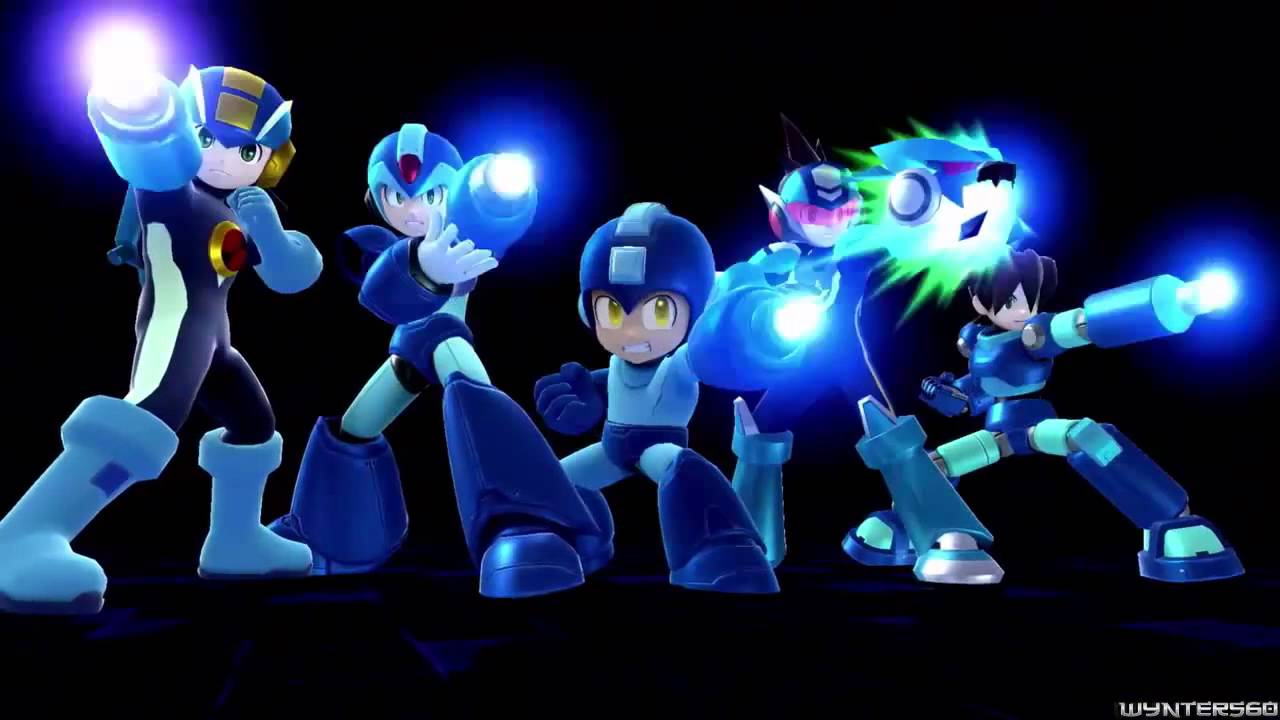
The difficulty in defining Mega Man as the star of his own franchise begins with defining who you are referring to when you refer to Mega Man. Do you mean the classic 8-bit rendition, or the reploid named X, which bears resemblance? Perhaps you are referring to Mega Man Volnutt, or maybe the persona created by the fusion of Geo and Omega-Xis?

Will the real Mega Man please stand up?

If you were to count characters commonly referred to as Mega Man (by games of fans) you would come up with no less than five, or three in the classic timeline, and possibly as many as twenty or more depending on which renditions you “count”. Even if you were to only count three, all of them are separate entities with their own origins and personalities which they do not share with any of the others. Also, no one of those characters plays a major part in all of those games or series.

The best way around this is to hold to a view that Mega Man is not a single entity, but rather an idea centered around championing peace, justice, and the color blue to a troubled world. At that point, Mega Man is no longer a character, but a loosely-defined set of characteristics that do not find themselves clearly stated in the games, but are then defined by the player. It is an entertaining thought, but hardly a basis of a character.

One champion above the others…?

Now that we are forced to chose one Mega Man, we must choose wisely. First, we should immediately eliminate Mega Man Volnutt from the equation. His series takes place thousands of years apart from the other series, holding only tangential story ties.

Next is the classic Mega Man. It was with him that the franchise began, and I think that it is safe to say that he was the original protagonist of the series. But this Mega Man does not have any direct influence after the time of the classic series end. Though nostalgia may cloud our vision, he had to pass the torch eventually.

Lastly, we have X, which I believe is the best of the Mega Man candidates. We see his origins in the classic series, created by Dr. Light as Mega Man’s successor and an experiment that one day robots might be just like humans. X’s main story begins in Mega Man X, extending through the X series. He fights in the Maverick Wars against Sigma and his underlings. X’s influence is seen through the Zero series (though not being the main protagonist) turning into a cyber elf, still fighting for the greater good, but dying-ish in Mega Man Zero 3. His soul returns in the form of Biometal Model X in the ZX series, continuing in his assistance to the current heroes.

No doubt X’s influence is felt throughout these time periods. His help in defeating Sigma countless times, as well as other threats against the earth cannot be overlooked. But even with all of these points, the developers have not ceased to draw our attention to the real star of the show.

Zero’s the Hero

Was there any doubt when you started reading this article who I would land on as the franchise’s main protagonist? Not only does Zero have a great design, killer moves, and hair that makes all the ladies jealous, but Zero is the central character of the Mega Man franchise as a whole.

First, there is the issue of presence. Of course, Zero is not clearly present in the Legends series (yet), but, once again, the Legends series is so far removed from the rest of the timeline that we must minimize its effect. Zero’s story, as X’s did, begins in the classic series with Wily’s creation of Bass as a rival to Mega Man. Though Bass failed to live up to Wily’s expectations, he studied the energy he had used to create Bass (called Bassnium, lol) to create the ultimate weapon. Here we see Zero’s sinister origins.
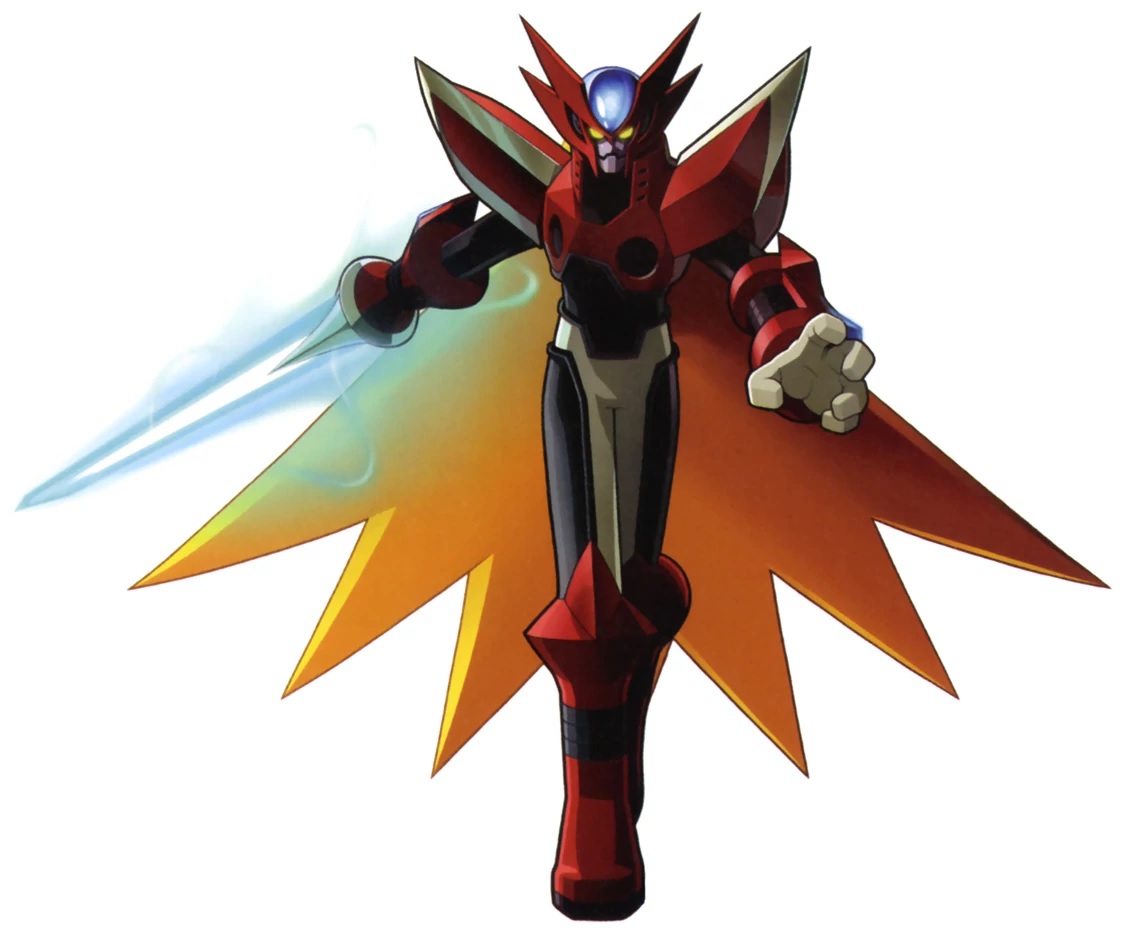
Before the events of the first Mega Man X game, Zero is shown to be a maverick (read: “crazed, destructive robot”), unstoppable by any of the Maverick Hunters except Sigma, and only that due to a headache caused by the Maverick Virus, which is released from Zero’s body upon defeat. Sigma has Zero brought back to the Maverick Hunters’ base.

From this point forward, the storyline of the series follows two repeating themes. The first is Zero’s redemption. Though Zero fights for truth, justice, and all that jazz, his primary struggle is against himself. In fact, just about everyone’s struggle from this point on, for the next few hundred years, at least, can be traced back to Zero, either directly, or in the form of the Maverick Virus, or some other “chunk” of Zero that finds its way to a sinister purpose. Sigma, the main villain from the X series, turned evil because he was infected by the Maverick Virus. All of these things set the stage for Zero to not only become the primary hero of the X series (and beyond), but also the primary antagonist, as he must fight to redeem his initial purpose as a weapon of evil and his past (and recurring) destructive actions. X is a hero for good that pretty much stays good. Boring.

The second theme is sacrifice and rebirth. As you may know, Zero dies. He dies A LOT. His deaths are not just the result of his defeats, however, as he routinely sacrifices himself for the greater good (defeating Vile on MMX, Sigma in X5, etc.). But just as the evil part of him is consistently brought back to life by some wicked plot, he always seems to find his way to the land of the living as well. The cycle continues at least through the ZX series, and probably beyond.

The passing of the torch

The last thing I feel I need to address is the “when”. When did the focus shift from Mega Man to Zero? I think the easiest answer is Mega Man X4, as we see a greater, overt emphasis on Zero’s role starting there (X1-3 seem to focus on X, X4-6 focus on Zero, and X7-8 on Axl), but I think we can go back a little further.

At the beginning of the first Mega Man X game, we see X defeated by Vile, and Zero swooping in to save the day. While giving X a pep talk Zero says, “If you use all the abilities you were designed with, you should become stronger…you may even become as powerful as I am.” From this point forward in the game, whenever X gains an armor upgrade, he becomes more and more like, say it with me, Zero (this point is taken from Arin “Egoraptor” Hanson’s Mega Man X Sequelitis video. There is strong language in the video, so follow it at your own risk)! Though X is the central protagonist, becoming like Zero is his ultimate goal. What is the plot of the Second X game? Rebuilding Zero after his heroism in the first game! Even when he is not alive, Zero is given the center stage. Though the plot in X3 does not necessarily revolve around him, he is still given an increasingly important role, as he is finally a playable character, setting the stage for him to be the center of attention for the rest of the series and, after that, the franchise.

So, there you have it. All roads in the Mega Man universe lead to Zero.


P.S. Did I mention that he also appears in the Battle Network timeline as well?

Super Ghouls ‘n Ghosts – Chop Til We Drop


Two Button Crew patrons voted that we subject ourselves to this torture, so we did. What felt like an hour of agony was really only 35 minutes of trial and error. And a lot of the SNES Classic Edition rewind feature. Thank goodness for that. Super Ghouls ‘n Ghosts may just be the hardest game we’ve played on the show, but watch the whole thing to see how we feel about it towards the end.

“Escape the Premises” Kevin MacLeod (incompetech.com)
Licensed under Creative Commons: By Attribution 3.0
http://creativecommons.org/licenses/by/3.0/

Nintendo’s Job ≠ Parents’ Job Scott's Thoughts

I grew up with three parents: Mom, Dad, and Nintendo.

My mother and father were great—kept me out of trouble, let me earn trust, and gave me some slack on the leash.

Nintendo, on the other hand, has always been the stereotypical helicopter parent.

And still is.

When I moved out of my Mom and Dad’s house, I took my Nintendo games with me. Along with them, I brought some overbearing restrictions along for the ride.

I got my own place to live, my own car to ride, and my own job to cover my bills. That’s what we call “adulting.” Unfortunately, I still feel like a kid when I try to play online and use the limited internet services built into Nintendo systems.

This company from Japan thinks it’s their job to raise me. It’s not, and it never was.

If Nintendo wants to provide a parental control app—great. The one for Switch has some neat features. That needs to be the end of their responsibilities, so parents can do the rest.

It would sure be nice to talk to my friends… or even my competitors if I want to!

Are We Any Good at Star Fox 2?


Star Fox 2 is a divisive game. Media outlets tried scoring it, but that was met with much strife over how a cancelled SNES game should be scored in 2017. Let’s put all that aside and actually play the game, shall we? Scott actually makes it way farther than he expected to in this run. Thoughts on the game? Comment below.

“Escape the Premises” Kevin MacLeod (incompetech.com)
Licensed under Creative Commons: By Attribution 3.0
http://creativecommons.org/licenses/by/3.0/

Are Portable/Console Hybrids the Future? Scott’s Thoughts

NX rumors began shortly after Wii U launched. People were quickly eager for the next big thing.

Closing in on Switch’s first year, and Nintendo fans aren’t fidgeting for news on its successor.
We’re content. Eager for certain game announcements, yes, but satisfied with the hardware.

“What do you want in the next Nintendo console?”
Even enthusiasts are having a hard time answering that. A more powerful Switch, I guess?

And I would agree with that. Friends texted me right after the Switch reveal video, asking me what I thought. My response: What more could you want? It’s got all the buttons, it’s HD, and you can play on your TV or take it anywhere.

In many ways, we’ve arrived. Similar to the cellular market, where your phone looks about the same as it did 4 or 5 models ago, the Nintendo hardware line is maturing.

Could you imagine a follow-up console to the Switch not being portable? You don’t want to think about that, do you?
Rest assured, the hybrid strategy is here to stay.

With Nintendo, that is.
Competitors like Microsoft and Sony might not adopt it so quickly because of their emphasis on graphical power.

You can think of those companies as desktop PC makers, whereas Nintendo has differentiated itself as the laptop provider. Not leading the charge in technical specifications but in form-factor.

There certainly are advancements still waiting to be made in the gaming industry, make no mistake. In five years or less, we’ll likely have the opportunity to purchase a 4K Switch tablet with VR capabilities.

But Switch represents a revolution in how Nintendo makes their flagship consoles.