#585 – Mario + Rabbids: Kingdom Battle hits store shelves (and eShop) today! To celebrate this monumental partnership with Nintendo, we’re looking back on where the Rabbids came from. Their humble origins started with an Ubisoft launch game on Wii, and they’ve skyrocketed to success ever since. Come for a trip down memory lane with us!
Footage credit: Bryce Games
“Escape the Premises” Kevin MacLeod (incompetech.com)
Licensed under Creative Commons: By Attribution 3.0
http://creativecommons.org/licenses/by/3.0/
#596 – Super Mario Odyssey is Nintendo’s next big hit game coming to Switch. We went hands-on and explored the Sand Kingdom. Included in this demo are a few different 8-bit challenge sections, purple coin locations, and an interesting Capture mechanic that involves a big Tiki Head and sunglasses. Enjoy this sneak-peak at Super Mario Odyssey!
“Escape the Premises” Kevin MacLeod (incompetech.com) Licensed under Creative Commons: By Attribution 3.0 http://creativecommons.org/licenses/by/3.0/
#541 – You buy the best Nintendo games, but do you find it hard to keep up with those smaller titles and 4rd party offerings? In this non-sponsored video about GameFly, Simeon and Scott discuss the pros and cons of the service and speak from their own experiences. Having a GameFly subscription is no replacement to owning your own collection of discs and cartridges, but there may be a good place for GameFly among your product purchasing plans!
“Escape the Premises” Kevin MacLeod (incompetech.com)
Licensed under Creative Commons: By Attribution 3.0
http://creativecommons.org/licenses/by/3.0/
#551 – The next big 3D Mario game is about to hit stores and Switches in a few short months. QUICK! Two Button Crew needs to get in their wish lists to the developers at Nintendo so that they can design the game to our exact specifications. Agree with our wish list? Let us know below!
Footage credit: Outside Xtra
“Escape the Premises” Kevin MacLeod (incompetech.com)
Licensed under Creative Commons: By Attribution 3.0
http://creativecommons.org/licenses/by/3.0/
Did we cross any lines in this episode? Barely not? Okay!
#563 – This video is a little hard to explain… let me try: You’ve been pronouncing everything Nintendo related WRONG. For a long long time. I’m sorry, but you’ve been horribly misled all these years. Your heroes, Simeon and Scott, have gone on a journey to discover the true pronunciations of all things Nintendo and this video contains their findings. Watch, listen, and learn… but most of all, repeat.
“Escape the Premises” Kevin MacLeod (incompetech.com)
Licensed under Creative Commons: By Attribution 3.0
http://creativecommons.org/licenses/by/3.0/
Be sure to decrease the sale value of your car with these awesome bumper stickers!
#575 – Gamers – that’s what we identify as. But it’s not enough just for our close friends and family to know that side of us… no, we need to broadcast it to the world with stickers for our bumpers. Simeon and Scott have selected the best Nintendo related bumper stickers and are going to share them with you!
“Escape the Premises” Kevin MacLeod (incompetech.com) Licensed under Creative Commons: By Attribution 3.0 http://creativecommons.org/licenses/by/3.0/
I think I discovered a pattern… this guy always let me win Round 1 and then spanked me!
#597 – Pokken is back! We played the original on Wii U, but now the Switch is receiving a deluxe inversion that includes all the arcade characters, plus a newcomer! Scott challenges a Nintendo rep in this video, so forgive him if he gets spanked. At least you get to see four playable characters in action that weren’t available on the Wii U version!
“Escape the Premises” Kevin MacLeod (incompetech.com) Licensed under Creative Commons: By Attribution 3.0 http://creativecommons.org/licenses/by/3.0/
We have stepped into the time machine. We brought you a souvenir from the past!
#542 – Something Nintendo dedicates a lot of time, money, and effort to, but most fans don’t pay attention to: their website. Yes, they’ve been updating their home on the web for many years, and it’s seen a ton of different iterations. Those iterations? We’ve found the most interesting ones and put them into this video for you!
“Escape the Premises” Kevin MacLeod (incompetech.com)
Licensed under Creative Commons: By Attribution 3.0
http://creativecommons.org/licenses/by/3.0/
#552 – They can’t afford to mess this one up. If Metroid Prime 4 bombs badly, then that could mark the end of the Metroid franchise. This is the sequel that fans have been begging Nintendo to make for a decade. With Retro not at the helm of this new entry, the game’s future is questionable!
Footage credit: Boss Fight Database | MrNintendoSense | thepixelpress
“Escape the Premises” Kevin MacLeod (incompetech.com)
Licensed under Creative Commons: By Attribution 3.0
http://creativecommons.org/licenses/by/3.0/
If you’re old enough to remember printed game manuals, you’ve probably heard gamers joke about how superfluous they were. Ever since the mid 90’s, games have featured in-game tutorials and, even then, most people are smart enough to figure out the basics just by fiddling with the controller for a few seconds. They were utterly redundant. And yet, just about everyone admits that the first thing they did when they bought a new game as a kid was read those blasted booklets cover to cover. I know I did.
Nowadays, print manuals have been phased out in favor of in-game tutorials and digital guides accessible with a few, quick button presses. But just because something’s extinct doesn’t mean it’s not worth studying. Let’s take a look at how game manuals evolved over the years.
These have been gone for eons, and yet every natural history museum has to have at least one.
I’ll be limiting this examination to one mainline Mario title per console generation: Super Mario Bros., Super Mario World, Super Mario 64, Super Mario Sunshine, and Super Mario Galaxy 2. Why? Because contrary to popular belief I actually have a life, and to do this properly is way more work than even I’m willing to put out.
Printing
The most noticeable difference between manuals at first glance is their physical construction. The original Super Mario Bros.‘s manual is approximately 5.2×4 inches, which is considerably smaller the manuals of later generations, which all average to roughly 4.6×7 inches. Of course, size differences pale in comparison to the actual printing. With the exception of the cover and the gold Nintendo Seal of Approval on the first page, Super Mario Bros.‘s manual is entirely in black and white. Later generations would feature full color print for their manuals. Moreover, much more thought was given to how the pages were laid out, with sentences no longer being split between pages and more organic placement of text and illustrations. The last item of note is Super Mario Galaxy 2‘s manual is written in three languages: English, French, and Spanish. As to be expected, this tripled the booklet’s thickness.
Story
Back in the day, the only way to know a game’s plot often times was reading it in the game’s manual. Even after games started to become self-contained by providing opening cinematics, manuals continued to provide brief summaries of the game’s premise.
As to be expected, the plot summary of the first Super Mario Bros. is short and to the point. It describes what happens, without going into much detail as to how or why. Moreover, we don’t get to see things from any character’s point of view. Because of this, the narration has a sense of detachment from the plight of the hero, giving the plot summary a matter-of-fact tone. In short, it’s not so much a story as it is a plot.
In short, it’s not so much a story as it is a plot.
By contrast, Super Mario World‘s story uses a limited third-person narrative, presenting the story from Mario and Luigi’s perspective. The characters are presented as, well, characters: they’re given motives, emotions, and even dialog. Moreover, the story is actually presented as a narrative, with events playing out in sequence. Interestingly, the story (in the North American manual, at least), makes reference to the events of Super Mario Bros. 3, indicating that SMB3 is canonical despite Miyamoto stating it was all a stage-play…
Super Mario 64 continues the increased focus on narrative, notably by spending two whole pages on story! The story starts with a dose of self-awareness by asking, “Is there no end to the constant feuding between Mario and Bowser?” Afterward, the plot is told entirely from Mario’s perspective, with frequent interjections from the man himself. These quips from Mario are actually a bit jarring for anyone used to Mario’s modern portrayal, as they actually communicate some personality. It seems at this point Nintendo wasn’t afraid to let Mario be his own character instead of a stand-in for the player. Other than that, the story unfolds much like Super Mario World’s, which is to say a narrative instead of a plot. Interestingly, Mario 64 and Super Mario World‘s stories both include some overlap with what the player would see during gameplay.
It seems at this point Nintendo wasn’t afraid to let Mario be his own character instead of a stand-in for the player.
Super Mario Sunshine‘s story section is somewhere between the style of Super Mario Bros. and its super Nintendo and N64 predecessors, mostly leaning toward the former. While it attempts to convey the story with the sense of drama of Super Mario World and Mario 64, it only describes things in broad strokes. Like Super Mario Bros., there’s no focus on characters, instead favoring a description of events from an outside perspective. I assume this is in part due to the inclusion of cutscenes in the game itself. Since this was the first Mario game to be almost entirely self-contained when it came to plot, Nintendo probably thought it would be redundant to put information in the manual that the player would receive in-game.
Lastly, Super Mario Galaxy 2 somehow manages to beat even Super Mario Bros. in brevity. It doesn’t even set up the story’s conflict. All we learn from it is that Mario’s been invited to the castle and meets a Luma along the way. That’s it. The Prologue page actually devotes more space to character bios than story, which—given the game’s focus on gameplay over any semblance of plot—is probably appropriate.
Controls and Gameplay
The most important part of a game, and thereby the most important part of a game manual, is the gameplay. Gameplay and controls vary from game to game, even within the same franchise. As such, these sections are going to differ quite a bit on the granular level. Seeing as this is an examination of the evolution of game manuals and not the Mario series, I’m going to look at the big picture: what’s emphasized and how those instructions are written.
So right off the bat, I noticed something peculiar about the way pre-2000’s manuals were written. Often times when explaining controls or specific actions, the manuals often phrase actions in terms of Mario and not the player. For example, when listing the uses for the A-button, the Super Mario World manual says it “Makes Mario jump,” instead of, say, “Makes you jump.” Sunshine and Galaxy 2‘s manuals instead phrase controls and player actions in terms of the player, using terms like “when you touch an enemy” and so on.
This is interesting as conveys the idea that—despite the player controlling him—Mario is his own separate entity, with the player simply giving him instructions rather than Mario being an extension of the player. That said, I would be remiss to not mention that the pre-2000’s manuals were inconsistent in this trend, often alternating between describing actions as being performed in third-person (i.e. Mario) and second-person (i.e. the player). Also interesting is that while Mario Galaxy 2‘s manual exclusively describes the actions Mario can perform in second-person, actions that Yoshi can perform are exclusively third-person, indicating that the player isn’t the character he’s controlling, he is Mario.
This conveys the idea that—despite the player controlling him—Mario is his own separate entity.
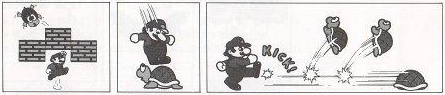
Older games take a very different approach to describing gameplay. Both Super Mario Bros. and Super Mario World go into great detail about everything: defeating enemies, items, kicking shells, using the weird pink ramps in Mario World, everything. Super Mario 64‘s manual spends most of its pages explaining analog movement, items, and how to progress through the game, with basic concepts like stomping on enemies being mostly glossed over. Sunshine‘s gameplay section is almost exclusively about all of the different moves and actions Mario can perform, only briefly touching on game progression or items. Lastly, while the Galaxy 2 manual mostly lists moves, it does go into more detail when explaining the mechanics of recurrent items and stage features like checkpoint flags than the previous 3D games.
Early manuals explained every facet of the game.
Personally, seeing how ideas and perspectives have changed over the last 30+ years is fascinating. We’ve seen Nintendo promote Mario as a character, only to make a 180 and make him a simple stand-in for the player. Then there’s getting to see what they thought was important for each game: back when Mario was first introduced, stomping on enemies, kicking shells, and so forth were new ideas, and the manuals tried to explain everything they could. Later games trusted that the player was familiar enough with the series—or video games in general—to figure out how to use their abilities and instead focused on the basic controls and the game’s new ideas, such as Mario 64‘s analog movement.
Unfortunately, this is where the story ends; Nintendo phased out print manuals during the Wii U era in favor of digital manuals, and now with the Switch, we don’t even have those. It’s a shame really, because, as I’ve just shown, even if you don’t need a manual to play a game or understand its plot, you can still learn from it.
I guess we’ll have to wait 384 years to see what this cryptic message means.
#576 – L Is Real. Those 3 mysterious words have echoed in our minds since the Nintendo 64 days, where they showed up in Super Mario 64 and later in Ocarina of Time. But the question still stands: what does it mean? This video goes out to Crew member Rachel!
Footage credit: The Easter Egg Hunter “Escape the Premises” Kevin MacLeod (incompetech.com)
Licensed under Creative Commons: By Attribution 3.0
http://creativecommons.org/licenses/by/3.0/
#587 – We haven’t seen the New Super Mario Bros. games in a little while, but is that such a bad thing? Nintendo was leaning heavily into the multiplayer aspects of these games, but many gamers found it surprisingly frustrating to share the screen with their friends. Maybe Mario just isn’t a well-suited series for multiplayer. Let’s discuss it! Footage credit: TheRunawayGuys, WiiLikeToPlay
“Escape the Premises” Kevin MacLeod (incompetech.com) Licensed under Creative Commons: By Attribution 3.0 http://creativecommons.org/licenses/by/3.0/
#598 – We really had an awesome trip to PAX West 2017. Our patrons funded the trip, and we’re super thankful that you guys made it happen. In this Vlog you’ll get to see us travel, snag some last-minute Sunday passes, meet IGN staff, sneak into the showfloor while it was closed(!), play some Nindie titles, as well as new Mario & Luigi and Fire Emblem Warriors games! Make sure to watch until the end!
“Escape the Premises” Kevin MacLeod (incompetech.com) Licensed under Creative Commons: By Attribution 3.0 http://creativecommons.org/licenses/by/3.0/
#543 – Vroom in the Night Sky is available on the Nintendo Switch eShop. Is it worth it? No… unless you can have a good laugh at a game like we can! Vroom’s terrible translation lends itself to some hilarious jokes (at its expense, of course). Seriously, if you haven’t seen this game, it’s so worth watching the footage and hearing us pick it apart!
“Escape the Premises” Kevin MacLeod (incompetech.com)
Licensed under Creative Commons: By Attribution 3.0
http://creativecommons.org/licenses/by/3.0/
You could call us “YouTube Trendsetters,” but… you’d be completely wrong.
#553 – Never seen a video like this before on YouTube, have you? We’re playing with Slime, and you can just chalk this up as a Splatoon video, alright? The object of the game is for us to get each other to guess Nintendo related characters, objects, icons and more, simply by manipulating stubborn slime with our bare hands. Should be fun, right?
“Escape the Premises” Kevin MacLeod (incompetech.com) Licensed under Creative Commons: By Attribution 3.0 http://creativecommons.org/licenses/by/3.0/
TBC’s regular viewers (the Crew) are truly the people who make Two Button Crew work. If you are reading this, you are probably one of them. If you are not, we welcome all with open arms (more on that later)! With such a growing community, I thought it would be helpful to remind myself what makes our community unique.
Faithfulness:
With the exception of a few, TBC’s videos have had consistent views, which means that the same viewers come back day after day to watch our videos. Recently, Scott and I have gone back and looked at the low points of our daily show. But I realized that, even when our videos were not our best efforts, our fans were always there, watching faithfully… Except for the Mystery Block. No one watched the Mystery Block.
Highway run…
Our overall channel views (which just recently crossed the 100,000 mark. Yay!) and comments section corroborate this fact; many of our regulars comment on all of our videos. Speaking of YouTube comments…
Kindness:
Something that is so common in many communities, no matter what type, is toxicity. People tend to tear each other down and apart much more than they like to build each other up. The Crew has been nothing short of amazing in this aspect. Comments on our videos are nearly always positive, whether it is a compliment or a criticism; all of it is done with grace. It was recently suggested to me that we add a “rules” section to our Discord. My first reaction was, “Yeah, that’s a really good idea. Why haven’t we done that already?” Then I realized that it was because we have not had to worry about such problems before. Just this last week seven of you recommended Scott for a gaming journalism position on Twitter to IGN. Seven! Kindness like this is a unique characteristic for a gaming community. As the Crew grows, I hope this is something we never lose.
Progression
The last element I want to focus on is something I like to call progression. Everyone starts out watching a single video (I wonder how many of you can remember which one it was!); this is the “peruser” phase. A peruser is shopping around to see what channel is worth investing in. After a few views, a peruser might become a subscriber and enter the Crew. From here, subscribers become faithful watchers and commenters. Some of the Crew, after spending some time in the family, might even take the next step into patronage; this means that they not only believe that the Crew is worth investing their time but also their resources. This is crazy to me, and I am so grateful that there are so many who have taken that step. Beyond this, some (*cough* Glen *cough) have even become content creators for TBC. Not every member of the Crew finds his way into the inner circle, but it amazes me to see fans make their progression further into the Crew.
The Crew should go down in the history books as the greatest internet-based community ever. Thank you so much for supporting TBC.
#577 – The Directional Pad is something that many gamers take for granted, but it really was a novel invention at the time that Nintendo introduced it. While it’s been largely taken out of the spotlight by analog sticks, the digital input solution still has its own merits. We’re going to discuss its inception, the Nintendo patent, and what their competitors did in response. It’s another interesting history lesson brought to you by Two Button Crew!
“Escape the Premises” Kevin MacLeod (incompetech.com) Licensed under Creative Commons: By Attribution 3.0 http://creativecommons.org/licenses/by/3.0/
#588 – We wish we could say we have “nothing but love” for video games, but to be honest, sometimes it’s more of a love/hate relationship. Our goal at Two Button Crew has always been to enhance your enjoyment of Nintendo gaming and fandom, so today we’re doing that quite literally: explaining how to have fun while gaming. We’ve got tips for casual and competitive environments, as well as single player gaming. Hope it helps!
“Escape the Premises” Kevin MacLeod (incompetech.com) Licensed under Creative Commons: By Attribution 3.0 http://creativecommons.org/licenses/by/3.0/
#599 – Nintendo has been around our whole lives, and when we take the time to stop and reflect on it, it turns out: we’ve learned quite a lot from the quirky Japanese game publisher. We knew Nintendo was fun and creative, but also a source of life lessons? Why not! Simeon and Scott have a list, as well as some great additions from Two Button Crew patrons. Thanks, Crew!
“Escape the Premises” Kevin MacLeod (incompetech.com) Licensed under Creative Commons: By Attribution 3.0 http://creativecommons.org/licenses/by/3.0/