#552 – They can’t afford to mess this one up. If Metroid Prime 4 bombs badly, then that could mark the end of the Metroid franchise. This is the sequel that fans have been begging Nintendo to make for a decade. With Retro not at the helm of this new entry, the game’s future is questionable!
Footage credit: Boss Fight Database | MrNintendoSense | thepixelpress
“Escape the Premises” Kevin MacLeod (incompetech.com)
Licensed under Creative Commons: By Attribution 3.0
http://creativecommons.org/licenses/by/3.0/
#551 – The next big 3D Mario game is about to hit stores and Switches in a few short months. QUICK! Two Button Crew needs to get in their wish lists to the developers at Nintendo so that they can design the game to our exact specifications. Agree with our wish list? Let us know below!
Footage credit: Outside Xtra
“Escape the Premises” Kevin MacLeod (incompetech.com)
Licensed under Creative Commons: By Attribution 3.0
http://creativecommons.org/licenses/by/3.0/
#550 – Out of nowhere, Linkle appeared and paved the way for a female Link. Simeon and Scott sit down today to discuss the issue of Link and gender. Will Linkle ever star in her own game? Should the Hero of Hyrule reincarnate as a woman in a future game? WHY NOT?
Footage credit: Direct-Feed Games
“Escape the Premises” Kevin MacLeod (incompetech.com)
Licensed under Creative Commons: By Attribution 3.0
http://creativecommons.org/licenses/by/3.0/
#549 – Astro Duel! You’ve seen it on the Switch eShop, but maybe you’re not entirely clear on how it works or how it plays. Wonder no more – Crew Member Glen himself is here with the review to fill you in. Make smart choices with that money of yours!
Footage credit: Nintendo World Report TV
“Escape the Premises” Kevin MacLeod (incompetech.com)
Licensed under Creative Commons: By Attribution 3.0
http://creativecommons.org/licenses/by/3.0/
If you ever have the chance to talk to Scott, ask him how I feel about Smash Bros. If he happens to recall all of the many times I’ve almost thrown my controller while playing it, he will remember to tell you that I hate those stinking piles of trash, and then probably begin laughing hysterically with memories of my salty tears.
Today, I am going to list reasons I despise the Smash Bros. series. I will not be focusing on one entry, but rather looking at the series as a whole. The list is also not exhaustive. The internet does not contain enough space to list all of this garbage. You may have found some of these same things frustrating, or you may not have. Let me enlighten you to the truth of these monstrosities:
The Crotch. I hate the crotch. For those of you who do not know what this means, it is a term I coined some years back referring to the point on the side of a stage (especially noticeable on Brawl’s Final Destination) at which one gets stuck while trying to recover. This was a major problem for Marth before they fixed things in Smash 4, as he would get stuck due to his forward momentum bringing his upward momentum into the crotch. FYI, you can also use crotch as a verb (“Oh, man, I just got crotched!“).
The invisible Ceiling, or Y-Cancelling. I’ve seen videos that say that Melee’s invisible ceiling is only noticeable when Luigi is being hit. That is so false. It is also extremely noticeable on Roy’s (and Marth’s) counter moves. That crap was extremely annoying.
Teching the sides of walls when you are going straight downward. What is this garbage?
Brawl had online. Hahaha! That was a thing! Hahaha! Oh, boy. Remember that funny joke? It was funny.
Nerfed Ike in Sm4sh. My favorite character to play in Brawl was Ike. It took a few patches, but Ike is finally at least semi-playable in Sm4sh. They did, however take out the best thing about him, which was that he had no landing lag on N-air, which allowed him to go straight into jab. That moment of landing lag is a killer.
Jank. No other competitive fighting game has this much jank, people, especially nowadays. That crap gets patched out. Why Samus’s standing up-B can kill at 0% I will never be able to explain to you.
Samus’ Matchups in Sm4sh. Speaking of Samus, she has some ridiculous matchups in the fourth Smash game. Samus may not be the best in the game, but Samus vs. Dorf or Samus vs. Ike is super dumb for the person who is not playing Samus.
Sm4sh’s “Voice Acting”. One of the first things I noticed about Sm4sh on release night was that a lot of the characters’ voice clips for the game were the same as Brawl. Now, that in itself is kind of lazy, but I get it. What I do not get is when ONE character has, like, THREE different voices! It’s especially noticeable in Dorf and Fox. You might be trying to recover and hear the sound of a chipmunk squeaking “Fire!”, Then the next moment, after your opponent has two-framed you, you hear the deep guttural bellows of 1,000 manly warriors entering the gates of Hades. What?
Playing Brawl on Wii U. It just drops inputs? WHY!? I have never had this problem with ANY other Wii game! Is there a reason? No. It’s just stupid.
B-Reversing. The reason I hate B-reversing is probably just a personal thing. I almost never try to do it intentionally, but it always seems to happen at the worst times when I use a grounded up-B. Why?
Melee Cultists. The rest of these are more “community” complaints, and for the sake of my own precious time, we all know what this one means. Oh, and if you miss meteor cancelling, just don’t get meteored. Git gud, scrub.
EVO making custom moves legal. *Sigh* Why did they have to complicate things so? If you’re not familiar with this fiasco, it goes like this: EVO is the biggest fighting game tournament of the year. All of the important games are there, all of the best fighters are in attendance, so when the EVO people make a rule set, everyone pays attention. In 2015, EVO set the Sm4sh rules to allow for custom moves. We even did one of our first episodes on it. This meant that, until EVO, all of the local tournaments used the new rule set, which meant that each player that was going to bring a set up had to play the stupid extra modes for hours on end trying to unlock all of the custom moves (which, by the way, you could collect multiple of, meaning each time you worked hard for one did not guarantee you would find one you didn’t have) AND set each character’s ten EVO-approved set-ups, which translates to days of work! After all of this local scenes stopped using custom moves after EVO 2015 passed, and the EVO people themselves discontinued this practice.
Project M Scene. I understand, if you enjoy a game, have fun with it. But if you want to play a Smash Bros. game that’s more like Melee… play Melee. I see Project M as an abomination. It’s not Melee, and it’s definitely not Brawl any more. Oh, and the fact that the scene pretty much died after it stopped getting updates? I laughed. #sorrynotsorry
Project M caught on instead of Balanced Brawl. Balanced Brawl was an attempt to fix the MANY problems that Brawl had, and, do you know what? It was pretty stinking good! It embraced what was good about the game instead of mutating it into an unrecognizable mess.
Because, um… uh… Fine. I do not hate Smash Bros. But it does have a bunch of stupid things that make me want to rip my hair out sometimes. Some of those are the same things that make me laugh at how ridiculously zany these games are. So, as much fun as it is to whine about smash Bros., I have to admit, it’s a heck of a lot of fun to rage about.
P.S.: Notice that I was able to write this article without even mentioning tripping. … Darn.
It hurts to be a puppet. An ADULT puppet? Downright painful.
#547 – Fun fact: The first video Simeon and Scott made together (about 15 years ago) was a puppet show. Well, they’re getting the band back together, pulling socks over their hands, and crouching underneath a tiny table. For your enjoyment. You’re welcome!
“Escape the Premises” Kevin MacLeod (incompetech.com) Licensed under Creative Commons: By Attribution 3.0 http://creativecommons.org/licenses/by/3.0/
How would you describe the chances that Simeon and Scott have a future in improv comedy? Eh, eh?
#546 – What does this episode contain? We don’t know! Usually the decription area of our videos is for giving you an idea of what is going to be discussed on the show, but today’s different… we’re going completely off the noggin! No notes, no topics, no outline. What will we talk about?
“Escape the Premises” Kevin MacLeod (incompetech.com) Licensed under Creative Commons: By Attribution 3.0 http://creativecommons.org/licenses/by/3.0/
Should have raised the stakes from a sharpie drawing to a tattoo…
#544 – Breath of the Wild’s first big DLC drop just happened over the weekend, and Simeon and Scott are wasting no time in getting their competition on. Who can make it further in the Trial of the Sword within 5 minutes? TIME will tell!
“Escape the Premises” Kevin MacLeod (incompetech.com) Licensed under Creative Commons: By Attribution 3.0 http://creativecommons.org/licenses/by/3.0/
The Legend of Zelda: Breath of the Wild is huge. Not just in terms of the scale and scope of the world it presents to players, but also in terms of its reception in the gaming industry. It’s received numerous perfect scores from critics and the Switch version of the game has reportedly sold more copies than the Switch itself. It’s a big flipping deal, and yet…I couldn’t throw myself into it. In the first episode of The TBCast, I stated that—while I thoroughly enjoyed this game—it didn’t even rank in my top three Zelda games. While I aired several of my grievances with the game’s design in that discussion (some of which will be making an encore appearance here), I never got around to going into detail on my biggest complaint about how the game was structured. But before I can explain what that hang-up is, we need to discuss a concept important to game design and narrative media in general.
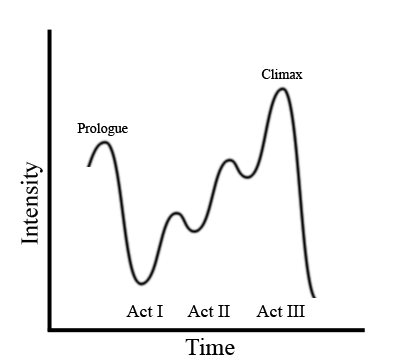
Ladies and gentlemen, I present to you the interest curve! An interest curve is a graphical representation of the excitement and engagement the audience of a work experiences throughout the duration of said work. The peaks of the curve represent moments of high excitement and intrigue, while the lows represent the story’s slower, quieter moments. While lows sound like they should be avoided, an optimal curve actually alternates between highs and lows, never staying in one or the other too long. The reason for this is that human beings (who are most game developers’ primary demographic) tend to get acclimated to things pretty quickly. Even action can get boring or even tiresome if there’s too much of it.
A depiction of an idealized interest curve. Note how it starts with a bang, alternates/rises in the middle, and includes falling action at the end to provide closure.
That’s not to say that interest shouldn’t slowly increase over time. The base level of interest—that is to say, how far down the graph dips—should increase as a game progresses. If the graph dips down further at the end than it did at the beginning, then the game feels like it screeches to a halt, thus killing the player’s sense of progression (*cough* Triforce pieces *cough*). Finally, the story shouldn’t end on the climax, but instead include a gentle falling action to give the player a sense of closure—commonly known as the denouement (pronounced day-noo-Maw…it’s French). Without a denouement, a story’s ending feels abrupt and rushed.
If you’ve ever heard a reviewer talk about a game having a good “gameplay cycle”, he or she is referring to this concept—most likely without even realizing it!
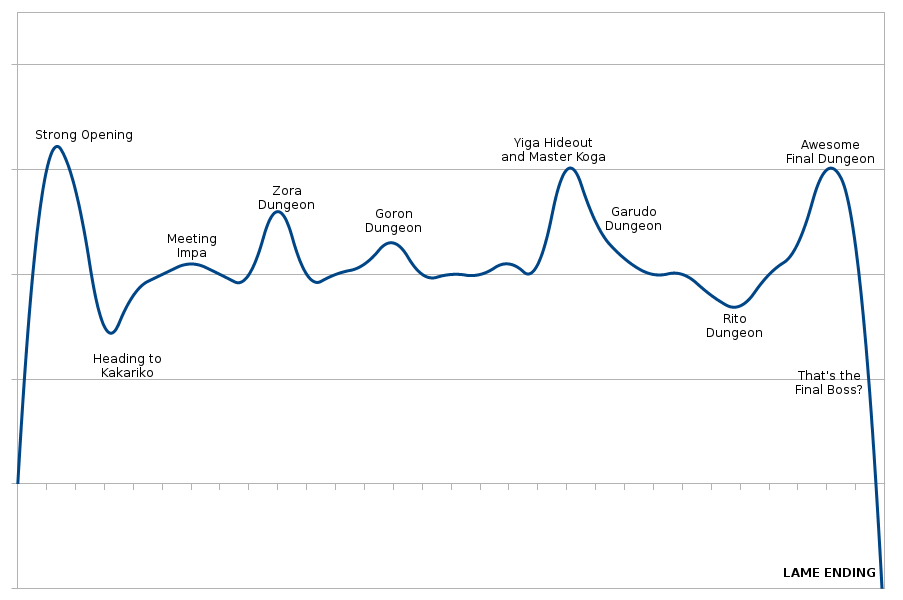
So what’s all this have to do with Breath of the Wild? Well, my primary issue is its interest curve looks something like this:
NOTE: The time between dungeons has been greatly compressed for the sake of legibility. Just increase them by a factor of five or six and you should be good.
Oh gosh, this is a mess…After a great introduction, everything just sort of flatlines. Now to be fair, this is based on my personal experience with the game, but even when the order of events are swapped around, I think this pattern basically holds true. The game’s overall arc seems to just maintain a complacent constant; there’s very little escalation, evolution, or extrapolation of the ideas the game presents. This ultimately leads to the game feeling repetitive.
The game’s overall arc seems to just maintain a complacent constant…
So what happened? What are some ways that Breath of the Wild hamstrings its overarching interest curve? What could they have done better? Let’s take a look, shall we?
The Main Quests
The easiest way to create a good cycle of engagement is to carefully craft a brilliant narrative and guide the player through it in a thoughtfully paced linear sequence…the whole point of Breath of the Wild is to not do that. That’s not necessarily a bad thing, however. My favorite Zelda game, The Legend of Zelda: a Link Between Worlds, was at the time of its release notable for being very open-ended. And that game had me hooked the whole time! So clearly, a carefully guided plot isn’t necessary.
That said, there are some notable differences between the the overarching structure of BotW and ALBW. For starters, A Link Between Worlds keeps the series’s usual two-part structure: in this particular instance the first half taking place in the light world, then after a plot twist the second half takes place in the dark world. This means that while the story doesn’t advance much throughout the halves of A Link Between Worlds individually, the events that link both halves of the game still give it the opportunity to raise the stakes of the game’s narrative thus raising the interest curve’s baseline mid-game. This compromise allows the player to pick how he wants to complete his adventure, while simultaneously ensuring the narrative escalates in a natural fashion.
Breath of the Wild, on the other hand, doesn’t follow this two-act structure. Instead, it features a main quest primarily consisting of two parts: awakening the Divine Beasts and the search for Link’s lost memories. Let’s start with the Divine Beasts. The Divine Beast quest is fairly modular, what with each part technically being optional. This means each segment aims to have a similar level of challenge and importance to the overall plot, consequently flattening the interest curve. While A Link Between Worlds‘ dungeons faced a similar issue, as stated before, having a discernible half-way point lets the game escalate the challenge and perceived stakes between the first half and the second making for a more engaging narrative, something Breath of the Wild‘s structure doesn’t.
Another trick A Link Between Worlds used to keep players from noticing the fairly steady baseline engagement throughout each act was the number of dungeons to complete. The concept of an interest curve is scalable, meaning it can apply to a level or chapter as well as a complete work. To this end, dungeons act as climaxes for the (for lack of a better term) chapters of the game they appear in. With several dungeons, the player is constantly experiencing the rising and falling action of finding a dungeon, completing the requirements to gain entry, and then clearing the dungeon and slaying its boss. So long as this cycle isn’t repeated too many times, this cycle sustains the player’s interest until he completes all of the dungeons and moves on to the next plot arc of the game. The problem is that the dungeons in Breath of the Wild are both short and very few and far between. This means that this part of the game is either over too quickly, or these local engagement highs are very spread out (as they were when I played the game).
The concept of an interest curve is scalable. To this end, dungeons act as climaxes for the chapters of the game they appear in.
Compounding with these issues are how the memory quest is presented. If the player follows the early quests in the manner the game suggests, he’ll quickly wind up with both the Divine Beast quest and the lost memory quest at the same time. They’re both very lengthy and the benefit of the latter is never really made clear (Spoiler: it changes the game’s ending and little else). This makes it hard for the player to prioritize which one to attempt first. I think the developers wanted players to search for memories intermittently (which is how I completed it), but this makes both quests feel very disjointed, unfocused, and the memory quest far less consequential to the overall experience. Honestly, I think the memory quest should’ve been saved until after the player completed all of the Divine Beast quests: by that point, the player would already be very familiar with Hyrule’s landmarks, making for a shorter quest that required the player to apply their knowledge, instead of one where they wander around looking for the N.P.C. that tells them where to look. It also would provide a makeshift second act, which would give the player a better sense of progression, pace, and momentum.
Anticlimax
Okay, on a macro scale, the game only manages to provide a complacent sense of pace, but the interest curve is a scalable model, right? So, how does it fair on a more granular level. Well…it is admittedly better moment to moment, but even then there are times where it outright shoots itself in the foot. Some of the moments of the game that should be exciting, epic, or climatic were memorable precisely because of how underwhelming they were when they play out.
Case in point, the Master Sword: in all prior Zelda games in which the “blade of evil’s bane” appears, getting the darn thing was a major plot point and consequently required some effort on the player’s part. As a result, it’s a big moment. In Breath of the Wild, the only real challenge is figuring out how to get to it. The game does provide some cutscenes upon discovering it and after obtaining it to try to hype it up, which is a good start, but the method in which the player does obtain it feels tacked on, like the quest was an afterthought.
Cutscenes are no substitute for a good quest. If I didn’t have to work for it, I don’t feel like I’ve earned it.
Previously, the player had to collect some items that represented the three virtues of the Triforce—power, wisdom, and courage—to prove their worth, but in this game all they have to do get enough hearts to pull the sword out of its pedestal without dying (it drains hearts to attempt). For any player that is actively looking for shrines, that’s something that’s going to happen in normal gameplay regardless. This means the quest for the Master Sword could be over as soon as the player finds where it’s hidden. This makes the quest’s pacing lopsided and its conclusion anticlimactic, especially for players used to the way previous games devote large portions of their respective stories to acquiring the Master Sword. Instead of an epic moment of triumph that’s built up to, it’s something on the player’s laundry list to be checked back on periodically. “Am I strong enough? No? ‘Kay, see ya after another four shrines!”
To make matters worse, there are three shrines dedicated to said virtues hidden throughout Hyrule. Why didn’t the game include those in the quest to get the Master Sword? I’d guess it probably had something to do with time constraints, but it still feels like a missed opportunity to provide a memorable and unique quest to the player. How much cooler would it be to have to scour the land to find the shrines and overcome a unique trial for each shrine related to the its respective attribute? Now I know some of you are probably saying, “but it’s a callback to the first Zelda,” to which I say, “so?” If the callback is really that important, they simply could’ve just done both methods.
Speaking of weapons, weapon durability also brings with it problems. While I admit finding new types of weapons is exciting, finding weapons themselves gets boring, especially in the game’s second half. One of the exciting aspects of finding a new weapon or item in previous Zelda titles was the understanding that Link was now innately more powerful. He had a new ability that made him more capable in combat or exploration that opened up new possibilities for the rest of the game. Not so in Breath of the Wild. That excitement quickly fades as the player realizes that the shiny new weapon he found will eventually break. In essence, weapons are just temporary power-ups like mushrooms or fire-flowers in Mario. Consequentially, players ultimately have less attachment to—and thereby less investment in—weapons than they would if weapons didn’t degrade.
In essence, weapons are just temporary power-ups like mushrooms or fire-flowers in Mario.
As a point of comparison, let’s examine clothing. Unlike weapons, clothing doesn’t break. This immediately makes clothing a more interesting item as it stays with the player as long a he wishes to keep it in his inventory. More over, it can be upgraded. This adds an element of mystery and intrigue to clothing as certain items gain additional bonuses when upgraded to a certain point. As a result, receiving clothing is exciting and immediately gets the player invested.
Now, I understand why the developers made weapons break. As several critics and apologists have already pointed out, having weapons be fragile forces the player to experiment with different weapon types and thus learn to be versatile in his fighting style. Again, I think a compromise would be fairly easy. Simply let the player find (after much effort) weapons that don’t break. Unlike other weapons, however, they would start off weak and need to be upgraded to be viable against the game’s stronger opponents. Even then these unbreakable weapons would only be upgradable to the point of straddling medium and upper tier, meaning if the player wanted to deal serious damage or utilize special effects (like elemental damage) he would have to stick to breakable weapons. See, that would at least make some of the weapons worth a darn!
I’d like to end this section with the ending. Don’t worry, I’m not going into specifics…because I don’t have to! If you’ve ever beaten a Zelda game before, I don’t think I can spoil this ending. It hits all of the beats, except—unlike other Zelda titles—it adds almost nothing of its own to the mix, making it feel more like the skeletal framework of a standard Zelda ending. It’s lackluster, boring, and predictable. It’s a real shame too, because pacing issues aside, this is otherwise one of the best written Zelda titles to date.
If you’ve ever beaten a Zelda game before, I don’t think I can spoil this ending.
Variety
Yet another way to keep the player engaged is to provide variety. As stated before, humans get acclimated to stimulus very quickly, so anything monotonous quickly loses people’s interest. To this end, Breath of the Wild features a huge world full of varied environments and unique landmarks…but then completely gives up when it comes enemies and shrines.
Three of the game’s main enemy types—bokoblins, moblins, and lizalfos—are basically all just variations of the same template. Moreover, each region just reuses variations from the same small pool of enemy types. While combat isn’t the main draw of the game, the fact that a hoard of monsters on one corner of the map looks and acts almost identical to a hoard of monsters on the complete opposite side of the world-space makes engagements incredibly boring and repetitive. Heck, even all of the dungeon bosses are basically palette swaps of each other! What makes this especially strange is that there is a lot of variety from region to region when it comes to flora and fauna. What gives, Nintendo? You clearly were able to populate each region with unique creatures. Why not extend that creativity to the enemy design?
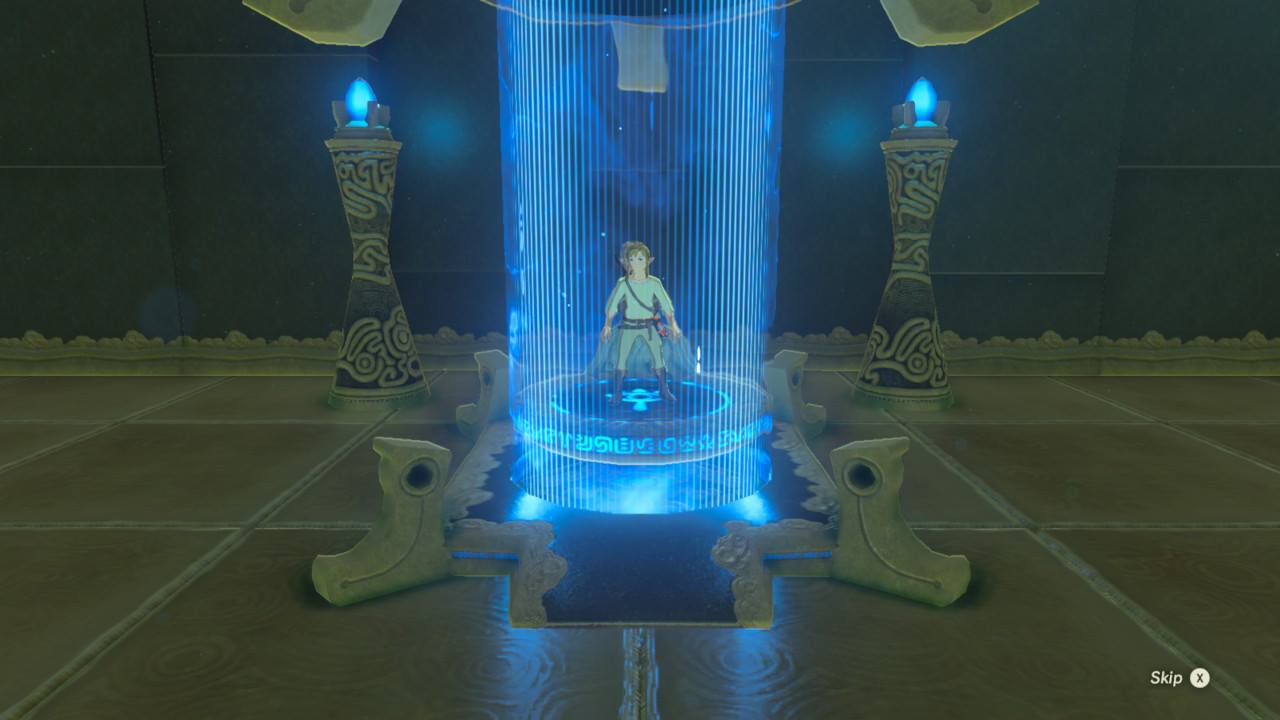
Then there’s the shrines: they all look and SOUND THE SAME! *Ahem* Excuse me. If you’re an O.C.P.D. completion-nut like yours truly, you will get sick of the foggy blue corridors and slow, ponderous music of the shrines. If you complete all the shrines, you will have heard that stupid shrine theme at least 120 times! That’s not to say there isn’t variety in the puzzles; oh no, the shrine puzzles are great. But would it kill them to come up with more than one shrine aesthetic? Maybe have puzzle shrines and combat shrines differentiated by their visual and audio design. Or perhaps have the shrines’ interiors vary from region to region, showing that even though they were all built by the Sheikah, each regions’ sense of aesthetics subtly influenced the shrines’ construction (that’s just good world building).
Despite an excellent variety of puzzles, every shrine looks exactly the same.
The Consequences of Heroism
Now that I’ve ticked off all of the Zelda fanboys, undoubtedly invoking the wrath of their Yiga assassins, let me talk about something Breath of the Wild did right—at least part of the time. Something that I love seeing, especially in open-world games, is the game’s world responding to my actions. A while back, I praised the first Battalion Wars for making me feel like my actions had a direct impact on the game’s progression. This is a concept I like to call “letting the player happen to the world.”
In most games, the player is an entity that reacts to the game’s environments (i.e. “the world happening to the player”). This is fine for level-based action games, but in narrative-heavy adventures or open-world games, this tends to make the player’s actions feel inconsequential—like everything is basically just meaningless busy-work. While I still think Breath of the Wild has room for improvement in this regard, it does at least actively contextualize many of the player’s actions.
I want to happen to the world, not let the world happen to me.
First, there’s the Divine Beasts themselves. After clearing an area’s dungeon, not only does the disaster afflicting the area cease in typical Zelda fashion, but the Divine Beast become visible for miles around. Next is the fact that the items and enemies scale in proportion to how far the player is in the game. These both give the game a much needed sense of progression. That said, I wouldn’t say either is anything mind blowing. Because the effects of the Divine Beasts are almost entirely localized, finishing a dungeon only really effects the region it’s found in. It would be far more interesting to see characters start to wander around more and more as Link made Hyrule safer to travel. For instance, wouldn’t it be cool if a Rito merchant showed up in Hateno Village after finishing the Rito dungeon? If they threw in a line about him feeling more at ease traveling now that the Divine Beast was no longer rampaging, it would go a long way toward giving the player a sense that his actions actually matter.
A great example of what I’m talking about would be the Yiga Assassins. At one point in the Divine Beast quests, the player has to infiltrate the Yiga H.Q. Not only is this section a great set-piece on its own merits, but it triggers a change in the Yiga’s behavior. After defeating their master, Kohga (one of the best characters and certainly the best boss in the game), the Yiga assassins go from passively waiting for Link to stumble into ambushes to actively hunting him down in an attempt to get revenge. While I’m sure many players found the constant random ninja attacks annoying, the fact that a specific action I took had a logical effect on the way a certain class of foe behaved absolutely delighted me!
No wonder the Yiga want to avenge him: this guy was awesome.
A Game of Little Moments
To Breath of the Wild‘s credit, it does a much better job of creating and maintaining a healthy interest curve on a more granular level. Individual quests, shrines, and subplots are well structured when viewed on their own, leading me to my conclusion that Breath of the Wild is a game of little moments. Despite the grandeur advertised, the game’s best moments come in small packages: the little references, the ways it rewards out of the box thinking, the clever quest design, surprisingly mature writing, etc.
That said, it still fails to feel like it grows or evolves. From my experience, this is actually a pretty common issue with open-world games. While the individual components work well, they don’t come together in a cohesive fashion. That said, compared to the other (admittedly few) open-world games I’ve played, Breath of the Wild really is a cut above the rest. I don’t mean to convince anyone that this game isn’t good. Heck, I’ll say it just to be clear: go play it if you haven’t already. It’s worth your time. But I fear all of the critical praise and 10/10’s may gloss over the obvious (to me, at least) issues that need to be addressed in future games. As I see it, the series is standing on a precipice: from here it can either take off soaring or tumble into another rut.
Sorry, we can’t stop talking about bae-I mean-Samus.
Metroid has a special spot in our hearts, and if you’re watching this, there’s a good chance that you know how we feel. Fans of Samus are feeling good after this year’s E3: Nintendo proved that they still care as much as we do. But why IS it that Nintendo fans have been asking for a new entry in this series for years? What makes us especially passionate about this particular bounty hunter? Simeon and Scott are here to break down the reasons that Metroid stands out from the crowd.
Footage Credit: CGRundertow
“Escape the Premises” Kevin MacLeod (incompetech.com)
Licensed under Creative Commons: By Attribution 3.0
http://creativecommons.org/licenses/by/3.0/
#543 – Vroom in the Night Sky is available on the Nintendo Switch eShop. Is it worth it? No… unless you can have a good laugh at a game like we can! Vroom’s terrible translation lends itself to some hilarious jokes (at its expense, of course). Seriously, if you haven’t seen this game, it’s so worth watching the footage and hearing us pick it apart!
“Escape the Premises” Kevin MacLeod (incompetech.com)
Licensed under Creative Commons: By Attribution 3.0
http://creativecommons.org/licenses/by/3.0/
We have stepped into the time machine. We brought you a souvenir from the past!
#542 – Something Nintendo dedicates a lot of time, money, and effort to, but most fans don’t pay attention to: their website. Yes, they’ve been updating their home on the web for many years, and it’s seen a ton of different iterations. Those iterations? We’ve found the most interesting ones and put them into this video for you!
“Escape the Premises” Kevin MacLeod (incompetech.com)
Licensed under Creative Commons: By Attribution 3.0
http://creativecommons.org/licenses/by/3.0/
Two Button Crew’s debut podcast release is all about the Switch sensation, the Wii U wonder, the one, the only… Legend of Zelda: Breath of the Wild! Join Scott, Simeon, Ryan, and Glen as they go in-depth on the game’s systems, storyline, gameplay, and DLC. Gear up for The Master Trials with our tips and unconventional methods! Receiving perfect 10s from around the industry, this is a game to remember! So take a deep breath, enjoy the moment, and come along for the ride as we embark on our podcasting journey. Ready for more TBC Podcast? We are an ad-free show, and you can support us on Patreon: http://patreon.com/twobuttoncrew Get Your Daily Nintendose of Fandom on our YouTube channel: https://www.youtube.com/TwoButtonCrew “Escape the Premises” Kevin MacLeod (incompetech.com)
Licensed under Creative Commons: By Attribution 3.0
http://creativecommons.org/licenses/by/3.0/
#541 – You buy the best Nintendo games, but do you find it hard to keep up with those smaller titles and 4rd party offerings? In this non-sponsored video about GameFly, Simeon and Scott discuss the pros and cons of the service and speak from their own experiences. Having a GameFly subscription is no replacement to owning your own collection of discs and cartridges, but there may be a good place for GameFly among your product purchasing plans!
“Escape the Premises” Kevin MacLeod (incompetech.com)
Licensed under Creative Commons: By Attribution 3.0
http://creativecommons.org/licenses/by/3.0/
#540 – Sometimes Nintendo will create a bundle or incentive for us fans to acquire the rare soundtrack CD, but why don’t they shift their business model and actually sell the music? Or offer it for streaming, because… who uses CDs these days, anyway? It seems like the Big N is behind the times in this regard, and it’s also odd that they aren’t utilizing their tracks as another stream of revenue. They pay a lot to orchestrate this stuff, why not offer them as products? “Escape the Premises” Kevin MacLeod (incompetech.com)
Licensed under Creative Commons: By Attribution 3.0
http://creativecommons.org/licenses/by/3.0/
This is it, Crew! We’re super close to our first Patreon stretch goal, and the first podcast episode is completely recorded, edited, mixed and ready to go! It’s all about Zelda: Breath of the Wild, our experiences with the game, and our anticipation going into the first round of DLC. The show was hosted by Scott, Simeon, Ryan, and Glen. You’re going to absolutely love it. By becoming a TBC patron, you get access to a ton of exclusive videos and you also have the ability to help us determine future content (depending on which level you select)! See you inside. “Escape the Premises” Kevin MacLeod (incompetech.com)
Licensed under Creative Commons: By Attribution 3.0
http://creativecommons.org/licenses/by/3.0/
One of Nintendo’s biggest and most popular franchises is also one of the hardest to explain why it is so beloved. When people find out that I love video games and ask me what my favorite one is, my reply is “Animal Crossing” – and the response is usually one of bemusement and bewilderment. People on the outside looking in don’t see what the big deal is. Why do I love Animal Crossing so much? What is it about this game that sets millions of people into a frenzy when a new installment is announced? Well, get your bells ready and let’s take a closer look…
Humble Beginnings
Animal Crossing debuted in North America on the Nintendo GameCube console in the fall of 2002. Nintendo has always had a reputation of being a “family friendly” (many read as “kiddie”) company – beginning with the controversial censorship of Mortal Kombat on the Super Nintendo, even though the subsequent installments had all the violence and blood that the game came with. The GameCube itself was small like a lunch box and had a handle for crying out loud with little tiny mini-discs. Kiddie? You couldn’t exactly argue against it.
A game like Animal Crossing is hard to market for, and when I saw the game in my local Electronics Boutique, I asked the cashier what it even was. Her reply was “It’s hard to describe. I’d say it’s like a Sims game but with animals.”
I love Sim games, and I love animals, so this sales pitch was a home run. The game came with a bonus memory card that included a “gift” on it for use in-game. After years of over-exposure to Mario and Zelda games, I was all excited to dive into a new Nintendo IP. I was ready to be entertained – but at first, the result was just the opposite.
Booting up the game started what felt like an inane game of Twenty Questions, as you were asked stuff like your name, if you were a boy or a girl, etc. I wanted to play a game, not go through the most basic of setups. After this unwanted pop quiz, the first major character you run into after the setup screens are finished was a raccoon named Tom Nook. Many longtime fans dislike poor old Tom, and with good reason – he is an unfriendly jerk and doesn’t even really do a good job of explaining the game to players (which was his entire function). I did a lot of planting flowers, planting fruit and other mundane tasks, and about 20 minutes into the game, I was wondering where the fun was hiding.
But once you are freed from Tom Nook’s “tutorial”, the world of Animal Crossing begins to open up. The comparisons to the Sims became more evident as you are encouraged to expand and decorate your own house, meet neighbors and become social with them… your interactions with them will have a definite outcome on their lives, too.
Throwback Any Day
Every budding franchise debut needs a hook, and Animal Crossing’s hook was a doozy. The player had the ability to find and play original NES games within your character’s house – games like Pinball, Donkey Kong, Excitebike, and hidden gems The Legend of Zelda and Super Mario Bros (both of which were never officially made available and need a cheat device to unlock). This predated the Virtual Console on the Wii and Wii U (and hopefully the Nintendo Switch), it represented the first time in a major mainstream fashion that old classic games could be played, full-screen, on a then-current console was mind-blowing. Collecting the NES titles became a game within the game. Retro games would not turn up in subsequent entries in the series, unfortunately.
Friendship Is Love
Beyond the retro hook, the one thing that kept me coming back to the game was the emphasis on community and building friendships. Talking with your animal neighbors daily and doing small favors for them allow the player to establish relationships in the game that really feel like friendships. Like in real life, you tend to open up to someone new on a bit-by-bit basis, and that is how it works in Animal Crossing. Using the GameCube’s internal clock, the game is advertised that it “keeps playing even when you aren’t,” and that’s true. Skip a couple days of playing and the game knows it – villagers will say the missed you, dreaded weeds will grow that you’ll need to pluck. The game would also change with the seasons and celebrate major holidays. It is taken for granted now, but this mechanic really was pretty groundbreaking at the time. It pushed me to check in every day and I would actually feel guilty if I didn’t.
I knew at this point that I was experiencing something special, and I became a fan of the subsequent entries in the series.
World Traveler
The game’s sequels – Wild World for the Nintendo DS and City Folk for the Nintendo Wii – introduced online play to the franchise to great results. Wild World also stripped out the NES games you could find and play, as well as the holiday celebrations, which was a very odd and saddening choice. I initially thought having Animal Crossing on a tiny portable system was a really dumb idea – but this is one area I was happy to be wrong in… having a game that is tied to the internal clock makes perfect sense to be on a portable system. I could check in on my town anywhere and not just at home during a dedicated gaming session on the couch.
Hopping online, you could visit a friend’s town, see their house, and talk to their villagers. It may not seem like much, but this addition opened up (pun alert) a whole world of fun, and made me want my house to be at its best for guests. The villagers would even talk to you about people who have visited after they leave.
It’s the little things that make a difference.
The Wii game, City Folk, was very similar to Wild World, all the way down to the hourly music used… but added a small city area you could travel to and shop in.
Saturday Night Fever
Speaking of music, one of the best aspects of the franchise is its use of original music. Each hour has a different theme, as do many holidays and special events. I have an entire playlist of nothing but Animal Crossing music from the various games and it always brings a smile to my face. Of course, I can’t talk about music without mentioning AC’s resident musician, K.K. Slider. He appears every Saturday night in various places depending on the game, and he always delivers the hippest music to the people…or, rather, the animals.
Hail to the Chief
The most recent mainline game in the franchise, Animal Crossing: New Leaf launched on the Nintendo 3DS in 2013 (2012 in Japan) and truly became a major franchise for Nintendo. It is proven to have boosted sales of the handheld and has gone on to sell over 9 million copies worldwide, and counting. New Leaf introduced a few new wrinkles that many fans have embraced: the ability to be Mayor and construct unique designs and extras in your town, thus taking overall customization to a whole new level. But best of all was the introduction of Isabelle – your trusty and loyal secretary who is your town’s biggest cheerleader.
As much as I love the other games, I would have to pick New Leaf as being the best Animal Crossing to date. In fact, it is not only my favorite Animal Crossing game but also my favorite game of all time overall. Yes, I love it that much.
Nintendo seems to realize the popularity of the series as well. 2015 brought an immense amount of marketing to the franchise. amiibo cards (used with the 3DS spin-off Happy Home Designer) that invoke memories of Game Boy Advance eReader cards that were incorporated with Wild World, made its debut… and its own amiibo figure line began to roll out as well. Mario Kart 8 (and Mario Kart 8 Deluxe) has a beautifully designed race track based in the Animal Crossing universe.
Not everything has been a hit, however. The aforementioned spin-offs, Happy Home Designer and (especially) amiibo Festival, were poorly received and had low sales. And speaking of low sales, the amiibo cards were popular at the beginning, but the actual amiibo figure line struggled – partially due to being associated with such a bad game – and many can be had for as low as $2 new on clearance. Animal Crossing ran the risk of overexposure because Nintendo, rather than give us a new game, decided to make the curious move and develop a couple of spin-offs that no one wanted. In an effort to possibly make it up to angry fans, an update to New Leaf was issued in 2016 that added amiibo support and a number of new features.
And even with all of that, I’m still anxiously anticipating the next full entry on the Nintendo Switch with baited breath.
Population: Growing
Animal Crossing (along with Pikmin) was, up until Splatoon in 2015, the last big original Nintendo IP that took off and became a huge success. I think it is more than worthy to sit alongside legendary franchises like Mario, Zelda and Pokémon. Its fan base continues to grow with each new game. It is often one of the most requested titles for any new Nintendo console launch – as evidenced by the number of disappointed people when an Animal Crossing announcement for the Nintendo Switch was not realized at E3 2017. I have spent more time than I care to admit playing various games the series and I still can’t fully explain what it is to friends when they ask. But I am okay with that… all of its charm, quirks, and addictiveness – it’s part of what makes Animal Crossing so warmly unique.
Are you an Animal Crossing fan? What is it about the series that has made you a fan?
Eric “Flapjack” Ashley has been a Nintendo fan for almost his entire life! While he also has a special place in his heart for Sega, it is Nintendo that gets him worked up and the franchises that capture his imagination and wonder. Eric is hopelessly in love with Animal Crossing. When he is not playing video games, he is a social media guru, assisting numerous organizations with their outreach and promotions, and he is also a big horror movie buff. Follow him on Twitter and Instagram @flapjackashley.
When our parents were our age, they would never have imagine being able to scan their toys into their video games. Well, now we’re living in the future, thanks to amiibo! But how exactly do these figurines, cards, and plushies interact with Nintendo’s systems? Do they really learn and level up? All those answers and more in this episode of NF + TBC. amiibo Footage credit: Gamecite, Game Wire
“Escape the Premises” Kevin MacLeod (incompetech.com) Licensed under Creative Commons: By Attribution 3.0 http://creativecommons.org/licenses/by/3.0/