Nintendo has removed the lid on their latest innovation: Labo. This new way of interacting with video games—through cardboard—could not have been predicted. I always allow room for Nintendo to surprise me with something that would never occur to me, and once again, they did not disappoint. We’ll be unboxing our boxes this April.
Or will we? I’m still not completely sold on the concept. This is no fault of Nintendo’s marketing department; the messaging for Labo is clear: kids and kids-at-heart get to Make, Play, and Discover functioning cardboard creations with the technological help of Nintendo Switch.
I’m no longer a kid, and my heart is still trying to decide how old it is. Were I to invest in multiple sets of cardboard kits, I would definitely need to find a place where I could tuck my creations away to keep them out of my cat’s reach. She would utterly destroy my hard work, and then meow at me with a mischievous glint in her kitty eyes.
But there’s the distinct chance that Nintendo could release Labo kits in the future that would be irresistible. Labo is all about imagination and creativity, right? For the purposes of this blog, I’ve let my imagination run wild and conceived 5 Labo Toy-Con I Would Insta-Buy…
Arcade Stand
You know this needs to be a thing. Arcade games are coming back in a big way thanks to Nintendo Switch. ACA (Arcade Archives) have been releasing arcade ports like crazy, and recently started porting some first-party Mario content as well. Additionally, indies have made a few unique offerings on eShop like Mutant Mudd Collection’s “Mudd Blocks,” Pinball FX, and more—all playable in portrait orientation. If Nintendo were to officially support portrait arcade games by creating a cardboard stand for the console… man, that would be totally tubular!
Camera
Here, I’m essentially asking Nintendo to please give me cheap DSLR lessons. Video games have been a good teacher to me before (I learned the basics of drums on Wii Music with two motion controllers and a balance board for foot pedals). And after kids get done learning piano on a cardboard keyboard, why not move on to photography? Nintendo actually showed a brief glimpse of this product in the initial Labo trailer, though it won’t be available as a product in either of the launch kits. A Joy-Con was shown both in the lens and the main body of the camera. If Nintendo could “gamify” learning the foundations of photography; aperture, exposure… lens… speed? See, I clearly need some help in this department and pointing a cardboard camera at some Pokemon on my TV might just do the trick.
Samus Aran’s Arm Cannon
Did I just blow your mind? Because with a cardboard Samus Canon, you can bet that some heads would be exploding. Imagine shooting with 1:1 pointer controls, but instead of holding a remote in your hand, your arm is the weapon. And with a mounted Joy-Con within reach, you’d be able to use your free hand for inputs like changing beams, calling in an attack from your gunship, and more. Just like our favorite bounty hunter does in-game.
Don’t get me wrong; I’m not saying that I want to play through Metroid Prime 4 dressed up like a poor cosplayer. The Prime series must be treated with great care and respect. But a Labo spinoff title (a la Nintendo Land) would be incredibly enticing.
Poltergust / Flashlight Combo
With a new coat of paint and a few different extensions, the Robot suit’s backpack could easily be transformed into Luigi’s Poltergust Vacuum. Having donned Luigi’s equipment, we would be scouring haunted mansions like never before. We’d be in the action. We’d be flashing lights and sucking baddies like no tomorrow. And HD Rumble could make us feel like we’re actually lugging around specters on our spines.
VR Goggles
While first viewing Nintendo’s promotional video for Labo, I thought that VR was becoming a reality for Nintendo fans. I was wrong, and the headset I saw was simply a decorative visor for Project Giant Robo—I mean—the cardboard robot suit. It’s probably wise for Nintendo to hold off on Virtual Reality for the time-being. With the Switch tablet’s 720p resolution, it’s not quite pixel-dense enough to hold up under the demands of VR. However, I believe that Switch and Labo are both initiatives that will last longer than a single traditional console generation. In 5 years, we might have a 4K Switch and a nice cardboard set of goggles to hold it. When that happens, Nintendo will transport us to another world.
There you have it! 5 Toy-Con that would be in my cart before I could say “Lab…Oh…No…”
What do you want Nintendo to craft from cardboard in the future?
Welcome back to the Nintendo Experience! I’m once again expanding the list of necessary games for every Nintendo fan. We’ve since added Photo Dojo to the list as the essential DSi game, and we’re moving on.
For the past few weeks I’ve really been enjoying the indie title Axiom Verge, and while it won’t be making its appearance on the Nintendo Experience, it is a great game. While trudging through the depths of cyberspace… or the subconscious… or another dimension… whatever that setting is, it got me thinking of the game that inspired it.
Super Metroid for the SNES is a Nintendo classic through and through. Originally marketed as Nintendo’s biggest game yet (see our Watching Old Nintendo Commercials episode), it sure does show. The game’s environments and inhabitants are varied and give an awesome sense of exploration and conquest as you traverse the world of Zebes. from your initial encounter with Ridley to the final showdown with Mother Brain, it is an unforgettable thrill-ride.
One of the clear inspirations that Axiom Verge took from Super Metroid is its use of traversal items. Though the two games’ items differ in specific application, they both serve the purpose of making you feel like you have the freedom to go anywhere and everywhere. You may start out feeling like you don’t have much in the way of mobility, but soon enough you’re getting from point A to point B using methods of which you’d never dreamed. The sense of control you have over your character and freedom to explore the environment is truly a great feeling.
It was also nice to recently revisit Donkey Kong Jungle Beat in a recent episode (man, I’m killing it with these shameless self-promotions!). There is something to be said about the Donkey Konga Bongos. While Donkey Konga and its sequel were alright for rhythm games, Nintendo didn’t leave the peripheral to be used for one game only. They decided to do what no one else had thought of: use a rhythm game controller for another kind of game. That’s genius! Have you seen “Guitar Hero Platformer” or “DDR Fighter”? No! Of course, you haven’t because Nintendo has harvested all of the geniuses in the world to come up with those ideas for them.
As far as how the game actually plays, it’s pretty good (nothing ultra groundbreaking besides the control method). But it’s the fact that one day, someone sat down and said “let’s use a set of drums to control a character,” then made it work that lands it a “must play” sticker for me.
Well, that’s it for the Nintendo Experience for now. It feels good to finally see the shelf start to fill out.
A few months ago, I decided to pick up an Arcade Archives title, Garou: Mark of the Wolves. I was feeling that fighting game itch, and eight bucks didn’t seem like that much scratch. Moreover, I’d never indulged in any of SNK’s classic fighting catalog, so I figured—if nothing else—it’d be an educational experience. So how is it? Arcade Perfect!
And that’s the problem.
For those of you who’re too young to remember when arcades were a big deal—which, come to think of it, largely applies to me as well—”arcade perfect” was a marketing buzzword used to describe home-console ports of arcade games. It meant that nothing was compromised (graphics, music, sound, and so on) when porting the game to consoles. See, arcade machines tended to be a bit beefier than home-consoles, as they weren’t just entertainment but also a business investment for store owners.As to be expected, the term has largely fallen out of use due to the declining relevance of arcades, but still gets thrown around from time to time, especially in arcade compilations like the upcoming Street Fighter collection.
“Arcade perfect” was a marketing buzzword that meant that nothing was compromised when porting the game to consoles.
Ultimately, my biggest gripe with Garou: Mark of the Wolves isn’t a design issue, it’s that the version on the eShop is literally just the arcade version running on an emulator. While there’s nothing wrong with that, per se, it does mean it’s missing many of the features that have been standard in home-ports since before the arcade version was even released. Honestly, it makes me question whether “arcade perfect” is really that good of a benchmark.
First of all, the game doesn’t have a training mode. The only single player content is arcade mode, meaning you have to learn the ins and outs of this game’s mechanics as the computer is mugging you for your (virtual) quarters. This wouldn’t be so bad if the game was a simple, straightforward one-on-one fighting game like Street Fighter 2, but that’s not the case. Garou was released in 1999, meaning it subscribes to the Street Fighter 3 school of design: master the incredibly precise timing of the parries and cancels or be content seeing your opponent’s win quote for the seventeenth time.
The game doesn’t have a training mode: you have to learn the game’s mechanics as the computer is mugging you for your virtual quarters.
Along the same lines is the lack of a proper move list. Granted, the emulator’s menu has a move list for each character, but each combatant only gets a limited amount of space, meaning that isn’t enough space for every move. If you want to know all of a character’s techniques, you’ll need to look up the commands online.
I could go on, but I think I’ve made my point. Of course, I’m looking at this from a modern perspective; what were home-ports like back in 1999? Well, while arcade versions usually had better hardware, the home version gave the developers the opportunity to fine-tune the game and add additional content. New characters weren’t uncommon, and it was standard practice to remix/remaster the soundtrack for the home version: Virtua Fighter 2, the Tekken series, and Garou: Mark of the Wolvesitself all had superior sounding music in their respective home-console versions.
More fleshed out versions of the game exist.
Maybe I’m taking the term a bit too literally, but the more I think about, the more I think “arcade perfect” is a pretty flimsy accomplishment. I by no means regret buying Garou: Mark of the Wolves, and I don’t think there’s anything wrong with the Arcade Archive series, but no matter how good the games or their emulation is, staying 100% true to the originals can leave a game lacking. Ultimately, what’s perfect for the arcades isn’t perfect for the home experience.
With Nintendo Labo announced, something that is sure to change the way we view how video games control, I find it appropriate to look back on some of the times that Nintendo flipped game control on its head. Now, obviously, not every time Nintendo ventures into an unexplored frontier is a smashing success, but they are usually the only company “daring” enough to branch out as far as they do. Games like WarioWare: Twisted, Kirby’s Tilt ‘n’ Tumble, and 1-2-Switch brought a whole new dimension to gaming that took the geniuses from the Big N to complete. Today, I will be adding three new games to the Nintendo Experience that challenged the boundaries of what it meant to be “in control”. (If you are not sure what the “Nintendo Experience” is, check out the previous blog posts).
Donkey Konga was Nintendo’s attempt at jumping into the (then-budding) rhythm genre. It was a little more entry-level than staples like Dance Dance Revolution or Guitar Hero, a little more immersive than Parappa the Rapper, and, of course, containing that Nintendo charm. Overall, it was an average game with mediocre covers of classic songs, but it did give birth to the DK Bongo peripheral. Once you had enough of Donkey Konga and its sequel (and tried it out on Smash Bros.), there did not seem to be much use for the hunk of plastic; I mean, if you consider the size-to-button ratio, you are losing the space-saving-game.
Donkey Kong Jungle Beat (GameCube)
Leave it to Nintendo to make a deep, compelling platformer that only uses two buttons. Consumers had the option to buy the whole package, including the bongos, or just the disc if you had the bongos already (you could also play it with the normal GameCube controller, but where’s the fun in that?). This game was fantastic, and is a must-play for fans of Nintendo that want that truly unique hybrid experience.
Wii Sports (Wii)
What more can I say about Wii Sports than has already been said? Motion controls may not have turned out how we thought they would (only seeing wide application currently paired with VR or AR), but it was really nothing before Wii Sports. Now, it is true that there was motion control games before Wii Sports, and that the Wiimote was not 1:1 like we (at least, I) thought, but from the first time I picked up this game, my view of what video games could be was never the same. I do not think I need to elaborate too much further, as I can almost be certain that everyone reading this blog has either played this or, at least, its sequel, Wii Sports Resort, and had a similar life-altering experience.
Metroid Prime 3: Corruption (Wii)
Just as Twilight Princess rolled the dice with motion controls in a beloved Nintendo franchise, Metroid Prime 3 similarly pioneered how the Wiimote would handle first person shooters. Other FPS’s had released on the Wii by the time Prime 3 was released, but those could not be compared to what Corruption brought to the table: not in genre, and certainly not in successful execution. In fact, Prime 3 controlled so great that Nintendo decided to re-release all three games of the trilogy with the new Wiimote controls. The world it created and the story it tells are fantastic as well, but the way Samus controls in the new age was forever revolutionized by this fantastic piece of Nintendo history.
These are just a few examples of Nintendo’s abstractly-controlled masterpieces. What are some of your favorites? The Nintendo Experience continues to grow…
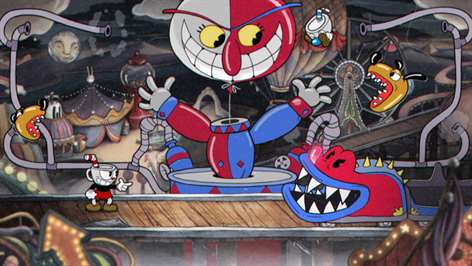
Cuphead was one of my favorite games released in 2017. Everything about it I adored. From the 1930 cartoon style visuals right out of the old Fleischer cartoons to the big band jazz ensembles to the cutthroat difficulty, this game has it all. Alas, it’s not on the Switch, or any Nintendo console for that matter, so you may be wondering why it’s appearing here. The reason is I believe that Cuphead would be an amazing fit on the Switch, and I hope it opens the door to other creative talent to hit the Switch in the future. Before you comment, “But Matt, Cuphead will never come to the Switch because Microsoft helped Studio MDHR fund the game”, I’m aware, so please don’t. The focus of this blog is to simply discuss why Cuphead would be a great fit for the Switch and what sets it apart from most other Indie titles.
It doesn’t take one long to figure out that there are a plethora of Indie titles on the Switch. Unfortunately, for me at least, it’s like wading through a dumpster trying to find jewels. I’m not saying that Indie developers should be discouraged from putting games up, nor dissing any one game in particular. But the majority of the games posted seem as though the developer put almost no thought or effort into the art direction, and some of these games even carry a $20 price tag. It baffles me that someone can put time and effort into something they obviously care about, but aren’t willing to go the extra mile to make it great. I know that indie developers have to deal with an extraordinarily reduced budget, and they don’t have a lot of time to work with. I really do get that, but there is no excuse for some of the games I have seen.
Every boss battle is fresh and meticulously crafted
What makes Cuphead stand out? Well, for one, the level of polish is evident. It looks and feels nearly perfect. Never have I thought that I would enjoy playing a 1930’s cartoon so much. Even though it’s old, it’s new. It’s a fresh concept and they took a risk that paid off. Whenever the debate arises whether or not videogames are art (this discussion warrants its own blog), it’s games like Cuphead that I think of. Next, the difficulty. Yes, to this day, I have over 400 deaths. That is what it took for me to complete my expert run, and not once did I get upset. For every single one, I accounted for a mistake that I made. Once I corrected my mistake, I moved on until I made the next mistake, where I learned and moved on progressively until a boss or level was defeated.
So what is my point? Simply put, Quality > Quantity. I would rather have one game that takes 3 years to complete than 100 games that take 3 months to complete. I’m not saying that all developers need to remortgage their homes, or draw everything frame by frame like the Moldenhauers of Cuphead, but just a little more time on the presentation and polish go a long way. My hope is that Cuphead will encourage developers to try unique art styles and better yet, follow their dreams. Gamers want quality games where passion is oozing out of everything seen on screen. Unfortunately, Cuphead will likely never see the light of day on the Switch, even though it would be a phenomenal addition to a fairly lackluster Indie library. Nonetheless, hopefully game designers are inspired and this will translate into better quality games. Perhaps you agree, or alternately you’ve been eating up the Switch eShop and loving it. That’s fine too. Whatever the case, I think we can all agree that gamers will always appreciate the extra mile. Hopefully Cuphead and Mugman will pave the way for the future, without dealing with the devil.
Several months ago while at a used game store, my older brother found and bought a copy of Minority Report: Everybody Runs for the GameCube, the licensed tie-in game for the 2002 film, Minority Report. His rationale was that he thought it’d be good for a laugh. Then we more or less forgot about it until a few weeks ago. My two brothers and I were hanging out one evening when Kyle, the aforementioned eldest, suggested we play the game and pass around the controller. Not having anything better to do, we shruggingly agreed. I have to admit, my brother was right: the game is absolutely hilarious in all the wrong ways. Read more Minority Report: Everybody RunsA Masterpiece of Ludo-Narrative Dissonance ›
Nintendo clearly loves its fans. Of the three current heavy hitters in the console wars, Nintendo is the only one to offer a Loyalty Program at no charge, as a reward to longtime and frequent customers. Sony offers PlayStation Plus, which is a marvelous program, but at a monthly cost – same with the revamped Games with Gold for the Xbox 360/Xbox One.
Club Nintendo closed in 2015. It’s replacement – dubbed My Nintendo – has received a very lukewarm reception, and the recently unveiled way of using earned coins (reward currency) for Nintendo Switch games has further frustrated many fans. One thing is clear to me… while it was hip to complain about Club Nintendo down the stretch, it was head and shoulders above what is being offered now. Let’s take a look back at what made Club Nintendo so special.
Inception
Club Nintendo was launched seemingly everywhere else in the world before it finally hit North America in 2008. Registration for the new program was marred by frequent website crashes and whatnot – something Club Nintendo users would frequently encounter towards the end of the program, making it a full circle-like of website woes. Long, mysterious PIN codes began to show up in game cases for Wii and DS games, as well as hardware. In America, you would get “coins” for registering your products and taking a survey – in other regions, you could obtain “stars”, and you would save them and cash them in on exclusive merchandise.
Rewards R Us
At fiscal year end (which would be normally in late Spring), Club Nintendo would reward you with a bonus item, free of any deduction in coins/stars as a thank you for those who reached a certain level of buying throughout the year.
The Elite Awards usually amounted to a $10 eShop game, a $5 Virtual Console game or, in later years, a nice desk calendar with original artwork. But the Platinum Awards were where it was at! For those who earned 600 coins in the year (a user could get up to 50 coins per game purchased/survey filled out, and 100-150 for a console purchase) you would be at the exclusive level to get something really special.
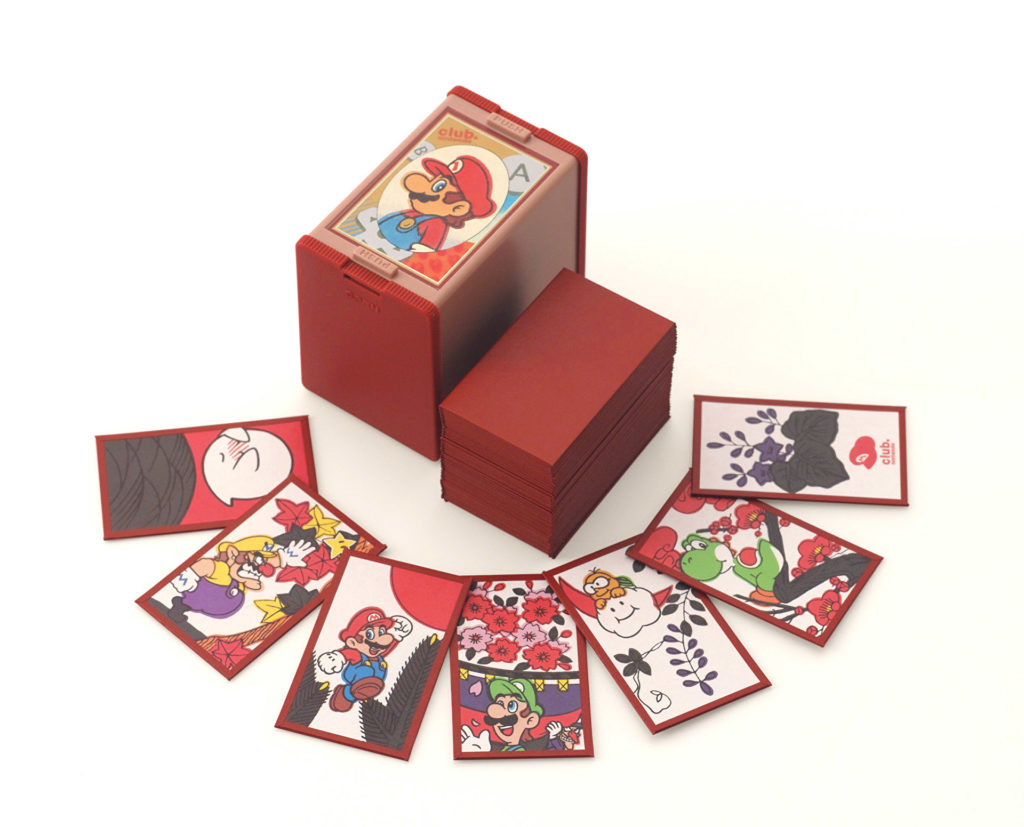
The first rounds of Platinum Awards were amazing. Among the first was a wearable Mario hat, a Super Mario statue (which fetches a good amount on eBay today), a badge set, limited edition posters and more. Club Nintendo was great.
But the real meat of the program was free games and random merchandise that would be offered throughout the year. Free games would be offered for coins every month – although the available titles would be selected by Nintendo, and many would end up repeating as time went on. But the merchandise often would be exciting and one-of-a-kind. I personally scored a Super Mario Starman Messenger Bag, decks of Animal Crossing and Mario Party playing cards, Animal Crossing and Mario 3DS carrying pouches, the Super Smash Bros soundtrack 2-CD set, Pikmin tote bag, History of Mario T-Shirt, Wii Remote holder, Animal Crossing DS card game case, Super Smash Bros posters, Animal Crossing posters, etc. I cashed in a lot, and you could probably get the feeling that I like Animal Crossing. Other rare items were offered including a couple great Game and Watch collection games for the Nintendo DS, unique styluses, and other items ranging from other T-Shirts to a much sought after Luigi’s Mansion figurine.
And, did I mention the shipping on everything offered down the line was also free?
Club Nintendo seemed like a dream.
Anger, Resentment, and Counterpoint
People can never seem to be happy, and the complaints held some merit. Users began to “grumble grumble” about filling out repetitive surveys after their purchases that Nintendo never seemed to take into consideration. People were frustrated with the forced selection of free games every month. And people began to write off Club Nintendo as a joke when rewards stopped being refreshed in a frequent manner.
Personally, I always found people complaining about a free program to be a little absurd. Club Nintendo was a completely free program. Some would say that we earn the coins to get the “free” stuff, so we are in a sense paying for it – but that is a backward way of thinking. I didn’t buy games to get Club Nintendo coins… I bought games to play the games. The Club Nintendo stuff was a bonus, which is what it was meant to be. People would say we paid in the time we spent answering surveys and stuff… but again, I can’t get mad about spending two minutes or less to earn coins that would get me free games and merchandise. I spent more time on the toilet each day and it is a far less rewarding experience! Sure I got tired of the sameness of their offerings, but I couldn’t complain – how could I whine about something that was free… and by free I mean didn’t cost me extra out of pocket money. Club Nintendo was always meant to be a rewards program bonus, and I never looked at it as anything more than that.
Decline and Closure
The decline in Club Nintendo became apparent in North America around 2012 when the same old rewards would be present and fresh offerings were few and far between. Tired old merchandise like Mario and bland Nintendogs postcards and cheap screensavers would always greet me when I would log in to check which free games were offered. Gone were the days when CN would break out something special every other month it seemed. The Platinum Rewards also took a hit, dwindling from
amazing Mario statues to a deck of Mario Party playing cards.
In its final two years, the year-end rewards went to all digital download games, with the Platinum members getting a choice of a selection of full-priced retail games (ranging from a value of $15-$50). When it happened in 2014, red flags were raised, and when the ending of Club Nintendo was announced in 2015, at least we were prepared for the end of the line.
To its credit, Club Nintendo of America trotted out some of its best merchandise at the end, including a Majora’s Mask messenger bag, sleek Duck Hunt posters, an 8-bit Mario T-Shirt, the aforementioned 2-disc Super Smash Bros Soundtrack CD and more. And they practically unloaded every digital game they ever offered in one lump selection sum. The final Elite/Platinum awards featured downloadable games up to a monstrous $50 in value. So, Club Nintendo went out with a bang – and offered up rewards that I wish the program did more often.
In Moratorium and the Future
Club Nintendo provided me with a lot of great collectible merchandise that I couldn’t get through any other means. Being a huge Animal Crossing fan, I cashed in on everything from decks of playing cards to posters to game card holders and more. I used my Starman messenger bag in New York when I visited the Nintendo World Store, like the proud Nintendo Nerd that I am. When I open up games now and they don’t come with a Club Nintendo code, I still weep a little inside. It was like losing a good friend who would pat me on the back and tell me thanks for supporting him. My Nintendo debuted in March of 2016, and it was met with a big resounding thud. It was clear from the beginning that the program was set to be heavy on rewarding people who bought digital games over physical ones, rewarding more coins for those purchases over boxed copies. Whereas Club Nintendo put an emphasis on digital content, My Nintendo does the same, but specializes in disappointing discounts on the retail eShop prices of games as opposed to actually offering free content as rewards – unless you count a parade of mobile and PC wallpapers as a thrill. Cashing in coins for dollars off of new Nintendo Switch (downloadable) games is good in theory until you realize that one coin equals one penny, so a stash of 700 gold coins from hundreds of dollars of purchases only nets you a paltry $7 off – and even then on a “select” title.
I mentioned that it was absurd to complain about a program that is free. It was true for Club Nintendo, and it is true for My Nintendo. But it just feels a little frustrating for a rewards program to start off so well in the form or the former, and end up so lackluster in the form of the latter.
One thing that My Nintendo has done, though, is make people realize just how good Club Nintendo was when it was around, proving that we really can take things for granted – until it’s gone.
I hate art. Well, to be more correct, I hate the concept of art. I am (as many of you reading this are) a man who likes concrete answers. Numbers. Black and white. Objectivity. Things that escape exactness vex me. With much art (especially of the abstract variety) not only do I not understand it, but I do not understand why I do not understand it. Why can it not be like math: “It is right (or wrong), and this is the reason why it is right (or wrong)”. At least give me a scale of one to ten to deal with, please!
Many of you can sympathize with my pain. Some of you are probably shaking your head, thinking, “You poor, lost soul.” Indeed, today I will tell you the tale of how this poor soul became lost, and how it found its way home. And I promise you that I will tie it back into video games in the end.
Bliss:
This story opens, as many others do, with a small child, happy in his home. He loves video games, movies, and sharing these experiences with his friends and family. This child… was me. I’ve watched comedies from the ‘30’s, the latest Disney releases, and all sorts in between. Of course, some movies I liked better than others and had my favorites, but I always recognized that a film was built to entertain me.
And entertain me they did; I hardly ever remember being bored while watching a movie as a kid. Other children would play, goof off, or run into the other room when a movie was playing. I do not know whether it was some etiquette I learned or a part of my nature, but once the screen flickered on, my eyes were glued. I was mystified at the thought that someone would get up to go to the bathroom or to get snacks in the theater. I still am, actually.
When you are a child things are bigger, magical, and you cannot see the little imperfections. This age of blissful ignorance lasted for some time: years, in fact. I still remember that fateful day when it all changed.
Innocence lost:
My oldest brother brought home a VHS tape from the video rental store (obligatory age joke here) and showed me the box. A phrase akin to “Winner of the Golden Turkey Award!” was displayed across the back. It was a film called Plan 9 from Outer Space, a 1959 b-movie about aliens and zombies. As I held it in my hands he told me, “This is the worst movie ever made.”
My eyes grew wide as he popped it in the VCR and pressed play. I was met by acting so bad I could hardly believe and pie tins held up by fishing line to be passed off as UFO’s. I strained to follow the plot as well as keep my eyes from closing or from looking at the clock. I never did finish the movie, but it had left its forever impression on me.
Of course, we laughed at how horrible it was. Eventually, though, the laughter subsided, and I was left with the question echoing in my head: “How could something be ‘the worst’?” Quite a simple question on its face, but it carries a lot of weight with it. By calling something “the worst”, you admit that a movie can be “bad”. From here all that needs to be decided is the metric which one uses to determine what is good and what is bad, and to what extent either is displayed. If you have watched “Dead Poets Society”, you may have already caught my fallacy. Unfortunately for me, my propensity to measure in finite terms took me for a longer drive than would be pleasant.
The Cynic:
For some years I tried in vain to measure the virtue of each art piece I consumed: movies, books, and especially video games. Not only did I point out why things I liked were great, but I could tell you as a fact why your choice was inferior. It did not help me that often my choice of company had similarly staunch opinions. If my knowledge ever fell short, they would be sure to educate me on what was the “best”.
It was during this period that Two Button Crew was in its primordial stages. It may or may not have had the same name, but Scott and I had started game journalism and reviews. We did not really have any “in” with Nintendo (or any following to speak of, for that matter), but that never kept us from producing content. We made blogs, podcasts, and even let’s-plays of Nintendo’s most recent. Scott’s frequent trips to Game Stop also got us a sweet deal: one of the managers let Scott take home a review copy of some recent games for a time. We would scrutinize them, looking for each imperfection in any jewel we were handed. Every new game became a performer, and we sat as the audience with a handful of tomatoes should it have any slip-ups. I even went so far so as to draw up a formula to determine a game’s definitive score in search, not of the best game, but of the perfect game. My philosophy told me that a perfect game could only come from one of two genres. Does all of this seem a little pretentious?
Needless to say, the search for a perfect game was a futile exercise. Video games became homework instead of leisure. Critics are supposed to expose errors, I thought. I had mistaken a critic for a cynic.
Surrendering the Yardstick:
Eventually, Scott noticed that playing video games no longer made us happy. It had become a chore. I remember him asking me, “Why aren’t video games fun anymore?” We both breathed a sigh and admitted our error. We were so focused on the negative. Video game reviews are meant to help others have fun, not to make a statement of truth to be etched into the obelisk of morality. We made a pact to each other to have fun playing games again.
And it worked! Over the next years I began not only enjoying games more, but my movies, too (I stopped reading books for fun. School can do that to you, kids). Every time I watch a movie I try to identify the things I like as well as things I dislike. It drives my wife nuts when I tell her that I like a movie, and then spend a half hour explaining the problems I had with it. Critical thinking, not cynicism, enhances my enjoyment of media. I see criticism, discerning consumption, like eating a meal: sure I could scarf down my steak, but I will enjoy it much more if I chew each bite, taking in the texture and smell as I appreciate the unique situation around me. Whether you find me in a fancy restaurant or a dive, I hope you see a smile on my face as I take in that one-of-a-kind moment. The same goes for media. Even from the two movies I hate most I picked out a few things I liked.
Does this mean that I think that video game reviews are pointless? No. Do I think we should throw out rating scales? No, I don’t. My hope is that this journey has made me a better reviewer with a better rating scale. What I do think, however, is that each game is an experience. That experience will leave you with a memory. Don’t let anyone take that memory from you.
“Oh, there’s a Smash Bros. tournament? I’m totally going to win—I beat my friends every time!” said many newcomers to competitive gaming. The rude awakening swiftly followed, as the wide-eyed casual was introduced to brackets and tournament organizers and double elimination and commentators and fist-bumps.
eSports is an entirely different world from the living room rivalries of old. A world where most people lose.
I’ve been losing in Super Smash Bros. competitions for the better part of decade now. I attend tournaments, get beaten, learn a few lessons, and wake up the next day experiencing post tournament distress disorder, a phrase that I coined to describe how it feels inside the crushing cycle of defeat.
Clearly, I must be getting some enjoyment out of these events or else I wouldn’t keep coming back for more. I’m not a glutton for punishment—am I?
After talking to many fellow competitors, it’s safe to say I’m not alone. “I should just quit this game.” “I’m not coming back next month.” “I’m such a scrub.” “This is just a big waste of time and money.” All fairly common remarks to be heard as setups are unplugged and venues packed up.
PTDD normally dissipates in the weeks between big tournaments (or “monthlies”) as Facebook events are created, alliances are formed, top-ranked players make travel plans, and hype rises. But the funk waits to greet you at the threshold of your next elimination. And the cycle repeats.
Expectations Matter
If you are looking to curb the nasty effects of Post Tournament Distress, there are some techniques you can employ. Adjusting your expectations is a good place to start. Realize that your odds of winning the whole thing are slim, and remind yourself that winning isn’t what it’s really about.
Look for ways to improve. Don’t lose hope when your name is called along with someone who outclasses you; be in a constant state of downloading information. See if you can take more ground in the second match, even if you just 25% extra damage.
Set smaller goals. Over three tournaments, you can improve your overall rank if you maintain the right attitude and keep learning.
Choose your Battles
My miniature claim to fame was Ranked 7th best in Eastern WA. It was a lot of hard work to obtain that position, and I was proud of it. But you know what? It was even harder to keep it.
Players in my region really stepped up their game. Multiple weekly practice sessions sprung up all over, and the serious competitors were dedicating half their evenings to invest in their Smash skills.
I decided that this wasn’t my battle to fight. I had gotten married young, accepted a full time job, started side-projects like a daily YouTube channel and writing my own novel. In order to minimize the effects of PTDD, I had to realize that I simply can’t match the effort these other guys are putting in. Their situations are different than mine. I could practice as much as them to try and claw my way up to the #1 spot, but I’d be sacrificing other things in my life that I’m not willing to give up.
Fun on the Sidelines
It’s amazing how much I enjoy everything at the tournament… except for the tournament. The main attraction isn’t the most attractive to me anymore.
Oftentimes there will be crazy side-events, like Crew Battles or Smashketball (a weird mash-up of Smash Bros. and basketball using a custom stage) that are way more fun. These things cost $0 or $1, so the pressure is off and it’s easy to get into the team spirit and cheer people on.
Commentating is also a blast, especially when you’ve built a rapport with your co-host. Sometimes, it’s actually a relief to get booted out of bracket so you can sit down with a headset and help make an awesome live-stream.
If you want to be the very best (like no one ever was), it’s a long and hard road and I wish you good luck.
Otherwise, find every opportunity to release the tension, lower the stakes, and enjoy video gaming for what it is: a reprieve from the grind.
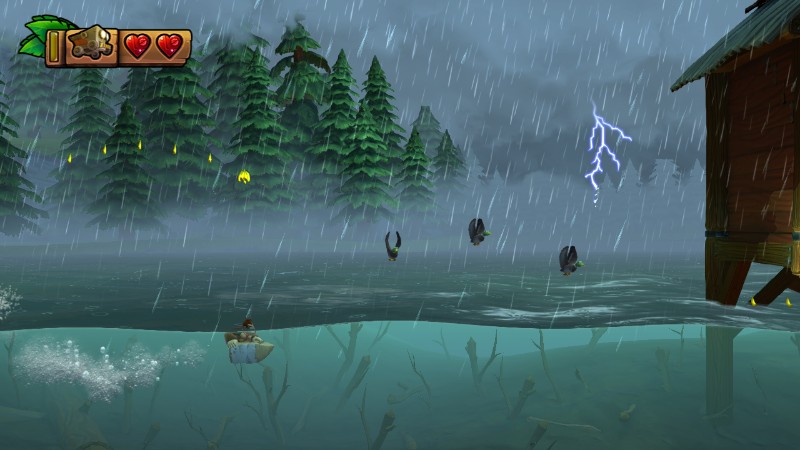
While the King of Kong scandal, centered on the alleged cheater Billy Mitchel, is heating up, Donkey Kong is yet again taking center stage in a port on the Nintendo Switch, and the timing couldn’t be better for Donkey Kong Country: Tropical Freeze. If you know anything about me, you probably know that I am an absolute sucker for playing games at certain times of the year and this one is a perfect game to pick up in the summer. It starts out in the tropics and the player progresses into the later levels that slowly transition into dark and wintry which feel oddly dystopian. Tropical Freeze happens to be one of my favorite Wii U games. While this statement may not seem that earth shattering (sorry, Wii U), Tropical Freeze puts on a master class of what a platformer should be. It’s a challenging game and when player gets comfortable with one thing, the game throws in something totally new and unexpected. It took everything that was right with Donkey Kong Country Returns and amped up the experience tenfold.
First off, the game is pure beauty. The tropical vistas have never looked better, and the water effects are top notch. For me, the thing that sets this game apart is the ambiance. This is something that is hard to get right, and many developers still haven’t figured it out. It’s amazing how Retro Studios captures the ominous feeling of a dark and scary storm approaching on a clear and beautiful day. This game has the player experience the environment through the use of genius shading, intricate detail of the environment, and what seems to be a real life simulation of weather changes and other natural disasters. Whether the player is swimming deep in the ocean while there is a thunderstorm looming overhead, running through a scorching wild fire, or even bracing through a tornado, there is never a dull moment. What sets this apart from recent Mario side scrollers is that nothing is blocky and linear, it all looks like natural environment and from a development perspective, there is no noticeable copy and pasting of environmental textures going on.
Of course, the ambiance wouldn’t be possible without the music. David Wise, who was the composer for the original DKC Trilogy, captures the same magical feeling through his sweeping and oddly calming scores. Playing through the game, the level that actually gave me goose bumps was Grassland Grooves in the Bright Savannah. This level starts slow and builds up to a grand climax of cheerful music and visuals. It’s not all pleasant though. Some of the music also matches the fear of a raging thunderstorm and it only adds to the intensity. If you don’t believe me that this game has intense music, go ahead and Youtube “Vikings Island Theme” and tell me that isn’t one of the most adrenaline inducing songs you have ever heard.
Like any game, however, it does have some flaws. My biggest gripe is that there isn’t really enough variety between characters. Cranky Kong’s “Duck Tales” pogo-cane technique is fun, but the game never really forced me to utilize it so I usually wound up using Dixie Kong for her twirl technique. I do want to note that it never really subtracted from the gameplay. The other issue with the Wii U version was load times. These were downright awful. Loading a level could take upwards of half a minute, and sometimes it felt even longer. Lastly, some people critique the challenge in this game. Personally, I have no issue with it, but I can see where it would be challenging for newcomers of the series. The Switch version seems to have a solution for every one of these issues. For one, Funky Kong is now a playable character and should take some of that difficulty edge off. I’m not sure how much I will use him, but it’s nonetheless a neat addition. I’m expecting load times to be better based on the new hardware, but that is to be determined.
So if you can’t tell by now, I’m pretty pumped to play this game again. It should be a huge success on the Switch and will give those that didn’t want to get near the Wii-U a crack at a game that was already near perfection. By nature, platformers are great “pick up and play” games, so it should adapt perfectly to the Switch. Up to this point, I haven’t used the Switch portable feature much, but I predict that should change upon release of this game. Though the price point may seem a little steep for a release of an older game, if you have never experienced the joy that is Donkey Kong Country: Tropical Freeze, do yourself a favor, pick it up, and go bananas. (Sorry!)
I know that what you do is an art form. You strive hour after hour to perfect your masterpiece. You build hype the best you can in order that as many people as possible will enjoy your work. You are a craftsperson, you are a businessperson. You are an artist. You are good at what you do.
Dear video game developer…
Stop it. Stop it, please.
I despise your talent. I hate it because you are too good at what you do. Because you pour your blood sweat and tears into your Sistine Chapel of a game, I never want to stop playing. And it’s not just one of you, it is so many talented individuals who create endless grand adventures. I cannot be separated from your works. My only hope to play all of these amazing games is for you all to quit now. I implore you; have mercy.
Now, to those of you who make bad games, on the other hand, please, I beg of you, never stop. In the spirit of Two Button Crew, your terrible games bring me most profound joy. They bring me a laugh, or, at the very least, a scowl of confusion. Your immediate stench alerts me to the fact that I have encountered the extent of what you have to offer me in the first five minutes. You bring me smiles. You bring me tears. You make me want to pull my hair out because of your painfully obvious design flaws. Most importantly, you give me no incentive to come back for more, so that I can move on to the next piece of garbage. Our love is a passionate, though brief, one.
Oh, the pains of pleasure! To hate to love, or to love to hate? Why must this mortal frame force me to choose betwixt the two? For to do both would throw me into a deep valley and leech my time to naught.
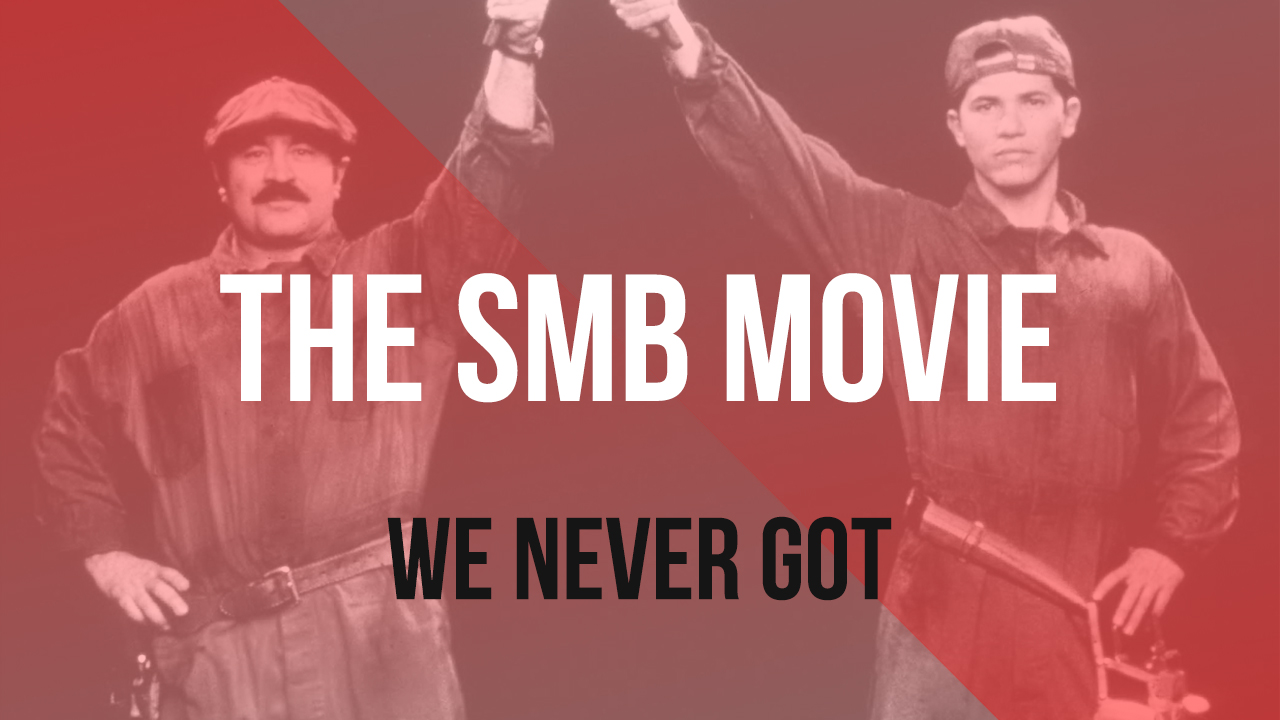
Confession time, boys and girls! I like the Super Mario Bros. Movie. There, I said it! I admit, it’s probably just residual nostalgia from the many times I watched it as a kid, seeing as how the movie is a horrendous adaptation of the games (which was no less obvious to four-year-old me as it is today). Even then, I think when judged on its own merits, the movie has a sort of cheesy charm: it’s a film made in the early 90s trying so hard to be a mid-to-late 80s styled action-adventure thriller. In my opinion, it works in a weird, probably unintentional way. Regardless, the film has become infamous among gamers, who deride it for—among other things—not being much like the games on which it’s, ahem, “based.”
The film has become infamous among gamers, who deride it for not being much like the games on which it’s “based.”
However, this was not always the case. The movie had a long and troubled production, mostly due to differing opinions on which direction the film should take. The end result? Many, many rewrites. Most versions of the script are more or less in the vein of the final product, a sci-fi action-adventure sort of a thing. However, there is one major exception: the first draft. Indeed, the first draft was not a sci-fi action-adventure sort of a thing, but instead a comical romp through a bizarre fantasy world. More to the point, it also included many more nods to the series on which it was, ahem, “based.” So, does accuracy to the source material make this version of the movie better? Let’s find out! Uh, I mean, “let’s-a go!”
I’m pretty sure that’s what the cool kids are saying these days…
Summary
Seeing as how it’s doubtful the average gamer knows about the many rewrites this movie went through, much less bothered to read the original script, I think it’d be a good idea to briefly go over the plot detailed in the aforementioned first script. The movie follows a pretty clear three-act structure, with the first act taking place in Brooklyn, the second in the Mushroom Kingdom, and the third being comprised of the climax and denouement, as one would expect.
Act 1: Brooklyn
The story begins much like the finished movie does: a dark and stormy night, a robed figure, an infant, and some sort of mystical artifact, in this case, a jewel encrusted locket shaped like a mushroom. In this story, however, the nun that answers the door fails to notice the locket, and it consequentially slips out of the basket and into a nearby storm drain. After leaving the child on the door step of a church, the robed figure—in this version an old man—tries to beat a hasty retreat but is blocked by the shadowy figure of the story’s villain, King Koopa. Koopa threatens the man with unimaginable suffering, and the frail old man—being quite old and frail—dies of fright.
Twenty-something years later in modern-day, early 90s Brooklyn, Mario and Luigi are doing what plumbers do: fixing pipes. Or, at least, Mario is, Luigi is daydreaming about the love of his life, a girl that works at a nearby flower shop. Mario, having been hurt by love some unspecified amount of time ago, abrasively attempts to dissuade Luigi from pursuing a relationship.
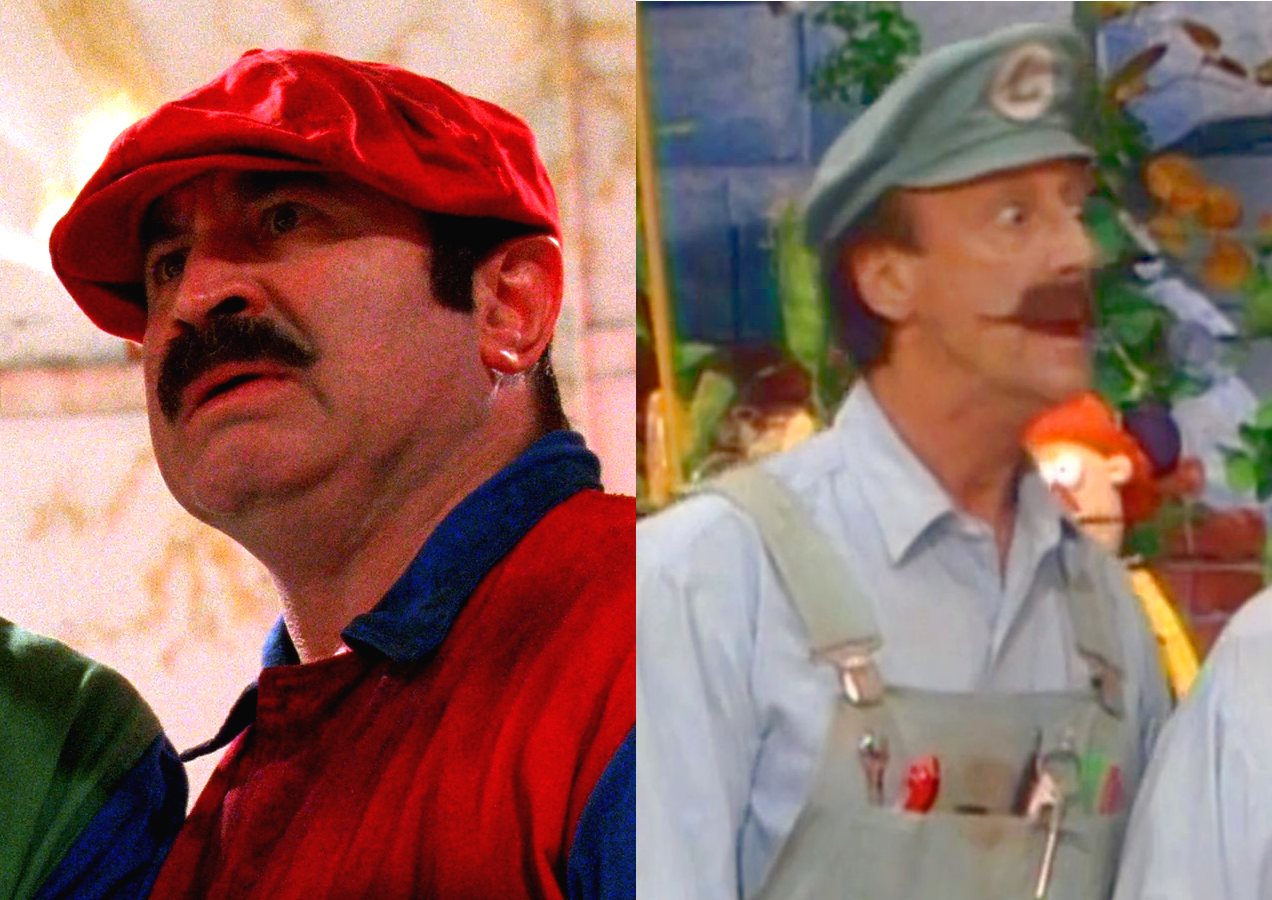
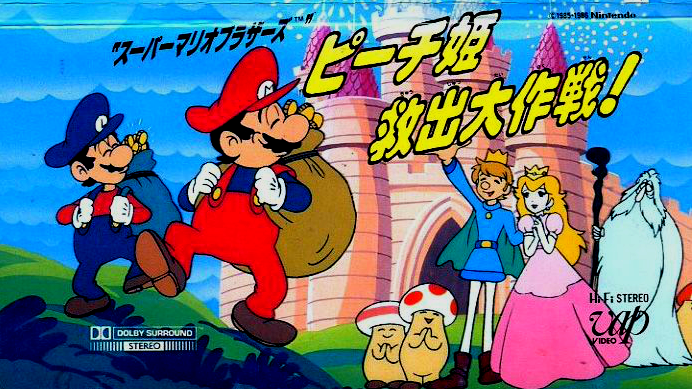
Quick aside: for maximum enjoyment, I recommend envisioning Mario being played by Bob Hoskins—like he was in the final version of the film—and Luigi being depicted by Danny Wells like he was in the Super Mario Bros. Super Show.
Clearly the best casting decision this side of Charles Martinet.
Anyway, Mario and Luigi aren’t exactly in the best shape financially. Mario is deep in debt to a loanshark named “Big Eddie” (pro tip: never loan money from anyone whose name starts with “big”). Further adding to their problems are the differences between each brother: Mario is all business—which is understandable given his circumstances—while Luigi is compulsively generous and prone to messing up while on the job, resulting in more work for Mario. Case in point, after leaving to fetch some tools he left in the van, Mario returns to find that Luigi has turned the pipe they were working on into something akin to a modern art piece.
Later, after fixing the pipe, Luigi heads down to the flower shop to confess his love to Hildy. Wait, Hildy? Why Hildy? I mean, at least Daisy was an established character in Mario canon (albeit an incredibly obscure one back when the movie came out). Whatever, Dai—Hildy is rebuffing the advances of some sleazy dude named Vinnie. Apparently the two went out on a date sometime ago, and Dai—Hildy gave him a black eye. Luigi enters the shop just after Hildy convinces him to leave via argumentum ad tubulum irrigandum. After wussing out of telling Hildy how he feels, an argument breaks out between Hildy and her employer: Hildy put top dollar flowers in a budget wedding bouquet because weddings should be special or something. Afterward, Luigi and Hildy make lunch plans for the next day.
So to summarize, Mario is gruff and cynical, Luigi is warm and whimsical, and Hildy is tough but sweet.
Later that night, after having dinner with his brother (and some arguing), Luigi heads out on the fire escape to look at the city lights. He starts daydreaming (nightdreaming?) about being with Hildy. His happy thoughts are soon interrupted by that most inconsiderate of bugbears, foreshadowing. He imagines Hildy being stolen away by a reptilian claw and then himself holding the locket from opening. He then wakes up in bed, which leads me to question how much of the previous scene even happened. Did Mario and Luigi even have dinner, or was that part a dream too?
The next day, Luigi bumps into some of Big Eddie’s goons. They start hassling him until Mario steps in. Mario assures Eddie and his thugs he’s got a job lined up and he’ll be able to pay them soon. Mario then heads to the City Engineer’s office. Unfortunately, the City Engineer won’t even look at Mario’s proposal for the unspecified project until Mario pays a bribe. Mario, of course, refuses to stoop to bribery. After a debate on business ethics, the meeting inevitably concludes with the defenestration of the City Engineer’s golf bag.
Afterward, Luigi is telling some of the neighborhood children a story about a fisherman who outwitted a wrathful genie by daring him to enter a bottle. Mario, already having a bad day, dismisses the tale. Luigi attempts to cheer his brother up by telling Mario he found them a (pro bono) job fixing a leak in the basement of the church from the opening. During the job, they accidentally break open a sewer pipe, out of which comes the locket. Luigi immediately recognizes it as the one from his dream, and Mario immediately recognizes it as his ticket out of debt.
The next day, an unusual fellow tells Hildy he’s a detective working for her parents, and they would like to meet her. Previously believing herself to be an orphan, Hildy readily agrees. Meanwhile, Mario meets with Big Eddie to pay off his debt using the locket. Unfortunately, Luigi switched the locket with a rock when Mario wasn’t looking, which Big Eddie doesn’t find amusing. Back in the flower shop, Luigi shows up for his lunch date only to catch the Hildy right before she leaves with the strange man. Quickly realizing something’s amiss, Luigi chases after their cab in the Mario Bros.’s van. Mario, trying to escape Big Eddie’s goons, tries to escape to the van and after a brief chase only barely manages to hop in the back. Luigi chases the cab to an alley and continues his pursuit on foot. Mario follows him and they enter an abandoned diner with a large pipe jutting from the floor in the kitchen. They enter the pipe and are quickly whisked away.
Act 2: The Mushroom Kingdom
They exit on the other side of the pipe in…well, the movie never specifies, but we’ll just say the Mushroom Kingdom. After a brief scuffle over the locket and an encounter with some Piranha Plants, the brothers start wandering about, trying to determine where they are. They eventually stumble across Toad, who’s attached to a metronome-like deathtrap. They free him and he decides to tag along.
I should mention that this depiction of Toad is more or less the same as his portrayal in The Super Mario Bros. Super Show, but with a little less chutzpa in the face of danger. I’ll leave it to you to decide just how annoying that sounds.
The brothers eventually catch up to Hildy and the strange man, who then changes form to reveal himself to be none other than King Koopa (why can’t they ever just call him Bowser?). Luigi rushes off to save her, and—having no plan or weapons—gets himself and Mario captured. King Koopa leaves with Princess Hildy (she’s apparently a princess now) in tow while Mario and Luigi are to be executed via ballista. They just barely manage to show their executioners—who happen to be of a bearded human-like race known as “Yeelahs”—the locket before the trigger is pulled. Upon seeing the locket, the Yeelah proclaim the Mario Bros. the heroes of prophecy (is it just me, or are prophesies more common in movies than the Bible?). They then direct the trio to a nearby village to meet a wizard.
They meet the wizard, Woltan, and after some convincing, he sends them on a quest to the Pit of No Return to retrieve his wand. Meanwhile, Toad sends a message stating the brothers are still alive to Koopa via rocket-powered carrier turtle. Woltan gives Luigi three silver coins and sends the three on their way. As Mario’s complaining about never wanting to go on any quest, Luigi gives a beggar the three silver coins and receives a magic bean in return.
Meanwhile at Koopa’s castle, Koopa elaborates that he needs Princess Hildy to willingly marry him so that he can get his claws on the Crown of Invincibility. After briefly and awkwardly attempting to use charm and wit to persuade her, he defaults to love-potion laced chocolates, because apparently, it’s consensual when she’s under the effects of a love potion. The script cuts back to the progression of this plot point several times, presumably to provide a sense of urgency, but I’m not going to bother.
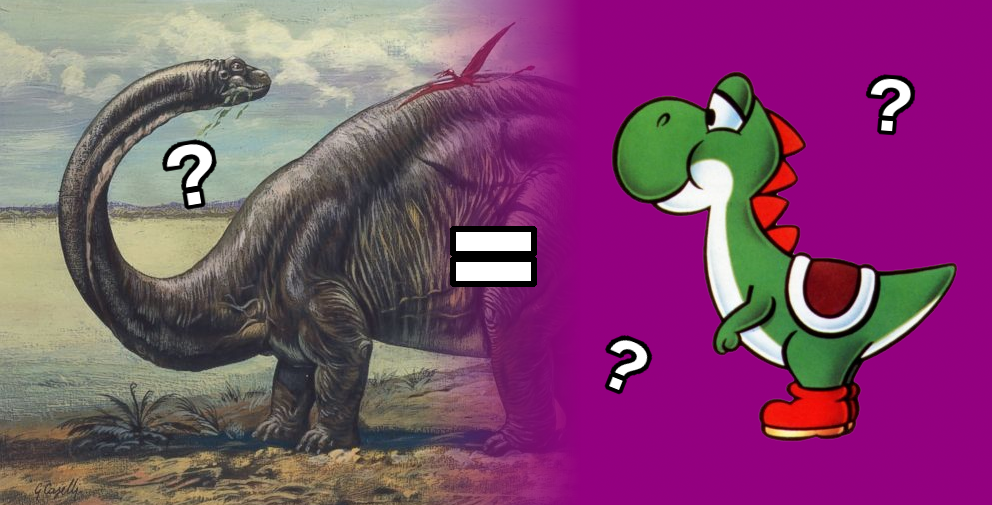
After camping out for the night, the Mario Bros. (and Toad) eventually stumble across a group of “toadstoolians” (i.e. Toads) working as slaves for King Koopa. This is followed by a chase scene in which the Mario Bros. have to run from the Hammer Bros., who’ve been sent to assassinate them. After escaping the Hammer Bros. and some more of Koopa’s minions, they find an egg in the woods which hatches into a “brontosaurus-like” creature. It’s actually a Yoshi, but is never referred to as such. It imprints on Mario, who shoos it away. After some more hiking, they (finally) come to the cave’s entrance. They enter, navigate some traps: including Thwomps and a strangely out-of-place Bob-omb, and enter a treasure chamber where the wand is. While in the treasure chamber, Luigi finds a jar of mushroom powder, and Toad takes a red leaf.
Pictured: a comparison of some promotional artwork of a Brontosaurus (left) and an artist’s rendition of what a T. Yoshisaur Munchakoopas may have looked like (right).
Outside, they’re greeted by Koopa and his minions. Koopa shoves Luigi and Toad off the ledge at the edge of the cave, sending them plummeting to their doom. Fortunately for our heroes, Luigi and Toad have the raccoon-leaf from earlier and use it to land safely. Mario, thinking his brother is dead, swears vengeance on Koopa as the Yoshi from earlier comes to his rescue. After the two escape from Koopa’s troops, Mario says goodbye to the Yoshi as it goes to be with its real mother.
Act 3: Koopa’s Castle
On his way to Koopa’s castle, Mario comes across the beggar Luigi got the magic bean from. The beggar reveals himself to be Woltan. Mario returns the wand and they head off to defeat Koopa. Koopa’s chief wizard, Beedleman, senses that Woltan has regained his powers and summons a storm to slow them down. As the storm brews, Mario takes cover, but Woltan tells him that there is nothing to fear because his magic is strong enough to protect them from the storm. Immediately afterward he’s vaporized by a bolt of lightning (Okay, I got to admit that’s pretty funny). Anyway, Mario continues onward, alone.
Mario arrives at Koopa’s castle and rushes in. Luigi and Toad, who escaped the caves by sprouting the magic bean from earlier into a vine they could climb, see him run in but are too far away to call out to him. Inside, Mario finds the place unexpectedly deserted. He seeks out Hildy, following her cries for help. He follows the voice only to find that (all together now) it’s a trap! After delivering the famous “the princess is in another castle” line (which is probably the most clever allusion to the games in the whole movie), Mario is taken away in chains. Fortunately, his captivity is brief as Luigi rescues him en route to the dungeon of Koopa’s real castle.
Now reunited, the brothers sneak into Koopa’s castle. The duo knock out some guards, steal their uniforms, and inadvertently stumble into King Koopa’s bachelor’s party. The king mistakes them for jesters and demands a song. After improvising a tune, the brothers sneak off to find Hildy. Upon finding her, they are shocked to find that the once sweet Hildy has been transformed into a “grotesque wench” (way too much makeup, long claw-like fingernails, etc.) by the chocolates. Hildy only barely recognizes Luigi before the guards barge in and take the Mario Bros. to the dungeon.
In the dungeon, our two heroes await their fate: in the morning the floor—which is made of ice—will melt and they will plunge into a pool of man-eating fish. Without anything better to do, Luigi resorts to having a real-talk with Mario. Turns out, the only reason Luigi still lives with Mario is because he promised their mother that he would look after Mario, because all Mario cared about was money and work.
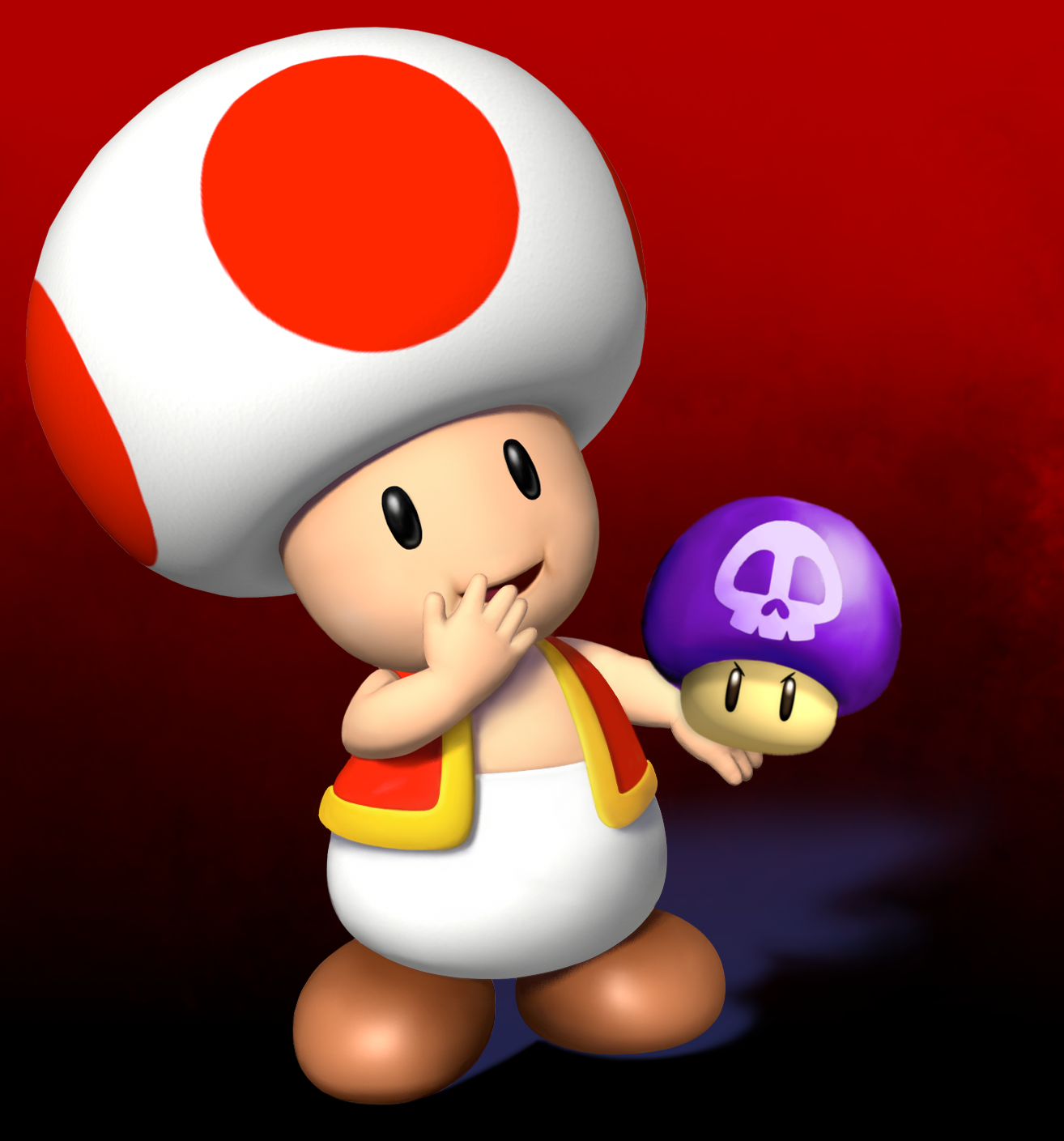
The next morning, the ice begins to crack, Toad finally decides to check and see what’s taking our heroes so long, and Koopa’s wedding begins. Just as the remaining ice becomes too small to support both Mario Bros., Toad shows up. He manages to trick the dungeon’s guard into eating a poison mushroom, thereby straight up murdering him, and then rushes to the brothers aid.
Does this look like the face of mercy?
Mario and company barge into the wedding. Unfortunately, Koopa is able to finish the ceremony while the protagonists are busy fighting through the guards. Just after Hildy says “I do,” Luigi breaks the spell on her via the mushroom powder he obtained in the Cave of No Return. Now the rightful-ish ruler of the kingdom, Koopa takes the crown and uses its power to begin turning Luigi to stone. Mario hefts Luigi’s petrified body and attempts to escape with Toad and Hildy. Just before his petrification completes, Luigi reminds Mario of the story of the genie and the fisherman.
As they escape, there’s a largely pointless confrontation with a pair of chain-chomps and a rather cool implementation of roto-disks. Eventually, the group is chased into an underground chamber…full of magma. Duh.
Our heroes attempt to cross a rickety rope bridge when Koopa finally catches up to them. Mario directs the others to take Luigi and get to safety. Koopa, at first, tries to use illusions to defeat Mario. When that doesn’t work, he uses his magic to pull Mario toward him and deliver a powerful uppercut. Mario is sent flying and only barely manages to grab onto the bridge. With his opponent now dangling precariously above a pool of magma, Koopa approaches to deliver the coup de grace. Just before Koopa cuts the rope Mario is hanging on, Mario remembers the story of the fisherman and the genie. Mario says that even though he may be small, he’ll always be bigger than Koopa. Koopa, of course, uses the crown’s power to grow. Mario continues to egg him on but Koopa becomes wise to Mario’s ploy and begins levitating to avoid destroying the bridge with his weight. That wasn’t Mario’s plan, however: Mario tells King Koopa that his shoe is untied and Koopa reflexively looks down, thus causing the crown that is now many times too small to fit on his head to slip off. Koopa plummets into the magma and everyone (including his former henchmen) rejoice. But suddenly, a giant flaming head emerges from the fire. Mario does the only logical thing in this situation and…tells Koopa that it’s over and he just needs to give it a rest? With one last furious roar, Koopa takes Mario’s advice and finally dies.
Woltan reappears and reveals that he was actually the former king of the Mushroom Kingdom all along. Later, in the field of pipes that will take our heroes home, the King gives a speech congratulating the Mario Bros. and Toad and presents them with medals. He then gives Hildy permission to return to Brooklyn so she can be with Luigi, stating that he will simply remarry and produce another heir to the throne. That’s a…surprisingly practical way of resolving that plot issue. Anyway, after saying their goodbyes, Mario, Luigi, and Hildy all return to Brooklyn.
Three months later, the trio are eating dinner at an Italian restaurant. Hildy and Luigi are now married, and Mario is finally out of debt. The newly-wed couple ask Mario if he’s seeing anyone. Just as he starts to explain—while he’s very happy for them—he’s not interested in a relationship for himself, he spies an attractive woman sitting by herself who happens to resemble a bit character who I didn’t bother mentioning before now because she only exists for the sake of this one call back. We see Mario walk up to her and start a conversation through the front window of the restaurant as the camera begins to pull back, revealing the Mario Bros. van whose side now reads “Super Mario Bros.: Ace Plumbers.”
The End.
Analysis and Review
So, this story is obviously more faithful to the source material, therefore it’s clearly better, right? Eehhhh…
Okay, first things first, movies are a collaborative effort: they are the end product of many people’s input and passion. For that reason, it’s hard to judge a hypothetical film solely on a script alone. Many factors can influence the quality of a movie: direction, acting, editing, the list goes on and on. So for this reason, I’m judging this assuming the performers never miss a beat, the director has some actual talent, and no scenes were cut for length. With that in mind…
Let’s start with the positives. Some of the jokes are actually really funny. I like that this script has a rather dark sense of humor in places, like having Woltan vaporized with little warning or fanfare. Some of the one-liners are fairly clever (though most are a little cheesy) and—if properly acted and edited—the slapstick could potentially be almost on par with something like Looney Toons or the good seasons of SpongeBob. Over all, many of the jokes have potential, and they do a good job of establishing a wry, yet light-hearted tone.
Over all, many of the jokes have potential, and they do a good job of establishing a wry, yet light-hearted tone.
I also like the dynamic between Mario and Luigi. Having Mario resent Luigi for no reason other than the latter is a responsibility the former never asked for may not be the most original idea, but I think it was a very interesting direction and made for a surprisingly deep and psychological take on the characters. Also, let’s not forget the reveal near the end in which Luigi admits to having similar feelings regarding Mario, which I thought was a good pay off for their character arcs.
Lastly, I liked that they made an effort to make the movie’s world resemble the games’. The thought of seeing a live action Super Mario Bros. that more closely resembles the games is enough to make me salivate.
Now the bad, few of the other characters other than Mario and Luigi get much character development. With the possible exception of Toad, none of the side characters really change or grow throughout the course of the story. Hildy remains tough but sweet, Woltan’s only change is that we discover he’s really the king, and Koopa’s not fleshed out much as a villain. This last one’s particularly infuriating because Koopa at one point mentions how his father had everything taken from him and his family was reduced to living in abject poverty. Taken by whom? King Woltan? That moment raised so many questions: questions I was very much looking forward to having answered, and they never mentioned it ever again! Easily the most aggravating thing in this script!
Next were some miscellaneous issues. Firstly, you probably noticed there were quite a few scenes that I only mentioned in passing. Well, that’s because a lot of scenes don’t really add much to the story and were effectively padding. Next, the story doesn’t quite know who its protagonist is. I know of two basic ways of determining who’s the story’s hero: “who drives the plot?” and “who undergoes the most character development?” For most of the film, Luigi’s driving the plot, but Mario undergoes most of the character development, but toward the end the movie changes gears and has Mario do both. I don’t think this is too big of a deal, seeing this is the Super Mario Bros. movie, and thus the writers may have just figured both brothers should share the spotlight, but even then it came across as a tad unfocused. Lastly, the movie shows its age in some of the worst ways possible: parts of it are painfully cheesy and cliché-ridden. It’s very clearly a product of the 90s.
A lot of scenes don’t really add much to the story.
Now for the Reznor in the room: the efforts to reference the games are often times distracting. I know that doesn’t sound right, so hear me out. The script makes an effort to reference the games, but it’s incredibly inconsistent in how it does so. I’m not against there being new ideas—especially considering this script was written in ’91 and there was a lot less material to go off of—but there are missed opportunities all over the place. For example, they never call the Mushroom Kingdom the Mushroom Kingdom, or Hildy “Princess Toadstool”—even as a title. Also, why have the majority of Koopa’s army be comprised of Yeelahs instead just having Yeelahs be the conquered peasants (I’m not anti-Yeelah, but give me my gosh-darn Koopa Troopas!)?
Because of this, the movie’s references feel kind of half-hearted: like they only included them out of necessity. Heck, some come across as completely shoe-horned, like the bob-omb in the Pit of No Return or the Chain-Chomps in Koopa’s castle: both come completely out of nowhere and add very little to the plot. While reading this, I got the impression there were times where the writers stopped and said, “wait, weren’t we writing a Super Mario Bros. movie? Oh crud! Quick, put in a character from the games.”
This may sound really weird, but I think the movie we got is easier for me to judge on its own merits than this one because it doesn’t try as hard to connect itself to the games, meaning I have to overcome less bias to accept it as its own thing. Because the first draft includes so many references to my favorite video game franchise of all time, I want it to be even more faithful.
Because the first draft includes so many references to my favorite video game franchise of all time, I want it to be even more faithful.
Verdict
In its current state? It’s okay. I don’t think it would’ve been as controversial as the version that made it to theaters, though. It would probably be seen much the same way as Street Fighter: The Movie is. Either way, it’s nothing spectacular. I do think with some revisions, some trimming, a good director, and talented actors, it could be quite good. I liked most of the stuff in Brooklyn, and I think the climax works pretty well, but the second act drags and is lacking in the Mario charm I expect.
All in all, while it may be fun to speculate, I don’t think we’d be much better off with this version of the movie. But hey, Nintendo’s said they’re going to start licensing the movie rights to their franchises, so maybe a good Super Mario Bros. movie isn’t that far down the road.
About the author: Glen is a lifelong Nintendo fan whose love of video games has inspired him to pursue a career in computer programming; so much so that he is currently studying to get his masters in computer science. He also likes the Street Fighter movie for much the same reasons he likes The Super Mario Bros. Movie, cementing the fact he has questionable taste in films.
It’s that time of the year again! E3 2018 is just a couple days away, and the excitement around the gaming community is quickly escalating. Every year when I get out of bed on the day of Nintendo’s E3 press conference (Direct, as of late), I’m essentially a kid waking up on Christmas morning. The anticipation is high, and I can’t wait for the flurry of announcements that Nintendo has been holding from the public for months. The reason why I have what I refer to as “E3 Jitters”, is because Nintendo is known for taking their fans on an emotional roller coaster during E3. Whenever I expect to hear something, they announce something completely different and unexpected. I understand from a marketing and competitive standpoint that this puts them at an advantage, but it usually drives me and a lot of the fan base crazy. However, I would argue this spontaneity just adds to the anticipation. Nintendo really is like a box of chocolates. The games are usually sweet, but you NEVER know what you are going to get.
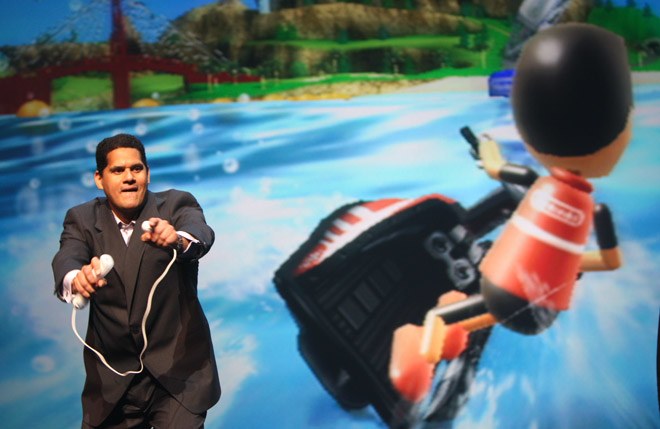
He’s a power guy, what can I say?
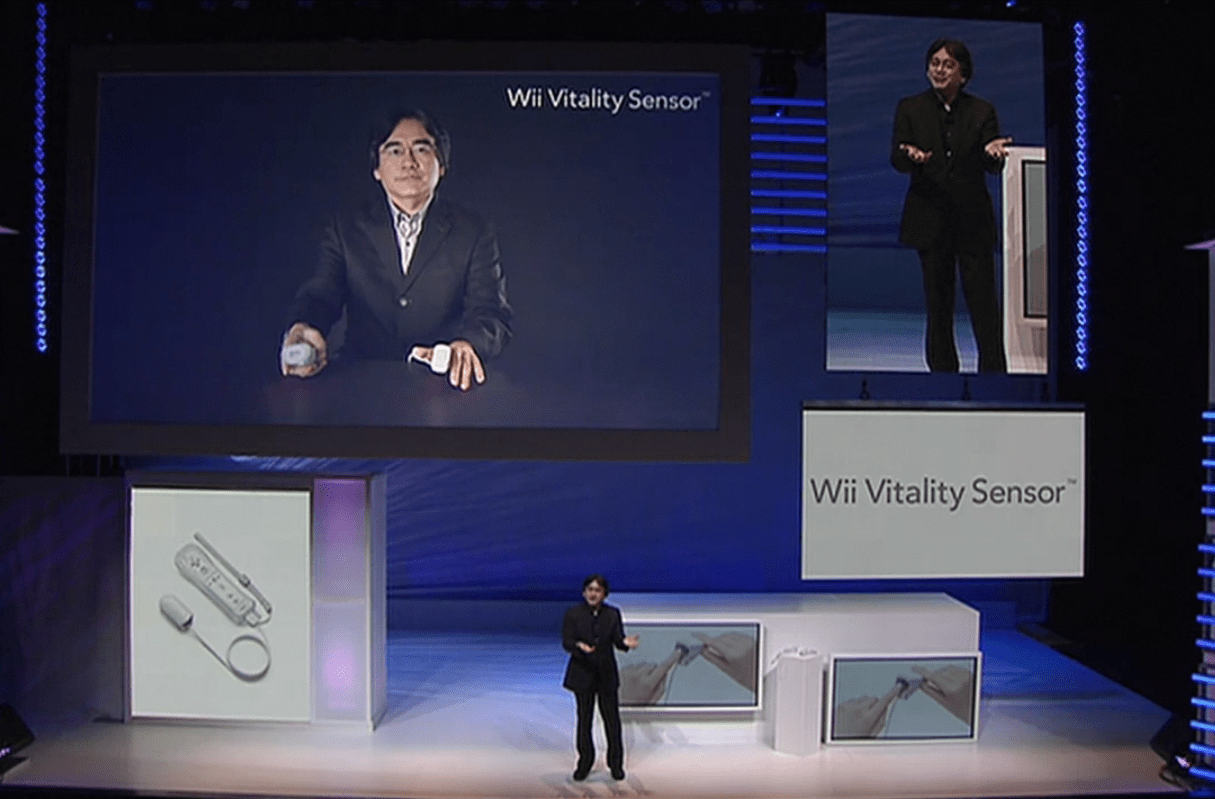
From Reggie officially being classified as overweight, to Cammie Dunaway awkwardly throwing virtual Frisbees at dogs, to Iwata announcing the vitality sensor, to Ravidrums and the entire Wii Music catastrophe, we’ve seen it all. Of course, they’ve had their high notes as well, such as when Miyamoto came on stage for the Twilight Princess announcement. From the lows to the highs, I can say it has always been a ride that I anticipate greatly, despite often leaving disappointed. Nonetheless, E3 has provided some fantastic entertainment value, and Nintendo certainly isn’t the only company to have E3 blunders. Just look up Ubisoft’s Mr. Caffeine. He managed to singlehandedly make every single person in the audience uncomfortable just in a matter of seconds. That’s almost impressive.
Yes, it was as rough as it looks.
This year the usual suspects are of course Smash Bros. for the Switch and Metroid Prime 4. Though I’m excited for both of these games and this may put me in the minority, I hope there is minimal coverage on both. We haven’t seen any gameplay for either, so a pair of 5 minute gameplay videos would be just enough to get me excited, and then they can move on to the next announcement. When Nintendo bogs down their E3 showcase with announcements that gamers already know, to me, that is filler. Let’s just have a video or small demonstration of what we already know is coming and move on. Nintendo, among other competitors, have been known to spend way too much time talking about sales numbers, though this has been less of a problem lately.
Absolutely no disrespect toward the late Mr. Iwata, but this idea was just bad. Really bad.
Besides the obvious heavy hitters, I’m sure there will be at least some coverage on Pokémon Let’s Go!, Mario Tennis Aces, and Go Vacation for Switch. I wouldn’t mind some actual Super Mario Odyssey DLC (come on Isle Delfino), or possibly even expansions for Breath of the Wild, but these might be stretching it a bit. There may be some coverage on their new online service and downloadable games. I don’t mind Indie games either, as long as this section is short and sweet. Of course, as I mentioned above, Nintendo always rides the wave of the unexpected, so we’ll just have to wait with anticipation.
I do want to point out that Nintendo is not only selling to gamers, but investors. Companies selling to this odd mix can create some of the best, and most awkward moments in gaming history. Whatever be the case for 2018, I’m sure we’re in for a ride. When I wake up on E3 morning, I’m going to be hoping for an Animal Crossing Switch or Pikmin 4 announcement under my theoretical E3 Tree. What are you most anticipating this year?
After this year’s E3 video presentation, the consensus among the Crew here at TBC is that, as a whole, it was a little disappointing. There were very few “surprises”, and, though we were excited to see Smash Bros., we felt like the amount of time they spent showing us what they showed us was not wisely used. You can see our in-depth E3 reactions here.
Even so, Nintendo can’t present a game for a half-hour at E3 and not show anything to get excited about (don’t. Just… Don’t). In the spirit of contented mess, I wanted to draw attention to three things about Super Smash Bros. Ultimate that should get us excited.
#1: Port-Like Qualities
This may sound like something to gripe about, but I see so many advantages to all of the similarities between Sm4sh and Ultimate. First, some minute balance issues aside, Sm4sh was a fantastic fighting game. My hopes for the upcoming title were that it was either a totally new direction for the series (ala Marvel Vs. Capcom) or a tweaked port, and it looked like the Big N granted my latter wish. Do we really need major “improvements” when what we have is already great? I do not think so.
Second, porting a game with slight changes should take less time and cause fewer problems at the game’s release. For Sakurai’s sake, I hope this is the case. The man’s tireless dedication to his work is legendary, and he needs some sleep.
#2: Attention to Audience
Super Smash Bros. has evolved a lot over time. It started out as a fun new foray into the crossover fighting genre. Melee made the game more competitive. Brawl fleshed out the single player experience as well as made the game more accessible to newcomers. Smash for 3DS and Wii U fleshed out previous imperfections, making it clear that, though party elements are still very much present, it had grown into a well-balanced fighting game.
With the last entry, especially, we saw a shift in the developers listening more to the competitive fans. Even in the simple gesture of placing the stage select before the character select, we see that Ultimate will continue this tradition. They are piecing elements of what made each of the previous entries great and unique together to make happy a crowd that has wanted to see this series taken seriously. Sakurai shaking his head at imbalances, roll staling, ”easy” character unlocking, and more keep me excited for release.
#3: Everybody’s here!
So what if “Echo Fighter” is just an attempt to avoid calling characters “clones”? The fact that every fighter from all previous games is playable right out of the box has me stoked! The fact that Sakurai stated that there will be few new characters does not have me concerned for a number of reasons. First, the amount of free characters is more than any previous game in its final state, and we do not have to pay extra to have that. Second, Sm4sh had a large enough roster as it was. Throwing in more characters makes the game more and more difficult to balance. Lastly, I think Sakurai is not quite being honest with us. The DLC support for the previous game was extensive, and, though the initial bundle might not be teeming with new characters, I am sure we will see more newcomers after first release.
Nintendo’s Direct this year might not have been knock-your-socks-off great, I think there are plenty of things for which to be grateful. I think ultimately (see what I did there?) what I am trying to say is that people who are complaining about the lack of Animal Crossing need to grow up and realize they got a game every year for the past three.
Each and every year, Nintendo endeavors to surprise and delight you. They spend months holding meetings about E3, planning their lineup, signing deals, scripting speeches, recording VO, and editing trailers meant to drop your jaw.
Each and every year, gamers scour Internet forums and fansites for the latest news, rumors, and speculation.
Is there any wonder why you weren’t in shock and awe after the Nintendo Direct?
For some unknown reason, Nintendo fans expect that they can examine every patent, floor plan, internal email, and industry job listing—yet STILL be blown away when it finally comes time for the Big N to show their big guns.
You can’t have it both ways!
Badly Kept Secrets
Do you know how epic (pun intended) it could have been when Fortnite was revealed? That was a moment that was passed over without fanfare because we knew it was coming. Imagine going into E3 blind, then finding out: not only is Fortnite confirmed for Nintendo Switch, it’s free… and you can get it now!
Or Killer Queen Black, a 5v5 arcade game that’s sweeping the scene with its unique gameplay and set up, now coming to a much more convenient portable/console hybrid.
Dragon Ball FighterZ, Paladins, FIFA 19, Overcooked 2, and more… all these announcements were stolen from Nintendo.
Unmet Expectations
Another way leaked information harms the industry is… well, sometimes it’s not true. And who are we to say what’s fake and what isn’t? Nintendo “doesn’t comment on rumor or speculation,” so anybody with a Resetera account can string along the entire community of Switch gamers, get every podcast and YouTube channel talking about them, just by making something up and saying they “heard” it. Since when did we decide to be this gullible?
There are actually people feeling down about the absence of Star Fox: Grand Prix and Simon Belmont in Super Smash Bros. Ultimate because those things didn’t materialize. You could argue that Nintendo is holding those cards for the future, and maybe they are—but I prefer not to peak at the player’s hand across the table. It takes the fun out of the game.
Put a Cork in It
Curious how Nintendo feels about E3 leaks? Here’s Reggie via IGN: “You know, as a company, we want to surprise and delight our fans. That’s what we live to do. So when leaks happen, it’s really disappointing. We work hard to maintain the confidentiality of our information. In this day and age where everyone has a camera and everyone is looking for their 10 seconds of internet fame, it’s really tough. But we try hard, very hard to keep our information confidential and keep leaks from happening.”
Nintendo is doing their part, but Reggie is right: after the advent of smartphones, leaks can’t be stopped. You simply can’t cork all the holes in the boat.
But you CAN put a cork in your mouth, and help stop the spread of leaks. If you find yourself underwhelmed at Nintendo’s announcements, maybe it’s time to start doing things differently. Make a change. Ask content creators to stop reporting leaks as news, or at least preempt them with a spoiler warning.
I didn’t know that I needed Fortnite in my life until E3 2018, where it was “surprise” dropped on Nintendo Switch. It quickly became one of my favorite games on the platform!
After quickly sinking multiple days’ worth of hours into the Battle Royale title, I’ve taken some time to reflect on what makes Fortnite so good. Usually I’m one to ignore what’s popular in the mainstream, but after giving it a fair-shake, I realize that Fortnite earned its spotlight and deserves all the attention it’s getting. Why? Read on…
The Gameplay Loop
Every single match, 100 players fly over an island and skydive down to their desired destination. Everybody starts with nothing, no matter how new or advanced the player, the battle starts on an even playing ground. You feel so vulnerable in those opening moments, with only a pickaxe in hand, and it’s exciting to gather a competent loadout and reassuring to find those much-needed health and shield items.
Risk/Reward
Depending on your skill level, you might drop right into Tilted Towers, grab a high-powered gun and immediately start fighting for your life. Or if you are more of a beginner, you can paraglide to the farthest reaches of the map where you’re not likely to run into another player for several minutes. Fortnite is constantly presenting the player with risk/reward choices: Should I get a headstart on the storm, or find that treasure chest? Should I drink my shield potion now, or save it for later? Should I fire on that distant enemy, or remain hidden? As you get more comfortable with the game, it becomes very rewarding to take more risks.
The Storm
The storm is an ever-present factor in Fortnite gameplay. You begin with 100 players on a huge island, but the game intelligently constricts the playspace as users fall one-by-one. You are given brief respites while the storm stands still, and you can use this to explore areas of the map which will soon be shrouded in toxic rain, or you may want to hurry up and get to the eye where you can set camp and stay safe. The storm is constantly drawing combatants together, causing people to be on the move, out in the open, and encountering one another (just like a good Hunger Games gamemaker).
Evolving World
The island has been mentioned a few times, and rightly so: it has a lot of character. New players will be tempted to think that it’s so big and diverse, it must be procedurally generated. But no! While weapon and chest locations are slightly randomized, the team at Epic crafted a huge world with unique locations that blend together seamlessly. Not only that, but the map changes with time. Recently, I was in a squad when the gunfire stopped as everyone watched a rocket launch and tear a crack in the sky dome—a crack that has been spreading ever since. The world feels alive and it’s great to know that the developers are putting continuous effort into a portion of the game that would otherwise become stale.
Aesthetic Monetization
A quick glance about the gaming industry reveals some split opinions and shady tactics around microtransactions. Especially in online multiplayer shooters, developers and publishers are thinking of very creative ways to nickel-and-dime their playerbase. It was a breath of refreshing air to see that Fortnite only sells aesthetic options like character skins and stylized pickaxes. You can’t pay for an advantage in this game, unlike others where getting killed prompts a pop-up “YourMom64 killed you with a SuperSniper. Would you like to buy a SuperSniper for $2.99?” Fortnite’s doing it right!
Quick Matchmaking
Thanks to the compelling gameplay loop, and “one more game” syndrome, you’ll find yourself wanting rematch after rematch. Fortunately, Fortnite makes it all too easy to get in a lobby with 99 other players. Whether you’re playing solo or squadding up with friends—even with crossplay!—the process is painless (which is such a relief to say on a Nintendo platform).
Voicechat
The developers pulled it off! You can literally plug a 3.5mm headset into the Switch and use native, in-game voicechat with your teammates. It’s kind of incredible: no apps, no Wiispeak—just you, your headphones, and the game. That’s what we call “not overcomplicating things!”
There you have it… several reasons why Fortnite is a work of genius. And it’s free, so what are you waiting for? Give it a download and add “Scott TBC” before my wife stages an intervention and pries the Pro Controller out of my hands!
I may have been late to the bandwagon, but there is no denying the fun that is Fortnite. If you are tired of hearing about this game, and have not yet played it, I highly recommend you give it at least a try. And now is the perfect time to join! It’s the start of a new season, which means that the map is new, there are new weapons and features, and everyone is getting used to them together. Plus, it Is free to play on Switch (or computer, if you’re taking a more tactical approach)!
Enough advertising. I was skeptical to start playing Fortnite for a number of reasons, including:
The game has been out for a while, which means I thought I had no chance (which turned out not to be the case).
I am not very good at, or typically drawn to, any type of shooting game.
The game is super popular, and sometimes I’m a hipster hater like that.
In the end, though, after an invitation from Scott, I finally succumbed and gave it a shot. Scott had been introduced by his brother, and it was his turn to bring me into the fold. After a round or two of battle royale (100 competitors all against each other) I was cracking the top twenty, and my turns were regularly lasting longer than Scott’s. Unbeknownst to me, I began to unlock some mind games that, although not beneficial for me, threw my buddy into a mood.
During one particular match as I decided which shotgun was better to keep, Scott, having been unable to find a gun his previous match, mocked with, “HUH! SHOULD I HAVE PUMP SHOTGUN, OR SHOTGUN PUMP?!” His brother and I were the only ones laughing.
After a day or so, Scott and I had about evened out, regularly placing in the top ten, but never claiming the elusive first place.
My wife happened to be with me on one such visit and requested to give it a shot to see what the big deal was. My wife is by no means a gamer, and I was elated that she was willing to give this ridiculous game that held her husband captive a shot. She dropped from the flying bus pretty much straight down next to the lake with a cabin situated on an island in the middle of it. without a gun, she marched through the lake, up the hill, and into the house without any opposition. Climbing the stairs, she entered a room with an occupant, and the rest of us (Scott, his wife and brother, and myself) cried out in shock! Swinging her pickaxe, she slew the unwitting squatter and took his gun.
We cheered and yelled through each step of her run, as the storm slowly forced her out of the house, making her take cover on the shores where the eye set up camp for the rest of the game. She crouched and crawled around as the number of remaining players dwindled. A port-a-fort popped up in the valley below. She popped out of cover, lobbing a stink grenade into the opening. Though she was not credited with the kill, we all saw that the bomb’s victim was killed after being forced into the open.
Eventually, the streak came to an end, and my significant other was slain. Her first game’s placement? Third place. We were all flabbergasted at the results. But her results were no fluke: her next two runs landed her in second and fifth respectively.
Though Scott has finally netted several victory royales since, the two of us were both jealous of my wife’s success. I had my very own piece of humble pie to eat. No matter the game, sometimes salty humble pie is the fuel of champions.
We’ve all heard the saying, “everyone’s a critic.” It’s true, just about anyone can tell you when something’s bad; some can even tell you why it’s bad, but for some strange reason, very few ever take the time to determine how to take something bad, terrible, or simply unpolished and make it shine. Welcome to Spit Shine, a new blog series where I attempt to do just that: find the flaws in games that are good, bad, or anywhere in between and spitball ways to fix those issues while building upon what already works. In short, I’ll be refining games, not redesigning them from the ground up.
Just under a year ago, I published my first game review here at Two Button Crew (assuming you don’t count my That Was a Thing series). Despite ultimately liking the experience Astro Duel Deluxe offered, I couldn’t help but take issue with its lack of content and some staggeringly bad U.I. design. Read more Astro Duel DeluxeSpit Shine ›


_(En,Fr,De)-14.jpg)