The Cuphead Influence

Cuphead was one of my favorite games released in 2017. Everything about it I adored. From the 1930 cartoon style visuals right out of the old Fleischer cartoons to the big band jazz ensembles to the cutthroat difficulty, this game has it all. Alas, it’s not on the Switch, or any Nintendo console for that matter, so you may be wondering why it’s appearing here. The reason is I believe that Cuphead would be an amazing fit on the Switch, and I hope it opens the door to other creative talent to hit the Switch in the future. Before you comment, “But Matt, Cuphead will never come to the Switch because Microsoft helped Studio MDHR fund the game”, I’m aware, so please don’t. The focus of this blog is to simply discuss why Cuphead would be a great fit for the Switch and what sets it apart from most other Indie titles.

It doesn’t take one long to figure out that there are a plethora of Indie titles on the Switch. Unfortunately, for me at least, it’s like wading through a dumpster trying to find jewels. I’m not saying that Indie developers should be discouraged from putting games up, nor dissing any one game in particular. But the majority of the games posted seem as though the developer put almost no thought or effort into the art direction, and some of these games even carry a $20 price tag. It baffles me that someone can put time and effort into something they obviously care about, but aren’t willing to go the extra mile to make it great. I know that indie developers have to deal with an extraordinarily reduced budget, and they don’t have a lot of time to work with. I really do get that, but there is no excuse for some of the games I have seen.
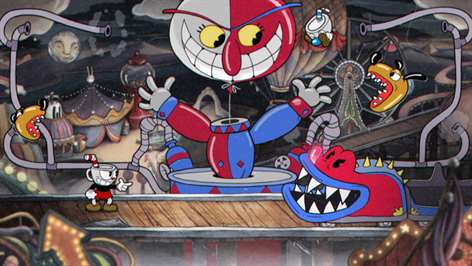
Every boss battle is fresh and meticulously crafted

What makes Cuphead stand out? Well, for one, the level of polish is evident. It looks and feels nearly perfect. Never have I thought that I would enjoy playing a 1930’s cartoon so much. Even though it’s old, it’s new. It’s a fresh concept and they took a risk that paid off. Whenever the debate arises whether or not videogames are art (this discussion warrants its own blog), it’s games like Cuphead that I think of.  Next, the difficulty. Yes, to this day, I have over 400 deaths. That is what it took for me to complete my expert run, and not once did I get upset. For every single one, I accounted for a mistake that I made. Once I corrected my mistake, I moved on until I made the next mistake, where I learned and moved on progressively until a boss or level was defeated.

So what is my point? Simply put, Quality > Quantity. I would rather have one game that takes 3 years to complete than 100 games that take 3 months to complete. I’m not saying that all developers need to remortgage their homes, or draw everything frame by frame like the Moldenhauers of Cuphead, but just a little more time on the presentation and polish go a long way. My hope is that Cuphead will encourage developers to try unique art styles and better yet, follow their dreams. Gamers want quality games where passion is oozing out of everything seen on screen. Unfortunately, Cuphead will likely never see the light of day on the Switch, even though it would be a phenomenal addition to a fairly lackluster Indie library. Nonetheless, hopefully game designers are inspired and this will translate into better quality games. Perhaps you agree, or alternately you’ve been eating up the Switch eShop and loving it. That’s fine too. Whatever the case, I think we can all agree that gamers will always appreciate the extra mile. Hopefully Cuphead and Mugman will pave the way for the future, without dealing with the devil.

Death Squared: Try Not to Die


Death Squared is a new indie game that takes GREAT advantage of the Switch hardware and its natural bent toward casual cooperative affairs. In this title, players must work together and employ good communication and a healthy amount of caution to survive and clear test-chamber-like puzzles. Spoiler: it’s a blast!

“Exit the Premises” Kevin MacLeod (incompetech.com)
Licensed under Creative Commons: By Attribution 3.0
http://creativecommons.org/licenses/by/3.0/

Nintendo Making New Switch Peripherals


We selected the BIGGEST news story possible on this *cough* slow *cough* news week. It turns out… Nintendo is actually working on some new peripherals right now! For the Switch! No way, right? Totally unexpected, right? Our minds are blown too.

“Exit the Premises” Kevin MacLeod (incompetech.com)
Licensed under Creative Commons: By Attribution 3.0
http://creativecommons.org/licenses/by/3.0/

“Arcade Perfect”

A few months ago, I decided to pick up an Arcade Archives title, Garou: Mark of the Wolves. I was feeling that fighting game itch, and eight bucks didn’t seem like that much scratch. Moreover, I’d never indulged in any of SNK’s classic fighting catalog, so I figured—if nothing else—it’d be an educational experience. So how is it? Arcade Perfect!

And that’s the problem.

For those of you who’re too young to remember when arcades were a big deal—which, come to think of it, largely applies to me as well—”arcade perfect” was a marketing buzzword used to describe home-console ports of arcade games. It meant that nothing was compromised (graphics, music, sound, and so on) when porting the game to consoles. See, arcade machines tended to be a bit beefier than home-consoles, as they weren’t just entertainment but also a business investment for store owners. As to be expected, the term has largely fallen out of use due to the declining relevance of arcades, but still gets thrown around from time to time, especially in arcade compilations like the upcoming Street Fighter collection.

“Arcade perfect” was a marketing buzzword that meant that nothing was compromised when porting the game to consoles.

Ultimately, my biggest gripe with Garou: Mark of the Wolves isn’t a design issue, it’s that the version on the eShop is literally just the arcade version running on an emulator. While there’s nothing wrong with that, per se, it does mean it’s missing many of the features that have been standard in home-ports since before the arcade version was even released. Honestly, it makes me question whether “arcade perfect” is really that good of a benchmark.

First of all, the game doesn’t have a training mode. The only single player content is arcade mode, meaning you have to learn the ins and outs of this game’s mechanics as the computer is mugging you for your (virtual) quarters. This wouldn’t be so bad if the game was a simple, straightforward one-on-one fighting game like Street Fighter 2, but that’s not the case. Garou was released in 1999, meaning it subscribes to the Street Fighter 3 school of design: master the incredibly precise timing of the parries and cancels or be content seeing your opponent’s win quote for the seventeenth time.

The game doesn’t have a training mode: you have to learn the game’s mechanics as the computer is mugging you for your virtual quarters.

Along the same lines is the lack of a proper move list. Granted, the emulator’s menu has a move list for each character, but each combatant only gets a limited amount of space, meaning that isn’t enough space for every move. If you want to know all of a character’s techniques, you’ll need to look up the commands online.

I could go on, but I think I’ve made my point. Of course, I’m looking at this from a modern perspective; what were home-ports like back in 1999? Well, while arcade versions usually had better hardware, the home version gave the developers the opportunity to fine-tune the game and add additional content. New characters weren’t uncommon, and it was standard practice to remix/remaster the soundtrack for the home version: Virtua Fighter 2, the Tekken series, and Garou: Mark of the Wolves itself all had superior sounding music in their respective home-console versions.

I haven't played it, so I can't say whether there's an "insert quarter" button in this version.
More fleshed out versions of the game exist.

Maybe I’m taking the term a bit too literally, but the more I think about, the more I think “arcade perfect” is a pretty flimsy accomplishment. I by no means regret buying Garou: Mark of the Wolves, and I don’t think there’s anything wrong with the Arcade Archive series, but no matter how good the games or their emulation is, staying 100% true to the originals can leave a game lacking. Ultimately, what’s perfect for the arcades isn’t perfect for the home experience.

Luigi’s Balloon World – Super Glitchfest!


What do you think about cheaters? How about people who take advantage of exploits in Super Mario Odyssey’s new balloon mode to hide things out of bounds? We’ll discuss all that, and more, in this week’s Nintendo News segment by Two Button Crew.

“Exit the Premises” Kevin MacLeod (incompetech.com)
Licensed under Creative Commons: By Attribution 3.0
http://creativecommons.org/licenses/by/3.0/

Celeste: Scaling The Mountain


Celeste is a beautiful new indie game available now on the Switch eShop. In this pixelated platformer, you play as Madeline as you attempt to scale the treacherous Celeste Mountain. With a stunning musical soundtrack, a compelling storyline, and tough platforming challenges, it seems this game might just have it all.

“Exit the Premises” Kevin MacLeod (incompetech.com)
Licensed under Creative Commons: By Attribution 3.0
http://creativecommons.org/licenses/by/3.0/

Labo Just Gets Better and Better!


Headlining our Nintendo News segment this week is some huge developments on the Labo front. With the unveiling of Toy-Con Garage, it’s starting to look like there will be no limit to our cardboard creativity come April 20th.

“Exit the Premises” Kevin MacLeod (incompetech.com)
Licensed under Creative Commons: By Attribution 3.0
http://creativecommons.org/licenses/by/3.0/

Xeodrifter: Launching into Space


The talented creators at Atooi have brought one of their finest titles to Switch: Xeodrifter, a bite-sized love letter to the Metroidvania genre. This little indie gem is ready to blow your socks off as you traverse the alien landscape, blast baddies, and power up to take on big bosses. We hope to give you a taste of what this title is like, and we definitely recommend you give it a look in the eShop!

“Exit the Premises” Kevin MacLeod (incompetech.com)
Licensed under Creative Commons: By Attribution 3.0
http://creativecommons.org/licenses/by/3.0/

Xeodrifter Review (Nintendo Switch)


Xeodrifter is a retro-styled, Metroid-like game from indie developer Atooi. It’s a bite-sized love-letter to the Metroidvania genre, originally released on the 3DS and newly ported to Nintendo Switch.

You play as a little red guy (or girl? You never know with these games…), equipped with a gun, exploring 4 neighboring planets. You’ll need to unlock equipment and abilities as you go to advance through new areas.

Beating bosses earns you power-ups, and you can configure your blaster on the fly by allocating points to its speed, bullet size, spread, and more. Most other unlockables increase your mobility in fun and useful ways; think along the lines of the Metroid series’ shine-spark or rocket jump, but with its own Xeodrifter-flavored twist. The game prompts some “aha” moments as you’re forced to use these mobility upgrades in tandem for some truly memorable segments.

This game presents a real challenge. Once in a great while you will stumble on an enemy nest where you can farm for life replenishment, but by and large you have to traverse through these alien structures with care and caution, where every hit matters. It regularly took me multiple attempts to get what I needed and make it back to the safety of my gunship before embarking on the next mission.

The graphical presentation of Xeodrifter can only be described as simple. When first booting up the game, it didn’t strike me as beautiful when compared to some other modern takes on pixel graphics, but the art style actually did grow on me. For this version, graphics AND rumble were given the “HD” treatment. I also didn’t find myself missing the stereoscopic visuals from the 3D original. However, in the absence of a second screen, a little mini-map in the corner would have saved me a lot of pausing.

One more thing I have filed under the “would have been nice” category is variable jump-height. Whether you quickly tap or hold the jump button down, the character executes the same move and sometimes stays in the air longer than I would have liked. Variable jump height is something the developer has implemented in other games, and that lacking aspect of control did limit my precision.

Overall, I had a fun time with Xeodrifter. The game doesn’t hold your hand, leaving the player to his or her own devices to figure out where to go. In such a compact world, I never felt truly lost. You are encouraged to explore and see where your new weapons can take you.

Some gamers might have a complaint about the boss levels; roughly a half-dozen encounters that use the same giant enemy and attack patterns with increasing difficulty. I actually thought this was a cool analog to my character, as if I was growing more powerful in parallel with my archenemy over multiple showdowns, like you might find with Dark Samus in the Metroid Prime games. The boss fights were another area where this game doesn’t hold back in difficulty, and beating each one felt like an accomplishment.

Xeodrifter is short. It’s an excellent palate-cleanser between bigger titles, a great option for people who miss the Metroid gameplay loop, and a good effort from a passionate indie developer. For the $10 asking price, I can easily recommend it to fans of the genre. Xeodrifter gets a 7.75/10.

Mario Kart Tour – Coming to Mobile!


One of Nintendo’s biggest—and we mean BIGGEST—franchises is coming to an iPhone or Android near you. This is only one of many news stories that Simeon and Scott are here to discuss today, because the world of Nintendo news never seems to slow down. We talk Metroid Prime 4, SteamWorld series, and much, much more.

“Exit the Premises” Kevin MacLeod (incompetech.com)
Licensed under Creative Commons: By Attribution 3.0
http://creativecommons.org/licenses/by/3.0/

Can You SteamWorld Dig It? (Switch)


SteamWorld Dig is a revolutionary indie game that took the 3DS eShop by storm. Now it’s back in high definition on Nintendo Switch, ready to be taken anyway or taken in on the big screen. This game features Rusty, perhaps the most beloved SteamWorld hero. This is Simeon’s first time taking to the dirty, dank underground caverns. How will he fare?

“Exit the Premises” Kevin MacLeod (incompetech.com)
Licensed under Creative Commons: By Attribution 3.0
http://creativecommons.org/licenses/by/3.0/

5 Labo Toy-Con Nintendo MUST Invent

Nintendo has removed the lid on their latest innovation: Labo. This new way of interacting with video games—through cardboard—could not have been predicted. I always allow room for Nintendo to surprise me with something that would never occur to me, and once again, they did not disappoint. We’ll be unboxing our boxes this April.

Or will we? I’m still not completely sold on the concept. This is no fault of Nintendo’s marketing department; the messaging for Labo is clear: kids and kids-at-heart get to Make, Play, and Discover functioning cardboard creations with the technological help of Nintendo Switch.

I’m no longer a kid, and my heart is still trying to decide how old it is. Were I to invest in multiple sets of cardboard kits, I would definitely need to find a place where I could tuck my creations away to keep them out of my cat’s reach. She would utterly destroy my hard work, and then meow at me with a mischievous glint in her kitty eyes.

But there’s the distinct chance that Nintendo could release Labo kits in the future that would be irresistible. Labo is all about imagination and creativity, right? For the purposes of this blog, I’ve let my imagination run wild and conceived 5 Labo Toy-Con I Would Insta-Buy…

Arcade Stand

You know this needs to be a thing. Arcade games are coming back in a big way thanks to Nintendo Switch. ACA (Arcade Archives) have been releasing arcade ports like crazy, and recently started porting some first-party Mario content as well. Additionally, indies have made a few unique offerings on eShop like Mutant Mudd Collection’s “Mudd Blocks,” Pinball FX, and more—all playable in portrait orientation. If Nintendo were to officially support portrait arcade games by creating a cardboard stand for the console… man, that would be totally tubular!

Camera

Here, I’m essentially asking Nintendo to please give me cheap DSLR lessons. Video games have been a good teacher to me before (I learned the basics of drums on Wii Music with two motion controllers and a balance board for foot pedals). And after kids get done learning piano on a cardboard keyboard, why not move on to photography? Nintendo actually showed a brief glimpse of this product in the initial Labo trailer, though it won’t be available as a product in either of the launch kits. A Joy-Con was shown both in the lens and the main body of the camera. If Nintendo could “gamify” learning the foundations of photography; aperture, exposure… lens… speed? See, I clearly need some help in this department and pointing a cardboard camera at some Pokemon on my TV might just do the trick.

Samus Aran’s Arm Cannon

Did I just blow your mind? Because with a cardboard Samus Canon, you can bet that some heads would be exploding. Imagine shooting with 1:1 pointer controls, but instead of holding a remote in your hand, your arm is the weapon. And with a mounted Joy-Con within reach, you’d be able to use your free hand for inputs like changing beams, calling in an attack from your gunship, and more. Just like our favorite bounty hunter does in-game.
Don’t get me wrong; I’m not saying that I want to play through Metroid Prime 4 dressed up like a poor cosplayer. The Prime series must be treated with great care and respect. But a Labo spinoff title (a la Nintendo Land) would be incredibly enticing.

Poltergust / Flashlight Combo

With a new coat of paint and a few different extensions, the Robot suit’s backpack could easily be transformed into Luigi’s Poltergust Vacuum. Having donned Luigi’s equipment, we would be scouring haunted mansions like never before. We’d be in the action. We’d be flashing lights and sucking baddies like no tomorrow. And HD Rumble could make us feel like we’re actually lugging around specters on our spines.

VR Goggles

While first viewing Nintendo’s promotional video for Labo, I thought that VR was becoming a reality for Nintendo fans. I was wrong, and the headset I saw was simply a decorative visor for Project Giant Robo—I mean—the cardboard robot suit. It’s probably wise for Nintendo to hold off on Virtual Reality for the time-being. With the Switch tablet’s 720p resolution, it’s not quite pixel-dense enough to hold up under the demands of VR. However, I believe that Switch and Labo are both initiatives that will last longer than a single traditional console generation. In 5 years, we might have a 4K Switch and a nice cardboard set of goggles to hold it. When that happens, Nintendo will transport us to another world.


There you have it! 5 Toy-Con that would be in my cart before I could say “Lab…Oh…No…”
What do you want Nintendo to craft from cardboard in the future?

SteamWorld Dig Review (Switch)

SteamWorld Dig is indie developer Image & Form’s first claim to fame. Originally released on 3DS in 2013, Dig was universally “dug” around the industry. On February 1st, 2018, Nintendo fans get another chance to play this instant classic on Switch.

SteamWorld Dig joins its sequel and SteamWorld Heist, on the eShop. The main differences between the original Dig and Dig 2 are that, 1: this game is shorter, and 2: the underground labyrinths are randomly generated. It’s kind of like having your own village in Animal Crossing, where all the same features are present, but their placements are determined by an algorithm. This is helpful for people like me who have beaten the game before, to have a fresh experience upon revisiting the steampunk world.

You play as Rusty as you navigate the Earth’s underbelly, mining deeper and deeper under the surface. As you traverse, you’ll gather gems and ore along the way. Once your pouch is full, or your lantern runs out, you will return to the town above, sell your goods, and use the money you earned to upgrade equipment. (By the way, the non-playable robot who you sell to is Dorothy, who goes on to star in SteamWorld Dig 2.) Stronger tools allow you to dig deeper, unlocking more sections of the world in a creative spin on the Metroidvania gameplay loop. Continuing to advance, you will discover caves featuring puzzles that have a predetermined design.

This pattern of digging, mining, spending, upgrading, and repeating is the core of SteamWorld Dig. And it’s a strong core. Few games rival it in instantly hooking the player. The soundtrack is solid (even eliciting memories of Metroid Prime at times), controls and interface are extremely user friendly, and everything periphery melts away as you focus on your goal. However, one aspect of the game sticks out like a sore thumb—and that is combat, which is neither compelling nor rewarding. Rudimentary enemy patterns and limited offensive options leave you feeling lucky when you succeed, but more often, just wishing you could avoid enemies altogether. On that note, with the right tools you can hurry and strike some baddies before they hatch, preventing a cumbersome encounter.

Combat is a mere distraction and not an essential part of the experience, which continues to be a weakness in the series. That’s just about the lone complaint there is to find in this game. Although, I have to wonder if Image & Form could have spent longer to make this a more enticing package. The developers have come a long way and learned many lessons since this game was released. Originally, SteamWorld Dig was finalized at the point just before their team went bankrupt. They’ve gone on record saying that it wasn’t wholly completed to their liking. This port was an opportunity to enhance or add value, but the devs instead opted to do a quick and dirty port.

Okay—the port isn’t dirty at all, but how could I resist that pun with a game about digging? To be clear, the game runs and looks great on Switch. And with no additional bells or whistles, they’ve created an affordable entryway into the wonderful SteamWorld lineup of games. This is worth picking up if you’ve somehow skipped the series, or if you’ve been missing Rusty, his original adventure, and the grassroots origin of one of the best developers on Nintendo eShop. You’d be hard-pressed to play this game without a grin on your face.

SteamWorld Dig gets an 8/10.

Seven Billion Humans Announced for Switch!


The creators of World of Goo and Human Resource Machine are back at it again with the newly announced Seven Billion Humans! Also, stick around for Simeon and Scott to discuss the closure of Miitomo, Nintendo’s first foray into the mobile app market. That, and more, on today’s Nintendo News episode with Two Button Crew!

“Exit the Premises” Kevin MacLeod (incompetech.com)
Licensed under Creative Commons: By Attribution 3.0
http://creativecommons.org/licenses/by/3.0/

Super Meat Boy Review (Switch)

Super Meat Boy is a classic indie game, finally slurping and splashing its way onto Nintendo Switch.
This cruel platformer is infamous for its steep difficulty and unforgiving level design. Sounds like my kind of game!

The first time I hit the jump button and felt Meat Boy’s insanely high amount of aerial mobility, I thought I’d never get used to the controls. But I was wrong! The game does a great job of onboarding the player, teaching tough platforming techniques gradually.

Whether you’re playing in Handheld mode, with a single Joy-Con, or the Pro Controller, the control scheme feels great. Running and jumping are the only two button inputs, and you can opt to use a variety of face and shoulder buttons if your grip gets tired.

Which it will, because the moment-to-moment gameplay is intense. Your goal is to navigate Meat Boy between buzz-saws and bullets, and over gigantic ravines and pits of lava in order to get to Bandage Girl. The game’s antagonist, Dr. Fetus, is always one step ahead of you, so you’ll have to overcome multiple unique worlds with plenty of challenges before your final showdown.

The difficulty in this game is inherent, but expert players can challenge themselves further in scoring an A Rank on every level by completing them under a specified amount of time. You can also search out hidden bandages in hard-to-reach locations, but because the User Interface doesn’t indicate when a level has one to find, you’ll have to turn to the Interwebs to complete your collection.

Speaking of collecting, there are a bunch of playable characters to unlock as well. Some have to be found, and others must be earned with bandages. Each character has a unique ability, like floating or double-jumping. It was awesome to see Commander Video from the Bit.Trip games, and other heroes from indie classics like Braid. On the other hand, some of the characters are too similar to Meat Boy to be very compelling.

Music in Super Meat Boy is pretty good, with an energetic soundtrack that will fuel your long and frustrating (yet rewarding) play sessions. Unfortunately, these aren’t the tunes that shipped with the original release on Xbox 360, preferred by many.

Load times are very quick, and once you get into a level, there’s no delay between death and your next attempt, which makes it easy to apply what you’ve learned from past mistakes and try, try again.

The game’s visuals are pretty simple, with a no-frills, grungey aesthetic. It was a treat to find the occasional level that put a spin on the art style, whether it was using backlit silhouettes or old arcade graphics.

During cutscenes, the game’s age and budget showed a bit, although it didn’t detract from the story being established: Dr. Fetus is a really bad dude, and Meat Boy is determined to stop him and rescue Bandage Girl.

As a timed exclusive for the Nintendo Switch version, Team Meat added a local multiplayer Vs. mode. The screen is split in half, and players race each other to complete a certain amount of levels. This mode was tense, and a lot of fun, but undeniably rough around the edges. The stage-selection menu was unintuitive, the character selection screen was visually squished, and worst of all; game-breaking crashes occurred about every 10 minutes. Suffice it to say, Vs. mode could use a few bandages of its own.

In conclusion, it’s wonderful to have this grossly charming hunk of meat join the Nintendo Switch lineup. This was actually my first play-through of Super Meat Boy, and I was compelled to complete the whole thing AND go back and get 100%. If you’re a fan of platformers, don’t miss this title as you prepare for the auto-running sequel to launch later this year!

Super Meat Boy gets an 8.5/10.

Shovel Knight – Co-Op mode!


What do you get when you have two friends, two controllers, a Switch, and Shovel Knight? You get an awesome co-op romp through an amazing 8-bit indie game! That’s right, Simeon and Scott are donning their helmets and hefting their shovels as they raid King Knight’s castle—the villain that will soon be playable in the next update from Yacht Club games.

“Exit the Premises” Kevin MacLeod (incompetech.com)
Licensed under Creative Commons: By Attribution 3.0
http://creativecommons.org/licenses/by/3.0/

Why am I Still Playing Breath of the Wild?

It has almost been a full year since Breath of the Wild was released. My intention is to not beat a dead horse by writing about my love for this game again, but rather discuss how it’s holding up just short of a year later. As sappy as it sounds, I still remember exactly how I felt when I first booted up the game and stepped foot on the Great Plateau. This was an entire world for me to explore, and the Great Plateau served as the training wheels to my stunning adventure ahead. There were no tutorials to get my feet wet. It was a matter of exploration, failure, and most importantly, education. You had to learn how to fight, when to run (a strategy much more relevant in this Zelda game than any other in my opinion), how to glide, how to cook, how to climb, and so much more. For the majority of these, I learned by failing, and that is the reason why I am still playing the game today. A year later, and I am still learning things.

Despite over a hundred hours, there is still so much to be discovered.

At this point in my adventure, I have about 140 hours of gameplay in. I have about 200 Korok seeds, completed all Shrines, both main and DLC, completed Trial of the Sword, and finished the game. One would think this would be close to the end of the road, but I still want to keep coming back. Of course I am finding Korok seeds all over to add to my count and zooming around on my Master Cycle Zero like it’s a guilty pleasure, but I’m also learning. Every time I play I discover a new location. I learn more recipes. I meet new people. Just recently I was roaming around at night and started hearing some ominous music playing. Music I haven’t heard in my previous 100+ hours in the game. I was baffled what it was until I finally ran into the culprit: Kilton the Monster Parts Merchant. It is absolutely astonishing to me that after everything in this game that I have accomplished, there is still so much to educate myself on and explore. After meeting Kilton, I have the pleasure of doing it with a sweet Lynel mask.

A year ago I wrote about Breath of the Wild being a special game. Present day, I can not only confirm that, but add to it. Breath of the Wild has to be in the top five games I have ever had the pleasure of playing, if not the top spot. I never thought that Wind Waker would ever be dethroned, but this might do it. I can’t say for sure because I still have so much to explore in Breath of the Wild, and I’m just not satisfied putting it down. A year later and I feel as I haven’t mastered the game. There is still so much to learn. My hope is that Nintendo keeps releasing DLC, but that’s hard to predict at this point. Whether or not this is the case, I know I will be riding around on my Master Cycle Zero rocking a Lynel mask for hours to come.

Nintendo Labo? Nintendo LABO!


Nintendo lifted the curtain on Labo, their new cardboard initiative. Simeon, Scott, and Producer Glen share their thoughts on Ninty’s newest innovation and take a look at the pros and cons of these first few sets being released.

“Exit the Premises” Kevin MacLeod (incompetech.com)
Licensed under Creative Commons: By Attribution 3.0
http://creativecommons.org/licenses/by/3.0/

Come at Me, Super Meat Bro


Super Meat Boy is an older indie game, but it’s brand new to Switch AND has an exclusive Vs. mode for Simeon and Scott to try out. They’ll be racing, split-screen style, to see who can reach Bandage Girl first. Also, they might discover a few bugs and glitches along the way… but no matter what, be sure to enjoy the rage that’s induced by this incredibly difficult platformer!

“Exit the Premises” Kevin MacLeod (incompetech.com)
Licensed under Creative Commons: By Attribution 3.0
http://creativecommons.org/licenses/by/3.0/

The Physical Version Curse Scott's Thoughts

I’ve gone on record multiple times defending my decision to buy physical Switch games whenever possible.

For all the big releases, you get your decision: cartridge or download. Launch day. Choose your adventure.

Unfortunately, it’s proven pretty difficult to stick to my guns with indie games, which have complicated the buying process by releasing digitally way earlier that the physical version comes out. This is the case for Axiom Verge, Mutant Mudds, Overcooked, and more.

I want to support developers by paying the higher price-tag. I want the neat physical goodies they’re including in the box. I want the ability to sell my copy if I don’t end up liking it… but that requires a lot of waiting, which has its downsides if you’re a game reviewer that needs to be in on the conversation as it’s happening in real-time.

Matters are made worse when indie companies are wishy-washy about the potential release of a physical cartridge, either saying “we’ll see how it sells digitally” OR just announcing that a physical edition is coming after customers have already downloaded their game (Rocket League). Now I’m stuck with the digital version, and the hours I’ve put into my save-file.

We need Switch developers and publishers to be more forthright about upcoming physical releases, and to close that release date gap.