Introducing… MILES! Guest host for the week and TBC’s resident “old guy’ friend, Miles is here to take Rocket League for a spin with Simeon. A famous indie game finally making its way to Nintendo platforms, Rocket League is a blast (even if you don’t typically enjoy soccer or cars).
“Escape the Premises” Kevin MacLeod (incompetech.com)
Licensed under Creative Commons: By Attribution 3.0
http://creativecommons.org/licenses/by/3.0/

Switch
Which Games are “Perfect for the Switch”? Scott's Thoughts
“That game is perfect for Switch!”
I’ve heard that phrase every day since the system launched. But what does it mean?
What makes a game perfect for Switch? I started getting a little confused when I heard it simultaneously applied to games like Legend of Zelda: Breath of the Wild and Picross. Two completely different, polar opposite experiences.
- Is the Switch perfect for long, single-player adventures because you can chip away at them whenever you have time, on the go?
- Is the Switch perfect for bite-sized games that you can boot up and score a quick-win in a couple minutes?
- Is Nintendo’s new console a match made in heaven for single player games that you can hold up close and personal?
- Or is it perfect for multiplayer, competitive games in a LAN setting?
The answer, of course, is yes. Yes to all of the above. Nintendo seems to have caught lightning in a bottle and created a piece of kit that’s begging to have every new release, multiplatform game, indie title, and definitive edition developed for or ported to it.
There has never been a home console or portable that draws games toward it with such a magnetic force, attracting a diverse collection of titles at that.
A new phenomenon has started to happen where multiplatform announcements are discussed as “coming to Switch and other platforms.”
Making Time for Gaming As Adults
The great majority of our viewers are adults, so you know what it’s like to try and squeeze a hobby into your schedule. You’re already busy, whether it’s with kids, work, school, or all of the above. How does one set aside time for gaming? What are some things you might have to say “no” to, in order to get that coveted console time in? Simeon and Scott have a few thoughts and ideas to share.
“Escape the Premises” Kevin MacLeod (incompetech.com)
Licensed under Creative Commons: By Attribution 3.0
http://creativecommons.org/licenses/by/3.0/
Incoming Super Mario Movie!
Hold the phone – Nintendo’s working on a movie?! Let’s talk about that! And as usual, Nintendo sales are up and more developers are committing to bringing their games to the Switch!
“Escape the Premises” Kevin MacLeod (incompetech.com)
Licensed under Creative Commons: By Attribution 3.0
http://creativecommons.org/licenses/by/3.0/
Online Infrastructure Scott's Thoughts
Forget my two front teeth. All I want for Christmas is a solid online infrastructure for Nintendo Switch!
Add Friends
Can friend codes please go die in a deep, dark, flaming, sulfury smelling hole? Thanks.
There’s no reason that friend codes should still exist. They’re long, impersonal, impractical, and not used in any other modern technological setting.
See Friends
Nintendo has historically been all about the “couch multiplayer” experience, but it’s time those sensibilities were extended to online play. Their preferences don’t excuse them for providing trash solutions over the Internet. When my friend comes online to play a game, I get a little pop-up in the top left corner of my screen… but that’s it! I can’t tap on it, can’t spectate their session, can’t send them a message… nothing. Nintendo could also bring competitive leaderboard features to the forefront by notifying me when my scores are broken by a friend, even before I pop the cartridge in!
Join Friends
It should be easy to play online with my friends, no matter which mode. It should also be painless to make sure we’re on the same Splatoon team, rather than randomly being pitted against each other. Nintendo has always brought friends together, so let’s write the extra lines of code necessary to facilitate that when we aren’t in the same room.
Talk to Friends
Tools. That’s all we need! We just require the tools to speak to our friends, the tools to monitor or restrict that usage for our children, and the ability to use our own equipment. You won’t catch me dead with that horrid squid dongle with a web of cables running every which way… keep it simple.
It shouldn’t matter if we’re playing the same game, either. System-wide party chat has been solved for a couple console generations, so the Big N needs to jump on the bandwagon.
I’m not being too demanding because Nintendo’s competitors have all of this covered already. This is nothing new.
Nintendo starts charging for online play in 2018, and the ramp-up hasn’t looked very promising with how they’ve handled their mobile app and voice chat so far. For crying out loud, Discord has even gone on record saying that Nintendo could contract them to handle this whole infrastructure! There are no more excuses. They have to get this right if they think fans will subscribe to their service.
There’s a 2D Breath of the Wild on Switch eShop Scott’s Thoughts
On the Nintendo Switch eShop, there’s a 2-dimensional Breath of the Wild for sale.
It’s called SteamWorld Dig 2.
This is an indie title by Image & Form. You don’t have to like steampunk culture or have beaten the original to enjoy this title, it stands on its own as a must-play.
Everything that you loved about the the open-world Zelda adventure is here, in this little downloadable title.
Strictly speaking, Dig 2’s genre is most like a Metroidvania, but fans of Breath of the Wild will feel right at home in the game’s underground caverns.
Did you like defeating shrines? You’re in luck; with caves, puzzles must be completed to earn collectibles and power-ups. Just like shrines, caves feature additional hidden secrets apart from the main objective, for explorers and completionists.
Like Link’s stamina mechanics, the main character (Dorothy) has meters for water and light that the player has to keep an eye on and take into account while trying to reach new areas.
The game can be played nonlinearly, any time you wish to take a break from the main plotline to enhance your strengths.
Filling in Hyrule’s map by locating towers is not unlike uncovering new caverns and locating fast-travel points.
Special abilities can be unlocked that are very similar to the Champion Abilities in Zelda. I activated an especially helpful modification in SteamWorld which I lovingly referred to right away as “Mipha’s Grace.” Even the HUD elements share attributes in common, like how the special abilities indicate on-screen when they are ready to be used.
Don’t miss this title! Even if you don’t feel like you’re ready for “another Breath of the Wild,” keep in mind that this game is much smaller. SteamWorld Dig 2 doesn’t overstay it’s welcome.
It’s also plenty unique, with a creative world, interesting characters, and fun gameplay loops that keep you coming back and digging deeper.
Great Bad Game Design

Note: The following article contains spoilers for Sonic Mania. For those interested in Sonic Mania, I highly recommend waiting until you complete zone 2, act 2 before reading further.
Sonic Mania is amazing. But you probably already know that, either from experiencing it first-hand or from the mounds of praise heaped upon it by the general public. It quickly became my favorite entry into the franchise when I picked it up for myself a few months ago. It’s the “back to basics” game Sega has been promising—but ultimately failing—to deliver for nearly a decade now. Heck, this game is so good, it can even include one of the most egregiously wrong design choices I’ve ever seen and make it one of the most charming set-pieces of the entire game.
And no, that’s not hyperbole, one of the game’s most memorable moments is flat out stupid by conventional game design standards. What moment am I referring to? The Chemical Plant Zone Robotnik fight.
Why It Should be Horrible
The boss of Zone 2 isn’t a boss in the traditional sense; instead, it’s a game of Puyo-Puyo Pop. That’s right, instead of fighting some wacky contraption, Sonic, Tails, or Knuckles faces Dr. Robotnik in a lethal game of Puyo-Puyo. No instructions, no fore-shadowing, just dropped into a game and expected to win.
From a design standpoint, this looks like a bad idea on paper. As mentioned before, the player is given no instructions. Puyo Pop isn’t exactly the hardest game to understand, but the game assumes the player already knows how to play. There’s no pop-up for controls, no instructions on how to clear Puyos from the screen, nothing. If the player is familiar with drop-puzzles like Tetris or Dr. Mario, they may be able to intuit some objectives from the conventions of the format: namely matching colors.
That leads into the more pressing issue: genre shift. While switching between gameplay styles isn’t uncommon in video games, especially more recent Sonic titles, typically levels that dip into different gameplay formats only switch to genres of a similar nature. For instance, many side-scrolling platformer games include one or two levels that switch over to being a side-scrolling shoot-em-up. This is typically considered acceptable because the two gameplay styles have many similarities. Most notably, both are action games, meaning the skills needed to master them are almost identical. These skills include things like quick-reflexes, spacial awareness to assess threats and their proximity to the player, and prioritization of risks and rewards (such as power-ups).
Where switching gameplay styles gets frustrating is when the new style has little or nothing to do with the concepts of the core gameplay style. A pertinent example of such a gameplay switch is the fishing segments of Sonic Adventure. While many people speak fondly of the game those segments’ mechanics were based off of, Sega Bass Fishing, most people object to the inclusion of such mechanics in an action platformer. That’s not to say juxtaposed gameplay styles can’t be paired successfully, but that contrast typically has to be one of the game’s core principles with everything else designed around it (e.g. DS cult classic Henry Hatsworth).
Where switching gameplay styles gets frustrating is when the new style has little or nothing to do with the concepts of the core gameplay style.
Now compare that to Puyo-Puyo Pop. Being good at Puyo-Puyo requires players to plan on the fly. The player has to decide how to stack and group puyos in real-time to set up combos and react to his opponent’s attempts to interfere. I don’t have the background in Puyo-Puyo to know what exactly goes into high level play, but I can tell you it’s a very different game than Sonic the Hedgehog. This means that the player is expected to use an entirely different skill-set from what the game has been training him to use up until this point. Moreover, this is the only place in the game—outside of an unlockable bonus Puyo-Puyo mode, that is—that the player is asked to exercise these skills.

Why It’s Awesome
So why does this moment work? There’s several factors at play here. First is the design of Puyo-Puyo Pop itself. First of all, Puyo Pop is a fairly easy game to learn: the computer is playing it along-side the player. If the player doesn’t understand how color matching works, he can just observe the computer match groups of four or more puyos of a single color.
Secondly, this battle is pretty easy. So long as the player keeps the board mostly clear, Dr. Robotnik’s incompetence will do the rest of the work sooner or later. Putting the battle so early in the game was actually a smart move: the encounter’s low difficulty allows the player to get used to the new gameplay style while still fitting the game’s expected difficulty curve.
Third, Puyo Pop is good. Many times when a game dips into a different style, the auxiliary gameplay style is under-developed. The majority of the developers’ time and effort (hopefully) goes toward the core gameplay, meaning mini-games don’t get the time and polish needed to fully flesh-out the concept. The Puyo-Puyo battle gets around this by implementing an already established idea. This way the Mania team didn’t have to haphazardly slap together a new gameplay concept, instead they just had to copy something they knew works.
Many times when a game dips into a different style, the peripheral gameplay style is under-developed.
Now that I’ve gotten the minor stuff out of the way, let’s talk about the two biggest reasons this works. I’m sure many of you are grinding your teeth by now with how I keep referring to this moment as “Puyo Pop”. Chemical Plant Zone’s Robotnik fight is actually a callback to the Sega Geneisis/Mega Drive classic Dr. Robotnik’s Mean Bean Machine (which was technically just a reskin of a Puyo-Pop game, but whatever). This attention to detail and acknowledgment of the Sonic series’ history is a huge part of what makes this bizarre set-piece work. Who in their right mind would anticipate such an obscure reference?
Companies like Sega and Nintendo often reference their past works, but they tend to stick to callbacks that are easy for fans to recognize. Even when a reference is to something more obscure, it’s out of the way and can be easily ignored. Most designers would stick some puyos/beans in the background and call it good. The Mania team, however, decided to put that callback front and center by making it a part of gameplay. If the reference is half of the reason this moment works, the sheer audacity that the designers would even attempt it is the other half. The element of surprise and the obscene amount of creative whimsy this moment embodies is more than enough to make up for any of its “bad” game design.
If the reference is half of the reason this moment works, the sheer audacity that the designers would even attempt it is the other half.
The combination of good implementation, recognizability, and surprise factor all come together to make this one of my favorite game set-pieces in recent memory. While I love analyzing what works and what doesn’t work in games, it’s important not to get too entrenched in sticking to “good” game design. There’s a delight in encountering the unexpected that is all too often ignored in favor of “safe” design practices. Formula is good, but too much results in a game being formulaic.
Nine Parchments – Can We Work Together?
Simeon and Scott tackle the brand new Switch eShop game, Nine Parchments! Spoilers: It’s great for two player co-op. This is an unusual twin-stick shooter, not taking place in outer space but grounded in the world of fantasy. Check the demo out for free on Switch eShop!
“Exit the Premises” Kevin MacLeod (incompetech.com)
Licensed under Creative Commons: By Attribution 3.0
http://creativecommons.org/licenses/by/3.0/
The Secret Selling Point of the Switch Scott’s Thoughts
It’s not what you think it is.
It’s not the games. It’s not the price. It isn’t the user interface or the branding.
The secret selling point is that the Switch is fun to use.
It’s physically fun to play with.
That dumb snapping noise that plays in all the commercials? It underscores one of the core benefits of the experience.
Seeing the hardware’s multiple configurations raises intrigue, then the tactile feedback received when sliding the pieces together does all the convincing.
Nintendo used to say Playing is Believing, but they advanced this concept a step further by creating believers before the console even powers on.
Pokken Tournament DX – I Choose You!
Simeon and Scott scored a copy of Pokken Tournament DX on Switch, so it’s time to battle it out and see how the updated version holds up! There are some odd choices for local multiplayer, so the Crew will test out which one is best for competitors, while showing off all the awesome new additions to the roster!
“Escape the Premises” Kevin MacLeod (incompetech.com)
Licensed under Creative Commons: By Attribution 3.0
http://creativecommons.org/licenses/by/3.0/
What if Classic Editions were Switch Cartridges? Scott’s Thoughts
“It’s so hard to find the NES Classic Edition! Why can’t Nintendo just put all those games on a cartridge and call it a day?”
It was the same story with the Super Nintendo version.
Nintendo fans and collectors, left baffled by supply issues, often bemoan the fact that these collections of retro games aren’t made available for Switch.
What if Classic Editions weren’t miniature reproductions of the original consoles, but simple game carts or eShop downloads?
Pros:
+ More convenient
+ Cheaper
+ Portable
+ Easier to purchase
+ Less clutter
Cons:
– You don’t get the original controllers
– Only lasts one console generation
– Less of a collector’s item
– Not as nostalgic
– Well… you can’t hack it to add more games.
Personally, I’m really glad Nintendo chose to recreate the consoles. I’ve been wanting NES to return to store shelves for a decade, but I never predicted the genius of shrinking it down to the size of your palm and preloading it with games.
I can also now say that I own an SNES, which is the only console I missed while growing up.
It’s easy to beg Nintendo to make things more convenient and cut some corners, but the experience just wouldn’t be the same.
Pokemon on Switch, Huge Splatoon 2 Update
Nintendo just blew the roof off Splatoon 2 by adding in a ton of new content, as well as feature we’ve been asking for since the original’s launch: fast gear swapping. We’ve also got news on the direction GameFreak will be taking Pokemon on Switch, and more! It’s a big news week so buckle up and hit the play button.
“Escape the Premises” Kevin MacLeod (incompetech.com)
Licensed under Creative Commons: By Attribution 3.0
http://creativecommons.org/licenses/by/3.0/
Retail Vs. Digital Pricing Scott’s Thoughts
There is a discrepancy.
When you walk into a store and purchase a new video game, you get more in return: a display case, a printed cover and (sometimes) instruction manual, a cartridge housing the game’s data, the ability to lend the copy to a friend, and the option of selling the copy when you’re done with it.
Downloadable versions provide none of the above benefits (though you could definitely argue for the convenience factor). They cost the same as a physical version, but take up more space on your hard drive or memory card, and are far cheaper for the publisher to distribute.
With digital games, creators don’t pay for printing discs or cartridges, packaging, shipping, or shelf-space at stores. They also don’t split any profit with retailers.
You would almost think the downloadable version should be cheaper.
Further confusing the matter are stores like Best Buy and Amazon, where you can actually get retail releases at a steep discount. It feels backward.
The reason Nintendo and its competitors are afraid to cut gamers a deal on digital versions is that it would make retailers upset. Their relationships with WalMart, Target and others would be severely damaged as gamers flocked to online offerings to get the lowest price.
Why doesn’t Nintendo just cut its retail ties and only offer their games digitally?
They’re not ready yet. The majority of sales still take place in brick and mortar, but that is starting to change.
Someday, a Nintendo console might not come equipped with a cartridge slot. And just maybe, downloadable games will be a little cheaper.
(Or not because of inflation, the rising cost of development, server infrastructure, and Nintendo being a business trying to make money. But one can dream.)
Pokemon Snap 2: Now or Never Scott's Thoughts
Pokemon Snap was an unexpected hit on Nintendo 64. Not only did it gather a cult following, but it went beyond that and achieved mainstream popularity.
It was a really simple game; basically an on-rails shooter with a camera instead of guns. Your “head-shots” were awarded based on how centered the pictures were, and you had items to help lure certain monsters out of hiding and into the frame. A truly excellent spin-off.
Nintendo fans haven’t stopped clamoring for a follow-up since it was released. Between then and now we’ve successfully argued our way into getting Earthbound localizations, Operation Rainfall RPGs, a 2D Metroid sequel, and more. But no sign of Pokemon Snap 2.
The Pokemon Company knows that it’s popular. They have heard their fans. Sun & Moon featured a bare-bones mode that nodded to Snap gameplay, but nowhere near enough to satiate the fanbase.
Look, I want a proper Pokemon Snap 2 as much as the next guy, but if we don’t get it on Switch, you can safely let go of that hope.
This is the generation that Nintendo is listening. They’re hungry and scrappy after the financial failure of Wii U, and they’re putting their best foot forward with Switch to provide gamers the experiences they’ve been asking for.
If Nintendo and The Pokemon Company don’t team up to make this happen in the next few years… I’m sorry, it’s just going to live on as a fond memory.
Now or never, Nintendo. Your move!
Smash Bros. on Switch: Sequel or Remake? Scott's Thoughts
Along with many Super Smash Bros. enthusiasts, I assumed that a port was on its way to Nintendo Switch.
Super Smash Bros. for Wii U felt fresh, recent, and was one of the main reasons to hang onto that console when considering an upgrade.
Now, as the launch of the portable-console hybrid grows more distant, I’m starting to reconsider my stance. Maybe Sakurai, Namco Bandai and co. are not tinkering away at a port, but instead are hard at work on the proper sequel.
It seems unthinkable; in many ways, Super Smash Bros. for 3DS and Wii U felt like the definitive edition of the series, with a wildly huge cast and surprisingly well-balanced gameplay.
But not so fast… those are 2014 titles. In 2018, a remaster might feel less appropriate than a straight-up sequel. Enough time has passed that a true follow-up is definitely on the table for discussion.
I’m honestly happy either way, but I feel like a port would have been released by now, with the launch of the system or especially with the final amiibo of the set.
We might actually be looking at a brand new title soon!
Are Portable/Console Hybrids the Future? Scott’s Thoughts
NX rumors began shortly after Wii U launched. People were quickly eager for the next big thing.
Closing in on Switch’s first year, and Nintendo fans aren’t fidgeting for news on its successor.
We’re content. Eager for certain game announcements, yes, but satisfied with the hardware.
“What do you want in the next Nintendo console?”
Even enthusiasts are having a hard time answering that. A more powerful Switch, I guess?
And I would agree with that. Friends texted me right after the Switch reveal video, asking me what I thought. My response: What more could you want? It’s got all the buttons, it’s HD, and you can play on your TV or take it anywhere.
In many ways, we’ve arrived. Similar to the cellular market, where your phone looks about the same as it did 4 or 5 models ago, the Nintendo hardware line is maturing.
Could you imagine a follow-up console to the Switch not being portable? You don’t want to think about that, do you?
Rest assured, the hybrid strategy is here to stay.
With Nintendo, that is.
Competitors like Microsoft and Sony might not adopt it so quickly because of their emphasis on graphical power.
You can think of those companies as desktop PC makers, whereas Nintendo has differentiated itself as the laptop provider. Not leading the charge in technical specifications but in form-factor.
There certainly are advancements still waiting to be made in the gaming industry, make no mistake. In five years or less, we’ll likely have the opportunity to purchase a 4K Switch tablet with VR capabilities.
But Switch represents a revolution in how Nintendo makes their flagship consoles.
Being a Nintendo Fan on a Budget
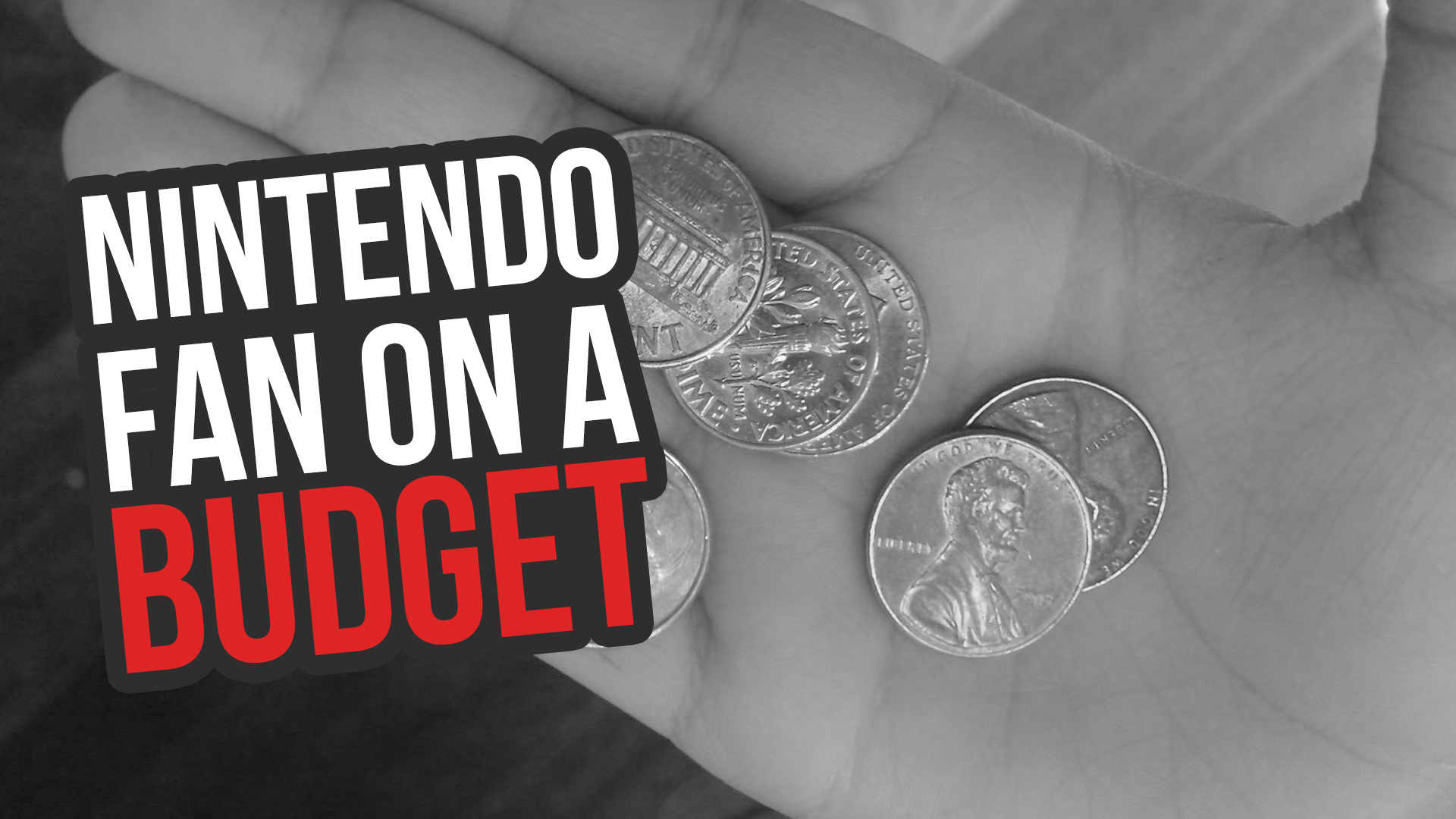
Some of you, the Crew, may have noticed that I am usually a little behind the times when it comes to my hardware library. If you were to ask me what I have been playing recently, you will probably catch me talking about Smash Bros. or about an older handheld title. It is an interesting dynamic, keeping up on current Nintendo news and zeitgeist, while not updating my Nintendo library alongside other Nintendo fans.
But I know it is not just me that has a hard time keeping up with Nintendo’s ever-expanding hardware and software library. I would like to start a discussion here on being a Nintendo fan on a budget. I want to keep it practical and easy, and I will kick it off with a few of my own tips and tricks.
Manage your Expectations
Before we get to practical application, we have to begin with the proper mindset. As I said before, Nintendo never stops making great consoles and games. It is not possible for pretty much any Nintendo fan to acquire everything they put out, much less spend quality time with each game. Not only can the quantity be overwhelming, but, just like it would be with any other hobby, playing video games is expensive. It may be true that gaming now is more affordable than ever, but that does not change the fact that even (most) gamers have bills to pay.
Also, refuse to get caught up in “must-play” mentality. It is fine to set goals of games you want to eventually play, but, as I have gone on record saying, do not let other people dictate the games you play. Just because a game is “10/10” or a “classic” does not mean you have to play it to be a Nintendo fan. Do not feel pressured into playing a game. It is likely you will not enjoy your experience, and the anxiety to acquire and complete that title is not worth it.
Bum Off your Friends
This is one I do a lot. There are some titles that are worth owning, and you and a friend each have your own copies. Often times with fighting games and other competitive games, you will want a copy for yourself to be able to play and improve at your own pace. Many other single-player ventures, however, can be experienced once through to satisfy your need. In these instances, it is handy to have a friend that can lend you the game and/or system. It is how friendships should work.
(Okay, maybe “bum off your friends” is a little over the top, but it gets my point across.)
Scott has lent me games on numerous occasions, and I have lent him some of my own things as well. Reciprocation is a healthy way to build a friendship. Often Scott will be too busy to play for a month, so he will allow me to borrow a game for that period. Currently, my wife and I are enjoying the SNES Classic. Later on, he just might have a problem that I’d understand. We all need somebody to lean on.
Check Pawn Shops
Now, no matter where you go, new equipment and games will probably cost you a few coins. But, if you have managed to manage your expectations properly (see what I did there?), you will not be driven by your need for the new stuff. This is where you have a decision to make: do you save up some money and/or wait for the new stuff to come down in price, or do you go for the bargain old junk at the pawn shop or eBay? Nintendo has so many classics to explore for the systems that you already own, and they can be more than reasonable in price.
Also, with pawn shops, you never know what you will find. Maybe you will run across a rare gem that would be exorbitantly priced elsewhere, or you might find a game that looks cheesy and bad for twenty-five cents, take it home, and make a new memory of the terrible piece of trash you found. You could even find a reasonably-priced old Nintendo console, allowing you to retread the glory days of your childhood, or see what gaming was like when your parents were kids.
Of course, if you want to get really edgy…
Foray into Non-Nintendo Fare
*Gasp!* Say it isn’t so! Am I suggesting you play something on a non-Nintendo console? Of course! If you have never owned a Sega console, pick one up at a local thrift store or pawn shop. I can recommend several titles, if you need any assistance digging for gold. All sorts of retro consoles wind up in second-hand stores, or in your uncle’s closet; grab one and try it out! Games can be cheap, and it exponentially broadens the field of games you can play. If anyone knows the value of playing retro games (even on non-Nintendo consoles), it is the staff here at Two Button Crew.
I hope this article has been an encouragement to you, especially if you are on a tight budget. You are not alone, and you can enjoy new experiences no matter your financial plan.
The Copious Console Color Curse Scott’s Thoughts
If you’ve ever bought a Nintendo handheld, this has happened to you: you saved up, bought your system, and seemingly the next day Nintendo releases the hardware in a different color.
This is becoming a problem for Switch owners as well. Early adopters had the choice between grey or Neon Joy-Con, but little did we know that Nintendo would release not one but two console bundles with exclusive controller colors… in just over 6 months!
It’s just common practice for the Big N. They revitalize sales by injecting new collectible colors into the market.
People say that the install-base for 3DS is 60-70 million. It’s not.
That’s how many systems have sold, period, not unique users.
The question becomes, when do you buy the system? When do you wait for a different color or edition? Galaxy, Samus, creamsicle, you name it… it could be on the way; right around the corner, three years from now. Or never.
Lucky for you, I have the perfect answer!
Oh wait—no, I don’t. It’s entirely subjective, but here’s what I personally like to do: as an early adopter, purchase one of the first editions. Skip all the other bundles and plastic dyes until the actual internal hardware is improved.
For example, I bought the original blue 3DS (the one that looked like a tiered cake). I didn’t upgrade until the New 3DS XL was released (and no, they haven’t convinced me to downgrade to any model of 2DS).
In a perfect world, Nintendo would handle this a lot differently. See, releasing the best stuff midway into a platform’s lifecycle is bad for your early adopters. It teaches fans the lesson “always wait to buy—the best is yet to come.”
To combat that: release all the best editions at the start. Make them “limited,” invite the masses onto the platform and let them choose from many different configurations. Once early adopters have been satisfied, narrow down the offering. Make it simple and easy for latecomers to choose a SKU.
The objection here is that console launches are hard, and releasing multiple colors complicates the production and fulfillment side of things.
I acknowledge that, but Nintendo already has production issues, so why not work on those and kill two birds with one stone?
They need to start sitting on inventory until they have enough to appease day-one buyers anyway. A conversation for another day.
I propose a method that will reward Nintendo’s loyal customers, not punish them and teach them to wait and buy.
Slime-San: Are we Sold?
Slime-San is an indie game for Nintendo Switch. It’s got a unique art style, interesting physics, and a steep challenge. There’s a demo available for free, and Simeon & Scott give it a spin to see if it’s worth the buy.
“Exit the Premises” Kevin MacLeod (incompetech.com)
Licensed under Creative Commons: By Attribution 3.0
http://creativecommons.org/licenses/by/3.0/
Picross S is NOT Competitive Scott’s Thoughts
Full disclosure: I have a Picross addiction. If Pavlov is Nintendo and Picross is a bell, I’m the salivating dog.
They release a new game in the series, I buy it, and the next 20 hours of my life are a blur as I perfect every puzzle.
Having said that, my excitement for the sudden release of Picross S on Switch was huge!
An important new feature was touted: multiplayer. New to the series, two players would be able to “play cooperatively, or compete to see who can place the most tiles!”
This was a game-changer! I have a friend from Picrossers Anonymous who would love to relapse with me and go head-to-head!
Well, Nintendo wasn’t fully honest with their description of this functionality. Technologically, it’s all there: two players can control cursors on the same screen, and it works. It’s fun to help each other out and solve puzzles together.
Competitively, the structure is non-existent. There’s no separate “Vs. Mode” or anything of that nature, it simply tallies up the number of tiles filled in by each player. The game doesn’t keep score over multiple rounds or celebrate a victor. The players are left to point out that their score was higher and rub it in their “opponent’s” face.
That’s not the extent of the issue, either. This game is impossible—I repeat—impossible to be treated competitively. It leaves the door wide open for cheating and unfair play.
I mentioned my fellow addict above. We got to playing a few rounds of Picross S together and it wasn’t long before he had outsmarted the game. Whenever I placed a tile, he would follow behind my cursor and overwrite it with a tile of his own color, taking my points for himself.
Picross S lets competitors get away with whatever they’d like, and also creates another problem by not awarding any points for blocking off tiles. Placing an X on a space that won’t contain a colored title is a critical part of Picross gameplay, but gamers are punished in multiplayer mode by not receiving any points, leaving their opponent to score off their work.
My advice to Switch owners: Purchase this title and enjoy it as a single player or cooperative affair.
Words to Nintendo: Be careful how you advertise your games; it’s important to be honest about what’s included in the package.
Update: Nintendo has adjusted the wording on their Picross S online listing to read ‘Unique to the Switch version, 2 players can now play simultaneously! Enjoy with friends and family!’
That’s better.