Full disclosure: I have a Picross addiction. If Pavlov is Nintendo and Picross is a bell, I’m the salivating dog.
They release a new game in the series, I buy it, and the next 20 hours of my life are a blur as I perfect every puzzle.
Having said that, my excitement for the sudden release of Picross S on Switch was huge!
An important new feature was touted: multiplayer. New to the series, two players would be able to “play cooperatively, or compete to see who can place the most tiles!”
This was a game-changer! I have a friend from Picrossers Anonymous who would love to relapse with me and go head-to-head!
Well, Nintendo wasn’t fully honest with their description of this functionality. Technologically, it’s all there: two players can control cursors on the same screen, and it works. It’s fun to help each other out and solve puzzles together.
Competitively, the structure is non-existent. There’s no separate “Vs. Mode” or anything of that nature, it simply tallies up the number of tiles filled in by each player. The game doesn’t keep score over multiple rounds or celebrate a victor. The players are left to point out that their score was higher and rub it in their “opponent’s” face.
That’s not the extent of the issue, either. This game is impossible—I repeat—impossible to be treated competitively. It leaves the door wide open for cheating and unfair play.
I mentioned my fellow addict above. We got to playing a few rounds of Picross S together and it wasn’t long before he had outsmarted the game. Whenever I placed a tile, he would follow behind my cursor and overwrite it with a tile of his own color, taking my points for himself.
Picross S lets competitors get away with whatever they’d like, and also creates another problem by not awarding any points for blocking off tiles. Placing an X on a space that won’t contain a colored title is a critical part of Picross gameplay, but gamers are punished in multiplayer mode by not receiving any points, leaving their opponent to score off their work.
My advice to Switch owners: Purchase this title and enjoy it as a single player or cooperative affair.
Words to Nintendo: Be careful how you advertise your games; it’s important to be honest about what’s included in the package.
Update: Nintendo has adjusted the wording on their Picross S online listing to read ‘Unique to the Switch version, 2 players can now play simultaneously! Enjoy with friends and family!’
That’s better.
Nintendo just blew the roof off Splatoon 2 by adding in a ton of new content, as well as feature we’ve been asking for since the original’s launch: fast gear swapping. We’ve also got news on the direction GameFreak will be taking Pokemon on Switch, and more! It’s a big news week so buckle up and hit the play button.
“Escape the Premises” Kevin MacLeod (incompetech.com) Licensed under Creative Commons: By Attribution 3.0 http://creativecommons.org/licenses/by/3.0/
1. If I earn something, just give it to me. Don’t tell me I earned it, then explain how I have to tap through menus to retrieve my reward. Just give it to me.
2. Crafting is not the best thing since sliced bread. Just because Minecraft was super popular doesn’t mean everything needs to be crafted from now on.
3. Simplify the exchange rates. I don’t want to pay real money for leaf tickets to buy a mining pass to collect gold in order to exchange that for bells so that I can use the bells to purchase digital furniture. The expression is “cut out the middleman,” not “let’s create an army of middlemen.”
Simeon and Scott scored a copy of Pokken Tournament DX on Switch, so it’s time to battle it out and see how the updated version holds up! There are some odd choices for local multiplayer, so the Crew will test out which one is best for competitors, while showing off all the awesome new additions to the roster!
“Escape the Premises” Kevin MacLeod (incompetech.com) Licensed under Creative Commons: By Attribution 3.0 http://creativecommons.org/licenses/by/3.0/
Our patrons voted that we should try out Earthbound for the SNES Classic Edition, and their wish is our command! This quirky RPG is sure to be weird, if nothing else. Should be entertaining!
“Escape the Premises” Kevin MacLeod (incompetech.com) Licensed under Creative Commons: By Attribution 3.0 http://creativecommons.org/licenses/by/3.0/
Miles is here to have an important discussion with Scott; what’s it like being an old man? Old men are important to video games, ever since the one in the cave told us it was dangerous to go alone. Miles will share his insight into being an old hero.
“Escape the Premises” Kevin MacLeod (incompetech.com) Licensed under Creative Commons: By Attribution 3.0 http://creativecommons.org/licenses/by/3.0/
Hold the phone – Nintendo’s working on a movie?! Let’s talk about that! And as usual, Nintendo sales are up and more developers are committing to bringing their games to the Switch!
“Escape the Premises” Kevin MacLeod (incompetech.com)
Licensed under Creative Commons: By Attribution 3.0
http://creativecommons.org/licenses/by/3.0/
Happy Thanksgiving, everybody! Here at the Crew, we’re a thankful bunch, and this is the perfect time of year to count our blessings and reflect on the many things we have to be grateful for.
Thankful for Switch
Nintendo’s latest and greatest console has been welcomed with open arms by the faithful few and, seemingly, the masses as well. The R&D team crafted a unique piece of kit that’s exactly what we wanted, and the launch was amazing. In the months following, software support has been both steady and spectacular. With Switch, Nintendo ushered in a new Golden Age of gaming, and it’s really special to have a platform that brings pure pleasure.
Thankful for the Crew
Two Button Crew affectionately refers to our viewers and subscribers as the greater “Crew,” and greater is the perfect word to describe you folks. The Internet can be a nasty and hate-filled place, but none of that comes with the viewers we attract. It’s been magical to see the sincerity and kindness demonstrated by people who tag along with our content. Every few days, we receive a nice note from a Patron or long-time subscriber, telling us how our entertainment has helped them and wishing us to keep going. The encouragement means the world.
Thankful for Podcasts
Nintendo podcasts are becoming more and more prevalent, with long-running ones still pumping out episodes and a number of new ones that popped up with the release of the Switch. Content creators are more eager than ever to discuss news, impressions, as well as an increase in meaningful topics being lobbied. If you aren’t a podcast listener, you’re missing out on some excellent sound-bites from insightful industry reporters and analysts. For hosts, podcasts are a chance to sit back and talk freely about what’s on their mind in the gaming spectrum. For listeners, it’s like having a group of friends (just as dedicated to Nintendo fandom as you are) that meet together weekly to celebrate all things Mario, Metroid, Zelda, and the rest. The podcast we started this year has been a lot of fun.
Thankful for Unforgettable Games
2017 will truly be a year to remember. We now have our modern version of Ocarina of Time vs. Super Mario 64, with the brand new installments Breath of the Wild and Odyssey. The debates between greater game will live on for decades, hopefully not overshadowing the outstanding Splatoon 2, ARMS, Mario + Rabbids, and swaths of indie games flooding the eShop each week. Switch is quickly becoming a home for masterpieces, whether they are brand new experiences, definitive editions, ports, or remakes.
Thankful for a Bright Future
This year was laser-focused on software quality and quantity. I picture Nintendo’s offices being “all hands on deck” to make this new hardware a success. However, there are other ventures that Nintendo is preparing to embark on; namely a theme park, an animated Mario film, more mobile titles, and more. Development on great software will continue as we are promised new entries in the Metroid Prime series (!) and Pokemon, which will sell systems like absolute bananas. The install base is shaping up to be so huge, no developers will be able to ignore it!
When Nintendo bounced back from the Wii U, they bounced back hard. They’re back in the spotlight, which is a huge payoff for people like us who have followed the brand through thick and thin. I’m thankful we’re currently in the thick of the action!
Have a wonderful Holiday, hug your family, and drag them to your room to play some Switch!
Introducing… MILES! Guest host for the week and TBC’s resident “old guy’ friend, Miles is here to take Rocket League for a spin with Simeon. A famous indie game finally making its way to Nintendo platforms, Rocket League is a blast (even if you don’t typically enjoy soccer or cars). “Escape the Premises” Kevin MacLeod (incompetech.com)
Licensed under Creative Commons: By Attribution 3.0
http://creativecommons.org/licenses/by/3.0/
I’m a collector. I have multiple shelves in my house dedicated to Nintendo, lined with cases of games, amiibo, preorder bonus merchandise, or Club Nintendo rewards (remember those? They used to be physical). My biggest console library belongs to Wii, and I hope to outnumber those games with Switch software this generation.
I’m also a tightwad. I prefer saving money over spending it. I don’t mind waiting months or years for things to go on sale before buying.
How does one balance the urge to collect games, when trading or selling them can help financially? It’s a tough choice.
I’ve purchased 9 Switch games in the system’s first 7 months and sold 3 of them. Sure, it was opposed to my goal of expanding my collection, but they weren’t great games. I’d rather have a small amount of excellent titles than a larger batch where you don’t know what you’re going to get.
When deciding to keep a game or not, first acknowledge that it’s probably disappointed you. If it hadn’t, you likely wouldn’t be debating what to do with it.
Next, this question is super helpful: Do I want to introduce my kids to this? Whether you’re a parent or not, it helps put things into perspective. Video game collections are best not when they take up a lot of space, but when you can proudly open up a box with your ten-year-old and tell him or her to pick anything; you know you’ll have a great time.
Do I want to play this with my daughter in fifteen years? No, it’s not the best one in the series. Sell this one. We’ll play the older version.
Keep the best, get rid of the rest! You’ll have more space and more money to put toward better experiences.
Oh my good gracious. Thank goodness for that 10x life code, or else Simeon and Scott would be up a creek without a paddle! We’re attempting to conquer the Contra game known as Super C, but it’s going to take all our patience and focus to make it past a level or two.
“Escape the Premises” Kevin MacLeod (incompetech.com)
Licensed under Creative Commons: By Attribution 3.0
http://creativecommons.org/licenses/by/3.0/
I often see newly released games being appraised for their graphics, controls, music, and price.
What the industry needs more of a focus on is simple: fun.
A game can have terrible graphics, no soundtrack, and clunky controls, but still be a lot of fun. Conversely, a beautiful and imaginative game can be boring and punishing.
Video games are a form of art, but that doesn’t mean they need to be treated with as much weight and gravitas as other mediums. Some critics don’t understand this and neglect to consider the fun factor, so take review scores with a grain of salt. A 7/10 game might be the most fun you and a friend have ever had.
I’m one of the first people to happily wave goodbye to the 3DS.
It’s low-resolution screen looked behind-the-times the moment I laid eyes on it on launch day. However, there is one aspect of its visuals which I will miss: glasses-free 3D.
Nintendo pulled something incredible off by releasing the only mass-market device employing the technology. Personally fine-tunable by a slider, no less!
The company also made a wise move in never requiring 3D visuals to advance in any games, ensuring those too young, who had eye problems, or just preferred flat images, weren’t forced to see in 3D.
But boy was it helpful.
Super Mario 3D Land, for example, is a fantastic title that takes full advantage of the unique screen hardware. I have a harder time lining up precise jumps on my Switch.
Nintendo is highly proactive with quality insurance, but every so often… glitch’s sneak in and they are real doozies. We’ve collected a top-10 list of our favorite glitches from Nintendo history – see if your favorite buggy childhood memory is included!
“Escape the Premises” Kevin MacLeod (incompetech.com)
Licensed under Creative Commons: By Attribution 3.0
http://creativecommons.org/licenses/by/3.0/
When you walk into a store and purchase a new video game, you get more in return: a display case, a printed cover and (sometimes) instruction manual, a cartridge housing the game’s data, the ability to lend the copy to a friend, and the option of selling the copy when you’re done with it.
Downloadable versions provide none of the above benefits (though you could definitely argue for the convenience factor). They cost the same as a physical version, but take up more space on your hard drive or memory card, and are far cheaper for the publisher to distribute.
With digital games, creators don’t pay for printing discs or cartridges, packaging, shipping, or shelf-space at stores. They also don’t split any profit with retailers.
You would almost think the downloadable version should be cheaper.
Further confusing the matter are stores like Best Buy and Amazon, where you can actually get retail releases at a steep discount. It feels backward.
The reason Nintendo and its competitors are afraid to cut gamers a deal on digital versions is that it would make retailers upset. Their relationships with WalMart, Target and others would be severely damaged as gamers flocked to online offerings to get the lowest price.
Why doesn’t Nintendo just cut its retail ties and only offer their games digitally? They’re not ready yet. The majority of sales still take place in brick and mortar, but that is starting to change.
Someday, a Nintendo console might not come equipped with a cartridge slot. And just maybe, downloadable games will be a little cheaper.
(Or not because of inflation, the rising cost of development, server infrastructure, and Nintendo being a business trying to make money. But one can dream.)
It seems like Switch is actually picking up steam with third-parties! Sounds like a lot of exclusives are under development right now, just like Breath of the Wild’s winter DLC is! That, and more on this week’s installment of Nintendo news.
“Escape the Premises” Kevin MacLeod (incompetech.com)
Licensed under Creative Commons: By Attribution 3.0
http://creativecommons.org/licenses/by/3.0/
NX rumors began shortly after Wii U launched. People were quickly eager for the next big thing.
Closing in on Switch’s first year, and Nintendo fans aren’t fidgeting for news on its successor. We’re content. Eager for certain game announcements, yes, but satisfied with the hardware.
“What do you want in the next Nintendo console?” Even enthusiasts are having a hard time answering that. A more powerful Switch, I guess?
And I would agree with that. Friends texted me right after the Switch reveal video, asking me what I thought. My response: What more could you want? It’s got all the buttons, it’s HD, and you can play on your TV or take it anywhere.
In many ways, we’ve arrived. Similar to the cellular market, where your phone looks about the same as it did 4 or 5 models ago, the Nintendo hardware line is maturing.
Could you imagine a follow-up console to the Switch not being portable? You don’t want to think about that, do you? Rest assured, the hybrid strategy is here to stay.
With Nintendo, that is. Competitors like Microsoft and Sony might not adopt it so quickly because of their emphasis on graphical power.
You can think of those companies as desktop PC makers, whereas Nintendo has differentiated itself as the laptop provider. Not leading the charge in technical specifications but in form-factor.
There certainly are advancements still waiting to be made in the gaming industry, make no mistake. In five years or less, we’ll likely have the opportunity to purchase a 4K Switch tablet with VR capabilities.
But Switch represents a revolution in how Nintendo makes their flagship consoles.
Snipperclips, Switch’s first split-Joy-Con-co-op experience has been expanded! More levels and modes were added as DLC, and sold as a complete physical package! Maybe you have the original game and are wondering if the upgrade is worth it? Or if you’re just ready to have a good time, watch Simeon and Scott snip and clip their way to victory.
“Escape the Premises” Kevin MacLeod (incompetech.com)
Licensed under Creative Commons: By Attribution 3.0
http://creativecommons.org/licenses/by/3.0/
Do you love huge, generalized sweeping statements? Well, you’re in luck!
Indies are way better than 3rd party developers.
When I play a 1st party Nintendo game, the polish is undeniable. I can practically taste the quality assurance oozing out of every aspect of the game.
Playing a 3rd party title is often a disappointing affair. I’m reminded how much less effort they put into their menus, onboarding new players, readability, and the overall stability of the experience.
Indies, however? I’ve had the pleasure of completing multiple independently-developed games that feel as if they belong in Nintendo’s own stable of IP. They often approach development the same way Nintendo does, creating a unique mechanic and building an entire world around it.
These self-published titles come with lower budgets and therefore have less marketing. They have to compensate with more ambitious pitches; it takes a lot to stand out on the Switch eShop, with handfuls of games being dumped onto the store weekly.
An indie game tries to do less, and with that narrower focus comes a more concentrated dose of polish.
For the most part, independent games are structurally and functionally tight. You can learn what’s expected of you in a matter of seconds, just like an old arcade or NES game.
They are more often labors of love, made by people who don’t come home with a check twice a month from an employer but quit their job to work on the idea that they just can’t get out of their head.
Indie games are less restricted by businessmen who demand a carbon copy of what’s already selling and are free to experiment with art styles and non-traditional music.
Do yourself a favor and enjoy indie games, thereby supporting these small studios. They both need it and deserve it.
Mega Man is at a weird juncture in its life. It has been five years since the last actual game release with Street Fighter x Mega Man. But since then, there have been fan games released, a “spiritual successor” in Mighty No. 9, guest appearances in fighting games like Super Smash Bros., a cartoon series and movie announced, and a “big announcement” coming in December for his 30th anniversary, not to mention several collections for modern consoles of some of his classic adventures. I guess you could say that he is experiencing his own mid-life crisis, trying to find his identity in these unfamiliar times.
Not to alleviate that, it is my goal today to tell him that the franchise that bears his namesake is not about him. It may be rude to kick someone while they are down, but I want to bring some reality to the situation. First, I want to prove that Mega Man is NOT the central protagonist of his franchise, then present to whom I believe the spotlight has shifted.
Background
In talking about this franchise, I would like to get some terminology out of the way. First, I will be using “series” and “franchise” in very different ways. “Franchise” will refer to all things Mega Man (especially media considered “canon”), and when I use “series” I will denote the specific subdivision of the franchise to which I am referring (i.e. classic, X, Battle Network, etc.)
Also, I will be dealing primarily with the “classic” timeline. For those of you unfamiliar, the Mega Man canon is divided up into 2 main timelines. The first is what I will refer to as the classic timeline. This includes the classic series, X series, Zero series, ZX Series, and Legends series. The second timeline, in which Dr. Light pursued software solutions as opposed to robotics, contains the Battle Network and Star Force series. It is a little more complicated than that, but, as I said, I will refrain from using those sources when I can.
I will also try to refrain from boring you with storyline minutia, though some talk of story points is inevitable. Consider this a spoiler warning… If you ever cared about the Mega Man storyline being spoiled for you…
Who is “Mega Man”?
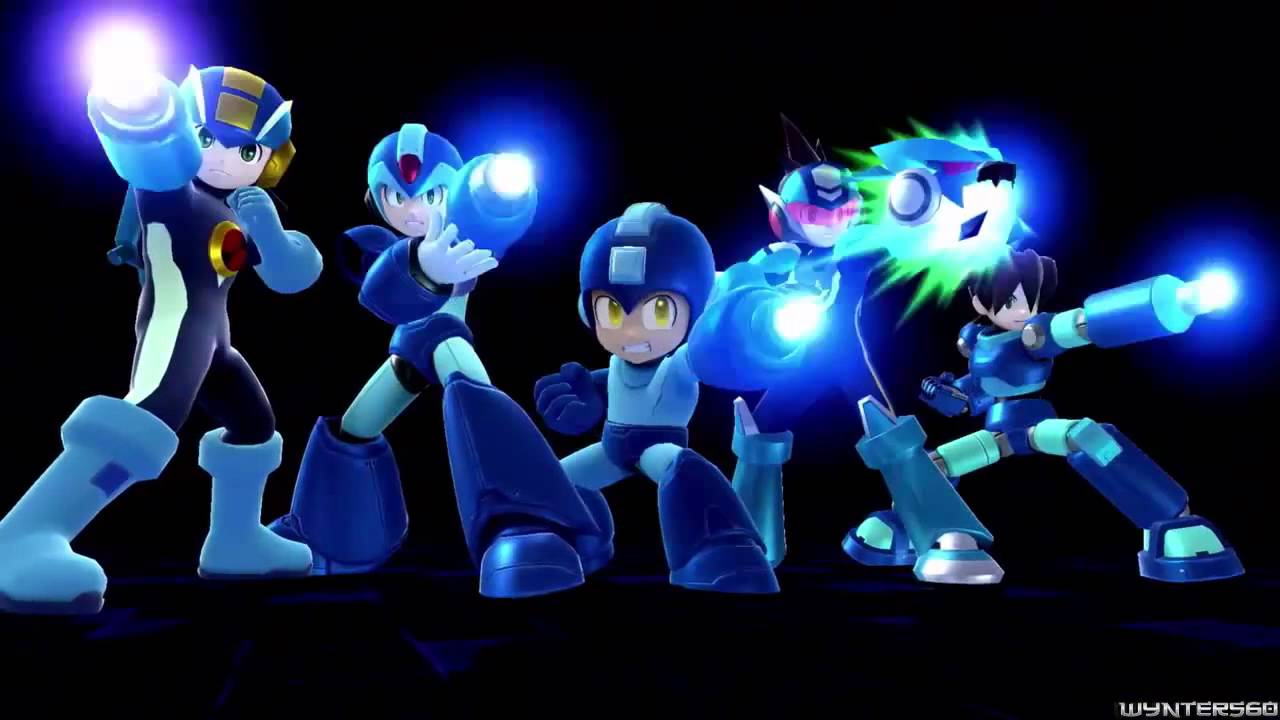
The difficulty in defining Mega Man as the star of his own franchise begins with defining who you are referring to when you refer to Mega Man. Do you mean the classic 8-bit rendition, or the reploid named X, which bears resemblance? Perhaps you are referring to Mega Man Volnutt, or maybe the persona created by the fusion of Geo and Omega-Xis?
Will the real Mega Man please stand up?
If you were to count characters commonly referred to as Mega Man (by games of fans) you would come up with no less than five, or three in the classic timeline, and possibly as many as twenty or more depending on which renditions you “count”. Even if you were to only count three, all of them are separate entities with their own origins and personalities which they do not share with any of the others. Also, no one of those characters plays a major part in all of those games or series.
The best way around this is to hold to a view that Mega Man is not a single entity, but rather an idea centered around championing peace, justice, and the color blue to a troubled world. At that point, Mega Man is no longer a character, but a loosely-defined set of characteristics that do not find themselves clearly stated in the games, but are then defined by the player. It is an entertaining thought, but hardly a basis of a character.
One champion above the others…?
Now that we are forced to chose one Mega Man, we must choose wisely. First, we should immediately eliminate Mega Man Volnutt from the equation. His series takes place thousands of years apart from the other series, holding only tangential story ties.
Next is the classic Mega Man. It was with him that the franchise began, and I think that it is safe to say that he was the original protagonist of the series. But this Mega Man does not have any direct influence after the time of the classic series end. Though nostalgia may cloud our vision, he had to pass the torch eventually.
Lastly, we have X, which I believe is the best of the Mega Man candidates. We see his origins in the classic series, created by Dr. Light as Mega Man’s successor and an experiment that one day robots might be just like humans. X’s main story begins in Mega Man X, extending through the X series. He fights in the Maverick Wars against Sigma and his underlings. X’s influence is seen through the Zero series (though not being the main protagonist) turning into a cyber elf, still fighting for the greater good, but dying-ish in Mega Man Zero 3. His soul returns in the form of Biometal Model X in the ZX series, continuing in his assistance to the current heroes.
No doubt X’s influence is felt throughout these time periods. His help in defeating Sigma countless times, as well as other threats against the earth cannot be overlooked. But even with all of these points, the developers have not ceased to draw our attention to the real star of the show.
Zero’s the Hero
Was there any doubt when you started reading this article who I would land on as the franchise’s main protagonist? Not only does Zero have a great design, killer moves, and hair that makes all the ladies jealous, but Zero is the central character of the Mega Man franchise as a whole.
First, there is the issue of presence. Of course, Zero is not clearly present in the Legends series (yet), but, once again, the Legends series is so far removed from the rest of the timeline that we must minimize its effect. Zero’s story, as X’s did, begins in the classic series with Wily’s creation of Bass as a rival to Mega Man. Though Bass failed to live up to Wily’s expectations, he studied the energy he had used to create Bass (called Bassnium, lol) to create the ultimate weapon. Here we see Zero’s sinister origins.
Before the events of the first Mega Man X game, Zero is shown to be a maverick (read: “crazed, destructive robot”), unstoppable by any of the Maverick Hunters except Sigma, and only that due to a headache caused by the Maverick Virus, which is released from Zero’s body upon defeat. Sigma has Zero brought back to the Maverick Hunters’ base.
From this point forward, the storyline of the series follows two repeating themes. The first is Zero’s redemption. Though Zero fights for truth, justice, and all that jazz, his primary struggle is against himself. In fact, just about everyone’s struggle from this point on, for the next few hundred years, at least, can be traced back to Zero, either directly, or in the form of the Maverick Virus, or some other “chunk” of Zero that finds its way to a sinister purpose. Sigma, the main villain from the X series, turned evil because he was infected by the Maverick Virus. All of these things set the stage for Zero to not only become the primary hero of the X series (and beyond), but also the primary antagonist, as he must fight to redeem his initial purpose as a weapon of evil and his past (and recurring) destructive actions. X is a hero for good that pretty much stays good. Boring.
The second theme is sacrifice and rebirth. As you may know, Zero dies. He dies A LOT. His deaths are not just the result of his defeats, however, as he routinely sacrifices himself for the greater good (defeating Vile on MMX, Sigma in X5, etc.). But just as the evil part of him is consistently brought back to life by some wicked plot, he always seems to find his way to the land of the living as well. The cycle continues at least through the ZX series, and probably beyond.
The passing of the torch
The last thing I feel I need to address is the “when”. When did the focus shift from Mega Man to Zero? I think the easiest answer is Mega Man X4, as we see a greater, overt emphasis on Zero’s role starting there (X1-3 seem to focus on X, X4-6 focus on Zero, and X7-8 on Axl), but I think we can go back a little further.
At the beginning of the first Mega Man X game, we see X defeated by Vile, and Zero swooping in to save the day. While giving X a pep talk Zero says, “If you use all the abilities you were designed with, you should become stronger…you may even become as powerful as I am.” From this point forward in the game, whenever X gains an armor upgrade, he becomes more and more like, say it with me, Zero (this point is taken from Arin “Egoraptor” Hanson’s Mega Man X Sequelitis video. There is strong language in the video, so follow it at your own risk)! Though X is the central protagonist, becoming like Zero is his ultimate goal. What is the plot of the Second X game? Rebuilding Zero after his heroism in the first game! Even when he is not alive, Zero is given the center stage. Though the plot in X3 does not necessarily revolve around him, he is still given an increasingly important role, as he is finally a playable character, setting the stage for him to be the center of attention for the rest of the series and, after that, the franchise.
So, there you have it. All roads in the Mega Man universe lead to Zero.
P.S. Did I mention that he also appears in the Battle Network timeline as well?


 First, there is the issue of presence. Of course, Zero is not clearly present in the Legends series (yet), but, once again, the Legends series is so far removed from the rest of the timeline that we must minimize its effect. Zero’s story, as X’s did, begins in the classic series with Wily’s creation of Bass as a rival to Mega Man. Though Bass failed to live up to Wily’s expectations, he studied the energy he had used to create Bass (called Bassnium, lol) to create the ultimate weapon. Here we see Zero’s sinister origins.