I’m still trying to figure out how we skipped from Super Mario 3 to Super Mario 64…
#517 – Super Mario 64 is a landmark game – a revolution in our industry. And recently, we had a young viewer named Rachel who watches our channel faithfully who asked us to “focus on some Mario games that people don’t talk about anymore, like SM64 and SM64 DS.” So that’s exactly what we’re going to do today! Watched some footage as we discuss this incredible step forward in 3D gaming, and see if you don’t have the urge to go and pick up your old three-pronged controller! Footage credit: Super Mario 64 – Matthewmatosis
“Escape the Premises” Kevin MacLeod (incompetech.com) Licensed under Creative Commons: By Attribution 3.0 http://creativecommons.org/licenses/by/3.0/
Now all we need are their social security numbers!
#518 – Forgive us for being just slightly on the “creepy” side today as we stalk some well-known Nintendo employees and associated on Instagram! We get to learn a little bit more about Bill Trinen, Charles Martinet, and “Karen”, and perhaps even observe some of their habits and behaviors! Delightful!
“Escape the Premises” Kevin MacLeod (incompetech.com) Licensed under Creative Commons: By Attribution 3.0 http://creativecommons.org/licenses/by/3.0/
#508 – Oh dear. We’ve done it… we’ve gathered the internet’s most awkward Nintendo screenshots and we’ve put horribly hilarious captions to them! See if you can top ours by leaving your own in the comments.
“Escape the Premises” Kevin MacLeod (incompetech.com) Licensed under Creative Commons: By Attribution 3.0 http://creativecommons.org/licenses/by/3.0/
#526 – Sometimes, the side mode ends up being the best offering of the whole game! When the main story mode just isn’t good enough when compared to the side mode, wonderful things happen! Here is a short list of our favorite bonus modes in all Pantendo games. Footage Credit: Mario VS Luigi – SullyPwnz | Super Smash Bros. – RedFalconGames
“Escape the Premises” Kevin MacLeod (incompetech.com)
Licensed under Creative Commons: By Attribution 3.0
http://creativecommons.org/licenses/by/3.0/
Sometimes, games have the craziest names! And other times, Simeon and Scott try to trick each other with wacky titles that COULD just be the real deal. It’s up to them to distinguish which is which in today’s episode, where they put each other to the test and try to call the bluffs. Play along and see how you do!
“Escape the Premises” Kevin MacLeod (incompetech.com) Licensed under Creative Commons: By Attribution 3.0 http://creativecommons.org/licenses/by/3.0/
How long do we have to keep being right in order for us to become paid industry analysts that make snarky remakrs for a living?
#528 – Each year, before the Electronic Entertainment Expo, Simeon and Scott take a stab at a swath of predictions! Nintendo will be streaming some bombshell announcements during their press conference / Nintendo Direct, and we’ve created a bingo board to keep track of our correct predictions! Can we score 5 in a row? Middle space is free!
“Escape the Premises” Kevin MacLeod (incompetech.com)
Licensed under Creative Commons: By Attribution 3.0
http://creativecommons.org/licenses/by/3.0/
#530 – Nintendo just had one of their best E3s ever, and it’s not even over yet. In the span of 25 minutes, they managed to blow the socks off most of their hardcore fans. They really pulled out some big guns this year! Simeon and Scott are here with their fresh impressions of Nintendo’s newest announcements, discussing their failed predictions, and talking over what excited and surprised them the most. Join in the E3 hype in the comments!
“Escape the Premises” Kevin MacLeod (incompetech.com) Licensed under Creative Commons: By Attribution 3.0 http://creativecommons.org/licenses/by/3.0/
#533 – Super Mario Odyssey had a strong showing at this year’s E3, not to be outdone by Metroid! Mario and Cappy explored some wildly different scenery, in search of different currencies and different rewards than Stars, and… well, all around this game is very different! Oh, and don’t forget the T-Rex!
“Escape the Premises” Kevin MacLeod (incompetech.com) Licensed under Creative Commons: By Attribution 3.0 http://creativecommons.org/licenses/by/3.0/
Best way to win a debate: Pick a side and give your opponent the other one to argue for.
It’s amazing how many heavy-hitters the Nintendo Switch is getting in its first year. Some of Nintendo’s biggest franchises are being represented with all new entries featuring innovation and a high level of polish. That said, which game deserves the #1 sales spot when all is said and done? Will Breath of the Wild maintain its momentum from launch and stay king of the hill, or will Super Mario Odyssey become a runaway hit this holiday and dethrone the competition? We want your thoughts – vote in the poll by clicking the “i” icon!
“Escape the Premises” Kevin MacLeod (incompetech.com) Licensed under Creative Commons: By Attribution 3.0 http://creativecommons.org/licenses/by/3.0/
#540 – Sometimes Nintendo will create a bundle or incentive for us fans to acquire the rare soundtrack CD, but why don’t they shift their business model and actually sell the music? Or offer it for streaming, because… who uses CDs these days, anyway? It seems like the Big N is behind the times in this regard, and it’s also odd that they aren’t utilizing their tracks as another stream of revenue. They pay a lot to orchestrate this stuff, why not offer them as products? “Escape the Premises” Kevin MacLeod (incompetech.com)
Licensed under Creative Commons: By Attribution 3.0
http://creativecommons.org/licenses/by/3.0/
#551 – The next big 3D Mario game is about to hit stores and Switches in a few short months. QUICK! Two Button Crew needs to get in their wish lists to the developers at Nintendo so that they can design the game to our exact specifications. Agree with our wish list? Let us know below!
Footage credit: Outside Xtra
“Escape the Premises” Kevin MacLeod (incompetech.com)
Licensed under Creative Commons: By Attribution 3.0
http://creativecommons.org/licenses/by/3.0/
You could call us “YouTube Trendsetters,” but… you’d be completely wrong.
#553 – Never seen a video like this before on YouTube, have you? We’re playing with Slime, and you can just chalk this up as a Splatoon video, alright? The object of the game is for us to get each other to guess Nintendo related characters, objects, icons and more, simply by manipulating stubborn slime with our bare hands. Should be fun, right?
“Escape the Premises” Kevin MacLeod (incompetech.com) Licensed under Creative Commons: By Attribution 3.0 http://creativecommons.org/licenses/by/3.0/
If you ever need your eyebrows slimed, call us first.
It’s popular with the kids and it’s popular with the squids – SLIME! Simeon and Scott are here to play with slime (in a Nintendo-like fashion) for YOUR enjoyment. So play along and see if you can guess the characters that their slimy faces portray.
“Escape the Premises” Kevin MacLeod (incompetech.com) Licensed under Creative Commons: By Attribution 3.0 http://creativecommons.org/licenses/by/3.0/
If you’re old enough to remember printed game manuals, you’ve probably heard gamers joke about how superfluous they were. Ever since the mid 90’s, games have featured in-game tutorials and, even then, most people are smart enough to figure out the basics just by fiddling with the controller for a few seconds. They were utterly redundant. And yet, just about everyone admits that the first thing they did when they bought a new game as a kid was read those blasted booklets cover to cover. I know I did.
Nowadays, print manuals have been phased out in favor of in-game tutorials and digital guides accessible with a few, quick button presses. But just because something’s extinct doesn’t mean it’s not worth studying. Let’s take a look at how game manuals evolved over the years.
These have been gone for eons, and yet every natural history museum has to have at least one.
I’ll be limiting this examination to one mainline Mario title per console generation: Super Mario Bros., Super Mario World, Super Mario 64, Super Mario Sunshine, and Super Mario Galaxy 2. Why? Because contrary to popular belief I actually have a life, and to do this properly is way more work than even I’m willing to put out.
Printing
The most noticeable difference between manuals at first glance is their physical construction. The original Super Mario Bros.‘s manual is approximately 5.2×4 inches, which is considerably smaller the manuals of later generations, which all average to roughly 4.6×7 inches. Of course, size differences pale in comparison to the actual printing. With the exception of the cover and the gold Nintendo Seal of Approval on the first page, Super Mario Bros.‘s manual is entirely in black and white. Later generations would feature full color print for their manuals. Moreover, much more thought was given to how the pages were laid out, with sentences no longer being split between pages and more organic placement of text and illustrations. The last item of note is Super Mario Galaxy 2‘s manual is written in three languages: English, French, and Spanish. As to be expected, this tripled the booklet’s thickness.
Story
Back in the day, the only way to know a game’s plot often times was reading it in the game’s manual. Even after games started to become self-contained by providing opening cinematics, manuals continued to provide brief summaries of the game’s premise.
As to be expected, the plot summary of the first Super Mario Bros. is short and to the point. It describes what happens, without going into much detail as to how or why. Moreover, we don’t get to see things from any character’s point of view. Because of this, the narration has a sense of detachment from the plight of the hero, giving the plot summary a matter-of-fact tone. In short, it’s not so much a story as it is a plot.
In short, it’s not so much a story as it is a plot.
By contrast, Super Mario World‘s story uses a limited third-person narrative, presenting the story from Mario and Luigi’s perspective. The characters are presented as, well, characters: they’re given motives, emotions, and even dialog. Moreover, the story is actually presented as a narrative, with events playing out in sequence. Interestingly, the story (in the North American manual, at least), makes reference to the events of Super Mario Bros. 3, indicating that SMB3 is canonical despite Miyamoto stating it was all a stage-play…
Super Mario 64 continues the increased focus on narrative, notably by spending two whole pages on story! The story starts with a dose of self-awareness by asking, “Is there no end to the constant feuding between Mario and Bowser?” Afterward, the plot is told entirely from Mario’s perspective, with frequent interjections from the man himself. These quips from Mario are actually a bit jarring for anyone used to Mario’s modern portrayal, as they actually communicate some personality. It seems at this point Nintendo wasn’t afraid to let Mario be his own character instead of a stand-in for the player. Other than that, the story unfolds much like Super Mario World’s, which is to say a narrative instead of a plot. Interestingly, Mario 64 and Super Mario World‘s stories both include some overlap with what the player would see during gameplay.
It seems at this point Nintendo wasn’t afraid to let Mario be his own character instead of a stand-in for the player.
Super Mario Sunshine‘s story section is somewhere between the style of Super Mario Bros. and its super Nintendo and N64 predecessors, mostly leaning toward the former. While it attempts to convey the story with the sense of drama of Super Mario World and Mario 64, it only describes things in broad strokes. Like Super Mario Bros., there’s no focus on characters, instead favoring a description of events from an outside perspective. I assume this is in part due to the inclusion of cutscenes in the game itself. Since this was the first Mario game to be almost entirely self-contained when it came to plot, Nintendo probably thought it would be redundant to put information in the manual that the player would receive in-game.
Lastly, Super Mario Galaxy 2 somehow manages to beat even Super Mario Bros. in brevity. It doesn’t even set up the story’s conflict. All we learn from it is that Mario’s been invited to the castle and meets a Luma along the way. That’s it. The Prologue page actually devotes more space to character bios than story, which—given the game’s focus on gameplay over any semblance of plot—is probably appropriate.
Controls and Gameplay
The most important part of a game, and thereby the most important part of a game manual, is the gameplay. Gameplay and controls vary from game to game, even within the same franchise. As such, these sections are going to differ quite a bit on the granular level. Seeing as this is an examination of the evolution of game manuals and not the Mario series, I’m going to look at the big picture: what’s emphasized and how those instructions are written.
So right off the bat, I noticed something peculiar about the way pre-2000’s manuals were written. Often times when explaining controls or specific actions, the manuals often phrase actions in terms of Mario and not the player. For example, when listing the uses for the A-button, the Super Mario World manual says it “Makes Mario jump,” instead of, say, “Makes you jump.” Sunshine and Galaxy 2‘s manuals instead phrase controls and player actions in terms of the player, using terms like “when you touch an enemy” and so on.
This is interesting as conveys the idea that—despite the player controlling him—Mario is his own separate entity, with the player simply giving him instructions rather than Mario being an extension of the player. That said, I would be remiss to not mention that the pre-2000’s manuals were inconsistent in this trend, often alternating between describing actions as being performed in third-person (i.e. Mario) and second-person (i.e. the player). Also interesting is that while Mario Galaxy 2‘s manual exclusively describes the actions Mario can perform in second-person, actions that Yoshi can perform are exclusively third-person, indicating that the player isn’t the character he’s controlling, he is Mario.
This conveys the idea that—despite the player controlling him—Mario is his own separate entity.
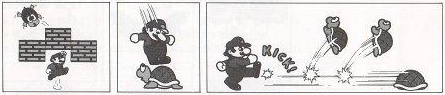
Older games take a very different approach to describing gameplay. Both Super Mario Bros. and Super Mario World go into great detail about everything: defeating enemies, items, kicking shells, using the weird pink ramps in Mario World, everything. Super Mario 64‘s manual spends most of its pages explaining analog movement, items, and how to progress through the game, with basic concepts like stomping on enemies being mostly glossed over. Sunshine‘s gameplay section is almost exclusively about all of the different moves and actions Mario can perform, only briefly touching on game progression or items. Lastly, while the Galaxy 2 manual mostly lists moves, it does go into more detail when explaining the mechanics of recurrent items and stage features like checkpoint flags than the previous 3D games.
Early manuals explained every facet of the game.
Personally, seeing how ideas and perspectives have changed over the last 30+ years is fascinating. We’ve seen Nintendo promote Mario as a character, only to make a 180 and make him a simple stand-in for the player. Then there’s getting to see what they thought was important for each game: back when Mario was first introduced, stomping on enemies, kicking shells, and so forth were new ideas, and the manuals tried to explain everything they could. Later games trusted that the player was familiar enough with the series—or video games in general—to figure out how to use their abilities and instead focused on the basic controls and the game’s new ideas, such as Mario 64‘s analog movement.
Unfortunately, this is where the story ends; Nintendo phased out print manuals during the Wii U era in favor of digital manuals, and now with the Switch, we don’t even have those. It’s a shame really, because, as I’ve just shown, even if you don’t need a manual to play a game or understand its plot, you can still learn from it.
I guess we’ll have to wait 384 years to see what this cryptic message means.
#576 – L Is Real. Those 3 mysterious words have echoed in our minds since the Nintendo 64 days, where they showed up in Super Mario 64 and later in Ocarina of Time. But the question still stands: what does it mean? This video goes out to Crew member Rachel!
Footage credit: The Easter Egg Hunter “Escape the Premises” Kevin MacLeod (incompetech.com)
Licensed under Creative Commons: By Attribution 3.0
http://creativecommons.org/licenses/by/3.0/
#581 – The man, the myth, the mustache… Mario himself. Did you know that Miyamoto originally wanted to use Popeye as a mascot? Do you know who Mario is named after? Prepare for your mind to be blown – we’ve got all the details!
Footage credit: Kotaku
“Escape the Premises” Kevin MacLeod (incompetech.com)
Licensed under Creative Commons: By Attribution 3.0
http://creativecommons.org/licenses/by/3.0/
#587 – We haven’t seen the New Super Mario Bros. games in a little while, but is that such a bad thing? Nintendo was leaning heavily into the multiplayer aspects of these games, but many gamers found it surprisingly frustrating to share the screen with their friends. Maybe Mario just isn’t a well-suited series for multiplayer. Let’s discuss it! Footage credit: TheRunawayGuys, WiiLikeToPlay
“Escape the Premises” Kevin MacLeod (incompetech.com) Licensed under Creative Commons: By Attribution 3.0 http://creativecommons.org/licenses/by/3.0/
#596 – Super Mario Odyssey is Nintendo’s next big hit game coming to Switch. We went hands-on and explored the Sand Kingdom. Included in this demo are a few different 8-bit challenge sections, purple coin locations, and an interesting Capture mechanic that involves a big Tiki Head and sunglasses. Enjoy this sneak-peak at Super Mario Odyssey!
“Escape the Premises” Kevin MacLeod (incompetech.com) Licensed under Creative Commons: By Attribution 3.0 http://creativecommons.org/licenses/by/3.0/
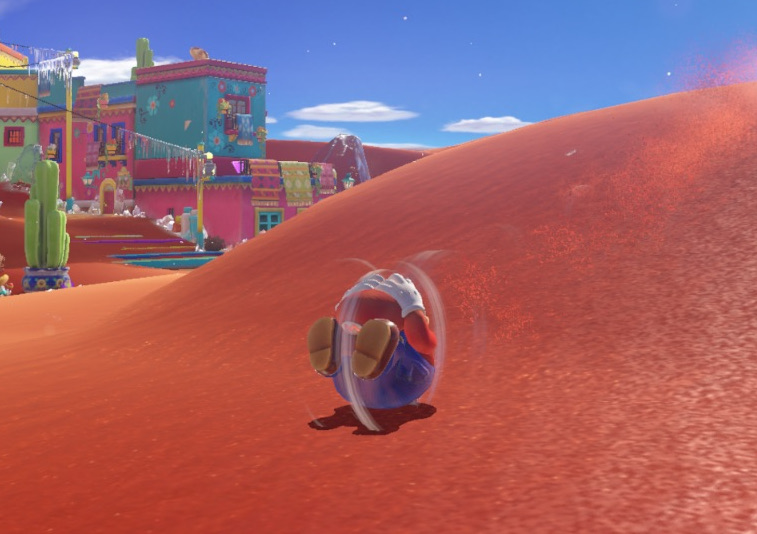
Super Mario Odyssey is out and—surprise, surprise—it’s good. As expected, Mario’s as athletic as ever, with a myriad of moves and abilities that not only elevate his already impressive jumping skills but greatly extend his lateral movement options, as well. One of my personal favorites is Mario’s new ability that allows him to curl up into a ball and roll along the ground like some sort of armadillo or hedgehog or something. It’s like some sort of…spinning dash!
Mario doing his best tumbleweed impression.
Wait a second…Great Gunpei’s Ghost! Super Mario Odyssey is the best 3D Sonic game ever!
Between the rolling technique and how Mario can preserve his speed through precise platforming, there are portions of Super Mario Odyssey that feel like the classic, momentum-based 2D Sonic gameplay in three dimensions. This is especially noticeable in timed segments such as the Koopa free-running missions where obtaining and maintaining Mario’s forward momentum by achieving fluidity of motion is essential. Much like classic Sonic, Super Mario Odyssey has a great sense of flow, which is something most 3D Mario titles can’t really boast.
There are portions of Super Mario Odyssey that feel like the classic, momentum-based 2D Sonic gameplay in three dimensions.
What is Momentum?
Okay, so before we can understand how Super Mario Odyssey achieves such an excellent sense of flow, we need to know what momentum is. In physics, momentum is the product of an object’s velocity and mass. In terms of video games, this means games that feature momentum-based mechanics have a few elements:
The protagonist has mass.
Mass implies the character has inertia.
Inertia implies the character does not instantly accelerate and the character does not instantly decelerate. Moreover, the greater an object’s momentum, the more difficult it is to alter its course.
Some games that exhibit these traits:
Asteroids: One of the earliest examples of momentum-based mechanics. The player’s ship does not accelerate instantly, but gradually, and continues to move even after the player has stopped using the ship’s thrusters. Moreover, altering the path of the ship requires substantial effort at high speeds.
Super Mario Bros.: Mario accelerates quickly, but not instantaneously. He either jogs to a stop if he is running too fast or skids to a halt when trying to change direction.
Sonic the Hedgehog: Sonic carries a lot of inertia. He accelerates slowly and must either skid to a halt or let his momentum slowly peter out.
Momentum as a Resource
In platformers like Mario and Sonic, the majority of the game’s challenge comes from executing precise acrobatics to navigate through the game’s various stages and their respective perils. Not only does the inclusion of momentum-based mechanics give the characters a satisfying sense of weight, but it adds an extra element of challenge. Because the character doesn’t move at top speed right away, building enough momentum to cross large gaps, find secrets, and ultimately complete the stage is an integral part of the game’s challenge.
So basically, in games that utilize momentum and inertia as mechanics, momentum is not only useful, but also—to some extent—scarce. This essentially makes it another kind of resource to be managed, much like health, ammo, or money. If you don’t mind the forced metaphor (all for the sake of a really cool, if not somewhat pretentious sounding, title), momentum is the currency of movement in Mario, Sonic, and similar games.
Essentially, momentum is another kind of resource to be managed.
Running with the fiscal metaphor, the value of this currency is different depending on the game: in Mario games, for instance, momentum is less critical in most situations than it is in Sonic games. That’s not to mention Sonic’s slightly slower acceleration and worse traction means manipulating his momentum takes more effort without the aid of outside forces or Sonic’s signature spin-dash—producing a greater scarcity of the desired momentum. This means that the plumber’s economy of motion has a higher saturation of momentum that has less demand than the hedgehog’s momentum, thus Mario’s momentum is generally less valuable by comparison.
Flow
With all of that out of the way, I can start unpacking what I meant by Mario Odyssey’s sense of flow. Flow—for the sake of this discussion, at least—means the smooth transition from one state of motion to another. Flow is important to games, even those that don’t heavily utilize momentum-based mechanics, though not in the way you’d think. People typically like flow, so when the player character takes damage, their flow is interrupted. This brief moment in which the player loses control and their character’s momentum suddenly shifts subconsciously communicates to the player that they’ve made a mistake.
Flow is the smooth transition from one state of motion to another.
This is why it’s typically not advisable to interrupt the game’s flow for something positive. Mario is a bit odd about this as many games do pause momentarily when the player snags a power-up, but the fact that the player’s momentum isn’t lost and instead continues a half second later may have something to do with why it’s not typically seen as an issue. But that’s really a minor nit-pick compared to the plumber’s more egregious violation of these principles: most notably the star-spin from Super Mario Galaxy and its sequel. Mario’s momentum completely stops as he lifts a short distance upward, leaving him with little ability to steer himself. This is awkward when combined with normal jumps, but it completely breaks any sort of flow when Mario is using a technique like the long jump. Mario goes from flying forward to barely having any lateral movement what-so-ever; it feels like running head-first into a wall, to be honest.
At first glance, these two moves seem similar, but they’re very different in practice.
Super Mario Odyssey does away with this in two ways. First of all, Mario doesn’t lose much—if any—forward momentum when throwing Cappy. Secondly, Mario can immediately launch himself forward with his jumping dive maneuver. Between these two factors, it’s possible for a skilled player to utilize Cappy as jump-assistance without losing his forward momentum. As mentioned in this article’s introduction, this is used to great effect in the game’s timed missions and Koopa races, where Mario has to build up speed using the rolling maneuver and then hold onto to it through precise platforming and clever use of his aerial repertoire.
While Mario Odyssey is by no means a perfect game, the controls and Mario’s own acrobatic aptitude are spot on. In true Mario fashion, the mere act of moving is fun, especially when you get into a good rhythm and can bound across the game’s colorful locales uninterrupted. It’s also interesting to see Mario take a page from Sonic’s playbook and adopt a rolling maneuver that allows him to travel faster than he can on foot at the cost of control. Hopefully someone at Sega is paying attention, because that’s an idea worth stealing back!
P.S. In case you’re wondering, this is the actual greatest 3D Sonic game ever.