I’ve been playing a lot of NES Classic Edition around the Holidays, and it’s a big hit. I think Nintendo hit it out of the park for multiple reasons, and I’m going to go in depth on each one!
Brand Top of Mind (in Absence of Switch)
Nintendo wouldn’t be kidding anyone if they told us that they didn’t want the Nintendo Switch to be released this holiday season. The November weekend before Thanksgiving is their favorite day to launch their biggest hardware and software, year over year. Yet they couldn’t quite make it in time for the 2016 Holidays, so the Switch will be releasing on their second-favorite slot: March. That left kind of a gaping hole in November, so Nintendo brilliantly filled it with the NES Classic Edition.
What’s going to be on every Christmas list? What is going to get brought out at family gatherings? The NES, or even simply, “the Nintendo.”
The brand might not have the benefit of the buzz through their new console this winter, but everyone’s going to be repeating their name thanks to their throwback console.
Nostalgia is Big Right Now
Who knew that 2016 would be such a perfect year to be a ’90s kid? Everything that was old is new again, and gaming, film, and TV industries have all wizened up and they’re repackaging our memories of old and selling them to us all over again. Nintendo is no different. Their stable of IPs is in the top 5 strongest in the world, among the likes of Disney, Marvel, and Star Wars (or should I say, Disney, Disney, and Disney).
The NES Classic Edition was a very calculated move. Down to the packaging on the box and each and every commercial, the marketing has been a complete throwback. There’s not a young-to-middle-aged adult alive who wouldn’t want to pick up the perfect replica of that controller. Nintendo didn’t wait too long for this and they didn’t do it too soon – the timing is just right.
It’s Not Just 3rd Parties
Nintendo has been working on this console rerelease for quite awhile. Want to know how I know? Because of all the licensing deals that went into it! They could have scraped together 25 or 30 first-party IPs and shipped it out, but instead they held meetings and struck deals with other companies, allowing third-parties to get in on the action. In my experience, Contra has been one of the most recognizable names on the system (albeit in the game Super C), so it’s a good thing that Nintendo branched out and expanded the library through its partners. The Big N doesn’t get to keep 100% of the profits anymore, but I think it was well worth it. I’m just surprised news of the mini-console didn’t leak with other companies being brought into the circle.
It Has Spot-On Emulation
I didn’t realize just how bad the NES emulation was on Wii U until I saw it in contrast to the NES Classic Edition.
Trust me, if you haven’t seen the difference in emulation quality, you will be appalled. Nintendo didn’t do so hot with NES games on Wii U, but we really couldn’t ask for better than the Classic Edition. With the three different display options and the boost in brightness and clarity over Wii U, it just can’t be beaten.
It’s Literally a Stocking-Stuffer
This thing is so small. I know that the first image Nintendo released of this console, it showed the mini-NES sitting in a model’s hand. Still, my mind didn’t quite grasp the size. It wasn’t until I opened up the tiny box and held the even-tinier console replica that I understood just how small it is! It’s absolutely fun-sized. And I think it could actually fit in kids’ stockings this Christmas. This thing has the potential to be the #1 impulse-buy of 2016, if Nintendo could only just produce enough to fill up store’s end-caps.
Also, the price is perfect. You see that the thing is $60, you see that 30 games are included, you do a little quick math in your head and you exclaim “That’s only $2 per game!” That’s literally every consumer’s thought process. Everyone feels like they are getting a steal of a deal. If there were only 25 games included or if the console was $70, the story would be completely different. Nintendo hit the bulls-eye on this one.
I’m really happy about this product. I’m a huge NES fan and I’ve actually been wanting Nintendo to reproduce the system for many years. I never had the idea of it being miniature and coming with packed-in games, but they absolutely made the right choice with that design. There’s no bulky consoles or rows of cartridges taking up shelf-space, just this little joy of a system. I hope all the TBC fans who want one are able to find a console of their own! Nintendo really needs to stop playing so conservative with their supplies and just make more of these things. But Foxconn is probably busy making Switch parts, and I won’t complain about that.
Next thing you know we’ll be stomping on actual Gamecube controllers.
There’s really nothing too weird for Simeon and Scott to attempt, so long as it pertains to Nintendo gaming. The Crew is taking it to a new level by attempting to beat classic Super Mario Bros stages using only a Gamecube Dance Dance Revolution dance pad. This challenge was suggested by viewer Glen – thanks for the idea! It’s a blast.
Shot by Alex Campbell
“Escape the Premises” Kevin MacLeod (incompetech.com) Licensed under Creative Commons: By Attribution 3.0 http://creativecommons.org/licenses/by/3.0/
November 19th, 2006. A date that is near and dear to the heart of Two Button Crew. Wii Day, we solute you.
Today is the day! A historic day in history, where gamers across the nation stood in line to receive their Nintendo Wii at midnight. This is the 10th anniversary of Nintendo’s revolutionary console, introducing motion controls, IR pointing, nunchucks, and Miis to the world! This is the console that brought us the likes of Super Mario Galaxy, Metroid Prime 3: Corruption, and Legend of Zelda: Twilight Princess. There is much to celebrate as we head into November 19th!
Shot by Alex Campbell
“Escape the Premises” Kevin MacLeod (incompetech.com) Licensed under Creative Commons: By Attribution 3.0 http://creativecommons.org/licenses/by/3.0/
How much sense do you think the command “backwards backwards foreward foreward” makes to you when you’re blindfolded?
If Super Monkey Ball 2 on the Nintendo Gamecube isn’t a big enough challenge for you, try to Beat It Blind! That’s the exact challenge that Scott and Simeon have before them today, using only the guidance of each other’s voice to complete the level. It’s no easy task, but they’ve proven in previous installments that teamwork can carry them across the finish line.
Shot by Alex Campbell
“Escape the Premises” Kevin MacLeod (incompetech.com) Licensed under Creative Commons: By Attribution 3.0 http://creativecommons.org/licenses/by/3.0/
Ah yes, the “nasty month-old Coke,” a staple at Scott’s household.
If you love embarrassing home videos, and/or gaming, you’re in for a treat today! On a recent episode, Scott and Simeon promised that if you gave the show enough likes, we would post an OLD Two Button Crew video that predates the Daily Show for Nintendo Fans. Well, here it is. The Crew harbors an intense hatred for cheaply made, sloppy 3rd Party Controllers that just don’t compare to the real deal. Mad Catz is a well-known culprit of terrible off-brand alternatives, and in this video, a Mad Catz Gamecube controller is destroyed. Literally.
Shot by Alex Campbell
“Escape the Premises” Kevin MacLeod (incompetech.com) Licensed under Creative Commons: By Attribution 3.0 http://creativecommons.org/licenses/by/3.0/
Poor Ryan, using the Wii Message Board as his primary texting app!
Nintendo’s Wii console is about to celebrate its 10th anniversary! We’re definitely feeling the celebratory spirit at the Crew, so you will hear us talking a lot about the Wii in the next few weeks as the system turns ten years old. Today, Ryan is hosting the show to discuss the Wii’s best Channels and his fond memories with them. From the music in the Wii Shop channel to the stiff competition on Check Mii Out, there was always fun to be had just a channel away after booting your Wii up. We’re sure Ryan’s not the only one who remembers the piercing blue light of getting a notification on the Wii Message Board, either!
Shot by Alex Campbell
“Escape the Premises” Kevin MacLeod (incompetech.com) Licensed under Creative Commons: By Attribution 3.0 http://creativecommons.org/licenses/by/3.0/
Depper. Large. These are the words you must put in the title of your game if you want it to be a success in Japan.
Some games get the honor of singing the sweet swan song for their console as it passes into history. We’ve found each game that Nintendo and 3rd parties published last for every console – enjoy!
Shot by Alex Campbell
“Escape the Premises” Kevin MacLeod (incompetech.com)
Licensed under Creative Commons: By Attribution 3.0
http://creativecommons.org/licenses/by/3.0/
With the autumn season upon us, what initially comes to mind? For most, probably colder weather, leaves falling, pumpkin spice x (where x = everything), hoodies, haunted houses, Halloween, and so on. I greatly appreciate the fall season and everything that comes with it. In fact, it’s probably my favorite season. But for me, it’s more than black cats and apple cider. It’s a time where I can enjoy certain types of video games at their best. Nintendo is absolutely fantastic at creating games that burst with seasonal energy. That is; games that display the best a season has to offer.
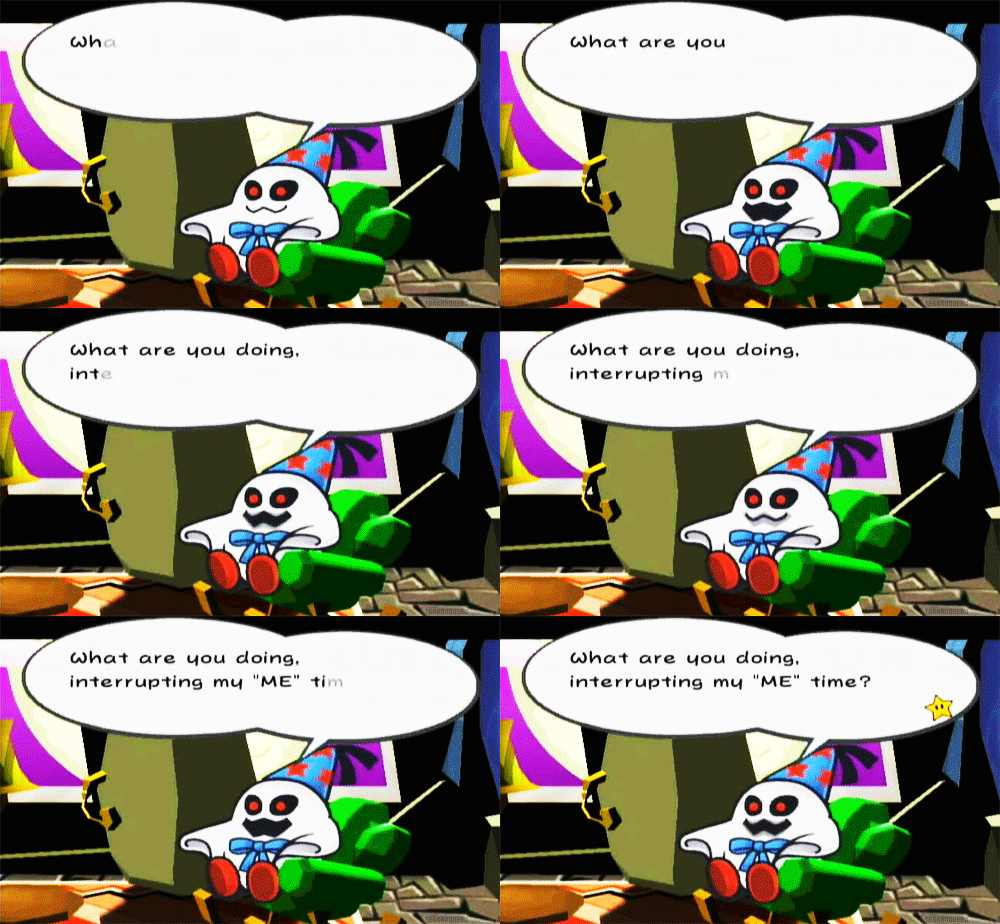
Of course, every game does it differently. Being the season that it is, I’ll start with the original Luigi’s Mansion for the GameCube. This game is built around one theme: a haunted house. My October would not be complete if I didn’t spend a weekend replaying through this game with the lights off. Not because it’s terrifying, but because for me, this is how the game should be played. I just get so much more out of it. Playing this game on a hot mid-summer night, or when snow is flying just doesn’t feel right. When running through the mansion vacuuming up ghosts and exploring dark rooms, I want to be able to look out my window and see colorful leaves. Another fall favorite of mine is Paper Mario: The Thousand Year Door. Why? This answer why may not be as obvious, but here it is: the chapter “For Pigs the Bell Tolls.” Yes, I know that there is a chapter where Mario travels to a tropical island and where there is snow, but making the trek to the Creepy Steeple (about 5 times), to me, is the most defining chapter. Everything about that section: the music, the characters, the lighting, the setting, creates a perfect Halloween experience.
Admittedly, I am biased when it comes to what season a game should be played because some of it has to do when the game came out, and my nostalgia for a game always peaks based on what time of the year I played through it and enjoyed it for the first time. The Thousand Year Door was released in October (yes, I may be a bit weird about my timely nostalgia). But seriously, if you haven’t experienced this glorious gem, there is no better time than now, and when you get to chapter 4, you’ll know exactly what I’m talking about.
And of course, there are games like Animal Crossing, where the game is set up to follow the time of year no matter what, so it can be played to the maximum level of enjoyment all year. This game has become immensely popular, and I attribute that a lot to what I referred to above as seasonal energy. It just feels right. Nintendo was brilliant to realize this and capitalize off of it. I remember playing the game and running around my town on Halloween looking for Jack, hearing my real world doorbell ring, and passing out candy to kids. This created a full 360° experience for me, and I’ll never forget it.
I won’t make a complete list of games I like to play during specific seasons, but here are just a few others that really stick out: Mario Baseball (spring/summer), Super Mario Sunshine (summer), Banjo Kazooie (fall/winter), Resident Evil 4 (fall), Splatoon (summer), Pikmin (any season – these games capture them all greatly), Wii Sports Resort (summer), Legend of Zelda: The Wind Waker (all but winter), and Kirby’s Epic Yarn (winter).
Lastly, the intention of this write-up is not to tell you when you can and can’t enjoy a game. Of course, this is 100% subjective, and everyone is going to have a different take. If you enjoy cleaning off Isle Delfino in the middle of winter to get some virtual sun and cure those winter blues, more power to you. I would love to hear comments about certain times of year you prefer what games, or if you don’t care at all and anytime is the best time. Now excuse me as I eat a freshly picked honey crisp apple and take on King Boo.
About the author: Matt has been a Nintendo fan since 1996 after his parents got him a Nintendo 64 with Super Mario 64. His love for gaming took off from there with games such as Diddy Kong Racing and Banjo Kazooie. When not playing video games, Matt can be found cycling, golfing, playing with his cat, reading math books, and partaking in anything nerdy. Once in a great while, he even may play a game that is… gulp… out of season.
Welcome back to the Nintendo Experience! I’m once again expanding the list of necessary games for every Nintendo fan. We’ve since added Photo Dojo to the list as the essential DSi game, and we’re moving on.
For the past few weeks I’ve really been enjoying the indie title Axiom Verge, and while it won’t be making its appearance on the Nintendo Experience, it is a great game. While trudging through the depths of cyberspace… or the subconscious… or another dimension… whatever that setting is, it got me thinking of the game that inspired it.
Super Metroid for the SNES is a Nintendo classic through and through. Originally marketed as Nintendo’s biggest game yet (see our Watching Old Nintendo Commercials episode), it sure does show. The game’s environments and inhabitants are varied and give an awesome sense of exploration and conquest as you traverse the world of Zebes. from your initial encounter with Ridley to the final showdown with Mother Brain, it is an unforgettable thrill-ride.
One of the clear inspirations that Axiom Verge took from Super Metroid is its use of traversal items. Though the two games’ items differ in specific application, they both serve the purpose of making you feel like you have the freedom to go anywhere and everywhere. You may start out feeling like you don’t have much in the way of mobility, but soon enough you’re getting from point A to point B using methods of which you’d never dreamed. The sense of control you have over your character and freedom to explore the environment is truly a great feeling.
It was also nice to recently revisit Donkey Kong Jungle Beat in a recent episode (man, I’m killing it with these shameless self-promotions!). There is something to be said about the Donkey Konga Bongos. While Donkey Konga and its sequel were alright for rhythm games, Nintendo didn’t leave the peripheral to be used for one game only. They decided to do what no one else had thought of: use a rhythm game controller for another kind of game. That’s genius! Have you seen “Guitar Hero Platformer” or “DDR Fighter”? No! Of course, you haven’t because Nintendo has harvested all of the geniuses in the world to come up with those ideas for them.
As far as how the game actually plays, it’s pretty good (nothing ultra groundbreaking besides the control method). But it’s the fact that one day, someone sat down and said “let’s use a set of drums to control a character,” then made it work that lands it a “must play” sticker for me.
Well, that’s it for the Nintendo Experience for now. It feels good to finally see the shelf start to fill out.
Let’s face it, we’ve all thought that at one point or another. Usually it doesn’t go any further than wishful thinking, though. Sure, some of us might doodle concept art or gameplay ideas in a notebook, a few might even learn to program, but even for those with all of the skills there’s another, more tangible hurdle: the tools. Game development isn’t free and procuring a software development kit (SDK or devkit for short) is often a costly proposition. For those of you not familiar with the game development process, a devkit is a collection of specialized software and hardware used to make and test games. They’re quite expensive: the Wii’s devkit cost around $5000, which at the time was rather cheap compared to the XBox 360’s and PS3’s $20,000 price tag. Now, those of you who are used to making do with free software—like me—are probably thinking, “do I really need all of those fancy tools?”
No.
Homebrew is the process of making software for a system without the original development kit or system distributor’s blessing (more commonly known as a “license”). The term originated among beer aficionados for beer brewed by an individual instead of a commercial brewing house, but now is used in many hobbies—including video games—to refer to unofficial/amateur produced content. Homebrewering shouldn’t be confused with modding or ROM hacking: homebrewing is concerned with making new content for a system, while modding and ROM hacking only intend to change or manipulate an existing game (sometimes to the point where it’s arguably a different game made from the parts of the original).
Homebrew is the process of making software for a system without the original development kit…
What’s Homebrew Like?
Homebrew provides a surprisingly diverse selection of content. There’s homebrew for almost all Nintendo systems, though the type of content varies greatly from system to system. Older systems mostly focus on games, while newer ones–from about the Wii onward–have homebrew for everything from games to system utilities. Let’s take a quick look at some examples.
Games
Just as “all toasters toast toast [sic]” Nintendo homebrewers homebrew games…duh. Sadly, most of the homebrew games I found in my research are simple, forgettable diversions much like the flash games of the early days of the internet. It’s not that surprising, considering game development on any level is an intricate and time consumptive process. That isn’t to say that all homebrewers lack diligence and ambition. There are still many quality original titles. Notice that I said original titles; a large number of homebrew game projects are simply ports, usually of games whose creators have released the source code to the general public. In fact, the Wii alone has ports of P.C. classics such as Tyrian, Quake, and Jazz Jackrabbit.
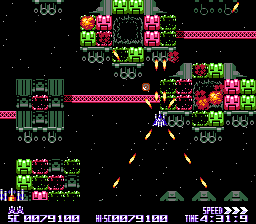
I’m not going to try to enumerate every homebrew project released for a Nintendo system, but for the sake of being thorough, there are some that warrant mention. First up is Blade Buster,a Famicom shoot-em-upnotable for its screen filling boss sprites (on an 8-bit console mind you), an insane number of sprites on the screen at a time, and unique time-attack styled gameplay. Next for the Super Nintendo is N-Warp Daisakusen, a game that allows eight—yes, eight—players to compete in a free-for-all brawl. Lastly, I want to mention a puzzle game for the DS named Negative Space which has the player drawing paths to guide two opposite colored blobs to their respective goal flags. The catch? They can only travel through the other’s color, meaning every path you draw for one is an obstacle to the other.
This game is also available as a free download on Android.
Emulators
After games, the most common type of homebrew is emulators. I’m not exactly sure why when emulators are already so prolific on P.C. Maybe people make them because they like the challenge of getting an emulator to function on the constraints of a game console. Maybe it’s to prove that more fully featured emulation is possible on Nintendo systems. Maybe people just think it’s funny to play Playstation games on their Wii. Whatever the reason, most of Nintendo’s modern systems have a multitude of homebrewed emulators available on them.
I can’t be the only one who thinks this is hilarious.
Obviously, many of the homebrewed emulators available online for Nintendo consoles are for older Nintendo systems. As I alluded to in the previous paragraph, however, the homebrewed emulator scene isn’t exclusively concerned with Nintendo systems. On the just Wii alone there are emulators for Sega Genesis/Mega-Drive, Sega Saturn, Playstation 1, CalecoVision, Commodore 64, Atari Lynx, and many, many, many, many, many more. Also, there’s a Super Nintendo emulator that runs on the original 3DS (I knew it!).
Whatever the reason, most of Nintendo’s modern systems have a multitude of homebrewed emulators available on them.
Miscellaneous Software
Not all homebrew projects are game related. Some are just the sort of software you’d find on any computer: music players, web browsers, etc. One such program of note is an art program called Colors! Which was originally developed as homebrew for the DS but has since gotten an official release on multiple systems, including the 3DS eshop. Then there’s software that changes system behaviors. For example, the 3DS has an application that removes the cap on the number of play coins a player can receive in a day. More impressive is a Wii hack that let’s the user change the region of the console—y’know, to play region locked games.
Linux
Where there’s hardware, there’s Linux. Much like the speed of light or the certainty of death and taxes, it’s one of the constants of our universe. Seriously, any system that’s powerful enough to run Linux sooner or later will. There’s Linux for the GameCube, Linux on the 3DS, Linux for the Wii, a distro is in development for the N64, there’s a version for the DS; heck, even the GameBoy Advance has…Unix?
…Wait, what?
What?
Any system that’s powerful enough to run Linux sooner or later will.
Cool! Let me try!
For those of you who don’t know, I happen to be a programmer, so when I write an article that gives me the opportunity to talk about programming, I’m going to talk about programming. If you think programming is some kind of voodoo (which it isn’t: it’s sorcery), you may want to skip this part.
Still here? Great! Believe it or not, if you’re already comfortable with programming it’s almost as simple as picking the system you want to develop for and a few Google searches. While homebrewing isn’t exactly the go-to past-time among bored nerds, there are several online guides and communities dedicated to the craft: forums, YouTube videos, blogs, and wikis galore! Heck, there’s an entire freebook on WikiBooks about Super Nintendo programming.
Even though you’re not going to be using The Man’s toolkit, you can’t exactly make a game with just your imagination and wishful thinking (trust me, I’ve tried). You will need software to compile the code you write and, if you’re developing for one of Nintendo’s more recent systems, an API library to interface with the system (getting controller input and such). You’ll also want an emulator. Fortunately, all of these tools can be easily acquired on the internet for free.
There are several online guides and communities dedicated to the craft: forums, YouTube videos, blogs, and wikis galore!
As for the coding itself, it’s mostly the same as regular programming. For example, I—out of curiosity—browsed through a tutorial on GameBoy Advance homebrewing and was quite relieved (and just a little surprised) to find that the code was hardly distinguishable from any other program written in C. There are certainly nuances to keep in mind—like in the case of the GBA, some memory addresses are reserved for the screen’s RGB values, tracking whether buttons are pressed, and so on. You may also need to go without some modern conveniences (hope you like compiling your code from command-line!). But by-and-large, anyone who’s sufficiently experienced with C and/or C++ should be fine.
Unless you’re developing for an 8 or 16-bit system. In that case I hope you really like 65c816 Assembly!
We Haven’t Even Touched the Red Pill
Instead of starting on a proper summation, I’d like to cover my backside real quick and stress that despite this being the longest article I’ve written for Two Button Crew to date, I have only given the barest of overviews of the subject. I encourage you to look further into this, either as someone interested in finding new games to play or someone hoping to make such games. More over, there’s a lot I omitted for length, like how some retail games have been pulled from store shelves because of homebrewers.
Having said all that, it’s a shame homebrew isn’t more popular. I understand why, though: if someone’s going to go to all the trouble to make a game, why make it for a dead system? And if it’s for a modern system, why make a game that they can’t license and sell? But, hey, who knows? Many Nintendo fans have grown up and started making games of their own. As time goes on and more fans get old enough to take an interest in game development, maybe some of them will try to make a few for the systems they played on as kids. Wouldn’t that be something, a flood of new old games?
About the Author:
Glen is a lifelong Nintendo fan whose love of video games has inspired him to pursue a career in computer programming; so much so that he is now studying to get a masters in computer science. He doesn’t understand that the average person isn’t interested in programming and won’t shut up about how awesome it is.
A game that belongs in our collections, but shall never be…
In this happy little episode, Simeon and Scott look back on the great work of Bob Ross and sadly discuss his canceled game – the Joy of Painting for Wii and DS! Watch for some pictures of the Crew attempting their own Bob Ross-inspired works of art.
Shot by Alex Campbell
“Escape the Premises” Kevin MacLeod (incompetech.com) Licensed under Creative Commons: By Attribution 3.0 http://creativecommons.org/licenses/by/3.0/
Can we please just have amiibo chips in everything?
Can you ever have too many amiibo? NO! Especially if they are very unique, like the ones we are officially requesting Nintendo to produce. We will preorder promptly when they are announced!
Shot by Alex Campbell
“Escape the Premises” Kevin MacLeod (incompetech.com) Licensed under Creative Commons: By Attribution 3.0 http://creativecommons.org/licenses/by/3.0/
As little as Nintendo focuses on storylines sometimes, they have still managed to create a number of amazing works of fiction within their games. We present you with the top 10 stories created by Nintendo!
Shot by Alex Campbell
“Reformat” Kevin MacLeod (incompetech.com) Licensed under Creative Commons: By Attribution 3.0 http://creativecommons.org/licenses/by/3.0/
With the announcement of the NES Classic, it’s inevitable that the big N is going to come out with an SNES Classic sooner or later. Today we’re talking about its inevitable library!
Shot by Alex Campbell
“Reformat” Kevin MacLeod (incompetech.com) Licensed under Creative Commons: By Attribution 3.0 http://creativecommons.org/licenses/by/3.0/



_(En,Fr,De)-14.jpg)