Battalion Wars | That Was a Thing

Welcome to That Was a Thing! A new series in which I discuss my favorite weird, obscure, or simply underrated pantendo games and media. Think of it as the evil twin to Simeon’s Nintendo Experience series. In this inaugural installment, I’m going to look at one of my favorite—not to mention one of the only—real-time strategy Nintendo series out there: Battalion Wars.

The Battalion Wars duology was a spin-off of the Nintendo Wars franchise and originally had the working title of Advanced Wars: Under Fire. Unlike the other Nintendo Wars games, however, Battalion Wars wasn’t developed by Nintendo or Intelligent Systems, but a British company: Kuju Entertainment. The first game was released for the GameCube on September 19, 2005 and its sequel debuted on the Wii on October 29, two years later.

Overview

The Battalion Wars games are a combination real-time strategy and third-person shooter. Like most R.T.S. games, players are tasked with completing objectives with the units provided for the mission—riflemen, tanks, bombers, etc. Needless to say, each unit type had its own strengths, weaknesses, and abilities and the majority of the strategy revolves around knowing where and when to deploy each unit. The unique selling point of this game is that the player directly controls one of the units the whole time, with the ability to freely switch between units as needed. Think of it as being sort of like Pikmin but with guns…and tanks.

Both games are set in a fictional world filled with global super-powers just itching to find a use for their massive armies. Seeing as the series was developed in England, each of the games’ fictional nations are comically stereotypical counterparts to real-life countries. The United States is represented by the gung-ho Western Frontier, the Tundran Territories are an odd combination of Tsarist/Soviet Russia, likewise Xylvania combines Imperial Germany with Nazi Germany, the Solar Empire is a futuristic tropical Japan, and the Anglo Isles—first introduced in the second game—mirrors the Anglo Isles…I mean the United Kingdom…seriously, they weren’t even trying to be subtle with that one.

As to be expected, each of these nations employ an eccentric and colorful cadre of commanders. Each mission has the player receiving orders from one of their faction’s commanding officers while the enemy commander emotes and responds according to the events of the game. While they don’t offer any special gameplay bonuses like the commanders of the Advance Wars series, the commanders’ typically blasé attitude toward warfare and nonchalant dialogue helps keep the tone light. I would say the only commander that I personally didn’t care for was Empress Lei Qo of the Solar Empire—who left so little of an impression on me, I had to look up her name just to write the previous sentence.

The third-person perspective really is what makes gameplay stand out. Giving orders from the perspective of one of your men while returning fire yourself really makes you feel like you’re an actual part of the conflict, instead of some ghostly observer calling the shots. When your battalion’s under fire, you’re under fire, and having to make tactical decisions in the midst of the chaos of the battlefield can create some really tense moments. Then there are the times when you spot some enemies in the distance or look at the map and have to plan your next move. I’m not sure I can properly express the feeling I would get as my men crowded around me, expectantly waiting for me to formulate a plan of attack.
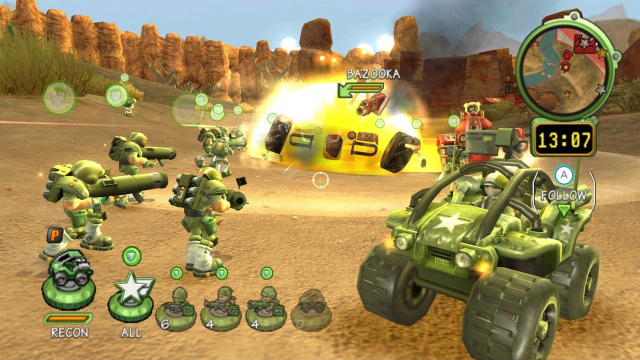
Take that ya tsarist turnip!
Being an entity on the battlefield requires the player to look after both himself and and his units.

If quality gameplay wasn’t enough, these games are also overflowing with personality. The games’ humor and cartoonish visuals give the series a lighthearted tone; these aren’t games out to deliver a ham-fisted “war is bad” message but instead revel in the innocent—and perhaps naive—feeling of playing with toy army men. Despite having the depth of a Saturday morning cartoon, almost every character is likable in some way—with my personal favorites being Tsar Gorgi, Kaiser Vlad, and Col. Austin—and I genuinely wanted to know what happened to them next. Each faction’s units are instantly recognizable, and their designs convey a lot of personality, not just for the unit itself, but for the faction it belongs to.

Giving orders from the perspective of one of your men while returning fire yourself really makes you feel like you’re an actual part of the conflict.

Now that we’ve covered the basics, take a closer look at the first game.

Battalion Wars
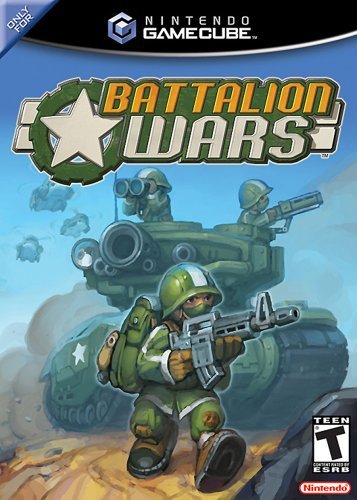
Clearly, this is a real man's adorable war game.
The cute proportions and solemn color choice of the cover art sums up the game’s unique atmosphere quite well.

I first heard of Battalion Wars from the now defunct Nintendo Power Magazine. That’s not to say I immediately took an interest in it, however. I wouldn’t pay it much mind until my younger brother returned from the now defunct Hasting’s Entertainment with a used copy of the game. Shortly after he inevitably lost interest in it, I took a crack at it and fell for it harder than Tsar Gorgi off a bridge (too soon?).

The game places the player in command of the forces of the Western Frontier—with some exceptions in the form of unlockable bonus missions. The story begins during an uneasy truce between the Western Frontier and their longstanding enemies, the Tundran Territories. War breaks out when Western Frontier troops find a Tundran spy on the Frontier side of the border. As the plot continues, the Tundrans ally themselves with the Xylvanians, the Xylvanians betray the Tundrans, an old man is thrown off a bridge, I think there was a zombie-ghost legion at some point…you get the picture.

While it won’t win any awards, the story has a great sense of progression to it. Plot-wise, mission objectives often tie into something you did in a previous stage. If you saved a spy, you can bet his intel is what will point you toward your next target. The fort you defend in one mission is essential to launching a counter attack in the next and so forth. It’s a small detail, but having your actions contextualized like that goes a long way toward making your input feel meaningful.

While it won’t win any awards, the story has a great sense of progression to it.

While we’re talking about writing, I need to discuss the most important character: the grunts. Throughout the game, the troops under your command are constantly responding to your orders, quipping at the enemy, talking among themselves, or commenting on the situation at hand…and it is freaking adorable! Okay, I know that sounds like it’d get annoying after awhile, but the troops have so many lines that I would sometimes still be discovering new ones on my fourth or fifth play-through of particular missions.
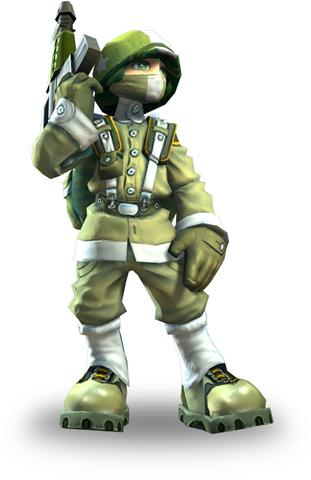
“I’m beat…let’s make camp and whip up some cocoa!”

On to the atmosphere: the visual style is a strange blend of cute, chibi soldiers and vehicles and a muted color palette that gives the environments an oddly grim and gritty feel. This, in conjunction with a great soundtrack that wouldn’t sound out of place in an old WW2 movie, produces a unique atmosphere in which the tone is never too heavy or oppressive but the player is still fully aware that—no matter how cute the enemy’s tanks are—this is still war.

The game isn’t without faults, however. The A.I. for units under the player’s control is a little slow on the uptake, to the point of seemingly lacking a self preservation instinct at times. I found any mission where I had to fight enemy aircraft especially aggravating, as anti-air vets tend to not take initiative, resulting in massive losses from even brief lapses in focus. I didn’t care much for missions where the game expects me to command planes and ground forces at the some time, either. For whatever reason, when given the wait command, planes continuously fly in a straight line instead of staying in proximity to where they were when the order was given. This required me to constantly check back on them to make sure they weren’t about to fly over enemy anti-air embankments.

Battalion Wars 2
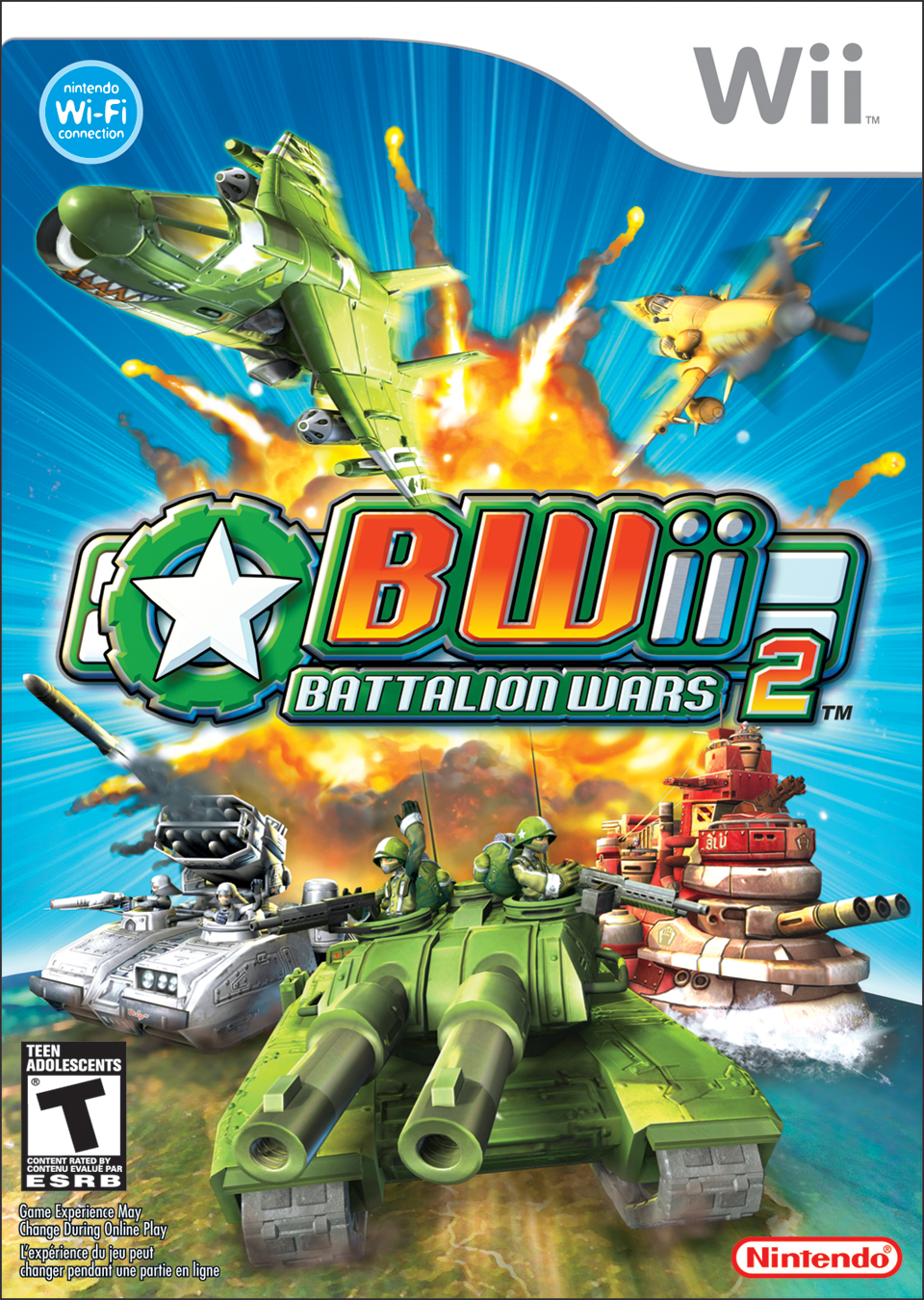
"Sir, the last game didn't sell well." "Then put an explosion of the cover of the next one!"
More playable factions, more unit types, more color! KA-BOOM!

Battalion Wars 2 starts its story off 200 years in the past by showing the player the final conflict between the Solar Empire and Old Xylvania at the end of the “Lightning Wars”. Bottom line is that the S.E. nukes O.X.’s H.Q. with an orbital death ray and then—fearing that the weapon is too much power for anyone to wield—chucks the controller (a staff) into a glacial ravine…what could possibly go wrong?

Back in present day, it’s been 2 years since the events of B.W. 1 and the nations of the world are at peace…until the Anglo Isles preemptively attack the Solar Empire based on rumors that they are harboring some sort of super weapon. The plot jumps between flashbacks and modern day from there with each campaign focusing on a different faction: a conflict between the Western Frontier and Tundra, the Anglo Islands staving off the Solar Empire’s retaliation, one where the player controls Old Xylvania’s forces, and finally Tundra’s attempts to prevent Xylvania from finding the staff.

The plot sounds a lot more complicated, but it really isn’t. I assume the 200-year-old-artifact-of-doom plot was meant to make the story feel bigger than the last game’s. Unfortunately, I’m not very fond of epics; I much prefer down-to-earth plots as I think they tend to have better focus and require the author to actually make me care about something specific like people or places. Fortunately, most of the characters are still quite likable, including most of the new ones.

Sadly, the narrative’s constantly changing point of view leaves the story unfocused and absolutely kills that sense of progression the first game had. You only play as any one faction for at most five missions (usually less). Between less emphasis being placed on the player’s actions between missions and the fact the player constantly switches sides, that feeling from the first game of being a single commander fighting in a series of much larger conflicts is completely gone.

Did I mention the volume on the player’s soldiers has also been dramatically reduced? They still speak, and I’m sure it’s still adorable, but I for the life of me can’t hear what they’re saying.

The narrative’s constantly changing point of view leaves the story unfocused and absolutely kills that sense of progression the first game had.

Moving on to the visual design of this game: many of the units received redesigns, especially the Tundran Territories’ infantry, most of which I think are improvements. The same can’t be said for Brigadier Betty: her look, not to mention her distinctive voice and a good deal of her peppy can-do attitude, are gone, making this iteration rather bland and forgettable. Speaking of bland, the game’s color palette is much more colorful which, while fitting well with the cartoonish style, demolishes the unique atmosphere of the B.W. 1 and stands out less by comparison.
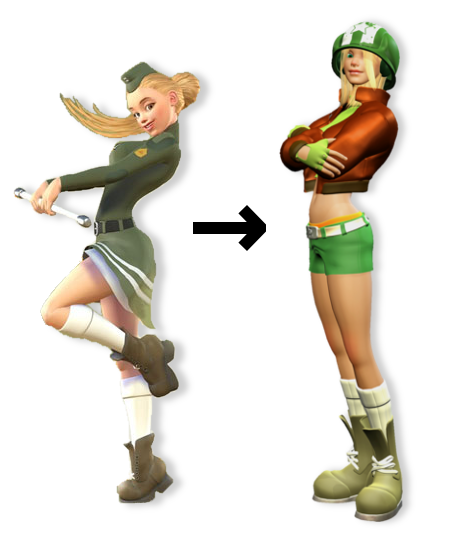
What's that orange bit above her shorts? Her underwear? C'mon guys, this is a Nintendo game...
On the left, a plucky, upbeat, and memorable character; on the right, the uncanny valley.

Okay, so maybe the aesthetics and narrative aren’t on par with the original, but this game fixes many of its predecessor’s failings when it comes to gameplay. The A.I. is much more proactive: there were many times I would be ordering my units to attack a tank or some entrenched enemy infantry and would be surprised by the wreckage of an enemy gunship I didn’t notice suddenly crashing nearby. Oh, and planes finally fly in circles when put on standby!

The motion controls also make targeting enemies and issuing commands a snap. The only place where they really feel out of place is when controlling aircraft, as pointing the Wii remote up or down controls altitude. This feels awkward, especially if the player is trying to target a ground based unit, partially due to the game not making the change in altitude immediately obvious.

The game’s missions do feel a bit more repetitive than before. BWii’s missions follow a pretty predictable formula: defend a location then go on the assault or go on the assault and then defend the capture point. That said, BWii doesn’t have any missions that drag on too long or feel unfair—which the first game was occasionally guilty of, so I guess it more or less balances out.

The game’s missions do feel a bit more repetitive than before. That said, BWii doesn’t have any missions that drag on too long or feel unfair—which the first game was occasionally guilty of.

Of course, Battalion Wars 2 also brought new gameplay elements to the table: naval units and buildings. Naval units basically feel like tanks and artillery, but much more sluggish. That said, the game does a great job of conveying their weight and scale, and their long range means naval missions don’t feel too drawn out. Unfortunately, missions in which the player has to command both land and sea units tend to feel disjointed and tedious, due the two unit types’ inability to travel together and the player not being able to use the “All Units” button to regroup their units without messing up their positioning.

Buildings are a solid addition. Players can’t select their position, instead having to secure predetermined locations. Once under the player’s control, buildings will periodically replace fallen units corresponding to the type of building (e.g. aircraft for airfields). These help take the edge off, as the player doesn’t have to worry about losing essential personnel. That said, the fact that units have to run all the way to the players position, which can be on the other side of the map, means the player can’t rely on reinforcements too much.

Debriefing

Despite all of the flak I just gave Battalion Wars 2, I do think it’s the better game. While I think Battalion Wars has more personality, it can also be much more tiring—and sometimes frustrating—to play. Of course, neither is particularly hard to come by, and they’re both worth your time.

Sadly, Nintendo never commissioned Kuju to make a Battalion Wars 3. I think it’s blend of action and strategy would’ve been a great fit for the Wii U, and the Wii U gamepad would’ve been a great help in micromanaging units, something that neither game made easy. Nintendo still seems to have a fondness for cartoony wars games if the recent 3DS game Tank Heroes is anything to go by, so I haven’t completely given up hope. If the rumors of GameCube games coming to the Switch’s Virtual Console are true, I’d happily double dip on Battalion Wars…and not just because of how utterly unreliable old GameCube memory cards are.


About the Author

Glen Straughn is a lifelong Nintendo fan whose love of video games has inspired him to pursue a career in computer programming. He is currently studying to receive his masters in computer science from Oklahoma State University. He has gotten an S rank on every mission in BWii, and even managed to get an S on the final mission on his first successful play-through…completely by accident.

Nintendo’s New Approach to New IPs

Over the years, Nintendo’s franchises have continued to grow, but many old games (F-Zero, Ice Climbers) may not see a new entry, and a few games (Code Name: S.T.E.A.M., Captain Rainbow) will likely never get a single sequel. There are a couple new strategies they’ve started using that are really elevating the new IPs right out of the gate.

Free Content

They don’t even call it DLC because it’s not optional. Updating new games instead of asking people to spend extra money on something new and unknown is such a smart move. You can purchase a game at launch knowing you’re getting the full experience… over time. There were a few things that should have been in Splatoon at launch (TEAMS!), but the map and weapon additions every Friday after the game came out that continued for months kept me going back. There’s no way I would have bought all the content in that game (as I tend to like certain weapon types), but giving them to me for free convinces me to try them out and dig deeper into the game. They’ve already confirmed that new fighters, stages, and arms will be available in ARMS following launch, so I know I’ll be throwing punches for a while.

Free content = Ongoing happiness

Tournaments

Splatoon was featured as part of the Nintendo World Championship and now both ARMS and Splatoon 2 have tournaments at E3 2017. This builds so much hype around their games and shows off the competitive side as well. Looking from the outside, ARMS and Splatoon appear to be casual games, and can totally be played as such, but for the gamers that want a deep and challenging experience, there’s no better way to show it off than on a big flashy stage.

Nintendo Directs

Having a Nintendo Direct specifically dedicated to a game has done WONDERS for Nintendo. For the day(s) from announcing the direct until the actual stream, I see Nintendo fans going wild with rumors and speculation of what the Big N has up their sleeve. Showing off new stages and modes plus announcing new characters in ARMS has reignited a spark for that game in a lot of people (myself included). There have been a ton of posts on social media about which fighter is someone’s favorite and planning which arm combos they’ll use with said character.

The possibility of more Reggie is never a bad thing.

Global Tests

Both Splatoons have had a Global Testfire and with ARMS set to have a Global Testpunch this weekend and the following weekend, it’s bound to get even more people interested and talking about the game. While it would be nice to have longer increments to check the game out, I think it’s smart to give people a taste with set times to play. It whets your appetite for the game just enough to sell it to you and makes you want to play the title right at launch to get back into it.

Here’s hoping to the success of ARMS and Splatoon 2. With all the hype that continues to build around them, I don’t see them going anywhere in the near future… but only time will tell.

The Hardest of Hard Games

Some people are gluttons for punishment. I’ll pass on the aneurism.


#522 – These games make our face veins pop just thinking about them! If you’re looking for a challenge, thise here is the starting line.

Footage Credit: Super Monkey Ball Banana Blitz – Claris Robyn | Super Mario Bros. Lost Levels – NintendoComplete

“Escape the Premises” Kevin MacLeod (incompetech.com)
Licensed under Creative Commons: By Attribution 3.0
http://creativecommons.org/licenses/by/3.0/

The Master Trials (Zelda: Breath of the Wild DLC)

Should have raised the stakes from a sharpie drawing to a tattoo…


#544 – Breath of the Wild’s first big DLC drop just happened over the weekend, and Simeon and Scott are wasting no time in getting their competition on. Who can make it further in the Trial of the Sword within 5 minutes? TIME will tell!

“Escape the Premises” Kevin MacLeod (incompetech.com)
Licensed under Creative Commons: By Attribution 3.0
http://creativecommons.org/licenses/by/3.0/

Dream Jobs at Nintendo

Nintendo, you can reach us on our Contact page.


Who wouldn’t want to work for Nintendo? The company is among the ranks of Apple and Disney, places that seem like they’d be more fun than they are work. Well, Simeon and Scott are writing their own job descriptions in home that a Nintendo employee will watch this video and hook them up. Join us in the comments!

“Escape the Premises” Kevin MacLeod (incompetech.com)
Licensed under Creative Commons: By Attribution 3.0
http://creativecommons.org/licenses/by/3.0/

Which Button Am I Pressing? (Blindfolded!)

You’re really pressing my buttons.


Are you so familiar with Nintendo controllers that you could recognize individual buttons without looking?! That’s exactly what Simeon and Scott are attempting today, while blindfoldedly shoving fingers into gaming input devices. Who will win?

“Escape the Premises” Kevin MacLeod (incompetech.com)
Licensed under Creative Commons: By Attribution 3.0
http://creativecommons.org/licenses/by/3.0/

What’s the History of Mario’s Design?

Heh. Tom Selleck. Heh heh.


#581 – The man, the myth, the mustache… Mario himself. Did you know that Miyamoto originally wanted to use Popeye as a mascot? Do you know who Mario is named after? Prepare for your mind to be blown – we’ve got all the details!

Footage credit: Kotaku

“Escape the Premises” Kevin MacLeod (incompetech.com)
Licensed under Creative Commons: By Attribution 3.0
http://creativecommons.org/licenses/by/3.0/

Predicting The Final 3DS Games (Before it Dies)

But what we really want is Face Raiders 2, of course.


#592 – 2011 is the year Nintendo 3DS launched, followed quickly by Wii U. Nintendo’s home console floundered and died while their revolutionary portable thrived, building up an amazing catalog of games and huge install base worldwide. Finally, in 2017, it appears that the system is winding down and coming in for a landing. As such, we started to think about what its final games would be, and we’ve made this list for your viewing pleasure!

“Escape the Premises” Kevin MacLeod (incompetech.com)
Licensed under Creative Commons: By Attribution 3.0
http://creativecommons.org/licenses/by/3.0/

1-2-Switch… With a Twist

Order your Simeon Mouth Screenshot Prints now!


Just when you thought these video couldn’t get any weirder, Simeon and Scott place Joy-Con in their mouths. Yuck? It’s all in good fun though, as they attempt to thwart each other in three intense rounds of 1-2-Switch. No hands allowed, only tongues, teeth, and lips. If you can handle that, you will be entertained!

“Escape the Premises” Kevin MacLeod (incompetech.com)
Licensed under Creative Commons: By Attribution 3.0
http://creativecommons.org/licenses/by/3.0/

Heads-Up: Two Button Crew Edition!

Slightly self-indulgent? Never!


#593 – Buckle up and prepare for some inside jokes! Today we’re playing Heads-Up: Two Button Crew Edition in the app’s Create Your Own Deck mode. Simeon and Scott challenge each other to recall words from Nintendo and TBC lexicons. Can they reach each other’s minds? And more importantly… can you keep up?

“Escape the Premises” Kevin MacLeod (incompetech.com)
Licensed under Creative Commons: By Attribution 3.0
http://creativecommons.org/licenses/by/3.0/

The Improvised Episode

How would you describe the chances that Simeon and Scott have a future in improv comedy? Eh, eh?


#546 – What does this episode contain? We don’t know! Usually the decription area of our videos is for giving you an idea of what is going to be discussed on the show, but today’s different… we’re going completely off the noggin! No notes, no topics, no outline. What will we talk about?

“Escape the Premises” Kevin MacLeod (incompetech.com)
Licensed under Creative Commons: By Attribution 3.0
http://creativecommons.org/licenses/by/3.0/

My Favorite 3D Mario Title

With Super Mario Odyssey looming in the horizon, I thought it would be appropriate to write about my favorite 3D Mario Game. Yes, it’s Super Mario Sunshine, and probably the 3D Mario game with the most divided opinions. The game is by no means perfect (looking at you, Pachinko Machine), but I’m going to outline some key points that for me, make this game better than Super Mario 64, Super Mario Galaxy 1 and 2, and the most recent “3D” installments that I have a tough time even grouping into this category. Let us begin.

The Locale

I’ll get this one out of the way first. I’m an absolute sucker for the tropics. Maybe it’s something about the water lapping up against the shore or the gorgeous sunsets, but I just find myself being really relaxed whenever I play this game. It’s as if you aren’t only playing a stellar Mario game, but having a day at the beach. All of the levels are artfully designed, and even though they are all based around the tropical theme, they each have their unique personality. Whether you’re in the peaceful country life of Bianco Hills, the island theme park known as Pinna Park, or enjoying a world class sunset at Sirena Beach (my favorite), you feel like you are on a vacation. I also really enjoy the fact that you can see different levels in the distance within each area. It’s a simple addition, but a nice touch nonetheless since the world seems connected.

The last thing I’ll mention in this category are the local inhabitants. It’s not your traditional toads, koopas, and goombas. Here, we have Piantas, Nokis, and a whole new variety of enemies. It’s different and refreshing. Nintendo crafted a world here that really does feel genuine. The further you get in a level, the more involved you become in its story, and it’s really nice to feel involved in an environment, rather than just running around for the sake of collecting things.

There are so many good things happening here…

The Gameplay

I have a really tough time describing this one because I’m not sure how to define what makes it better. To me, it’s just more fun to control Mario in this game. It could in part be to the addition of the FLUDD and that you have more moves in your arsenal, but somewhere in the development of Galaxy 1, they tweaked it, and it hasn’t felt as good since then. It seems like Mario controlled tighter and was more responsive in Sunshine. Not to say that later Mario games don’t control well, but I don’t feel like I have the same level of precision control over Mario. I have a feeling that Odyssey will conform to the more recent “loose” style, but we’ll have to wait and see.

The Challenge

This game is hard. This is the aspect of the game that I believe deters some gamers from liking Sunshine. This title does house some of the toughest levels in the entire Mario Franchise, even going back to the original. I’ve beaten it countless times, and each playthrough there are a number of levels that still give me pause (even a Game Over screen or two – something which I never really see in newer Mario titles). On top of some challenging levels, each world features a number of platforming stages where shadow Mario removes your FLUDD. In these levels, the only thing separating you from the Shine Sprite is a gauntlet of platforms. It’s deceivingly simple, and there are some stages that are absolutely brutal, especially later in the game. Not to mention the classic Mario music is playing here, which for some reason makes it even more intense for me.

The last thing in this category I want to include are the blue coins. I’m a completionist, and I must collect every blue coin. The game doesn’t do a fantastic job of tracking these for you, other than giving you a count for each level. I do sometimes get annoyed when I’m missing the last few and I admittedly have to go online to hunt them down. No shame if you do the same.

So here is where the divide occurs. The above points may seem like negatives that take away from the overall experience, and for some, they are. But personally, they enhance my experience by doing something that Mario games rarely do today, and that is make me want to beat it. When I see that Game Over screen, the adrenaline kicks in and I focus. This makes victory that much sweeter. I have to be fair and say that later Mario games do bring in this level of difficulty, but usually at the very end of the game, after you collect everything else. I had fun in the Champion’s Road and Grandmaster Galaxy’s “The Perfect Run”. I can certainly see why Nintendo would put the ultimate challenge of the game at the very end, but it would be nice to have this flavor be added  more throughout the game, albeit as optional.

Plan your next move carefully…

The Graphics and Music

 I grouped these categories together because they complement each other so nicely. The music does a fantastic job of speeding up or slowing down depending on what you are doing, and it always sticks to the tropical theme. For an early GameCube title, the graphics are incredible. These visuals have aged really well, and I always look forward to replaying the game just to see the eye candy that it still offers to this day. I still hope that Nintendo makes an HD remake, because that would be… well… tear inducing.

Conclusion

So that is my defense of Super Mario Sunshine. If you want to play a really fun Summer game and need a break from inking squids, pick up Sunshine and do yourself a favor. It’s such an incredible and unique entry in the series that this blog can’t do it justice. If you disagree (which I anticipate as somewhat likely), please let me know, and why. What is your favorite 3D Mario game?

Here’s hoping in just a few months we’ll all have a new favorite!

The Ethics of Console Bundling

I’ll take one NES Classic Edition with a side of GOUGE-ME-FOR-$200 please and thank you!


#569 – GameStop, ThinkGeek, and other retailers are starting to hold their Nintendo inventory hostage and sell it along with a bunch of other junk. If you’re looking for a Switch or even an NES Classic Edition, you may have noticed this questionable business practice… Simeon and Scott are here to look at the issue from all the angles, and determine if stores have a right to do this. And is it in consumers’ best interest? (Go ahead and guess the answer to that one.)

“Escape the Premises” Kevin MacLeod (incompetech.com)
Licensed under Creative Commons: By Attribution 3.0
http://creativecommons.org/licenses/by/3.0/

DLC – Is it Actually Doing the Industry a Favor?

I finally got around to playing Breath of the Wild’s First DLC pack and I had a lot of fun with it. When I finished it though, I started thinking whether or not DLC is really essential to enhance the experience of the game, or is it something that company’s feel obligated to do now, because it may look bad if they don’t. Obviously, there are different types of DLC out there, including but not limited to: enhancements (BoTW DLC Pack 1), additional story elements (BoTW DLC Pack 2), new modes, etc. I get that the advantage of DLC is that companies can release their games without further delay if they want to make an addition to the game but it is too late to fit it in the release schedule, and DLC can make a game last longer. But is that also opening the door for companies to release “unfinished” games? Nintendo themselves have even expressed disinterest in DLC in the past, saying that they want the consumer to have the full experience up front, but the tide has apparently turned.

A while back, I recall a company releasing DLC that was actually already loaded on to the original disc. Long story short, this created a huge controversy, and ever since, DLC has had sort of a negative tone to it, for me at least. The fact that you could buy the disc and not truly own all of its content seemed, well, cheap. I know that this is a rare case, but I consider it a turning point for this type of additional content. Just the idea of adding something after the fact makes me question the motive and ethics in general.

But from a positive viewpoint, DLC can drastically increase the life of a game if done right. I’m hoping the second DLC pack for Breath of the Wild, The Champion’s Ballad, will add a lot more to the game and justify the $20 price I paid for both DLC packs. Considering $20 is 1/3 of the price of the entire game, I’m expecting a lot of content. I do think it’s smart for Nintendo to “sell” the DLC a little more by releasing amiibo with it, hence the four Champion amiibo, which do look amazing. In my opinion, the more DLC can stand alone, the better it is. Yes, add-ons and enhancements are nice, but I think it’s tougher to pay for those compared with actual, fresh content. I do want to disclaim that this is in no way a review of The Master Trials DLC.

Mario Kart 8 is another game that comes to mind. I loved the bonus tracks included in the DLC, but I still can’t help but think they should have been included in the actual game. My fear, and point of this blog is that DLC in general, if not done right, can only decrease the value of the consumer dollar. Nintendo has surely jumped on the DLC bandwagon, and I think they are still in the experimentation phase. It seems like when it comes to releasing content after the fact, more developers have been getting away with charging more for less. At least that’s how things seem to be trending. The Master Trials was a fun motivator for me to get back in the game, but I really felt like it should have been included in the first place. Hopefully, the Champion’s Ballad proves to be a breath of fresh air (that pun was intended).

The Champion’s Ballad is scheduled to release this Holiday Season

It seems like the DLC trend Nintendo has been riding is here to stay. It will be interesting to see how it evolves.

The Metroid Conspiracy

Warning: The following blog contains spoilers for both Metroid Fusion and Metroid: Other M.

A while back, I made a cryptic remark along the lines of, “it’s almost as if Other M was an attempt to rewrite Fusion in hopes of removing the latter from the series continuity.” While the announcement of two new Metroid games at E3 back in June was exciting—and certainly bodes well for the franchise—I can’t help but think something’s off about the whole thing. This is just a hypothesis, but I think Nintendo really did try to retcon Metroid Fusion!

Motive

But why would the Big N try to remove Fusion from the series continuity? Well, first let me just point out that the Metroid series is rather unique among Nintendo’s repertoire in that it actually observes continuity. Unlike other series that either only present plots that span a few games before moving on to another setting (such as Fire Emblem) or are designed “gameplay-first” with timelines being a mere afterthought (e.g. Zelda), the events of each Metroid game are closely tied to those of the games previous to it. So unlike other series, plot developments have consequences moving forward.

The events of each Metroid game are closely tied to those of the games previous to it.

This makes Fusion problematic for a company that’s rather fond of maintaining status quo. Metroid Fusion shakes up the series in a couple ways. Firstly, it ditches the heroine’s iconic appearance, potentially disrupting the franchise’s branding. Samus now sports a rubbery, blue suit instead of her iconic orange, metal suit and pilots a spindly, purple spacecraft instead of her more rounded, orange ship. Moreover, Fusion ends with her still using this equipment. Even when she regains her powers from SA-X, Samus is still wearing the fusion suit, now just with an orange color palette.

I can't tell you how happy I was to find two pictures of Samus in striking the same pose in different suits.
Years of branding makes one of these more marketable than the other.

Of course, this isn’t that big of a deal, as redesigns are reversible or even welcome at times (I’m looking at you Breath of the Wild). No, the biggest problem is what the game does to the continuing Metroid storyline. Metroid Fusion ends with Samus directly defying the Galactic Federation. She not only destroys their metroid breeding program, but foils their attempts to weaponize the X-parasites. By the end of the game, she’s most likely angered some very powerful people. I think it’s safe to say that after Fusion, Samus is a wanted criminal.

Metroid Fusion has far reaching consequences for the series, fundamentally changing the relationships between the Metroid universe’s various factions and thus the types of stories that can be told. This presents an intimidating challenge, as these new stories would require the writers to accept that they can’t rely on the plot conventions of previous games. Furthermore, shifting the focus to combating a corrupt industrial-military complex instead of the unilaterally evil space pirates may radically alter the tone of the series, potentially alienating fans.

Method

I’ve already gone on at length about how Other M is essentially a retelling of Fusion, but let’s look at one of the ways the two are different: the ending. As mentioned, Fusion ends with Sammy triumphantly thwarting the federation’s misguided efforts to weaponize the lifeforms of SR-388. Other M ends on a much more somber note; after Ms. Aran and co. manage to defeat the malevolent (and possibly “just misunderstood”) A.I. controlling the bottle ship, the federation arrives and starts sweeping up. Samus is allowed to go freely, but knows that the federation will take whatever data it can find and continue to research bio-weapons. It has a very different “you can’t beat the system” kind of feel to it.

Other M‘s ending has a very different “you can’t beat the system” kind of feel to it.

Other M‘s ending is much more open ended: Samus isn’t implied to be an enemy of the state, thus allowing her to take more jobs from the federation. This means that if Other M replaced Fusion, Nintendo could easily continue with the typical Metroid plot structure of taking assignments from the federation, which in turn means future games need not revolve around governmental conspiracies.

Supporting Evidence

This brings us to the present day. Nintendo has just released a remake of Metroid II: Return of Samus and Metroid Prime 4 is on the horizon…somewhere. Notice anything strange about that? One’s a remake and the other is a continuation of the Prime series. For those of you who don’t know, the Metroid Prime games take place between the events of Metroid and Metroid II. That means they’re technically prequels and don’t continue the story. Fusion is the last entry on the Metroid timeline; there hasn’t been an actual continuation of the overarching narrative in fifteen years! I think it’s safe to say Nintendo either isn’t interested in continuing the story, or just doesn’t know how.

There hasn’t been a continuation of the overarching narrative in fifteen years!

See You Next Mission?

In a weird way, I’m actually glad Other M received so much criticism. If it had been a resounding success, Fusion may have been quietly removed from the series’s continuity. While I’m positive that Nintendo feels like they’ve painted themselves into a corner, I think Fusion sets up a fascinating and fresh new direction for the franchise’s story. Yeah, it’d have a different tone from the games before, but I think the acclaim Fusion got for incorporating horror elements proves that the series is capable of tonal evolution. Unfortunately, with things as they are, I’m losing hope we’ll ever see a proper Metroid 5

The Puppet Show Episode

It hurts to be a puppet. An ADULT puppet? Downright painful.


#547 – Fun fact: The first video Simeon and Scott made together (about 15 years ago) was a puppet show. Well, they’re getting the band back together, pulling socks over their hands, and crouching underneath a tiny table. For your enjoyment. You’re welcome!

“Escape the Premises” Kevin MacLeod (incompetech.com)
Licensed under Creative Commons: By Attribution 3.0
http://creativecommons.org/licenses/by/3.0/

What Nintendo Character Am I?

If you ever need your eyebrows slimed, call us first.


It’s popular with the kids and it’s popular with the squids – SLIME! Simeon and Scott are here to play with slime (in a Nintendo-like fashion) for YOUR enjoyment. So play along and see if you can guess the characters that their slimy faces portray.

“Escape the Premises” Kevin MacLeod (incompetech.com)
Licensed under Creative Commons: By Attribution 3.0
http://creativecommons.org/licenses/by/3.0/

You’re NintenDoing It Wrong

We take OBJECTION to these gamers!


#570 – Points for trying. That’s the only thing we are authorized to award in this episode because we’re featuring some spectacular fails! Epic fails, some might even say. These Nintendo fans either weren’t fans at all, or they were having VERY off days. Get a kick out of this compilation, or at least feel better that YOUR picture isn’t being circulated like this on the Internet.

“Escape the Premises” Kevin MacLeod (incompetech.com)
Licensed under Creative Commons: By Attribution 3.0
http://creativecommons.org/licenses/by/3.0/

Worst TBC Episodes of All Time

Don’t forgive us!


#582 – In the past 581 episodes, we’ve messed up a handful of times. We’ve given you sub par content that doesn’t live up to our high-quality standard. What’s the best thing to do with those shows? Put them in a collection and laugh at them, of course! Feel free to make fun of us in the comments today. This is a day for fun at our expense. Enjoy!

“Escape the Premises” Kevin MacLeod (incompetech.com)
Licensed under Creative Commons: By Attribution 3.0
http://creativecommons.org/licenses/by/3.0/