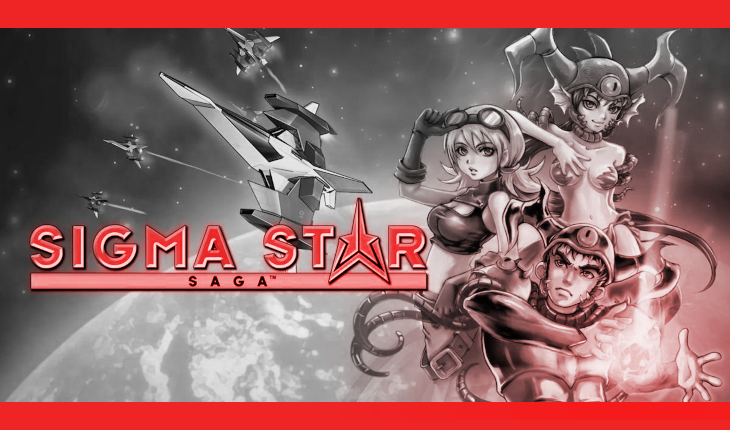
Note: The following article was written in February of 2022. As such, its contents represent the author’s opinions on the original GameBoy Advance version of Sigma Star Saga and may not be reflective of the game’s updated re-release, Sigma Star Saga DX.
Novelty is a powerful thing. While there’s value in perfecting an existing concept, the gaming public flock to new ideas like chickens to a carton of expired blueberries. There’s just one problem: coming up with new ideas is hard! One simple, time-honored trick for coming up with original gameplay hooks is to simply graft together two unrelated, existing ideas. This is the premise behind genre-mashup games. Metroidvania and first-person shooter? Metroid Prime! Mix together a third-person shooter with a real-time tactics game and you get Battalion Wars. What happens when you combine a side-scrolling shoot-em-up with an R.P.G.? You get the subject of today’s edition of That Was a Thing, Sigma Star Saga.
Released on August 16, 2005 for the Game Boy Advance, Sigma Star Saga was developed by WayForward Technologies and was published by Namco (now Bandai-Namco) in North America and by Atari in Europe. Like so many games of that time, I first heard about it through the now defunct Nintendo Power magazine. I vaguely recall skimming their coverage of the game back when it first came out. Their description of random battles—which were a foreign concept to me, having never played a traditional J.R.P.G. at that time—confused me and ultimately turned me off from the game.
I wouldn’t think of it much until years later when NF Magazine, the spiritual successor to Nintendo Power, featured an article on the many leading ladies of WayForward’s numerous titles. Listed among the likes of Shantae and Officer Patricia Wagon of Mighty Switch Force was the purple-skinned, alien girl from Sigma Star Saga. The revelation that WayForward—a company I had come to respect in the intervening years—was behind the game piqued my interest. Sometime later, I managed to snag a copy while revisiting a used games story I frequented in grad school. Sadly, it wouldn’t be until this last summer that I finally made time to play it.
Story
Sixty years before the events of the game, a race of extraterrestrial warriors known as the Krill attacked the earth, gouging a “hole the size of Canada” out of the floor of the Atlantic ocean. As to be expected, the environmental impact of such a cataclysmic event nearly destroyed all life on earth. The game itself begins with the return of the Krill. The player assumes the role of Ian Recker, the leader of an elite, space fighter squadron known as Sigma Team, as he repels the Krill fleet. Sadly, despite successfully repelling the Krill, only Recker survives the battle.
Once the Krill retreat, Recker is hailed as a hero. However, he’s far too distraught over the loss of his team to revel in his victory. It’s then that his commanding officer, Commander Tierney, offers him a new assignment. Tierney would like Recker to pose as defector and infiltrate the Krill’s ranks. Wanting to end the war and likely suffering from survivor’s guilt, Recker agrees without hesitation. The commander then poisons Recker, placing him in a coma, and sends him into Krill space in a maximum security cell. Y’know, to make it convincing. I think…
Once aboard a Krill star base, Recker quickly ingratiates himself to the base’s commander, completes missions for the Krill, and rises through the ranks, all while covertly sending intelligence to Commander Tierney. The story is rife with twists, turns, betrayals, and tough choices. Eventually Recker finds himself questioning who he can trust and even his own loyalties.
One of the most notable aspects of the game’s writing is its tone. While the game features plenty of WayForward’s brand of goofy and irreverent humor, the story also gets pretty dark at times. As the plot progresses, it becomes increasingly obvious that neither side of the war is particularly noble. There are conspiracies, double crosses, and themes of survivor’s guilt. The protagonist is even ordered to commit war crimes just to maintain his cover. One scene I found particularly grim was returning to a Krill base to find the halls littered with corpses. The reason? The base’s commander discovered there was a spy in her ranks (which was actually the main character for the record) and decided murder was the simplest solution. Call me cynical, but I think this game only got an E-10 E.S.R.B. rating because it was made for the Game Boy Advance. If it weren’t a 2D game with low-resolution pixel graphics, it probably would’ve gotten a T for Teen.
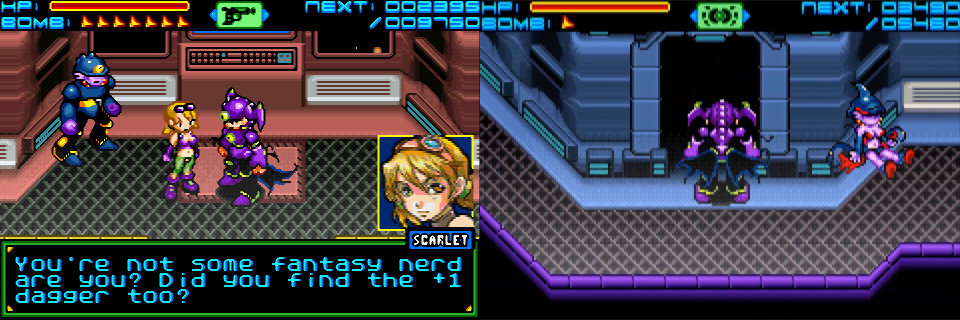
The story is probably the game’s strongest component. Each character has their own motivations and secrets, leaving the player guessing who can be trusted. The entire story also maintains a through line of mystery as the hero attempts to uncover what each side’s goals really are. It’s not perfect, however. The plot gets pretty complicated in places and can be quite hard to follow. Additionally, the story includes a clumsy, shoehorned love triangle that doesn’t serve any purpose.
Presentation
Normally when discussing a WayForward title, this would be the part where I proclaim the animators at WayForward peerless masters of 2D animation and so on. While the visuals are still nice, I’d say they don’t stand up next to WayForward’s other titles. The first problem, oddly enough, is that the character sprites are drawn in the signature WayForward style. This clashes with the promotional art and character portraits which feature a less colorful, less cartoony aesthetic. Secondly, many of the animations are stiff, especially the walking animations. It looks like the limbs were drawn and animated separately and then stitched together into one sprite, sort of like the 2D puppet animation seen in many Flash cartoons.
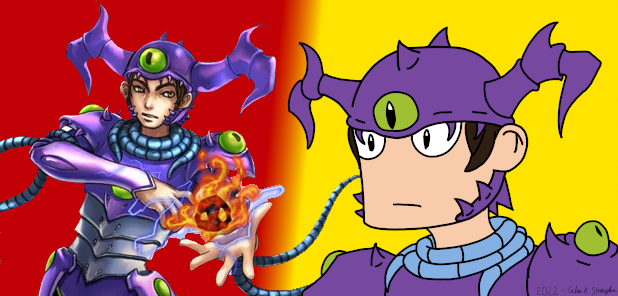
Lastly, during the shoot-em-up portions of the game, it can be really hard to tell what’s in the foreground and what’s in the background. Normally, backgrounds in video games use a darker, duller palette than the foreground graphics, making foreground objects pop. Sigma Star Saga doesn’t, however, meaning every new stage introduces an element of guess work.
I don’t have much to say about the game’s soundtrack. It does what it’s supposed to: setting the tone and mood of the game, and it does is fairly well. Overall, it’s good; it just doesn’t feature any standout tracks.
Gameplay
Sigma Star Saga is an R.P.G.-Shoot-em-up hybrid, in which the player explores environments on foot from a top-down perspective. While exploring, players may be pulled into randomly occurring battles, much like other R.P.G.s. Unlike other R.P.G.s, however, these fights aren’t turn-based but instead take the form of a side-scrolling shooter.
Exploration
Let’s go over the field gameplay first. While on foot, Recker can talk to N.P.C.s, fight enemies, and navigate his environment using a variety of tools. Throughout the game, the player will encounter several obstacles which require a certain item to pass. Of course, Recker doesn’t start the game with any of these items, thus requiring the player to hunt them down during the course of the game. Due to its item-centric progression and simplistic, real-time combat, this portion of the game is more Zelda than Final Fantasy.
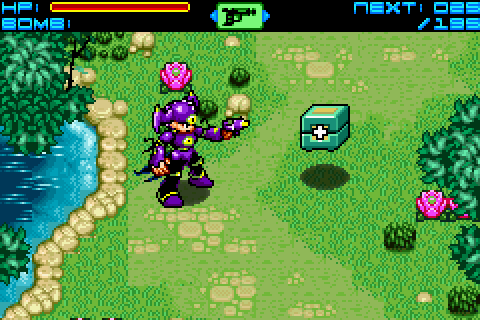
Unfortunately, this is probably the weaker half of the game. For starters, the protagonist takes up a lot of space on screen, making it hard to avoid enemies once they come into view. As such, I often found myself moving through areas very slowly. As for combat, it’s very simplistic, with little in the way of enemy variety or tactics.
Likewise, the exploration is fairly bare-bones. Most objectives boil down to using Recker’s various tools to go to a specific point on the map to activate a story sequence. There aren’t any puzzles or even shops where the player can stock up on items or pick up new gear. Thankfully, there are weapon upgrades hidden in the game’s many nooks and crannies to reward the player’s curiosity and encourage exploration. Honestly, I think adding some short, dungeon-like areas filled with traps and puzzles would have gone a long way toward fleshing out this part of the game.
The exploration is fairly bare-bones. Most objectives boil down to using Recker’s various tools to go to a specific point on the map.
Ship Combat
As mentioned before, Sigma Star Saga features side-scrolling shooter battles. Some of these occur at predetermined points in the story, but most are triggered randomly while exploring the surface of the game’s many planets. The predetermined fights are just plain, old-fashioned shooter stages that end with a boss fight. The random fights, on the other hand, task the player with defeating a set number of enemies. Sometimes this entails shooting down several small enemies, while other times it means defeating a single mini-boss. After defeat, enemies drop experience points. If the player collects enough experience points—and yes, experience has to be picked up like any other power-up—Recker levels up gaining attack and hit points in the process.
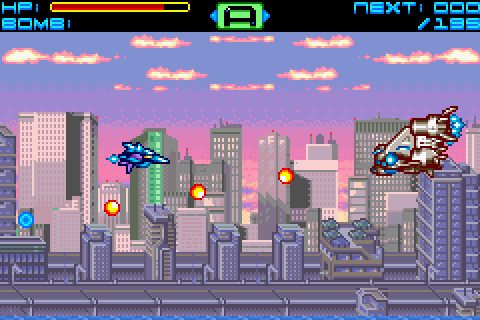
During random battles, players are randomly assigned one of a handful of different ships, each with different default weapons, maneuverability, and hit boxes. In addition to its default weapon, each ship comes with a secondary weapon that the player can customize with gun data. There are three varieties of gun data that affect the type of shot, the direction and quantity of the gun’s shots, and what the shot does when it impacts a wall or enemy. For instance, a ship’s gun could fire wavy shots out in an X pattern that cause every tenth enemy defeated to drop a small health restorative, or a gun could fire bouncing rubber balls in a spiral pattern that turns into a tornado upon impact.
The weapon-customization system is the game’s standout mechanic and the best part of the shooter segments. The amount of off-the-wall combinations is staggering, even if most of them aren’t particularly useful. This is contrasted, however, by the lack of variety in ships. There are only about five or six different types of ships, all but two of which are available from the start of the game. It’s disappointing that the game didn’t gradually introduce new ships as it progresses.
The weapon-customization system is the game’s standout mechanic.
Moreover, most of these ships also have the exact same, vanilla primary weapon that shoots straight ahead. This makes weapon customization frustrating for the first half of the game as it encourages making guns that enable the player to attack from different angles—such as above or below—but then leaves a massive blind spot for the ships that don’t have the default cannon. By the second half of the game, however, the player should be able to make an all-rounder gun that makes each ship’s default gun completely irrelevant. All of that said, it’s still a really cool system; so much so, that I’ve even contemplated implementing a similar system in the game I’m working on.
Another issue with the shooter portions is their length. The random battles in the mid and late game can overstay their welcome, with some fights requiring the player to shoot down 99 enemy ships. Unlike other R.P.G.s, players can’t run from fights either. Thankfully, there are ship customization options that reduce how many opponents the player must defeat.
The random battles in the mid and late game can overstay their welcome.
Overall, the shooting is good, with responsive controls and reliable collision detection. Well, good collision detection when I could tell the background from the foreground, that is. That said, I’m no connoisseur of the genre; I suspect that many hardcore shooter fans would find these segments pretty basic. Then again, hardcore shoot-em-ups quite frankly terrify me, so I’m not complaining.
Planet 5
My review of Sigma Star Saga wouldn’t be complete if I didn’t talk about Planet 5. Oh good golly, is Planet 5 terrible! First of all, the enemies on Planet 5 are a massive step up in terms of difficulty. This alone isn’t terrible, as the player can level grind, but some of the shooter levels require the player to navigate through tiny gaps with pixel-perfect accuracy. If threading a needle with a cargo ship wasn’t bad enough, this area is also terminally bugged. That’s right, sometimes the game will soft lock at the end of ship fights, leaving the player stuck piloting his ship through an infinitely repeating level without any enemies. I can’t tell you how many times I had to restart my game, either due to getting obliterated by a miniboss, crashing into a wall, or the game glitching out. Did I mention the player can only save at checkpoints?
I can’t tell you how many times I had to restart my game on Planet 5.
For a Game Boy Advance title, Sigma Star Saga was very ambitious. It combined a complex story with a unique hybrid of gameplay styles, and while each of those styles’ implementations aren’t groundbreaking on their own, they come together to make something truly distinct. While I wouldn’t describe it as a masterpiece, it’s a memorable game that perfectly illustrates that combining old ideas in new ways can be just as effective as a completely original gameplay hook.
Most of the problems this game does have are minor issues that simply require a little polish. Personally, I would love to see a remake of this game that sanded down some of its rough edges. Alternatively, a sequel could allow the team to expand on what worked. The lack of any ports, remakes, or sequels isn’t due to a lack of interest from WayForward, however. Unfortunately, the rights to the I.P. belong to Bandai-Namco. While I know there isn’t much demand for more Sigma Star Saga, I’m holding out hope that we’ll see it again someday.

Glen
Latest posts by Glen (see all)
- Sigma Star Saga That Was a Thing - 05/10/2026
- Goodbye, Two Button Crew - 12/28/2023
- TBC 40: The Legend of Zelda: Tears of the Kingdom - 12/27/2023