The Super Mario Bros. Movie We Never Got

Confession time, boys and girls! I like the Super Mario Bros. Movie. There, I said it! I admit, it’s probably just residual nostalgia from the many times I watched it as a kid, seeing as how the movie is a horrendous adaptation of the games (which was no less obvious to four-year-old me as it is today). Even then, I think when judged on its own merits, the movie has a sort of cheesy charm: it’s a film made in the early 90s trying so hard to be a mid-to-late 80s styled action-adventure thriller. In my opinion, it works in a weird, probably unintentional way. Regardless, the film has become infamous among gamers, who deride it for—among other things—not being much like the games on which it’s, ahem, “based.”

The film has become infamous among gamers, who deride it for not being much like the games on which it’s “based.”

However, this was not always the case. The movie had a long and troubled production, mostly due to differing opinions on which direction the film should take. The end result? Many, many rewrites. Most versions of the script are more or less in the vein of the final product, a sci-fi action-adventure sort of a thing. However, there is one major exception: the first draft. Indeed, the first draft was not a sci-fi action-adventure sort of a thing, but instead a comical romp through a bizarre fantasy world. More to the point, it also included many more nods to the series on which it was, ahem, “based.” So, does accuracy to the source material make this version of the movie better? Let’s find out! Uh, I mean, “let’s-a go!”

I’m pretty sure that’s what the cool kids are saying these days…

Summary

Seeing as how it’s doubtful the average gamer knows about the many rewrites this movie went through, much less bothered to read the original script, I think it’d be a good idea to briefly go over the plot detailed in the aforementioned first script. The movie follows a pretty clear three-act structure, with the first act taking place in Brooklyn, the second in the Mushroom Kingdom, and the third being comprised of the climax and denouement, as one would expect.

Act 1: Brooklyn

The story begins much like the finished movie does: a dark and stormy night, a robed figure, an infant, and some sort of mystical artifact, in this case, a jewel encrusted locket shaped like a mushroom. In this story, however, the nun that answers the door fails to notice the locket, and it consequentially slips out of the basket and into a nearby storm drain. After leaving the child on the door step of a church, the robed figure—in this version an old man—tries to beat a hasty retreat but is blocked by the shadowy figure of the story’s villain, King Koopa. Koopa threatens the man with unimaginable suffering, and the frail old man—being quite old and frail—dies of fright.

Twenty-something years later in modern-day, early 90s Brooklyn, Mario and Luigi are doing what plumbers do: fixing pipes. Or, at least, Mario is, Luigi is daydreaming about the love of his life, a girl that works at a nearby flower shop. Mario, having been hurt by love some unspecified amount of time ago, abrasively attempts to dissuade Luigi from pursuing a relationship.

Quick aside: for maximum enjoyment, I recommend envisioning Mario being played by Bob Hoskins—like he was in the final version of the film—and Luigi being depicted by Danny Wells like he was in the Super Mario Bros. Super Show.
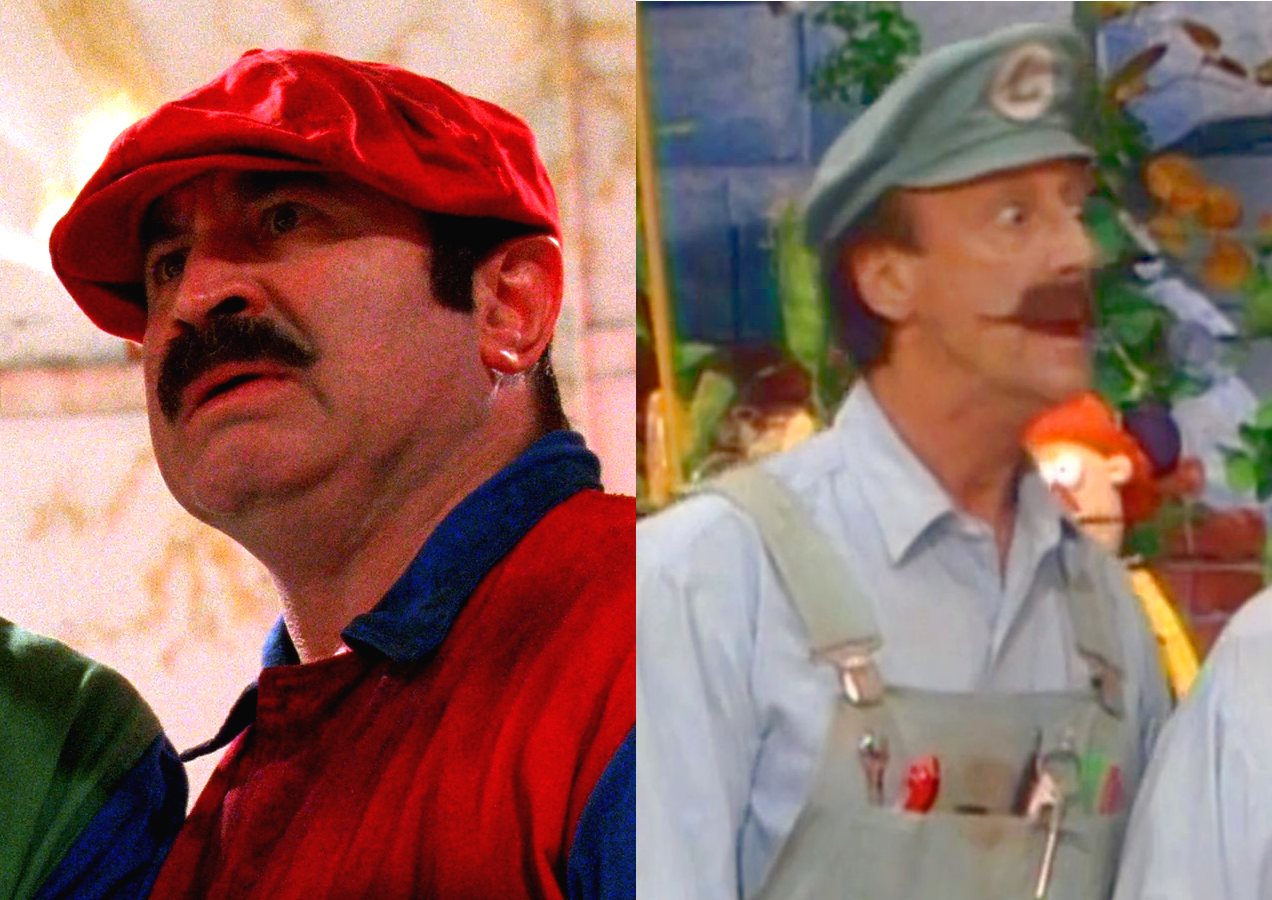
Bob and Danny
Clearly the best casting decision this side of Charles Martinet.

Anyway, Mario and Luigi aren’t exactly in the best shape financially. Mario is deep in debt to a loanshark named “Big Eddie” (pro tip: never loan money from anyone whose name starts with “big”). Further adding to their problems are the differences between each brother: Mario is all business—which is understandable given his circumstances—while Luigi is compulsively generous and prone to messing up while on the job, resulting in more work for Mario. Case in point, after leaving to fetch some tools he left in the van, Mario returns to find that Luigi has turned the pipe they were working on into something akin to a modern art piece.

Later, after fixing the pipe, Luigi heads down to the flower shop to confess his love to Hildy. Wait, Hildy? Why Hildy? I mean, at least Daisy was an established character in Mario canon (albeit an incredibly obscure one back when the movie came out). Whatever, Dai—Hildy is rebuffing the advances of some sleazy dude named Vinnie. Apparently the two went out on a date sometime ago, and Dai—Hildy gave him a black eye. Luigi enters the shop just after Hildy convinces him to leave via argumentum ad tubulum irrigandum. After wussing out of telling Hildy how he feels, an argument breaks out between Hildy and her employer: Hildy put top dollar flowers in a budget wedding bouquet because weddings should be special or something. Afterward, Luigi and Hildy make lunch plans for the next day.

So to summarize, Mario is gruff and cynical, Luigi is warm and whimsical, and Hildy is tough but sweet.

Later that night, after having dinner with his brother (and some arguing), Luigi heads out on the fire escape to look at the city lights. He starts daydreaming (nightdreaming?) about being with Hildy. His happy thoughts are soon interrupted by that most inconsiderate of bugbears, foreshadowing. He imagines Hildy being stolen away by a reptilian claw and then himself holding the locket from opening. He then wakes up in bed, which leads me to question how much of the previous scene even happened. Did Mario and Luigi even have dinner, or was that part a dream too?

The next day, Luigi bumps into some of Big Eddie’s goons. They start hassling him until Mario steps in. Mario assures Eddie and his thugs he’s got a job lined up and he’ll be able to pay them soon. Mario then heads to the City Engineer’s office. Unfortunately, the City Engineer won’t even look at Mario’s proposal for the unspecified project until Mario pays a bribe. Mario, of course, refuses to stoop to bribery. After a debate on business ethics, the meeting inevitably concludes with the defenestration of the City Engineer’s golf bag.

Afterward, Luigi is telling some of the neighborhood children a story about a fisherman who outwitted a wrathful genie by daring him to enter a bottle. Mario, already having a bad day, dismisses the tale. Luigi attempts to cheer his brother up by telling Mario he found them a (pro bono) job fixing a leak in the basement of the church from the opening. During the job, they accidentally break open a sewer pipe, out of which comes the locket. Luigi immediately recognizes it as the one from his dream, and Mario immediately recognizes it as his ticket out of debt.

The next day, an unusual fellow tells Hildy he’s a detective working for her parents, and they would like to meet her. Previously believing herself to be an orphan, Hildy readily agrees. Meanwhile, Mario meets with Big Eddie to pay off his debt using the locket. Unfortunately, Luigi switched the locket with a rock when Mario wasn’t looking, which Big Eddie doesn’t find amusing. Back in the flower shop, Luigi shows up for his lunch date only to catch the Hildy right before she leaves with the strange man. Quickly realizing something’s amiss, Luigi chases after their cab in the Mario Bros.’s van. Mario, trying to escape Big Eddie’s goons, tries to escape to the van and after a brief chase only barely manages to hop in the back. Luigi chases the cab to an alley and continues his pursuit on foot. Mario follows him and they enter an abandoned diner with a large pipe jutting from the floor in the kitchen. They enter the pipe and are quickly whisked away.

Act 2: The Mushroom Kingdom

They exit on the other side of the pipe in…well, the movie never specifies, but we’ll just say the Mushroom Kingdom. After a brief scuffle over the locket and an encounter with some Piranha Plants, the brothers start wandering about, trying to determine where they are. They eventually stumble across Toad, who’s attached to a metronome-like deathtrap. They free him and he decides to tag along.

I should mention that this depiction of Toad is more or less the same as his portrayal in The Super Mario Bros. Super Show, but with a little less chutzpa in the face of danger. I’ll leave it to you to decide just how annoying that sounds.

The brothers eventually catch up to Hildy and the strange man, who then changes form to reveal himself to be none other than King Koopa (why can’t they ever just call him Bowser?). Luigi rushes off to save her, and—having no plan or weapons—gets himself and Mario captured. King Koopa leaves with Princess Hildy (she’s apparently a princess now) in tow while Mario and Luigi are to be executed via ballista. They just barely manage to show their executioners—who happen to be of a bearded human-like race known as “Yeelahs”—the locket before the trigger is pulled. Upon seeing the locket, the Yeelah proclaim the Mario Bros. the heroes of prophecy (is it just me, or are prophesies more common in movies than the Bible?). They then direct the trio to a nearby village to meet a wizard.

They meet the wizard, Woltan, and after some convincing, he sends them on a quest to the Pit of No Return to retrieve his wand. Meanwhile, Toad sends a message stating the brothers are still alive to Koopa via rocket-powered carrier turtle. Woltan gives Luigi three silver coins and sends the three on their way. As Mario’s complaining about never wanting to go on any quest, Luigi gives a beggar the three silver coins and receives a magic bean in return.

Meanwhile at Koopa’s castle, Koopa elaborates that he needs Princess Hildy to willingly marry him so that he can get his claws on the Crown of Invincibility. After briefly and awkwardly attempting to use charm and wit to persuade her, he defaults to love-potion laced chocolates, because apparently, it’s consensual when she’s under the effects of a love potion. The script cuts back to the progression of this plot point several times, presumably to provide a sense of urgency, but I’m not going to bother.

After camping out for the night, the Mario Bros. (and Toad) eventually stumble across a group of “toadstoolians” (i.e. Toads) working as slaves for King Koopa. This is followed by a chase scene in which the Mario Bros. have to run from the Hammer Bros., who’ve been sent to assassinate them. After escaping the Hammer Bros. and some more of Koopa’s minions, they find an egg in the woods which hatches into a “brontosaurus-like” creature. It’s actually a Yoshi, but is never referred to as such. It imprints on Mario, who shoos it away. After some more hiking, they (finally) come to the cave’s entrance. They enter, navigate some traps: including Thwomps and a strangely out-of-place Bob-omb, and enter a treasure chamber where the wand is. While in the treasure chamber, Luigi finds a jar of mushroom powder, and Toad takes a red leaf.
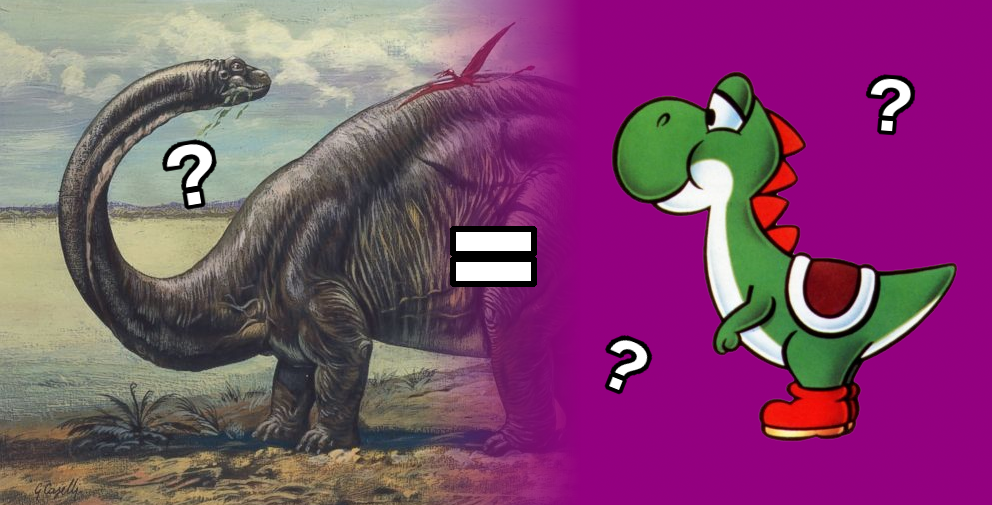
brontosaurusyoshi
Pictured: a comparison of some promotional artwork of a Brontosaurus (left) and an artist’s rendition of what a T. Yoshisaur Munchakoopas may have looked like (right).

Outside, they’re greeted by Koopa and his minions. Koopa shoves Luigi and Toad off the ledge at the edge of the cave, sending them plummeting to their doom. Fortunately for our heroes, Luigi and Toad have the raccoon-leaf from earlier and use it to land safely. Mario, thinking his brother is dead, swears vengeance on Koopa as the Yoshi from earlier comes to his rescue. After the two escape from Koopa’s troops, Mario says goodbye to the Yoshi as it goes to be with its real mother.

Act 3: Koopa’s Castle

On his way to Koopa’s castle, Mario comes across the beggar Luigi got the magic bean from. The beggar reveals himself to be Woltan. Mario returns the wand and they head off to defeat Koopa. Koopa’s chief wizard, Beedleman, senses that Woltan has regained his powers and summons a storm to slow them down. As the storm brews, Mario takes cover, but Woltan tells him that there is nothing to fear because his magic is strong enough to protect them from the storm. Immediately afterward he’s vaporized by a bolt of lightning (Okay, I got to admit that’s pretty funny). Anyway, Mario continues onward, alone.

Mario arrives at Koopa’s castle and rushes in. Luigi and Toad, who escaped the caves by sprouting the magic bean from earlier into a vine they could climb, see him run in but are too far away to call out to him. Inside, Mario finds the place unexpectedly deserted. He seeks out Hildy, following her cries for help. He follows the voice only to find that (all together now) it’s a trap! After delivering the famous “the princess is in another castle” line (which is probably the most clever allusion to the games in the whole movie), Mario is taken away in chains. Fortunately, his captivity is brief as Luigi rescues him en route to the dungeon of Koopa’s real castle.

Now reunited, the brothers sneak into Koopa’s castle. The duo knock out some guards, steal their uniforms, and inadvertently stumble into King Koopa’s bachelor’s party. The king mistakes them for jesters and demands a song. After improvising a tune, the brothers sneak off to find Hildy. Upon finding her, they are shocked to find that the once sweet Hildy has been transformed into a “grotesque wench” (way too much makeup, long claw-like fingernails, etc.) by the chocolates. Hildy only barely recognizes Luigi before the guards barge in and take the Mario Bros. to the dungeon.

In the dungeon, our two heroes await their fate: in the morning the floor—which is made of ice—will melt and they will plunge into a pool of man-eating fish. Without anything better to do, Luigi resorts to having a real-talk with Mario. Turns out, the only reason Luigi still lives with Mario is because he promised their mother that he would look after Mario, because all Mario cared about was money and work.

The next morning, the ice begins to crack, Toad finally decides to check and see what’s taking our heroes so long, and Koopa’s wedding begins. Just as the remaining ice becomes too small to support both Mario Bros., Toad shows up. He manages to trick the dungeon’s guard into eating a poison mushroom, thereby straight up murdering him, and then rushes to the brothers aid.
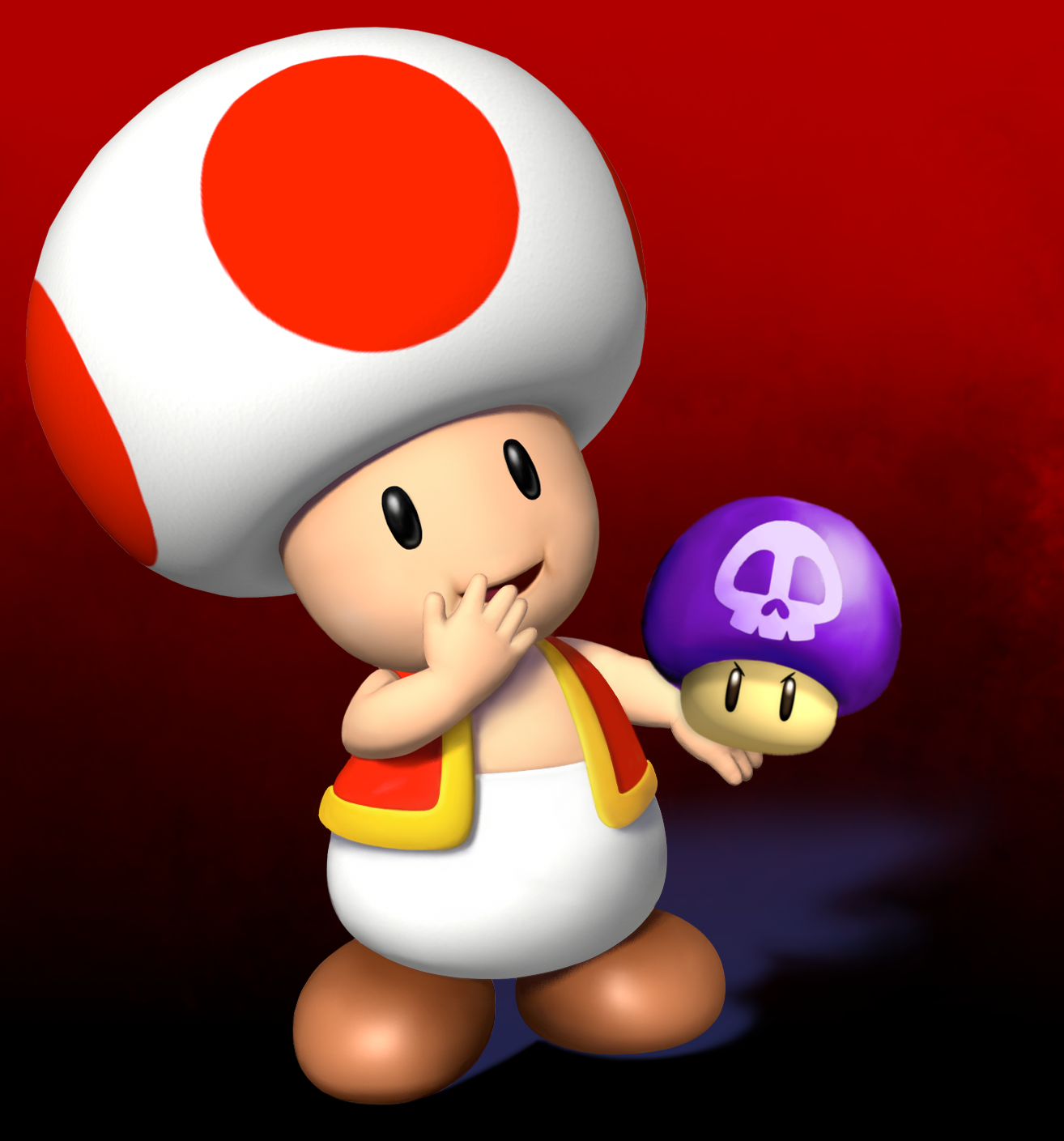
does-this-look-like-the-face-of-mercy
Does this look like the face of mercy?

Mario and company barge into the wedding. Unfortunately, Koopa is able to finish the ceremony while the protagonists are busy fighting through the guards. Just after Hildy says “I do,” Luigi breaks the spell on her via the mushroom powder he obtained in the Cave of No Return. Now the rightful-ish ruler of the kingdom, Koopa takes the crown and uses its power to begin turning Luigi to stone. Mario hefts Luigi’s petrified body and attempts to escape with Toad and Hildy. Just before his petrification completes, Luigi reminds Mario of the story of the genie and the fisherman.

As they escape, there’s a largely pointless confrontation with a pair of chain-chomps and a rather cool implementation of roto-disks. Eventually, the group is chased into an underground chamber…full of magma. Duh.

Our heroes attempt to cross a rickety rope bridge when Koopa finally catches up to them. Mario directs the others to take Luigi and get to safety. Koopa, at first, tries to use illusions to defeat Mario. When that doesn’t work, he uses his magic to pull Mario toward him and deliver a powerful uppercut. Mario is sent flying and only barely manages to grab onto the bridge. With his opponent now dangling precariously above a pool of magma, Koopa approaches to deliver the coup de grace. Just before Koopa cuts the rope Mario is hanging on, Mario remembers the story of the fisherman and the genie. Mario says that even though he may be small, he’ll always be bigger than Koopa. Koopa, of course, uses the crown’s power to grow. Mario continues to egg him on but Koopa becomes wise to Mario’s ploy and begins levitating to avoid destroying the bridge with his weight. That wasn’t Mario’s plan, however: Mario tells King Koopa that his shoe is untied and Koopa reflexively looks down, thus causing the crown that is now many times too small to fit on his head to slip off. Koopa plummets into the magma and everyone (including his former henchmen) rejoice. But suddenly, a giant flaming head emerges from the fire. Mario does the only logical thing in this situation and…tells Koopa that it’s over and he just needs to give it a rest? With one last furious roar, Koopa takes Mario’s advice and finally dies.

Woltan reappears and reveals that he was actually the former king of the Mushroom Kingdom all along. Later, in the field of pipes that will take our heroes home, the King gives a speech congratulating the Mario Bros. and Toad and presents them with medals. He then gives Hildy permission to return to Brooklyn so she can be with Luigi, stating that he will simply remarry and produce another heir to the throne. That’s a…surprisingly practical way of resolving that plot issue. Anyway, after saying their goodbyes, Mario, Luigi, and Hildy all return to Brooklyn.

Three months later, the trio are eating dinner at an Italian restaurant. Hildy and Luigi are now married, and Mario is finally out of debt. The newly-wed couple ask Mario if he’s seeing anyone. Just as he starts to explain—while he’s very happy for them—he’s not interested in a relationship for himself, he spies an attractive woman sitting by herself who happens to resemble a bit character who I didn’t bother mentioning before now because she only exists for the sake of this one call back. We see Mario walk up to her and start a conversation through the front window of the restaurant as the camera begins to pull back, revealing the Mario Bros. van whose side now reads “Super Mario Bros.: Ace Plumbers.”

The End.

Analysis and Review

So, this story is obviously more faithful to the source material, therefore it’s clearly better, right? Eehhhh…

Okay, first things first, movies are a collaborative effort: they are the end product of many people’s input and passion. For that reason, it’s hard to judge a hypothetical film solely on a script alone. Many factors can influence the quality of a movie: direction, acting, editing, the list goes on and on. So for this reason, I’m judging this assuming the performers never miss a beat, the director has some actual talent, and no scenes were cut for length. With that in mind…

Let’s start with the positives. Some of the jokes are actually really funny. I like that this script has a rather dark sense of humor in places, like having Woltan vaporized with little warning or fanfare. Some of the one-liners are fairly clever (though most are a little cheesy) and—if properly acted and edited—the slapstick could potentially be almost on par with something like Looney Toons or the good seasons of SpongeBob. Over all, many of the jokes have potential, and they do a good job of establishing a wry, yet light-hearted tone.

Over all, many of the jokes have potential, and they do a good job of establishing a wry, yet light-hearted tone.

I also like the dynamic between Mario and Luigi. Having Mario resent Luigi for no reason other than the latter is a responsibility the former never asked for may not be the most original idea, but I think it was a very interesting direction and made for a surprisingly deep and psychological take on the characters. Also, let’s not forget the reveal near the end in which Luigi admits to having similar feelings regarding Mario, which I thought was a good pay off for their character arcs.

Lastly, I liked that they made an effort to make the movie’s world resemble the games’. The thought of seeing a live action Super Mario Bros. that more closely resembles the games is enough to make me salivate.

Now the bad, few of the other characters other than Mario and Luigi get much character development. With the possible exception of Toad, none of the side characters really change or grow throughout the course of the story. Hildy remains tough but sweet, Woltan’s only change is that we discover he’s really the king, and Koopa’s not fleshed out much as a villain. This last one’s particularly infuriating because Koopa at one point mentions how his father had everything taken from him and his family was reduced to living in abject poverty. Taken by whom? King Woltan? That moment raised so many questions: questions I was very much looking forward to having answered, and they never mentioned it ever again! Easily the most aggravating thing in this script!

Next were some miscellaneous issues. Firstly, you probably noticed there were quite a few scenes that I only mentioned in passing. Well, that’s because a lot of scenes don’t really add much to the story and were effectively padding. Next, the story doesn’t quite know who its protagonist is. I know of two basic ways of determining who’s the story’s hero: “who drives the plot?” and “who undergoes the most character development?” For most of the film, Luigi’s driving the plot, but Mario undergoes most of the character development, but toward the end the movie changes gears and has Mario do both. I don’t think this is too big of a deal, seeing this is the Super Mario Bros. movie, and thus the writers may have just figured both brothers should share the spotlight, but even then it came across as a tad unfocused. Lastly, the movie shows its age in some of the worst ways possible: parts of it are painfully cheesy and cliché-ridden. It’s very clearly a product of the 90s.

A lot of scenes don’t really add much to the story.

Now for the Reznor in the room: the efforts to reference the games are often times distracting. I know that doesn’t sound right, so hear me out. The script makes an effort to reference the games, but it’s incredibly inconsistent in how it does so. I’m not against there being new ideas—especially considering this script was written in ’91 and there was a lot less material to go off of—but there are missed opportunities all over the place. For example, they never call the Mushroom Kingdom the Mushroom Kingdom, or Hildy “Princess Toadstool”—even as a title. Also, why have the majority of Koopa’s army be comprised of Yeelahs instead just having Yeelahs be the conquered peasants (I’m not anti-Yeelah, but give me my gosh-darn Koopa Troopas!)?

Because of this, the movie’s references feel kind of half-hearted: like they only included them out of necessity. Heck, some come across as completely shoe-horned, like the bob-omb in the Pit of No Return or the Chain-Chomps in Koopa’s castle: both come completely out of nowhere and add very little to the plot. While reading this, I got the impression there were times where the writers stopped and said, “wait, weren’t we writing a Super Mario Bros. movie? Oh crud! Quick, put in a character from the games.”

This may sound really weird, but I think the movie we got is easier for me to judge on its own merits than this one because it doesn’t try as hard to connect itself to the games, meaning I have to overcome less bias to accept it as its own thing. Because the first draft includes so many references to my favorite video game franchise of all time, I want it to be even more faithful.

Because the first draft includes so many references to my favorite video game franchise of all time, I want it to be even more faithful.

Verdict

In its current state? It’s okay. I don’t think it would’ve been as controversial as the version that made it to theaters, though. It would probably be seen much the same way as Street Fighter: The Movie is. Either way, it’s nothing spectacular. I do think with some revisions, some trimming, a good director, and talented actors, it could be quite good. I liked most of the stuff in Brooklyn, and I think the climax works pretty well, but the second act drags and is lacking in the Mario charm I expect.

All in all, while it may be fun to speculate, I don’t think we’d be much better off with this version of the movie. But hey, Nintendo’s said they’re going to start licensing the movie rights to their franchises, so maybe a good Super Mario Bros. movie isn’t that far down the road.

Wait, you thought the title was a reference to Super Mario Bros.: Peach-Hime Kyushutsu Dai Sakusen! and I meant “The Super Mario Bros. Movie We Never Got In America”?
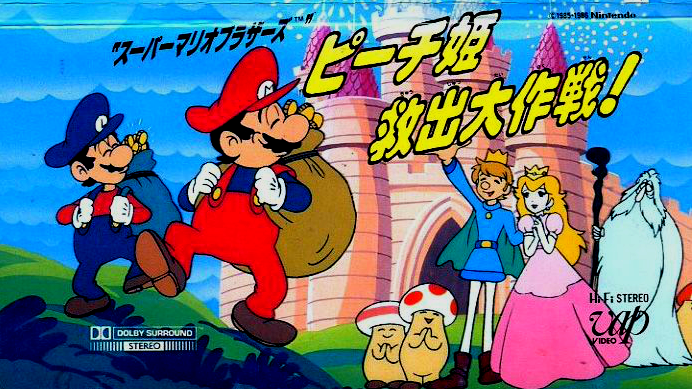
Mario: The Great Mission to Save Princess Peach VHS Cover


Whoops…


You can read the first draft’s script (and many others) here: http://www.smbmovie.com/SMBArchive/preproduction/script.htm


About the author: Glen is a lifelong Nintendo fan whose love of video games has inspired him to pursue a career in computer programming; so much so that he is currently studying to get his masters in computer science. He also likes the Street Fighter movie for much the same reasons he likes The Super Mario Bros. Movie, cementing the fact he has questionable taste in films.

A Debatably Brief Overview of Homebrew

I want to make Nintendo games.

Let’s face it, we’ve all thought that at one point or another. Usually it doesn’t go any further than wishful thinking, though. Sure, some of us might doodle concept art or gameplay ideas in a notebook, a few might even learn to program, but even for those with all of the skills there’s another, more tangible hurdle: the tools. Game development isn’t free and procuring a software development kit (SDK or devkit for short) is often a costly proposition. For those of you not familiar with the game development process, a devkit is a collection of specialized software and hardware used to make and test games. They’re quite expensive: the Wii’s devkit cost around $5000, which at the time was rather cheap compared to the XBox 360’s and PS3’s $20,000 price tag. Now, those of you who are used to making do with free software—like me—are probably thinking, “do I really need all of those fancy tools?”

No.

Homebrew is the process of making software for a system without the original development kit or system distributor’s blessing (more commonly known as a “license”). The term originated among beer aficionados for beer brewed by an individual instead of a commercial brewing house, but now is used in many hobbies—including video games—to refer to unofficial/amateur produced content. Homebrewering shouldn’t be confused with modding or ROM hacking: homebrewing is concerned with making new content for a system, while modding and ROM hacking only intend to change or manipulate an existing game (sometimes to the point where it’s arguably a different game made from the parts of the original).

Homebrew is the process of making software for a system without the original development kit…

What’s Homebrew Like?

Homebrew provides a surprisingly diverse selection of content. There’s homebrew for almost all Nintendo systems, though the type of content varies greatly from system to system. Older systems mostly focus on games, while newer ones–from about the Wii onward–have homebrew for everything from games to system utilities. Let’s take a quick look at some examples.

Games

Blade Buster

Just as “all toasters toast toast [sic]” Nintendo homebrewers homebrew games…duh. Sadly, most of the homebrew games I found in my research are simple, forgettable diversions much like the flash games of the early days of the internet. It’s not that surprising, considering game development on any level is an intricate and time consumptive process. That isn’t to say that all homebrewers lack diligence and ambition. There are still many quality original titles. Notice that I said original titles; a large number of homebrew game projects are simply ports, usually of games whose creators have released the source code to the general public. In fact, the Wii alone has ports of P.C. classics such as Tyrian, Quake, and Jazz Jackrabbit.


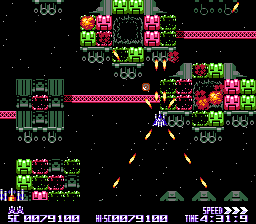
N-Warp ScreenshotI’m not going to try to enumerate every homebrew project released for a Nintendo system, but for the sake of being thorough, there are some that warrant mention. First up is Blade Buster, a Famicom shoot-em-up notable for its screen filling boss sprites (on an 8-bit console mind you), an insane number of sprites on the screen at a time, and unique time-attack styled gameplay. Next for the Super Nintendo is N-Warp Daisakusen, a game that allows eight—yes, eight—players to compete in a free-for-all brawl. Lastly, I want to mention a puzzle game for the DS named Negative Space which has the player drawing paths to guide two opposite colored blobs to their respective goal flags. The catch? They can only travel through the other’s color, meaning every path you draw for one is an obstacle to the other.

Negative Space
This game is also available as a free download on Android.

Emulators

After games, the most common type of homebrew is emulators. I’m not exactly sure why when emulators are already so prolific on P.C. Maybe people make them because they like the challenge of getting an emulator to function on the constraints of a game console. Maybe it’s to prove that more fully featured emulation is possible on Nintendo systems. Maybe people just think it’s funny to play Playstation games on their Wii. Whatever the reason, most of Nintendo’s modern systems have a multitude of homebrewed emulators available on them.

WiiSX
I can’t be the only one who thinks this is hilarious.

Obviously, many of the homebrewed emulators available online for Nintendo consoles are for older Nintendo systems. As I alluded to in the previous paragraph, however, the homebrewed emulator scene isn’t exclusively concerned with Nintendo systems. On the just Wii alone there are emulators for Sega Genesis/Mega-Drive, Sega Saturn, Playstation 1, CalecoVision, Commodore 64, Atari Lynx, and many, many, many, many, many more. Also, there’s a Super Nintendo emulator that runs on the original 3DS (I knew it!).

Whatever the reason, most of Nintendo’s modern systems have a multitude of homebrewed emulators available on them.

Miscellaneous Software

Not all homebrew projects are game related. Some are just the sort of software you’d find on any computer: music players, web browsers, etc. One such program of note is an art program called Colors! Which was originally developed as homebrew for the DS but has since gotten an official release on multiple systems, including the 3DS eshop. Then there’s software that changes system behaviors. For example, the 3DS has an application that removes the cap on the number of play coins a player can receive in a day. More impressive is a Wii hack that let’s the user change the region of the console—y’know, to play region locked games.

Linux

Where there’s hardware, there’s Linux. Much like the speed of light or the certainty of death and taxes, it’s one of the constants of our universe. Seriously, any system that’s powerful enough to run Linux sooner or later will. There’s Linux for the GameCube, Linux on the 3DS, Linux for the Wii, a distro is in development for the N64, there’s a version for the DS; heck, even the GameBoy Advance has…Unix?

…Wait, what?

GameBoy Advance Unix
What?

Any system that’s powerful enough to run Linux sooner or later will.

Cool! Let me try!

For those of you who don’t know, I happen to be a programmer, so when I write an article that gives me the opportunity to talk about programming, I’m going to talk about programming. If you think programming is some kind of voodoo (which it isn’t: it’s sorcery), you may want to skip this part.

Still here? Great! Believe it or not, if you’re already comfortable with programming it’s almost as simple as picking the system you want to develop for and a few Google searches. While homebrewing isn’t exactly the go-to past-time among bored nerds, there are several online guides and communities dedicated to the craft: forums, YouTube videos, blogs, and wikis galore! Heck, there’s an entire free book on WikiBooks about Super Nintendo programming.

Even though you’re not going to be using The Man’s toolkit, you can’t exactly make a game with just your imagination and wishful thinking (trust me, I’ve tried). You will need software to compile the code you write and, if you’re developing for one of Nintendo’s more recent systems, an API library to interface with the system (getting controller input and such). You’ll also want an emulator. Fortunately, all of these tools can be easily acquired on the internet for free.

 There are several online guides and communities dedicated to the craft: forums, YouTube videos, blogs, and wikis galore!

As for the coding itself, it’s mostly the same as regular programming. For example, I—out of curiosity—browsed through a tutorial on GameBoy Advance homebrewing and was quite relieved (and just a little surprised) to find that the code was hardly distinguishable from any other program written in C. There are certainly nuances to keep in mind—like in the case of the GBA, some memory addresses are reserved for the screen’s RGB values, tracking whether buttons are pressed, and so on. You may also need to go without some modern conveniences (hope you like compiling your code from command-line!). But by-and-large, anyone who’s sufficiently experienced with C and/or C++ should be fine.

Unless you’re developing for an 8 or 16-bit system. In that case I hope you really like 65c816 Assembly!


We Haven’t Even Touched the Red Pill

Instead of starting on a proper summation, I’d like to cover my backside real quick and stress that despite this being the longest article I’ve written for Two Button Crew to date, I have only given the barest of overviews of the subject. I encourage you to look further into this, either as someone interested in finding new games to play or someone hoping to make such games. More over, there’s a lot I omitted for length, like how some retail games have been pulled from store shelves because of homebrewers.

Having said all that, it’s a shame homebrew isn’t more popular. I understand why, though: if someone’s going to go to all the trouble to make a game, why make it for a dead system? And if it’s for a modern system, why make a game that they can’t license and sell? But, hey, who knows? Many Nintendo fans have grown up and started making games of their own. As time goes on and more fans get old enough to take an interest in game development, maybe some of them will try to make a few for the systems they played on as kids. Wouldn’t that be something, a flood of new old games?


About the Author:

Glen is a lifelong Nintendo fan whose love of video games has inspired him to pursue a career in computer programming; so much so that he is now studying to get a masters in computer science. He doesn’t understand that the average person isn’t interested in programming and won’t shut up about how awesome it is.

The Streamlined Turnabout

Note From the Author: The game discussed in this article, Phoenix Wright: Ace Attorney – Duel Destinies, has been rated M for Mature (ages 17+) by the ESRB for the following: violence, blood, suggestive themes, and language. That said, this article focuses only on the game’s mechanics and should be appropriate for all audiences. Please use care and caution when deciding what games are right for you and your family.

I typically don’t play story-heavy games during the school year: they take a long time to beat and all of that pesky suspense and intrigue makes them hard to pull myself away from. So when summer rolled around earlier this year, I decided it was high time I got around to playing a game I’ve been meaning to tackle ever since it came out way back in 2013, Ace Attorney: Dual Destinies.

After slogging through other plot-driven games in the past solely out of pride (I beat games, not the other way around), I figured that I—a busy adult with things to do—simply had grown out of those types of games. As such, I went in to Dual Destinies with fairly low expectations.

AA5_Holdit

It didn’t take me long to remember one crucial piece of information: I like the Ace Attorney series…a lot. This game is no different. While not the strongest entry in the franchise (clumsy writing in places, too much hand-holding, and not nearly enough Trucy Wright), Dual Destinies still managed to impress me, especially where I least expected it: the game mechanics.

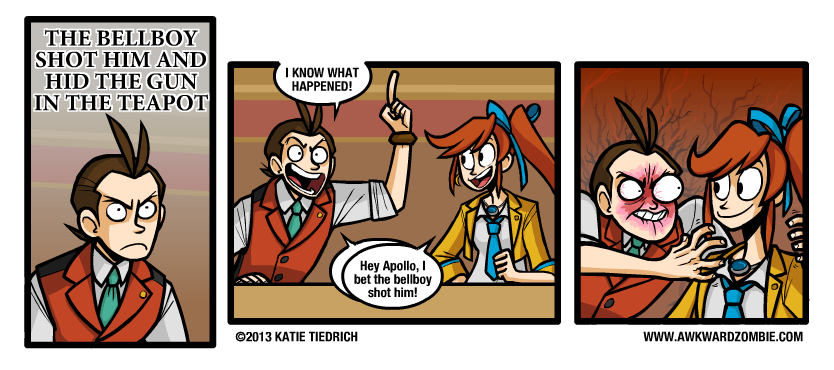
Awkward Zombie Trying My Patience Truncated
The game does have an annoying habit of spoon-feeding the player.

The Ace Attorney series is no stranger to introducing new gameplay mechanics and gimmicks, but until Dual Destinies, I honestly can’t think of a game in the franchise that took existing elements and trimmed the fat. Overall, the game has the best pacing and flow of the entire series, which is why I think it’s the perfect candidate for a case study on how to streamline gameplay mechanics. Court is now in session!

Dual Destinies managed to impress me, especially where I least expected it: the game mechanics.

Opening Statement: The Investigation Phase

Cases in the Ace Attorney franchise are generally split into two distinct parts: investigations and court sessions. For anyone not familiar with the franchise, defense attorneys in the Ace Attorney universe are two parts lawyer and one part private investigator. They question witnesses, search for clues, and sneak evidence out of crime scenes when the cops aren’t looking, all to prove their client’s innocence. This portion of the job is represented in gameplay with what’s known as the investigation phase and plays much like a traditional adventure game in the vein of the Monkey Island series or Princess Tomato in the Salad Kingdom. These segments of the game are often the longest, and fittingly, most of the trimming the game does is in these portions.

Defense attorneys in the Ace Attorney universe are two parts lawyer and one part private investigator.

Exhibit A: The Search Command

Like many adventure games, players in Ace Attorney games must search the environment to find items they can use, in this case evidence to prove their client’s innocence. The examine command brings up a cursor that the player can then use to click on objects in the environment to investigate them. Now, not everything the player sees in an area is going to be evidence (Phoenix’s office plant, Mr. Charlie, for instance), and when clicked these objects, instead of advancing the plot, will just trigger some flavor text wherein the protagonist and his plucky sidekick humorously palaver on about the object in question (#TeamStepLadder).

Screenshot of both screens of Phoenix Wright: Ace Attorney.
A typical investigation from the first game.

Now, in games prior to Dual Destinies, every location was searchable, even if there wasn’t any evidence there (I’m looking at you Wright & CO. Law Offices). This meant players were expected to search every area. Just because a murder occurred in, say, a public park doesn’t mean the player won’t end up searching an abandoned doctors office for clues on the whereabouts of the true killer’s lost shoes.

In games prior to Dual Destinies, every location was searchable, even if there wasn’t any evidence there.

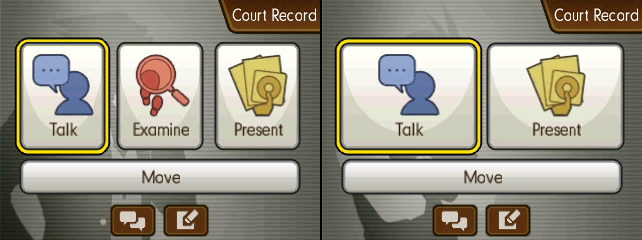
Examine UI
While conventional wisdom looks down on limiting what the player can do, sometimes it can improve the overall experience.
Cursor Comparison
The search cursor before and after examining an object.

Dual Destinies improves on this feature in several ways. First, the game limits use of the examine command strictly to crime scenes. This means that there’s only ever one searchable location for the player to worry about at a time, unlike previous games that let the player switch between searching multiple areas, each of which could change depending on event flags. More over, the game now has the courtesy to inform players when they’ve found everything they need, which too often wasn’t clear in previous titles. Lastly, Dual Destinies introduced the ever so subtle—but oh-so-useful—addition of having the cursor take the shape of a check mark if the object being highlighted by the player has already been investigated. Considering that many of the conversations triggered when clicking on something could be quite long, even with fast forwarding, this U.I. feature is something longtime fans can appreciate.

And to top it all of, despite the newly imposed restrictions there’s still plenty of that sweet, sweet flavor text.

Exhibit B: The Travel Menu

Locations in the Ace Attorney series are normally static, disconnected, one-screen “rooms” that the player travels between via selection from a menu. It’s about as utilitarian as it gets, and yet Dual Destinies still managed to smooth out the rough edges. See, for whatever reason, previous games in the franchise had a four option limit on the travel menu, meaning the player could only travel to four other locations from any given area. The way the developers got around this—quite frankly arbitrary—limit was to have each area have its own list of destinations. So, for example, if the player wanted to go from the detention center to the crime scene, they may have to travel to back to Wright’s Office, then to the front door of the building the body was found in, and then to the actual crime scene.

Of course, a sleek, afigimatiko-dynamic game like Dual Destinies isn’t about to put the player through all that for something as simple as getting from point A to point B! Enter the magic that is “scrolling”! With this space-aged technique, players now have the uncanny ability to pick any location from anywhere in the game simply by “scrolling” between options! (Restrictions may apply in accordance to plot demands.)

Ace Attorney 5 - Travel UI
The Ace Attorney series is known for its inclusion of supernatural elements; scrolling was only a matter of time.

Exhibit C: The Notebook

Anyone who’s played an old-school adventure game can tell you that the worst thing that’s guaranteed to happen to the player at some point is getting stuck without any clear directions. This is why many modern games of all genres keep an objectives list or provide a character who the player can ask for advice at any time. Unfortunately, until Dual Destinies the Ace Attorney games fell into the old adventure game trap of not always giving the player clear directions on what to do next. To make matters worse, N.P.C.s had an annoying tendency to just up and disappear until the player triggered the right event flag. This led to the player constantly going back and forth after every event to see which N.P.C.s had returned to their post and who had new dialog options.

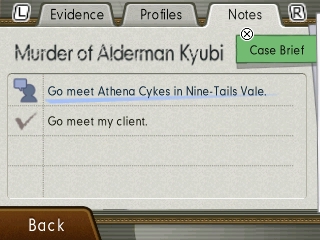
Ace Attorney 5 - Notebook
Oh right, I was investigating a murder! I should really get back to that…

Dual Destinies introduced an extra section to the court record (basically the player’s inventory screen) for notes—which in this case is more of a checklist than a place for the player to jot down information. Any time the player isn’t sure what to do next, they can just open the court record, hit the notes tab, and be on their way. Admittedly, Dual Destinies’ plot is structured in such a way that the player rarely needs extra input, especially once you factor in the previously listed enhancements, but the handful of times I did need it, I greatly appreciated the fact that I could just hit a few buttons and continue the game instead of wandering around in circles for ten minutes.

Any time the player isn’t sure what to do next, they can just open the court record, hit the notebook tab, and be on their way.

Closing Thoughts

What I hope to get across is how seemingly small changes eventually add up. Small U.I. improvements can help better communicate information to the player, which leads to less time spent on tasks that slow progression. Moreover, limiting when a player can perform certain actions—like investigating their environment—can keep them from getting side-tracked or lost. In Dual Destinies’ case, the end result is the first Ace Attorney game that didn’t have me at a complete loss for what to do next at any point. As I mentioned in the beginning of this article, it’s not necessarily the best game in the series (my personal favorite is Apollo Justice), but I will say right here and now that it’s the best structured and paced, all because the developers weren’t afraid to make some compromises regarding many of the accepted, long-standing conventions of the series. I’ll miss you, dear glut of humorous flavor text, but I can’t deny the game’s pacing is better off without you.


About the author:

Glen is a lifelong Nintendo fan and has been an Ace Attorney enthusiast ever since he first played Apollo Justice: Ace Attorney back in 2008. His love of video games has inspired him to pursue a career in computer programming and is currently studying to get a masters in computer science. Despite his name and choice of professions, he is in no way related to Glen Elg.

Metroid: Other Fusion

WARNING: The following blog post contains spoilers for Metroid: Other M and Metroid Fusion.

It’s tough being a Metroid fan. After a promising start, the series goes on hiatus for nearly a decade. Then after a resurgence and several great additions to the franchise, Metroid: Other M comes out and sends everyone into a tizzy. Cue another hiatus, and then after years of waiting, Nintendo finally announces a new entry into the series…and everyone loses it all over again. I don’t particularly like controversies, they have an odd propensity to throw gentlemanly discourse out the window and reduce (presumably) otherwise intelligent individuals to their embarrassingly base, vitriolic nature. That said, there is an issue regarding Metroid: Other M that seems to have slipped through the cracks, and with the aesthetically controversial Metriod Prime: Federation Force releasing this August, I think now would be a good time to get it off my chest and discuss what I think Metroid: Other M‘s real flaw is.

People have criticized Other M for a variety of things: potentially sexist undertones, awkward non-analog controls, Samus’s emotionless voice acting, etc. I, however, either didn’t notice or didn’t mind most of the commonly cited issues when I first played the game. No, there was something else. Something I couldn’t ignore. Something that kept scratching at the back of my mind in the same annoying fashion a house cat lazily paws at its sleeping owner’s face. Something that is never brought up when discussing the game’s flaws. Something that kept running through my moderately attractive head every time I played the game: I’ve seen this before.

To put it bluntly, Metroid: Other M is a rehash of Metroid Fusion.

No seriously, there are just too many similarities. Oddly enough, despite all of the discussion the game has (shine) sparked, no one ever discusses the Goyagma in the room and mentions how suspiciously similar the two games are, even when they’re listing reasons they don’t think the game is good. The only time I’ve seen it brought up was a forum post made shortly after the game was released, and that was quickly dismissed by the site’s other members. So let’s switch to our scan visors and take a closer look.

The Setting

Both games are set shortly after the masterpiece that is Super Metroid. The similarities between settings are more than chronological, however.

In Fusion, the game starts with our girl Sammy escorting a team of xeno-biologists on a mission to survey the metroid home-world, SR-388. After mercilessly blasting a hornoad that could’ve made for a valuable specimen, the creature reveals itself to be an X-parasite in disguise. Samus is infected, hospitalized, and eventually saved by a vaccine made from a DNA sample from the now dead last metroid. Deciding not to question the medical team’s severe misuse of the term vaccine, Samus immediately gets back to work and heads out on her next mission: to investigate a distress signal coming from the BSL (Biological Space Laboratories) Research Station.

The BSL Research Station is a space station-based research facility designed with the study of alien lifeforms in mind. It is equipped with top-of-the-line containment facilities that recreate the environments of the creatures that live in them. Each of these areas are referred to as sectors, are numbered one through six, and recreate a different biome (SR-388, jungle, desert/volcanic, aquatic, ice, and nocturnal).

Ah, the memories: like that one time I got stuck on the spider boss for 16 months.
The B.S.L. Research Station serves as the setting of Metroid Fusion.

Other M opens with Samus in a Federation quarantine bay being attended to by Federation medics after her harrowing escape at the end of Super Metroid. After a dry internal monologue and debriefing, Samus is off on her own to…I don’t know, hunt bounties? Anyway, she picks up a “baby’s cry” distress signal and—being the mercenary bounty-hunter that she is—goes to assist with no promise of financial compensation what-so-ever.

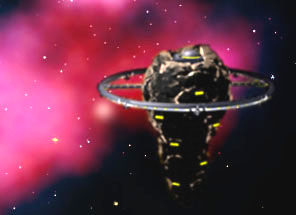
Upon arriving at the source of the transmission, Samus finds herself at the Bottle Ship. The Bottle Ship is a space station-based research facility designed with the study of alien lifeforms in mind. It is equipped with top-of-the-line containment facilities that recreate the environments of the creatures that live in them. Each of these areas are referred to as sectors, are numbered one through three, and recreate a different biome (jungle, volcanic, and ice). Sound familiar?

♪ One of these things is just like the other! ♫
The Bottle Ship serves as the setting of Metroid Fus–OTHER M! I was going to say Other M!

[They are] equipped with top-of-the-line containment facilities that recreate the environments of the creatures that live in them. Each of these areas are referred to as sectors, are numbered […], and recreate a different biome.

To top it all off, even the chamber from which the sectors are accessed are the same: a large room situated below the crew quarters and command center with color coordinated elevators.

The Antagonists

Both games also have similar antagonists. Anyone who’s played Fusion can tell you about the paranoia inducing terror that is SA-X. Heck, I still sometimes have nightmares about it. For readers who don’t know, SA-X is the X-Parasite’s mimicry of Samus: it has all of her powers, her knowledge, and—most of all—her suit. Throughout the game, it wanders the BSL, constantly attempting to sabotage Samus’s mission. It destroys machinery, doorways, it even tries to induce a meltdown in the station’s reactor. While the being makes a few onscreen appearances, it usually sticks to the shadows. Throughout the game, SA-X is a threat that seems to be around every corner, just out of sight.

Oh BTW, there are actually TEN of these.
Metroid Fusion is rated E? Man, when is Nintendo going to stop making kid’s games?!

Other M has a similar enemy: the Deleter. The Deleter is a mysterious entity that operates in the shadows. He/she/it constantly attempts to thwart Samus and her allies’ efforts to get to the bottom of what went down on the Bottle Ship by sabotaging equipment, jamming communications, and even systematically eliminating Adam Malkovich’s soldiers one-by-one. Trying to identify and stop the Deleter is one of the major plot elements of the game, much like stopping SA-X is in Fusion.

You never find out.
Surely, uncovering this criminal mastermind’s true identity will be the ultimate payoff!

But Other M doesn’t just have similar antagonists to Fusion, it even goes so far as to copy one of Fusion‘s most iconic bosses: Nightmare. Nightmare is a large, gravity-warping bio-weapon that gave Samus the gravity suit in Fusion. Its battle is one of the longest and most difficult in the game, and as to be expected the fight occurs near the end of the game. The boss returns in Other M, and just like in Fusion is fought near the end of the game. The only real difference is that Fusion bothers to build it up as a major threat, while Other M just shoe horns it into the game.

And then there’s Ridley…who’s in almost every game, so he isn’t worth mentioning. Moving on!

Adam Malkovich

Yet another of the similarities between Fusion and Other M is Adam and his role. In Fusion, Samus’s new ship comes with an on board A.I. that she nicknames Adam after a former commanding officer. Adam is Samus’s guide throughout the game, offering objectives and providing suit upgrades. Adam is eventually revealed to be an uploaded personality and is—in fact—the real (artificially simulated) Adam Malkovich. The real (not artificially-simulated) Adam appears in Other M. In that game he points out objectives to Samus and authorizes use of her various suit features, similar to in Fusion.

The two games also both depict him as potentially untrustworthy. Fusion shows that Adam, and the Federation at large, have a hidden agenda that they’re keeping a secret from Samus. This can also be said of Other M, though it is more ambiguously framed. Adam clearly knows more about the situation at hand than Samus, which is a major source of tension in the game’s story. Other M even goes so far as to depict Adam as a candidate for the true identity of the Deleter. All of this conspiracy mumbo-jumbo leads to my final point…

Surprise! It’s Full of Metroids!

Both game’s have a secret, hidden sector. It’s full of metroids. The Federation is cloning them. They want to use them as bio-weapons. The secret part of the space station is jettisoned into space. Samus fights an adult metroid.

I always imagined SA-X was freaking out a bit at this point.
Imagine this in 3D and then replace SA-X with Adam and you basically have what happens in Other M.

Despite what my very critical overview may suggest, I rather enjoyed Metroid: Other M. It certainly had a number of problems, but the end product still had tight controls, good gameplay, and great production values; overall an enjoyable experience. Unfortunately, as a prequel to Fusion, it’s an abysmal mess that introduces many, many plot-holes. I’d go so far to say it serves as a cautionary tale of how not to do a prequel. All of the similarities make Samus’s reaction to the events of Fusion completely unbelievable. She acts like it’s her first time stumbling across a secret metroid cloning project, or dealing with an enigmatic saboteur, or fighting Nightmare! It’s almost as if Other M was an attempt to rewrite Fusion in hopes of removing the latter from the series continuity like a lab full of metroids from a space-station. But I’ll admit, that’s a bit of a stretch. It’s not like the Big N is some sort of large, secretive collective that would conspire to do something like repeatedly clone Metroids to further their own ends, right?


Haven’t gotten enough Metroid: Other M? Click here to hear Scott and Simeon’s thoughts on the game.


About the author:

Glen is a lifelong Nintendo fan whose first foray into the Metroid Franchise was Metroid Fusion. His love of video games has inspired him to pursue a career in computer programming and is currently studying to get a masters in computer science. And yes, he really does sometimes have nightmares about SA-X.